Hacking Google Canvas: How to Build the Ultimate JEE Chemistry Tutor
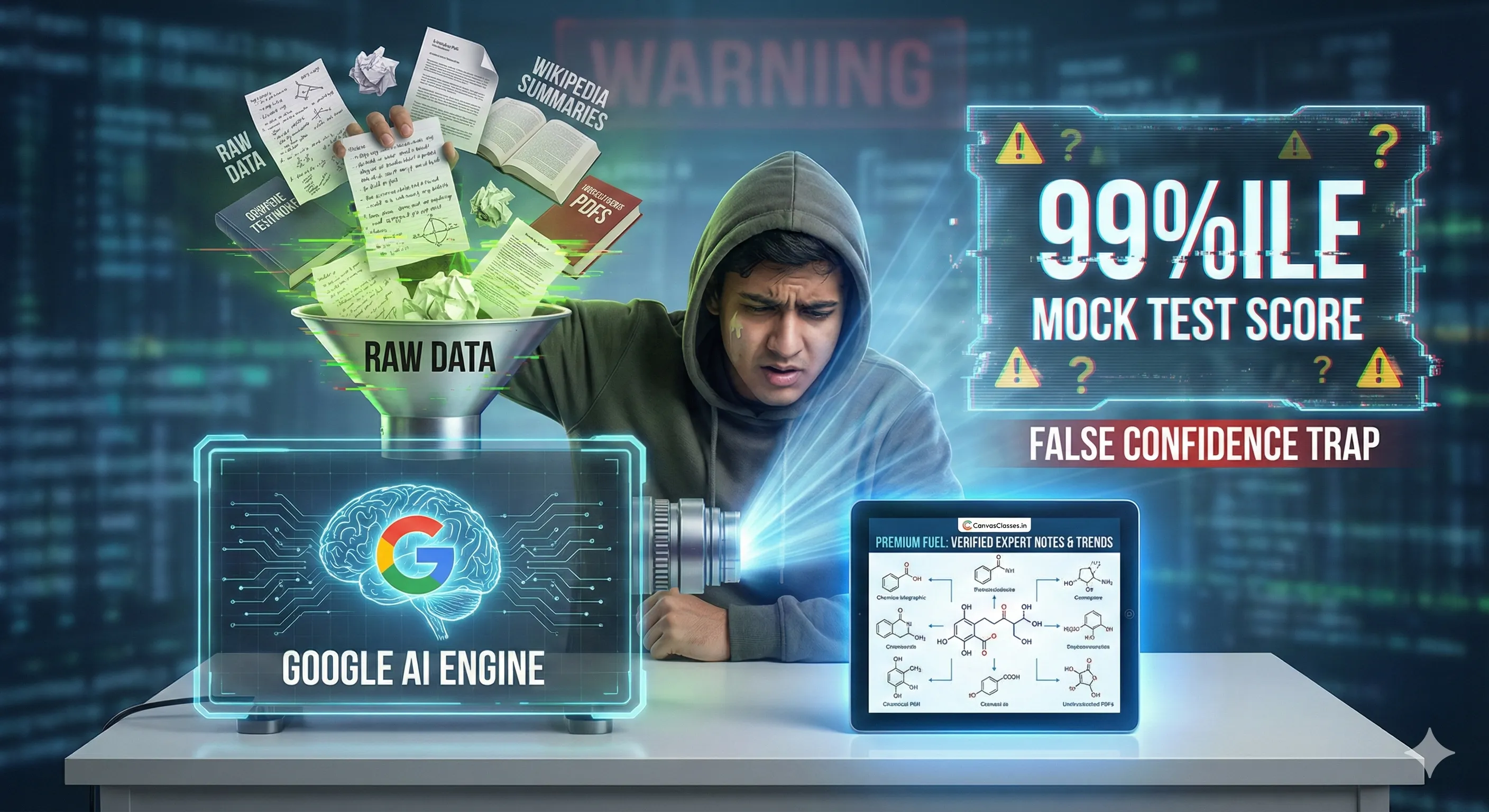
Google has just dropped a nuclear bomb on the EdTech industry: Free, unlimited JEE Main Mock Tests inside Gemini and the new Canvas workspace for students.
The hype is real. But there is a massive problem that no one is talking about.
Section 1: The "Garbage In, Garbage Out" Trap
Google’s AI is a Ferrari engine. It is fast, powerful, and free. But an engine is only as good as the fuel you put in it.
Most students are making a critical mistake: they are uploading raw, unstructured data—entire PDF textbooks, messy tuition scribbles, or random Wikipedia pages—into the Canvas tool.
The Result? The AI generates questions that are vague, too easy, or factually correct but irrelevant to the actual exam pattern. It creates a "False Confidence" trap.
The brutal truth is that Google’s AI is a generalist. It knows Chemistry, but it doesn't know JEE Chemistry. It doesn't know the specific traps NTA sets in Physical Chemistry questions. It doesn't know which Inorganic exceptions are tested repeatedly.
To hack this tool, you need to stop treating it like a teacher and start treating it like a calculator. You need to feed it High-Density, Verified Information.
Section 2: The "Canvas on Canvas" Strategy
If Google provides the Engine, Canvas Classes provides the Premium Fuel.
Here is how you use the resources at canvasclasses.in to force Google’s AI to act like a top-tier JEE ranker.
1. The Context Injection (Handwritten Notes)
Don't ask the AI to "teach me Coordination Compounds." It will give you a generic Wikipedia summary.
Instead, go to the Canvas Classes Handwritten Notes. These notes are structured by Paaras Sir specifically for the JEE curriculum.
- The Hack: Download the notes for your weak chapter. Upload them into Google Canvas.
- The Prompt:
"Using these specific notes as your source of truth, generate 5 trick questions that focus on the exceptions mentioned in the 'Isomerism' section."
Why it works: You are forcing the AI to ignore the general internet and focus on Expert Educator content.
2. Focus on Data Points, Not Textbooks (Interactive Graphs)
Uploading a 200-page NCERT PDF confuses the AI with too much noise. You need to feed it pure trends.
Use the Interactive Periodic Trends graphs. These isolate the key NCERT data points—Ionization Enthalpy, Atomic Radius, Electron Gain Enthalpy—without the fluff.
- The Hack: Feed the specific trend data into Canvas.
- The Outcome: The AI sees the exact anomalies in the graph and generates high-quality Assertion-Reasoning questions based on those trends.
3. The "Virtual Lab" Gap (Salt Analysis)
Google's text-based mock tests have a major weakness: Practical Chemistry. AI cannot simulate a colour change or a precipitate formation. It can only describe it.
If you get a Salt Analysis question wrong on the Google Mock Test, reading the solution isn't enough. You need to see it.
- The Fix: Immediately jump to the Salt Analysis Simulations.
- The Value: Perform the test virtually. Visualizing the "White Precipitate" turning "Soluble in excess NH4OH" locks the concept in your memory in a way text never will.
Section 3: Closing the Loop (The Human Touch)
You’ve taken the Google Mock Test. You’ve used the AI to generate practice drills. But how do you ensure you aren't just memorizing AI hallucinations?
You need the Human Validator.
AI knows the subject, but it doesn't know the "silly mistakes" that human students make under pressure. This is where Paaras Sir’s experience becomes non-negotiable.
Use the Chemistry Flashcards for your final revision.
- Not Bulk Generated: Unlike AI flashcards, these are hand-tweaked to include the specific "gotchas" and tricks that appear in JEE papers.
- Mock Test Triage: Did you fail a question on Thermodynamics in the Google Mock Test? Don't just read the AI explanation. Go to the Flashcards deck for that topic and perform a rapid-fire revision of the core formulas and sign conventions.
Final Verdict
Google Mock Tests are a wonderful tool—as long as they are used under expert guidance.
Don't let the shiny new AI tools distract you from the fundamentals. Use Google for the Volume of practice, but rely on Canvas Classes for the Quality of concepts.