The Four Kinds of Clues Historians Actually Use
A palm-leaf manuscript, a broken clay figurine, a stone inscription, an old coin — each tells historians something the others can't.
If you found an old coin buried in your backyard, what do you think it could actually tell a historian, beyond simply 'this is old'?
Look around your home for anything older than you — a coin, a stamp, an old photograph, a handwritten letter. What details do you notice?
History writing draws on a wide range of sources to understand the social realities of the past. Historians sort this evidence into a few broad types — each revealing something the others can't.
A historian finds only a single coin from a king's reign — no manuscripts or inscriptions survive from that period. Based on what numismatic sources are described as revealing, what could the historian still learn from that coin alone?
India's Living Archive
The Tirukkural survived for centuries on palm-leaf manuscripts, long before printing existed in India. Inscriptions like the one at Hampi's Virupaksha temple still stand in the open air, still readable, centuries after they were carved. India's epigraphic and literary record is one of the richest, longest continuous archives in the world.
Three Clues, One Village
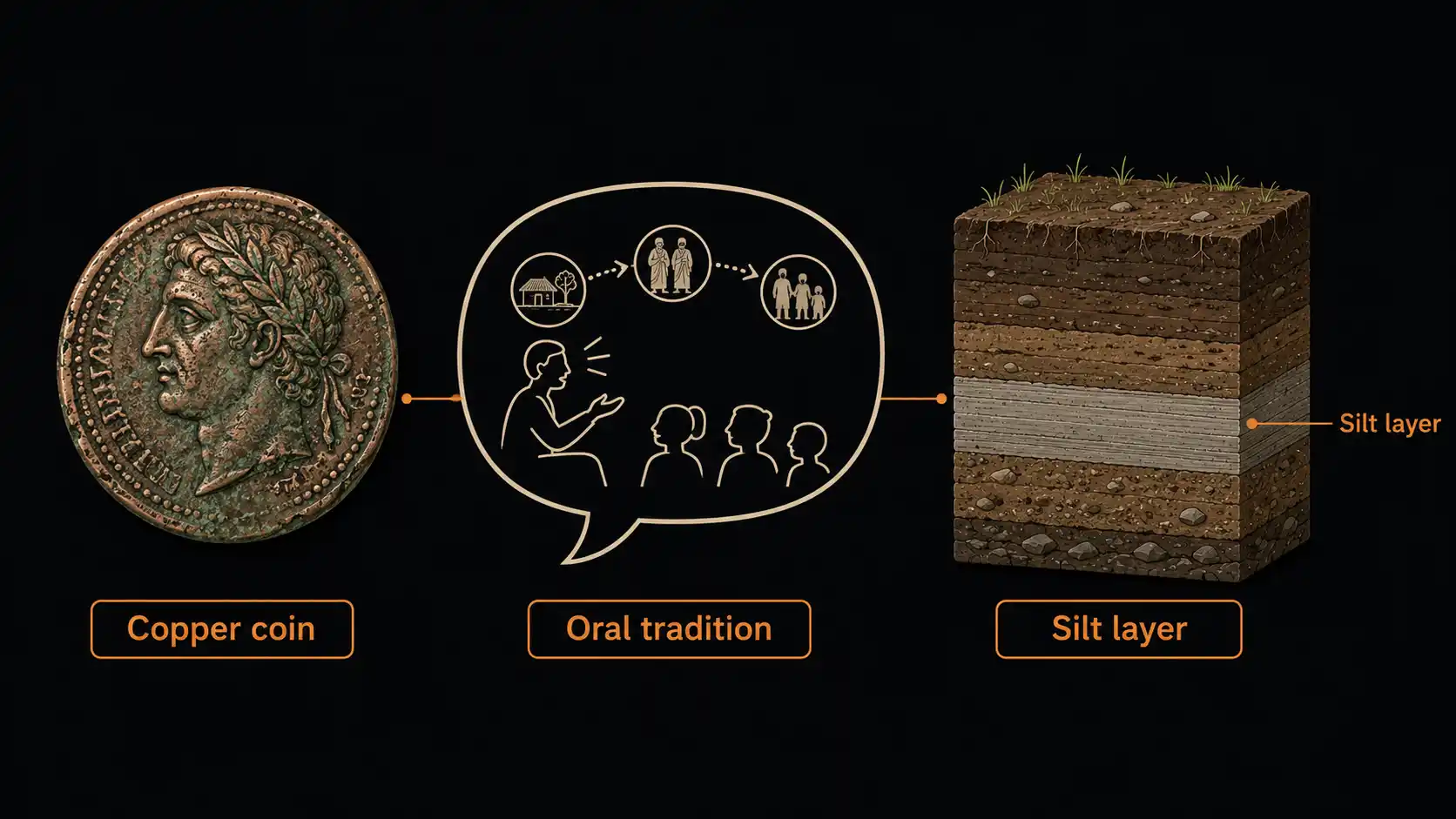
A team of historians is investigating a small settlement abandoned around 800 years ago. They have three pieces of evidence:
Look again at Clues A, B and C. The silt layer (Clue C) is physical evidence, but on its own it can't say WHO lived there or WHEN. The coin (Clue A) can date the settlement fairly precisely, but only proves someone was there — not why they left. The oral tradition (Clue B) directly claims a cause, but has passed through many retellings and could have changed with each one. Based on this, what is the strongest way for a historian to actually explain why the village was abandoned?
Take a moment to form your answer before reading further.
Q1.Which type of historical source includes travelogues, memoirs and genealogical records?
If you found an old coin buried in your backyard, what do you think it could actually tell a historian, beyond simply 'this is old'?
Look around your home for anything older than you — a coin, a stamp, an old photograph, a handwritten letter. What details do you notice?
History writing draws on a wide range of sources to understand the social realities of the past. Historians sort this evidence into a few broad types — each revealing something the others can't.
A historian finds only a single coin from a king's reign — no manuscripts or inscriptions survive from that period. Based on what numismatic sources are described as revealing, what could the historian still learn from that coin alone?
India's Living Archive
The Tirukkural survived for centuries on palm-leaf manuscripts, long before printing existed in India. Inscriptions like the one at Hampi's Virupaksha temple still stand in the open air, still readable, centuries after they were carved. India's epigraphic and literary record is one of the richest, longest continuous archives in the world.
Three Clues, One Village
A team of historians is investigating a small settlement abandoned around 800 years ago. They have three pieces of evidence:
Look again at Clues A, B and C. The silt layer (Clue C) is physical evidence, but on its own it can't say WHO lived there or WHEN. The coin (Clue A) can date the settlement fairly precisely, but only proves someone was there — not why they left. The oral tradition (Clue B) directly claims a cause, but has passed through many retellings and could have changed with each one. Based on this, what is the strongest way for a historian to actually explain why the village was abandoned?
Take a moment to form your answer before reading further.
Q1.Which type of historical source includes travelogues, memoirs and genealogical records?