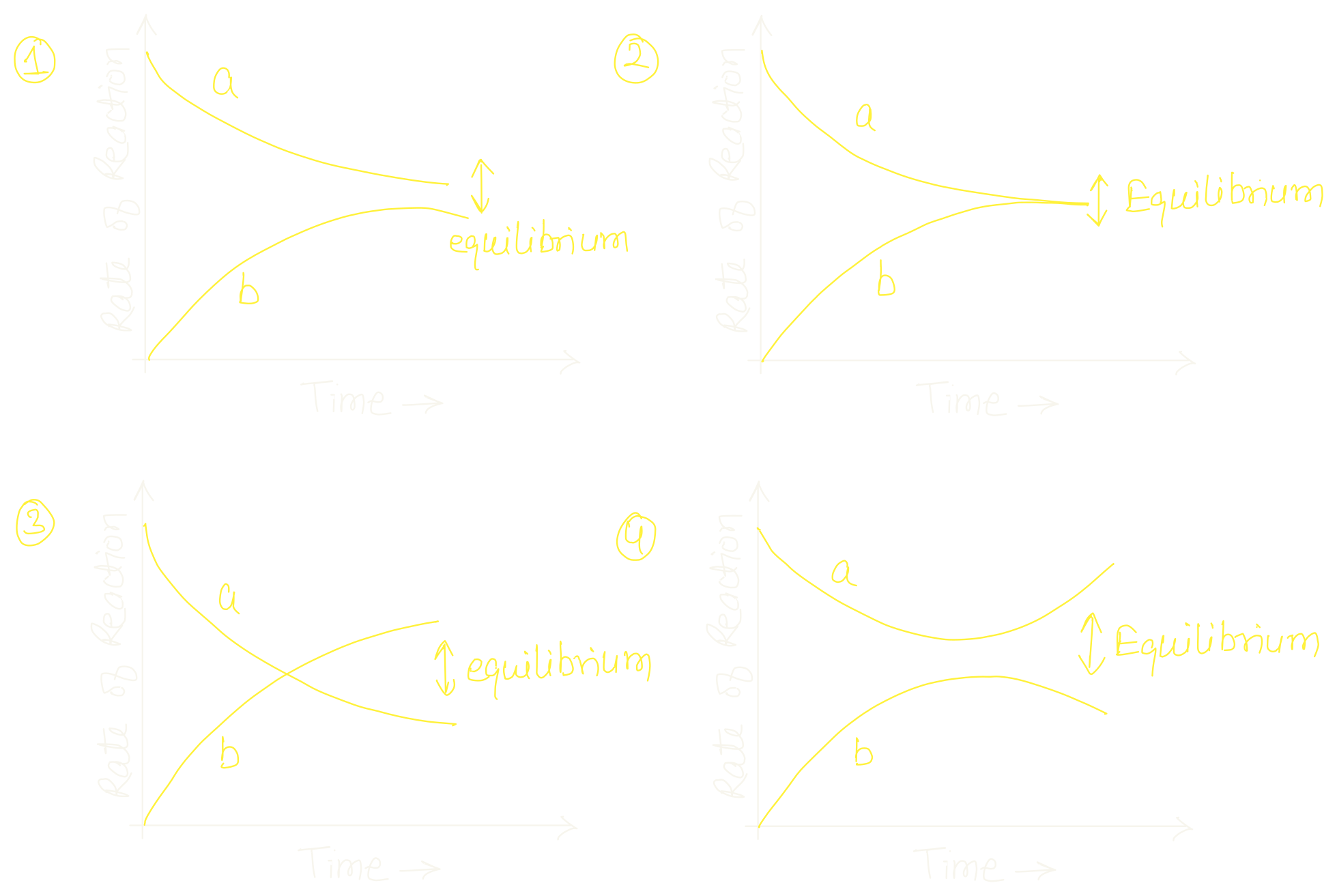
For the equilibrium A B, the variation of the rate of the forward (a) and reverse (b) reaction with time is given by:
Chemical Kinetics · Class 12 · JEE Main Previous Year Question
For the equilibrium , the variation of the rate of the forward (a) and reverse (b) reaction with time is given by:
- a
Option 1
- b✓
Option 2
- c
Option 3
- d
Option 4
Option 2
At the start of the reaction, the forward rate is maximum (high [A]) and the reverse rate is zero (no B present). As the reaction proceeds, [A] decreases so the forward rate decreases, while [B] increases so the reverse rate increases. At equilibrium, both rates become equal and constant.
The correct graph shows the forward rate (a) starting high and decreasing, the reverse rate (b) starting at zero and increasing, and both meeting at a constant value at equilibrium.
Answer: Option (2)
Practice this question with progress tracking
Want timed practice with adaptive difficulty? Solve this question (and hundreds more from Chemical Kinetics) inside The Crucible, our adaptive practice platform.
More JEE Main Chemical Kinetics PYQs
For the reaction 2A + 3B + 32C 3P, which statement is correct?
NO2 required for a reaction is produced by the decomposition of N2O5 in CCl4 as per the equation: {2N_2O_5(g) 4NO_2(g) + O_2(g)} The initial concentration of N2O5 is 3.00\,mol\,L-1 and it is…
In the following reaction: xA yB _{10}[-{d[{A}]}{dt}] = _{10}[-{d[{B}]}{dt}] + 0.3010 'A' and 'B' respectively can be:
Consider the following statements related to temperature dependence of rate constants. Identify the correct statements: A. The Arrhenius equation holds true only for an elementary homogeneous…
Reactant A converts to product D through the given mechanism (with the net evolution of heat): A - B slow; H = +ve B - C fast; H = -ve C - D fast; H = -ve Which of the following represents the above…