Relative stability of contributing structures:
General Organic Chemistry (GOC) · Class 11 · JEE Main Previous Year Question
Relative stability of contributing structures:

- a
(I) > (III) > (II)
- b✓
(I) > (II) > (III)
- c
(II) > (I) > (III)
- d
(III) > (II) > (I)
(I) > (II) > (III)
Rules for Resonance Stability
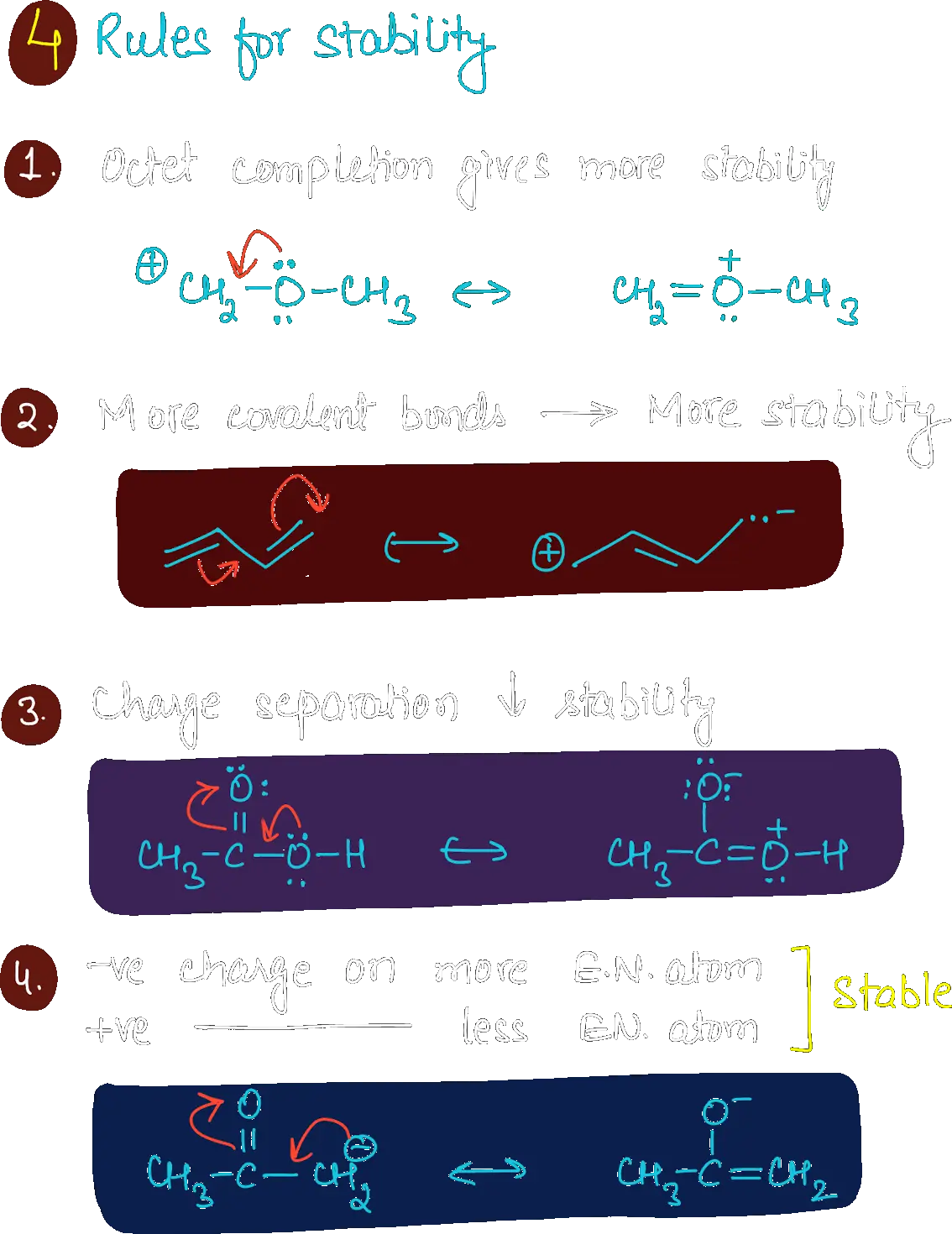 Step 2: Evaluating Structures
- (I) : Neutral, all atoms have complete octets. Most stable.
- (II) : Negative charge on Oxygen (electronegative).
- (III) : Negative charge on Carbon and positive on Oxygen. This is highly unstable as Oxygen is more electronegative than Carbon.
Step 3: Order (I) > (II) > (III).
Practice this question with progress tracking
Want timed practice with adaptive difficulty? Solve this question (and hundreds more from General Organic Chemistry (GOC)) inside The Crucible, our adaptive practice platform.
More JEE Main General Organic Chemistry (GOC) PYQs
Given below are two statements: Statement I: Hyperconjugation is not a permanent effect. Statement II: In general, greater the number of alkyl groups attached to a positively charged C-atom, greater…
Ascending acidity order of the following H atom is:
The set of meta directing functional groups from the following sets is:
Correct carbocation stability order:
How many compounds show inductive, mesomeric AND hyperconjugation effects?