Which of the following are aromatic?
General Organic Chemistry (GOC) · Class 11 · JEE Main Previous Year Question
Which of the following are aromatic?

- a✓
B and D only
- b
A and C only
- c
A and B only
- d
C and D only
B and D only
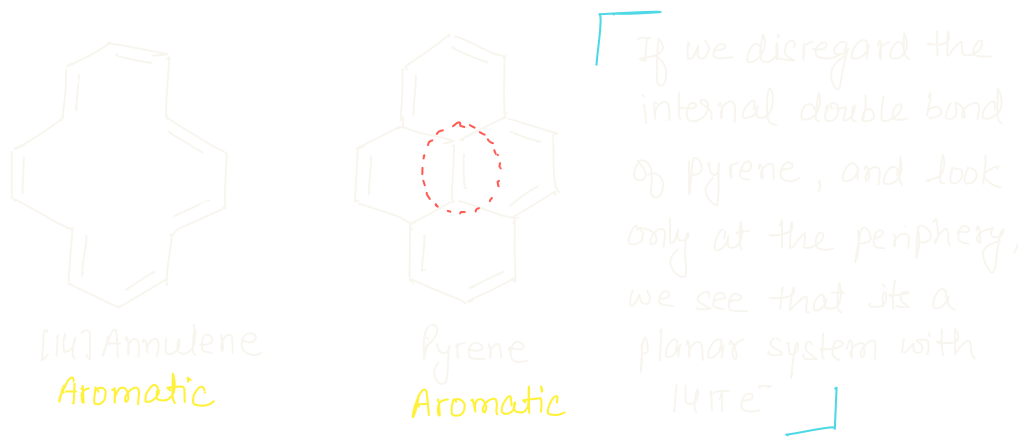
Hückel’s rule predicts that annulenes will be aromatic if their molecules have
(4n + 2) electrons and have a planar carbon skeleton. Consider the [14], [16], [18], [20], [22], and [24]annulenes as examples. Of these, as Hückel’s rule predicts, the [14], [18], and [22] annulenes (4n + 2 when n = 3, 4, 5, respectively) have been found to be aromatic. The [16] annulene and the [24] annulene are not aromatic; they are antiaromatic. They are 4n compounds, not 4n + 2 compounds.
 Examples of [10] and [12] annulenes have also been synthesized and none is aromatic. We would not expect [12]annulenes to be aromatic since they have 12 electrons and do not obey Hückel’s rule. The following [10]annulenes would be expected to be aromatic on the basis of electron count, but their rings are not planar.
 The [10]annulene I has two trans double bonds. Its bond angles are approximately 120 ; therefore, it has no appreciable angle strain. The carbon atoms of its ring, however, are prevented from becoming coplanar because the two hydrogen atoms in the center of the ring interfere with each other. Because the ring is not planar, the p orbitals of the carbon atoms are not parallel and, therefore, cannot overlap effectively around the ring to form the p molecular orbitals of an aromatic system.
Practice this question with progress tracking
Want timed practice with adaptive difficulty? Solve this question (and hundreds more from General Organic Chemistry (GOC)) inside The Crucible, our adaptive practice platform.
More JEE Main General Organic Chemistry (GOC) PYQs
Designate whether each of the following compounds is aromatic or not aromatic. Choose the correct designation:
The correct stability order of the following species/molecules is:
Which of the following molecule/species is most stable?
Given statements about Tropolone: Statement-I: Tropolone is aromatic and has 8π electrons. Statement-II: π electrons of C=O group in tropolone is involved in aromaticity. Choose the correct option:
Correct statements for given reaction are: (A) Compound B is aromatic (B) Completion is very slow (C) A shows tautomerism (D) Bond lengths C-C in B are same