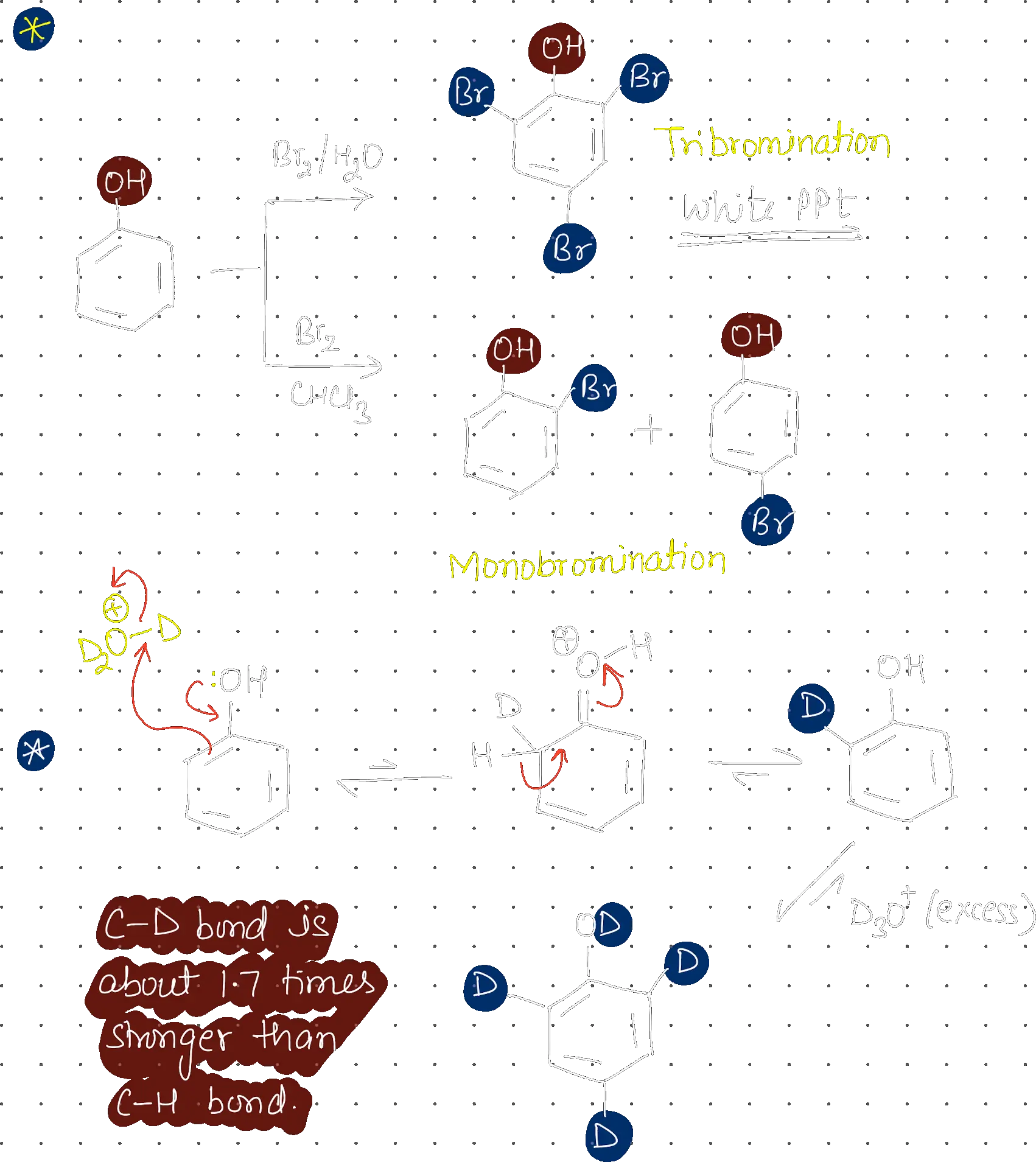
Difference in reaction of phenol with bromine in chloroform vs water is due to:
Alcohols, Phenols & Ethers · Class 12 · JEE Main Previous Year Question
Difference in reaction of phenol with bromine in chloroform vs water is due to:
- a
Hyperconjugation in substrate
- b✓
Polarity of solvent
- c
Free radical formation
- d
Electromeric effect of substrate
Polarity of solvent
Step 1: Reaction of Phenol with Bromine
- In Water: Phenol is highly activated and undergoes tri-substitution to form 2,4,6-tribromophenol. Water helps in ionizing phenol to phenoxide ion (strong activator).
- In Chloroform/: In a non-polar solvent, phenol does not ionize into the highly reactive phenoxide ion. It exists as phenol, which is less activated than the phenoxide ion.
Step 2: Conclusion The difference is primarily due to the polarity of the solvent, which influences the ionization of the substrate into the phenoxide ion.
Practice this question with progress tracking
Want timed practice with adaptive difficulty? Solve this question (and hundreds more from Alcohols, Phenols & Ethers) inside The Crucible, our adaptive practice platform.
More JEE Main Alcohols, Phenols & Ethers PYQs
What is the correct IUPAC name of the following compound?
The IUPAC name of the following compound is: HC\!\!C-CH2-CH(OH)-CH2-CH=CH2
Benzene is treated with oleum to produce compound (X) which when further heated with molten sodium hydroxide followed by acidification produces compound (Y). The compound Y is treated with zinc metal…
Identify the products [A] and [B], respectively in the following reaction: Chlorobenzene (i) NaOH, 623 K, 300 atm; (ii) H+ [A] Na2Cr2O7/H2SO4 [B]
Given below are two statements: Statement I: Dimethyl ether is completely soluble in water. However, diethyl ether is soluble in water to a very small extent. Statement II: Sodium metal can be used…