Ionic reactions with organic compounds proceed through: (A) Homolytic bond cleavage (B) Heterolytic bond cleavage (C)…
General Organic Chemistry (GOC) · Class 11 · JEE Main Previous Year Question
Ionic reactions with organic compounds proceed through:
(A) Homolytic bond cleavage (B) Heterolytic bond cleavage (C) Free radical formation (D) Primary free radical (E) Secondary free radical
- a
(A) only
- b
(C) only
- c✓
(B) only
- d
(D) and (E) only
(B) only
Step 1: Identifying Bond Cleavage in Ionic Reactions
Ionic reactions involve the formation and movement of cations and anions. This process is initiated by heterolytic bond cleavage, where the shared electron pair is retained by one of the atoms.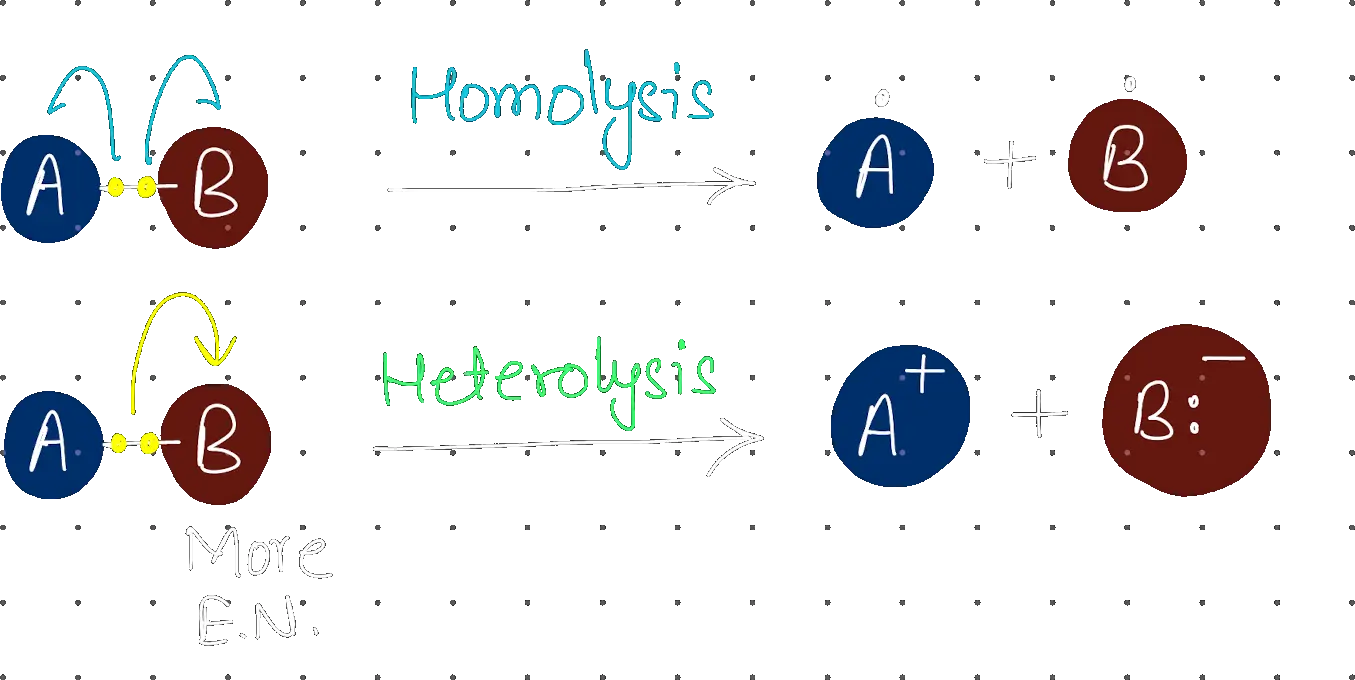 Step 2: Evaluating Other Methods
- Homolytic cleavage produces free radicals, leading to non-ionic radical pathways.
Practice this question with progress tracking
Want timed practice with adaptive difficulty? Solve this question (and hundreds more from General Organic Chemistry (GOC)) inside The Crucible, our adaptive practice platform.
More JEE Main General Organic Chemistry (GOC) PYQs
Consider the following compound (X): The most stable and least stable carbon radicals, respectively, produced by homolytic cleavage of corresponding C-H bond are:
The correct order of stability of following carbocations is:
In which pairs, the first ion is more stable than the second?
Which one of the carbocations from the following is most stable?
The most stable carbocation from the following is: