Benzene on nitration gives nitrobenzene in presence of HNO3 and H2SO4 mixture, where:
Hydrocarbons · Class 11 · JEE Main Previous Year Question
Benzene on nitration gives nitrobenzene in presence of and mixture, where:
- a
Both and act as bases
- b
Both and act as acids
- c✓
acts as a base and acts as an acid
- d
acts as an acid and acts as a base
acts as a base and acts as an acid
Step 1: Mechanism of Nitration
In nitration, the active electrophile is (nitronium ion):
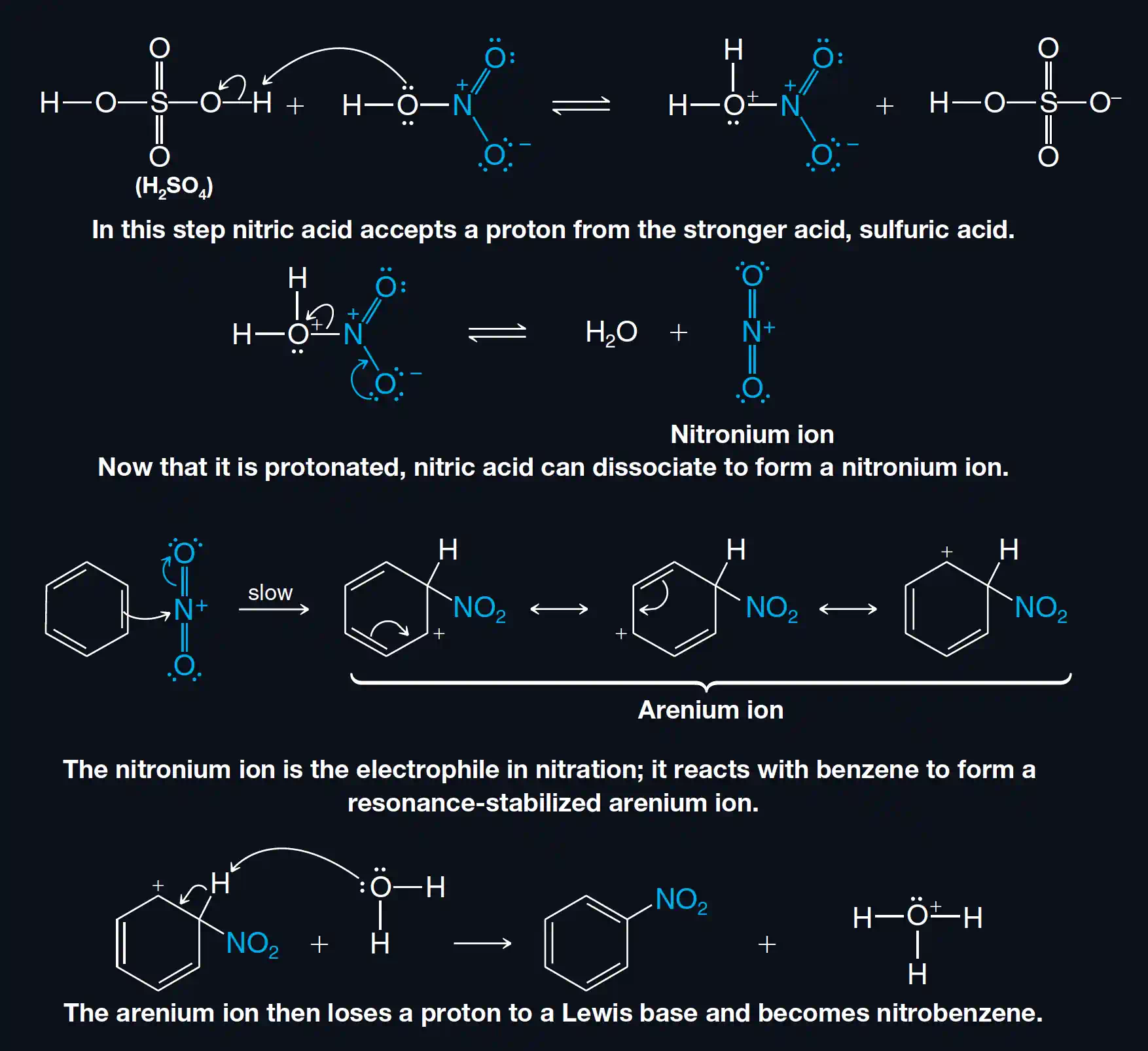 Step 2: Acid-Base Roles
In this reaction:
- (stronger acid, pKa is -9): donates a proton to (pKa is -1.4) = acts as an acid
- (weaker acid in this context, pKa is -1.4): accepts a proton from = acts as a base
So: = base (proton acceptor); = acid (proton donor).
Key Points:
- is a stronger acid than , so protonates
- acts as a base relative to
- The protonated nitric acid loses water to give (electrophile)
- This is a Bronsted acid-base interaction
Practice this question with progress tracking
Want timed practice with adaptive difficulty? Solve this question (and hundreds more from Hydrocarbons) inside The Crucible, our adaptive practice platform.
More JEE Main Hydrocarbons PYQs
Given below are two statements: Statement (I): On nitration of m-xylene with HNO3, H2SO4 followed by oxidation, 4-nitrobenzene-1,3-dicarboxylic acid is obtained as the major product. Statement (II):…
Identify correct statement/s: (A) -OCH3 and -NHCOCH3 are activating groups. (B) -CN and -OH are meta directing groups. (C) -CN and -SO3H are meta directing groups. (D) Activating groups act as ortho-…
Correct order of reactivity in electrophilic substitution reaction of the following compounds is:
Which compound will most easily be attacked by an electrophile?
Given below are two statements: Statement-I: Nitration of benzene involves the following step: Statement-II: Use of Lewis base promotes the electrophilic substitution of benzene. In the light of the…