Given below are two statements: Statement-I: Nitration of benzene involves the following step: Statement-II: Use of…
Hydrocarbons · Class 11 · JEE Main Previous Year Question
Given below are two statements:
Statement-I: Nitration of benzene involves the following step:
 Statement-II: Use of Lewis base promotes the electrophilic substitution of benzene.
In the light of the above statements, choose the most appropriate answer from the options given below:
- a
Both Statement-I and Statement-II are incorrect
- b✓
Statement-I is correct but Statement-II is incorrect
- c
Both Statement-I and Statement-II are correct
- d
Statement-I is incorrect but Statement-II is correct
Statement-I is correct but Statement-II is incorrect
Step 1: Evaluate Statement-I
Nitration of benzene involves formation of nitronium ion :
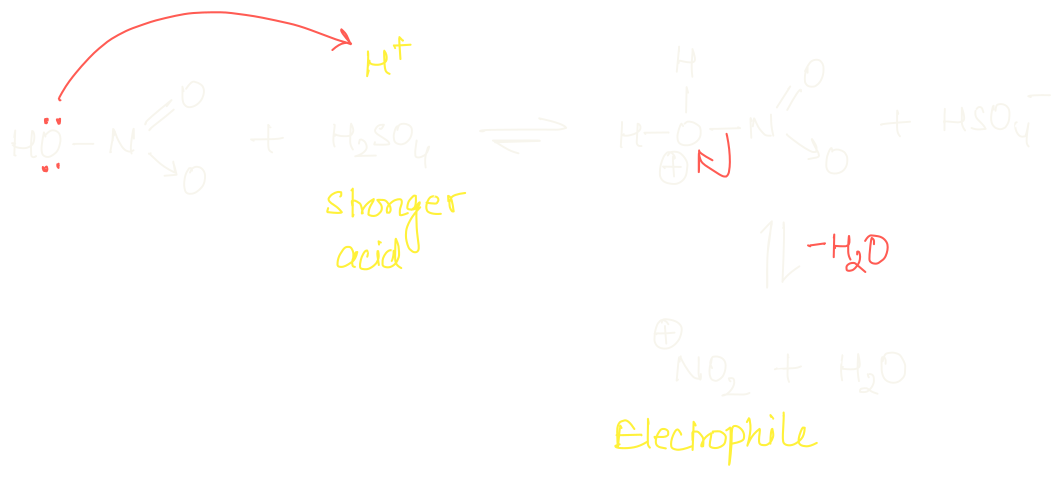 This is the correct mechanism for nitronium ion formation. Statement-I is CORRECT.
Step 2: Evaluate Statement-II
Electrophilic aromatic substitution (EAS) is promoted by a Lewis ACID (like , , ), NOT a Lewis base. Lewis acids generate the electrophile.
Lewis BASE would donate electrons, not generate electrophile. Statement-II is INCORRECT.
Key Points:
- Nitronium ion is the active electrophile in nitration
- acts as an acid to protonate , generating
- EAS requires Lewis ACID catalyst (e.g., ), not Lewis base
Practice this question with progress tracking
Want timed practice with adaptive difficulty? Solve this question (and hundreds more from Hydrocarbons) inside The Crucible, our adaptive practice platform.
More JEE Main Hydrocarbons PYQs
Given below are two statements: Statement (I): On nitration of m-xylene with HNO3, H2SO4 followed by oxidation, 4-nitrobenzene-1,3-dicarboxylic acid is obtained as the major product. Statement (II):…
Identify correct statement/s: (A) -OCH3 and -NHCOCH3 are activating groups. (B) -CN and -OH are meta directing groups. (C) -CN and -SO3H are meta directing groups. (D) Activating groups act as ortho-…
Correct order of reactivity in electrophilic substitution reaction of the following compounds is:
Which compound will most easily be attacked by an electrophile?
The correct arrangement for decreasing order of electrophilic substitution for the following compounds: