Which of the following is a metalloid?
Classification of Elements & Periodicity · Class 11 · JEE Main Previous Year Question
Which of the following is a metalloid?
- a
Sc
- b
Pb
- c
Bi
- d✓
Te
Te
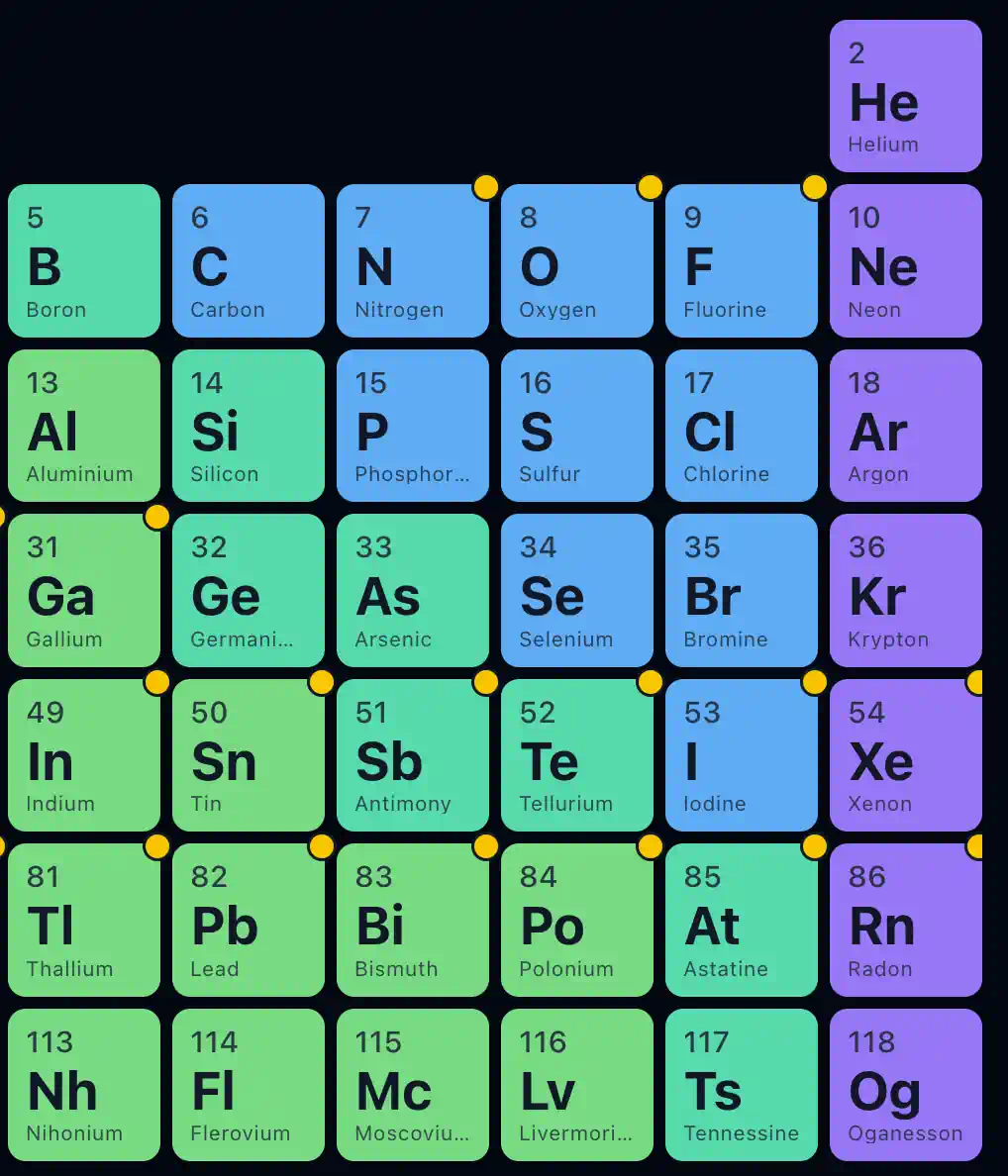
🧠 Metalloids form a staircase line in the p-block — memorize the seven The recognized metalloids are: B, Si, Ge, As, Sb, Te, and sometimes Po and At. They sit on the diagonal staircase between metals and non-metals in the p-block.
🗺️ Check each option Sc: Group 3, d-block transition metal. Definitely a metal. Pb: Group 14, Period 6. Heavy post-transition metal — soft, dense, fully metallic. Bi: Group 15, Period 6. Below the staircase line, classified as a metal. Te: Group 16, Period 5. Sits on the staircase. Recognized metalloid.
⚠️ The trap Many students mark Bi because they remember it has some non-metal-ish behaviour (forms acidic oxide states sometimes). But the standard NCERT classification places Bi as a metal. Te is the textbook metalloid in this set. Stick to the standard list.
Use this image to identify and memorise the metalloids, sitting between post-transition metals and nonmetals and depicted in mint-teal color.
Practice this question with progress tracking
Want timed practice with adaptive difficulty? Solve this question (and hundreds more from Classification of Elements & Periodicity) inside The Crucible, our adaptive practice platform.
More JEE Main Classification of Elements & Periodicity PYQs
An element 'E' has the ionisation enthalpy value of 374 kJ mol-1. 'E' reacts with elements A, B, C and D with electron gain enthalpy values of -328, -349, -325 and -295 kJ mol-1, respectively. The…
The type of oxide formed by the element among Li, Na, Be, Mg, B and Al that has the least atomic radius is:
Which one of the following elements will remain as liquid inside pure boiling water?
The correct order of metallic character is:
The metal that has very low melting point and its periodic position is closer to a metalloid is: