Which pair of oxides is acidic in nature?
Classification of Elements & Periodicity · Class 11 · JEE Main Previous Year Question
Which pair of oxides is acidic in nature?
- a
,
- b
,
- c
,
- d✓
,
,
🧠 Acidic oxide = non-metal/metalloid oxide; you need BOTH compounds in the pair to be acidic The question is asking for a pair where every member is acidic. So even one basic or neutral oxide kills the option.
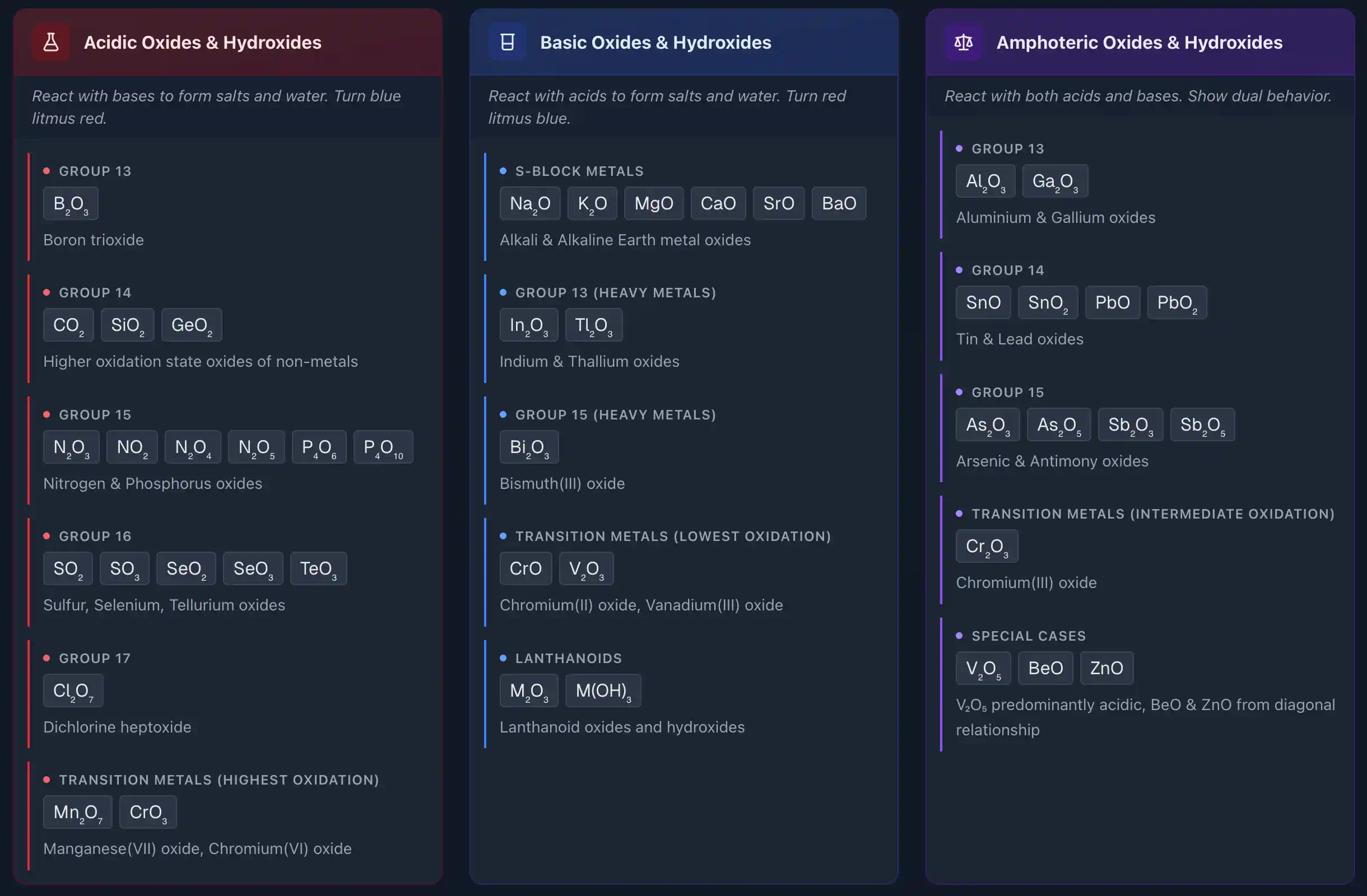
🗺️ Check each oxide : B is a metalloid, behaves like a non-metal here. Dissolves in water as boric acid. Acidic. : Si is a metalloid leaning non-metal. Reacts with NaOH to give silicate. Acidic. : Ca is a Group 2 metal. Reacts with water to give . Basic. : Ba is a Group 2 metal. Even more basic than CaO. Basic. (laughing gas): N in low oxidation state. Does not react with acid or base. Neutral.
Now scan the options: (a) acidic + basic — mixed. ✗ (b) neutral + basic — neither acidic. ✗ (c) basic + acidic — mixed. ✗ (d) acidic + acidic — both acidic. ✓
⚠️ The trap Don't confuse with or . Higher nitrogen oxides ARE acidic, but at the +1 oxidation state of nitrogen is neutral. Always check the oxidation state of nitrogen before classifying its oxide.
visit the interactive periodic table page to revise all the acidic, basic, and amphoteric oxides.
Practice this question with progress tracking
Want timed practice with adaptive difficulty? Solve this question (and hundreds more from Classification of Elements & Periodicity) inside The Crucible, our adaptive practice platform.
More JEE Main Classification of Elements & Periodicity PYQs
The nature of oxide (TeO2) and hydride (TeH2) formed by Te, respectively are:
Group-13 elements react with O2 to form oxides of type M2O3. Which among the following is the most basic oxide?
The set in which compounds have different nature is:
The acidic, basic and amphoteric oxides, respectively, are:
Three elements X, Y and Z are in the 3rd period. The oxides of X, Y and Z, respectively, are basic, amphoteric and acidic. The correct order of the atomic numbers of X, Y and Z is: