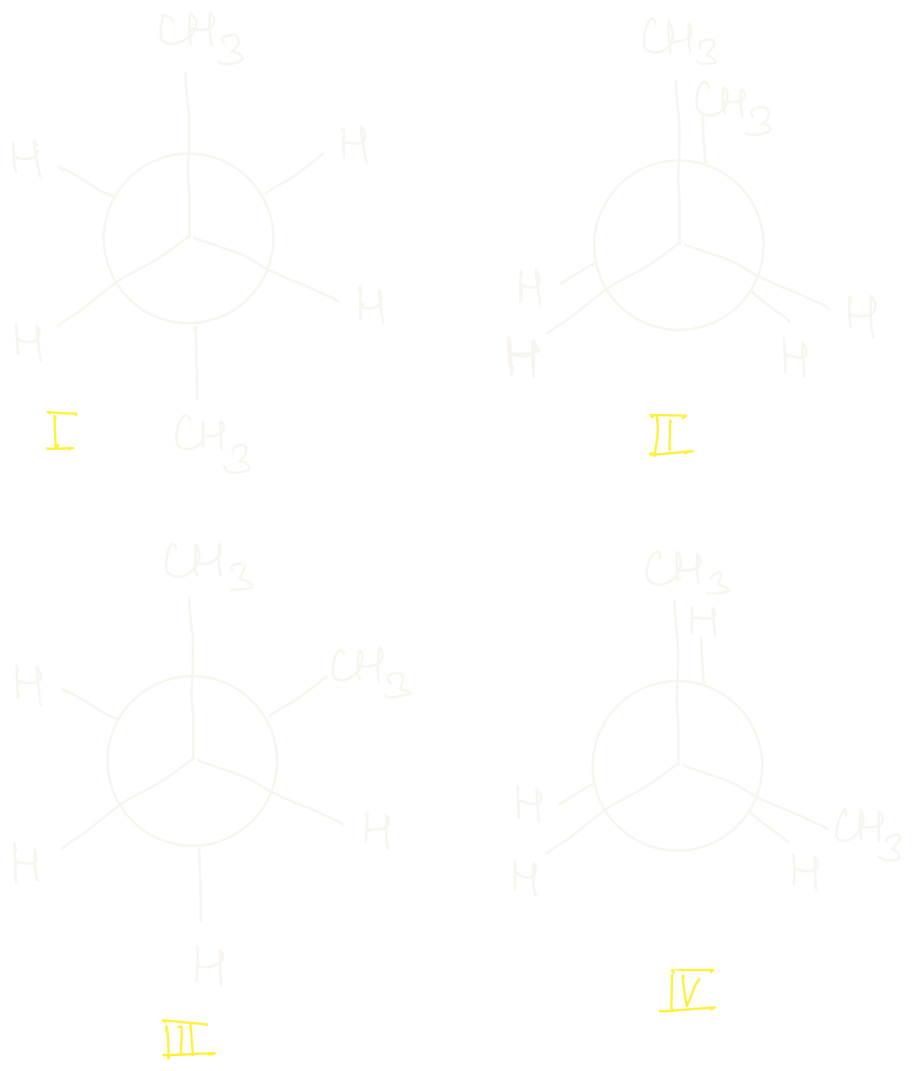
Arrange the following conformational isomers of n-butane in order of their increasing potential energy:
Hydrocarbons · Class 11 · JEE Main Previous Year Question
Arrange the following conformational isomers of n-butane in order of their increasing potential energy:
- a✓
I < III < IV < II
- b
I < IV < III < II
- c
II < III < IV < I
- d
II < IV < III < I
I < III < IV < II
Step 1: Identify the four conformations of n-butane
For n-butane (), the Newman projection about the C2–C3 bond gives:
- Conformation I (Anti): Dihedral angle = 180°, two groups are anti — most stable (lowest PE)
- Conformation II (Fully eclipsed): Dihedral angle = 0°, two groups eclipsed — least stable (highest PE)
- Conformation III (Gauche): Dihedral angle = 60°, groups gauche — second most stable
- Conformation IV (Partially eclipsed): Dihedral angle = 120°, eclipses — between gauche and fully eclipsed
Step 2: Order by potential energy (increasing)
Potential energy order (lowest to highest):
Step 3: Match to answer choices
Increasing PE: I < III < IV < II → Option (a)
Key Points to Remember:
- Anti (180°) = most stable for n-butane; gauche (60°) has 3.8 kJ/mol more PE
- Fully eclipsed (0°) = least stable; 19 kJ/mol above anti
- Partially eclipsed (120°) is between gauche and fully eclipsed
- Stability order: anti > gauche > partially eclipsed > fully eclipsed
Practice this question with progress tracking
Want timed practice with adaptive difficulty? Solve this question (and hundreds more from Hydrocarbons) inside The Crucible, our adaptive practice platform.
More JEE Main Hydrocarbons PYQs
The alkane from below having two secondary hydrogens is:
The incorrect statement regarding ethyne is:
In the following reaction, 'X' is:
Identify A in the given chemical reaction.
Which of the following compounds produces an optically inactive compound on hydrogenation?