In the above reaction, the reagent A is:
Hydrocarbons · Class 11 · JEE Main Previous Year Question
 In the above reaction, the reagent A is:
- a
- b
- c
- d✓
Alkaline ,
Alkaline ,
An aromatic ring imparts extra stability to the nearest carbon atom of its side chains. The aromatic ring and one carbon atom of a side chain can survive a vigorous permanganate oxidation. The product is a carboxylate salt of benzoic acid. (Hot chromic acid can also be used for this oxidation.) This oxidation is occasionally useful for making benzoic acid derivatives, as long as any other functional groups are resistant to oxidation.
Functional groups such as - NO2, halogens, - COOH, and -SO3H usually
survive this brutal oxidation.
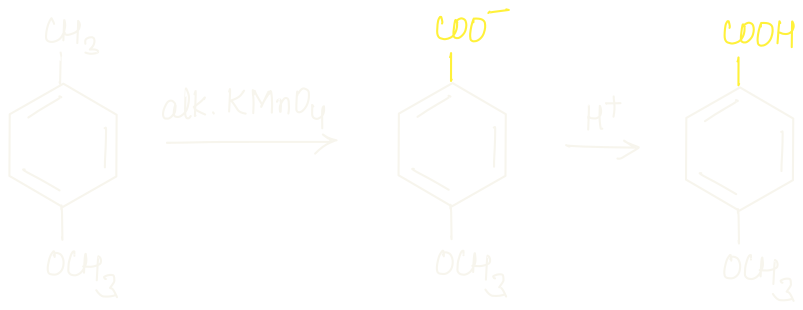 Key Points:
- Alkaline is the standard reagent to oxidize on aromatic ring to
- (methoxy ether) survives oxidation by
- All alkyl groups on benzene ring ultimately give under this oxidation
Practice this question with progress tracking
Want timed practice with adaptive difficulty? Solve this question (and hundreds more from Hydrocarbons) inside The Crucible, our adaptive practice platform.
More JEE Main Hydrocarbons PYQs
Given below are two statements, one is labelled as Assertion (A) and the other is labelled as Reason (R). Assertion (A): Benzene is more stable than hypothetical cyclohexatriene. Reason (R): The…
The major product P formed in the given reaction is:
For the given reaction: What is A (major product)?
For the following sequence of reactions, the correct products are:
Considering the above chemical reaction, identify the product X: