The one giving maximum number of isomeric alkenes on dehydrohalogenation reaction is (excluding rearrangement):
Hydrocarbons · Class 11 · JEE Main Previous Year Question
The one giving maximum number of isomeric alkenes on dehydrohalogenation reaction is (excluding rearrangement):
- a
1-Bromo-2-methylbutane
- b
2-Bromopropane
- c✓
2-Bromopentane
- d
2-Bromo-3,3-dimethylpentane
2-Bromopentane
Step 1: Recall dehydrohalogenation (E2 elimination)
Dehydrohalogenation removes to form alkenes. The number of isomeric alkenes depends on the number of distinct -hydrogens available.
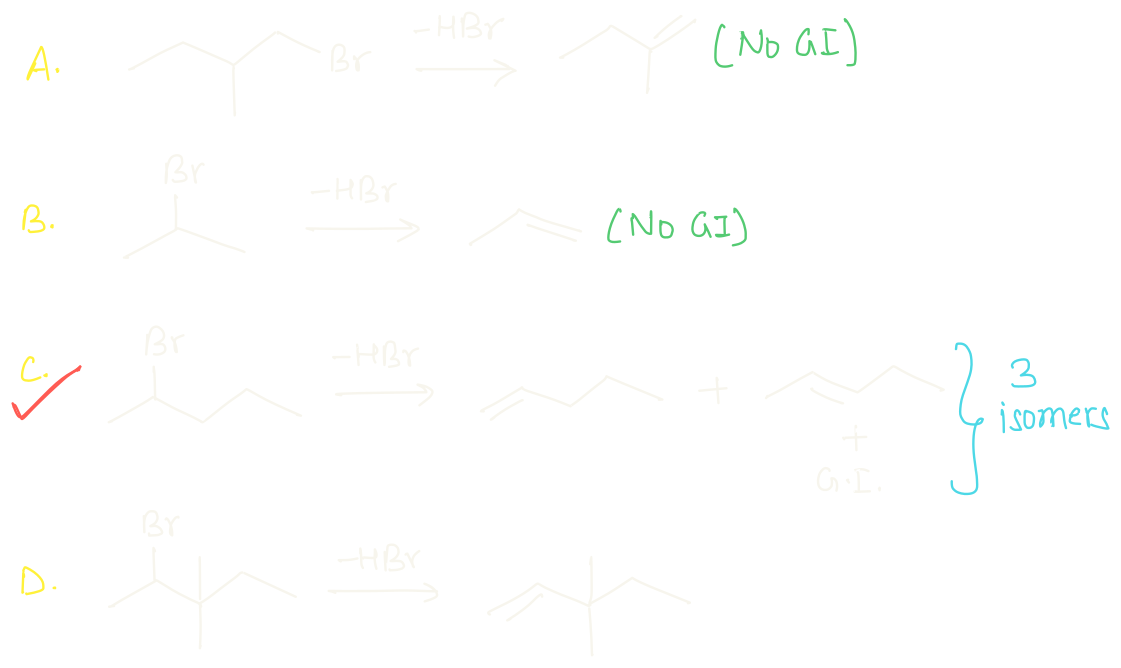 Answer: Option (c)
Key Points to Remember:
- Count distinct -carbons with H atoms to determine number of elimination products
- Geometric isomers (cis/trans) count as separate alkenes
- Quaternary carbons have no -H, so no elimination possible from that side
Practice this question with progress tracking
Want timed practice with adaptive difficulty? Solve this question (and hundreds more from Hydrocarbons) inside The Crucible, our adaptive practice platform.
More JEE Main Hydrocarbons PYQs
Consider the following molecule (X): The major product formed when the given molecule (X) is treated with HBr (1 eq) is:
Following are the four molecules "P", "Q", "R" and "S": Which one among the four molecules will react with H-Br(aq) at the fastest rate?
Major product of the following reaction is:
Number of and bonds present in ethylene molecule is respectively:
The incorrect statement regarding the geometrical isomers of 2-butene is: