How Chemistry Began
Two impossible dreams, an Indian thinker who saw atoms 2,500 years before Dalton, and the science that grew out of all of it.
"Chemistry is the science of molecules and their transformations. It is the science not so much of the one hundred elements but of the infinite variety of molecules that may be built from them."
— Roald Hoffmann (Nobel Prize, Chemistry, 1981)
A hundred elements. Infinite molecules. That’s the whole game.
Introduction to the page.
Listen to the audio explanation
Chemistry didn’t begin in a laboratory.
It began with two impossible dreams. The first was the Philosopher’s Stone — a fabled substance that could turn iron, copper, and lead into gold. The second was the Elixir of Life — a potion that would grant immortality. Neither dream came true. But chasing them, people across the world spent centuries melting, mixing, distilling, and burning — and accidentally invented an entire science.
This long, restless search has a name: alchemy. It thrived roughly 1300–1600 CE in Europe, after Arab scholars carried it westward. Modern chemistry — the precise, equation-driven discipline you’ll learn in this chapter — only took shape in the 18th century. Compared with physics or mathematics, chemistry is a young science.
But its roots are far older — and they run deep through India.
India was doing chemistry before Europe had a word for it
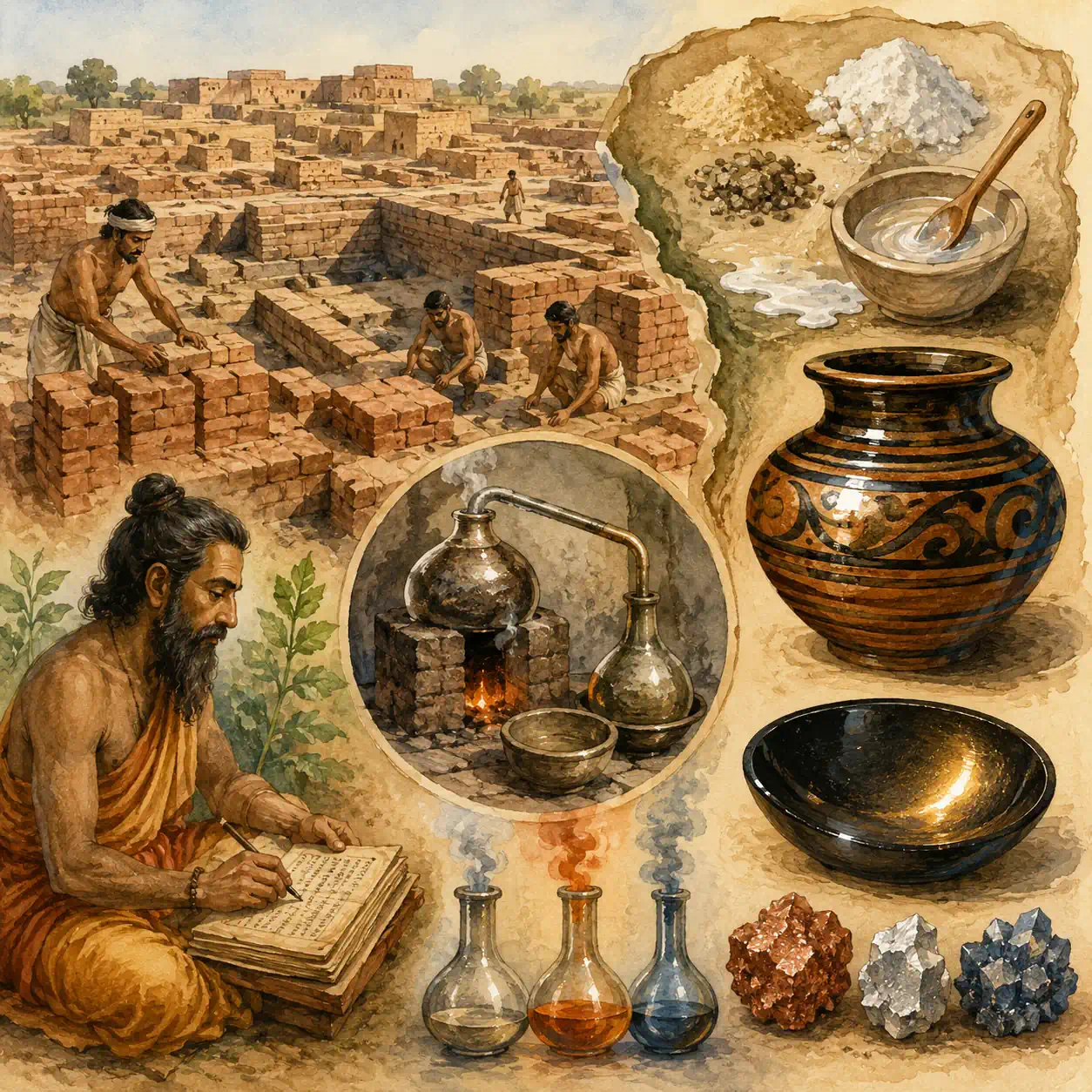
The Sanskrit word for chemistry is Rasāyana — Rasāyan Shāstra — older than the European idea of the subject by thousands of years. It covered metallurgy, medicine, glass, cosmetics, and dyes — a much broader sweep than what we call chemistry today.
Excavations at Mohenjodaro and Harappa show baked bricks, gypsum cement (lime, sand, and traces of ), and glazed pottery — mass chemistry, practised at scale, more than 4,000 years ago. The Charaka Samhita describes the preparation of sulphuric acid, nitric acid, and oxides of copper, tin, and zinc. The black-polished ware of northern India — with its strange golden gloss — has still not been chemically replicated.
By any modern definition, this was already chemistry.
Walk into the Qutub Minar complex in Delhi today and you can stand in front of a piece of working chemistry from the year 402 CE.
The Iron Pillar of Delhi is a 7.2-metre, 6-tonne wrought-iron column raised during the Gupta dynasty. It carries an inscription honouring King Chandragupta II (Vikramaditya). For 1,600+ years, exposed to Delhi’s monsoon humidity and summer sun, it has stood with almost no rust.
How? In 2002, Prof. R. Balasubramaniam at IIT Kanpur analysed the surface and found a thin, dense protective layer of misawite ( — iron oxyhydroxide) only about 100 microns thick (one-tenth of a millimetre).
The reason this layer forms: the pillar’s iron contains an unusually high phosphorus content of about 1%. Modern industrial steel has roughly 0.05% — twenty times less. The phosphorus, combined with Delhi’s wet-dry seasonal cycle, slowly precipitates that protective film, which then blocks any further oxidation underneath.
In other words: Indian metallurgists in 400 CE were doing alloy-engineered corrosion protection that the rest of the world only understood in the 2000s.
Acharya Kanad saw atoms 2,500 years before Dalton
Around 600 BCE, an Indian thinker named Acharya Kanad wrote one of the most striking things in early science. In a text called the Vaiśeṣika Sūtras, he argued that all matter is built from invisible, indivisible particles he called paramāṇu — “the smallest possible thing.”
His description is uncannily modern. Paramāṇu, he wrote, are eternal, indestructible, spherical, and in motion. They cannot be sensed by any human organ. There are different kinds of them — as different as the substances they make. And they combine in pairs and triplets, drawn together by unseen forces.
John Dalton arrived at essentially the same picture in 1808 — 2,500 years later — and his version became the foundation of modern atomic theory. Kanada had no balance, no microscope, no spectrometer. He reasoned his way to the atom.
That same atom is what the rest of this chapter is built around.
What chemistry is, now.
Chemistry today is what Hoffmann said it was: the science of molecules and their transformations. The world around you (water in your glass, the air in your lungs, the curd that formed from milk last night, the rust on an old gate) is matter built from a hundred-odd elements, arranged into an infinite variety of molecules.
Now, the strange part: you cannot see a single atom. You cannot weigh a single molecule on any scale that exists. Yet by the end of this unit, you’ll be able to count how many of them sit in a glass of water, predict how much of one substance reacts with another, and move effortlessly between the world of grams and the world of .
That is the leap modern chemistry made, and the one you are about to make.
How Science Works: Law → Hypothesis → Theory
Tell a law, a hypothesis and a theory apart, and see why chemistry’s big ideas all began as experiments.
Chemistry didn’t arrive as a finished set of facts. It was built, step by step, the way all science is built.
A scientist starts by observing and experimenting. When the same result shows up again and again, it gets summed up as a law — a short statement of what happens, every time (it does not say why). To explain why a law holds, someone proposes a hypothesis, a tentative idea. A hypothesis that survives repeated testing and goes on to explain many separate facts becomes a theory — and a good theory can even predict results no one has measured yet.
Every major idea in this book travelled that road. The Law of Conservation of Mass and the Law of Definite Proportions were squeezed out of careful weighing experiments; Dalton’s Atomic Theory was the idea that explained them; and because it kept working, it became the foundation the whole subject is built on.
How an idea grows in science
| Stage | What it is | Example from chemistry |
|---|---|---|
| Law | A concise statement of what always happens — with no explanation | Law of Conservation of Mass |
| Hypothesis | A tentative idea put forward to explain a law | Matter is made of indivisible atoms (early Dalton) |
| Theory | A well-tested explanation that fits many facts and predicts new ones | Dalton’s Atomic Theory |
How to Study Chemistry
Build the handful of habits that make chemistry click instead of pile up.
Chemistry feels hard at first for one honest reason: it is like learning a new language. There is fresh vocabulary (, mole, oxidation), new symbols, and some ideas you can’t see directly. The good news — with a few steady habits it becomes one of the most logical, rewarding subjects you’ll study.
- Don’t read passively. Skim a page’s outline first to see where it’s heading, then read for understanding. Reading chemistry like a story doesn’t stick.
- Work problems — don’t just watch them. You learn chemistry the way you learn cricket or cycling: by doing. Read a solved example, then close it and redo it yourself.
- Review the same day. Ten minutes revisiting today’s topic tonight saves an hour of relearning next week.
- Test yourself by explaining. If you can explain an idea to a friend in plain words, you own it. If you stumble, you’ve just found exactly what to revise.
- Ask early. One cleared doubt today prevents ten confused pages later.
How to Use This Book
Get the most out of every feature on these pages.
This isn’t a printed textbook — it’s built to teach you actively. Here’s how to use what’s on each page:
- Start at the chapter overview. It maps the whole journey so you always know where a topic fits.
- Watch and listen. The video and audio clips are short explanations in your teacher’s own voice — use them when a concept needs to be heard, not just read.
- Try the worked examples before revealing the answer. Attempt first, then tap to check. The struggle is where the learning happens.
- Use the quick quizzes as a checkpoint, not a test. Get one wrong and the explanation tells you why — that’s the point.
- Read the Exam Insight boxes for what JEE/NEET actually ask, and use the practice links to drill the topic in the Crucible question bank.
Q1.Acharya Kanad called the smallest, indivisible particle of matter by what name?
"Chemistry is the science of molecules and their transformations. It is the science not so much of the one hundred elements but of the infinite variety of molecules that may be built from them."
— Roald Hoffmann (Nobel Prize, Chemistry, 1981)
A hundred elements. Infinite molecules. That’s the whole game.
Introduction to the page.
Listen to the audio explanation
Chemistry didn’t begin in a laboratory.
It began with two impossible dreams. The first was the Philosopher’s Stone — a fabled substance that could turn iron, copper, and lead into gold. The second was the Elixir of Life — a potion that would grant immortality. Neither dream came true. But chasing them, people across the world spent centuries melting, mixing, distilling, and burning — and accidentally invented an entire science.
This long, restless search has a name: alchemy. It thrived roughly 1300–1600 CE in Europe, after Arab scholars carried it westward. Modern chemistry — the precise, equation-driven discipline you’ll learn in this chapter — only took shape in the 18th century. Compared with physics or mathematics, chemistry is a young science.
But its roots are far older — and they run deep through India.
India was doing chemistry before Europe had a word for it
The Sanskrit word for chemistry is Rasāyana — Rasāyan Shāstra — older than the European idea of the subject by thousands of years. It covered metallurgy, medicine, glass, cosmetics, and dyes — a much broader sweep than what we call chemistry today.
Excavations at Mohenjodaro and Harappa show baked bricks, gypsum cement (lime, sand, and traces of ), and glazed pottery — mass chemistry, practised at scale, more than 4,000 years ago. The Charaka Samhita describes the preparation of sulphuric acid, nitric acid, and oxides of copper, tin, and zinc. The black-polished ware of northern India — with its strange golden gloss — has still not been chemically replicated.
By any modern definition, this was already chemistry.
Walk into the Qutub Minar complex in Delhi today and you can stand in front of a piece of working chemistry from the year 402 CE.
The Iron Pillar of Delhi is a 7.2-metre, 6-tonne wrought-iron column raised during the Gupta dynasty. It carries an inscription honouring King Chandragupta II (Vikramaditya). For 1,600+ years, exposed to Delhi’s monsoon humidity and summer sun, it has stood with almost no rust.
How? In 2002, Prof. R. Balasubramaniam at IIT Kanpur analysed the surface and found a thin, dense protective layer of misawite ( — iron oxyhydroxide) only about 100 microns thick (one-tenth of a millimetre).
The reason this layer forms: the pillar’s iron contains an unusually high phosphorus content of about 1%. Modern industrial steel has roughly 0.05% — twenty times less. The phosphorus, combined with Delhi’s wet-dry seasonal cycle, slowly precipitates that protective film, which then blocks any further oxidation underneath.
In other words: Indian metallurgists in 400 CE were doing alloy-engineered corrosion protection that the rest of the world only understood in the 2000s.
Acharya Kanad saw atoms 2,500 years before Dalton
Around 600 BCE, an Indian thinker named Acharya Kanad wrote one of the most striking things in early science. In a text called the Vaiśeṣika Sūtras, he argued that all matter is built from invisible, indivisible particles he called paramāṇu — “the smallest possible thing.”
His description is uncannily modern. Paramāṇu, he wrote, are eternal, indestructible, spherical, and in motion. They cannot be sensed by any human organ. There are different kinds of them — as different as the substances they make. And they combine in pairs and triplets, drawn together by unseen forces.
John Dalton arrived at essentially the same picture in 1808 — 2,500 years later — and his version became the foundation of modern atomic theory. Kanada had no balance, no microscope, no spectrometer. He reasoned his way to the atom.
That same atom is what the rest of this chapter is built around.
What chemistry is, now.
Chemistry today is what Hoffmann said it was: the science of molecules and their transformations. The world around you (water in your glass, the air in your lungs, the curd that formed from milk last night, the rust on an old gate) is matter built from a hundred-odd elements, arranged into an infinite variety of molecules.
Now, the strange part: you cannot see a single atom. You cannot weigh a single molecule on any scale that exists. Yet by the end of this unit, you’ll be able to count how many of them sit in a glass of water, predict how much of one substance reacts with another, and move effortlessly between the world of grams and the world of .
That is the leap modern chemistry made, and the one you are about to make.
How Science Works: Law → Hypothesis → Theory
Tell a law, a hypothesis and a theory apart, and see why chemistry’s big ideas all began as experiments.
Chemistry didn’t arrive as a finished set of facts. It was built, step by step, the way all science is built.
A scientist starts by observing and experimenting. When the same result shows up again and again, it gets summed up as a law — a short statement of what happens, every time (it does not say why). To explain why a law holds, someone proposes a hypothesis, a tentative idea. A hypothesis that survives repeated testing and goes on to explain many separate facts becomes a theory — and a good theory can even predict results no one has measured yet.
Every major idea in this book travelled that road. The Law of Conservation of Mass and the Law of Definite Proportions were squeezed out of careful weighing experiments; Dalton’s Atomic Theory was the idea that explained them; and because it kept working, it became the foundation the whole subject is built on.
How an idea grows in science
| Stage | What it is | Example from chemistry |
|---|---|---|
| Law | A concise statement of what always happens — with no explanation | Law of Conservation of Mass |
| Hypothesis | A tentative idea put forward to explain a law | Matter is made of indivisible atoms (early Dalton) |
| Theory | A well-tested explanation that fits many facts and predicts new ones | Dalton’s Atomic Theory |
How to Study Chemistry
Build the handful of habits that make chemistry click instead of pile up.
Chemistry feels hard at first for one honest reason: it is like learning a new language. There is fresh vocabulary (, mole, oxidation), new symbols, and some ideas you can’t see directly. The good news — with a few steady habits it becomes one of the most logical, rewarding subjects you’ll study.
- Don’t read passively. Skim a page’s outline first to see where it’s heading, then read for understanding. Reading chemistry like a story doesn’t stick.
- Work problems — don’t just watch them. You learn chemistry the way you learn cricket or cycling: by doing. Read a solved example, then close it and redo it yourself.
- Review the same day. Ten minutes revisiting today’s topic tonight saves an hour of relearning next week.
- Test yourself by explaining. If you can explain an idea to a friend in plain words, you own it. If you stumble, you’ve just found exactly what to revise.
- Ask early. One cleared doubt today prevents ten confused pages later.
How to Use This Book
Get the most out of every feature on these pages.
This isn’t a printed textbook — it’s built to teach you actively. Here’s how to use what’s on each page:
- Start at the chapter overview. It maps the whole journey so you always know where a topic fits.
- Watch and listen. The video and audio clips are short explanations in your teacher’s own voice — use them when a concept needs to be heard, not just read.
- Try the worked examples before revealing the answer. Attempt first, then tap to check. The struggle is where the learning happens.
- Use the quick quizzes as a checkpoint, not a test. Get one wrong and the explanation tells you why — that’s the point.
- Read the Exam Insight boxes for what JEE/NEET actually ask, and use the practice links to drill the topic in the Crucible question bank.
Q1.Acharya Kanad called the smallest, indivisible particle of matter by what name?