Scientific Measurement
The SI system, units, and the conversions where exam marks are won and lost
On September 23, 1999, NASA’s Mars Climate Orbiter — a $327 million spacecraft — slammed into the Martian atmosphere instead of slipping into orbit around the planet. The craft burned up. The mission was lost.
The post-mortem found one cause, almost embarrassing in its simplicity: two engineering teams had been using different units. Lockheed Martin’s team had calculated thruster forces in pound-seconds (US customary). NASA’s navigation software read those numbers as newton-seconds (SI). The mismatch was never caught.
A factor-of-4.45 error in the most boring of details — a unit suffix — was enough to push a spacecraft into a planet.
Lesson for everything that follows in this chapter: a number without a unit is not a measurement. It’s just noise.
The SI System — One Language for All of Science
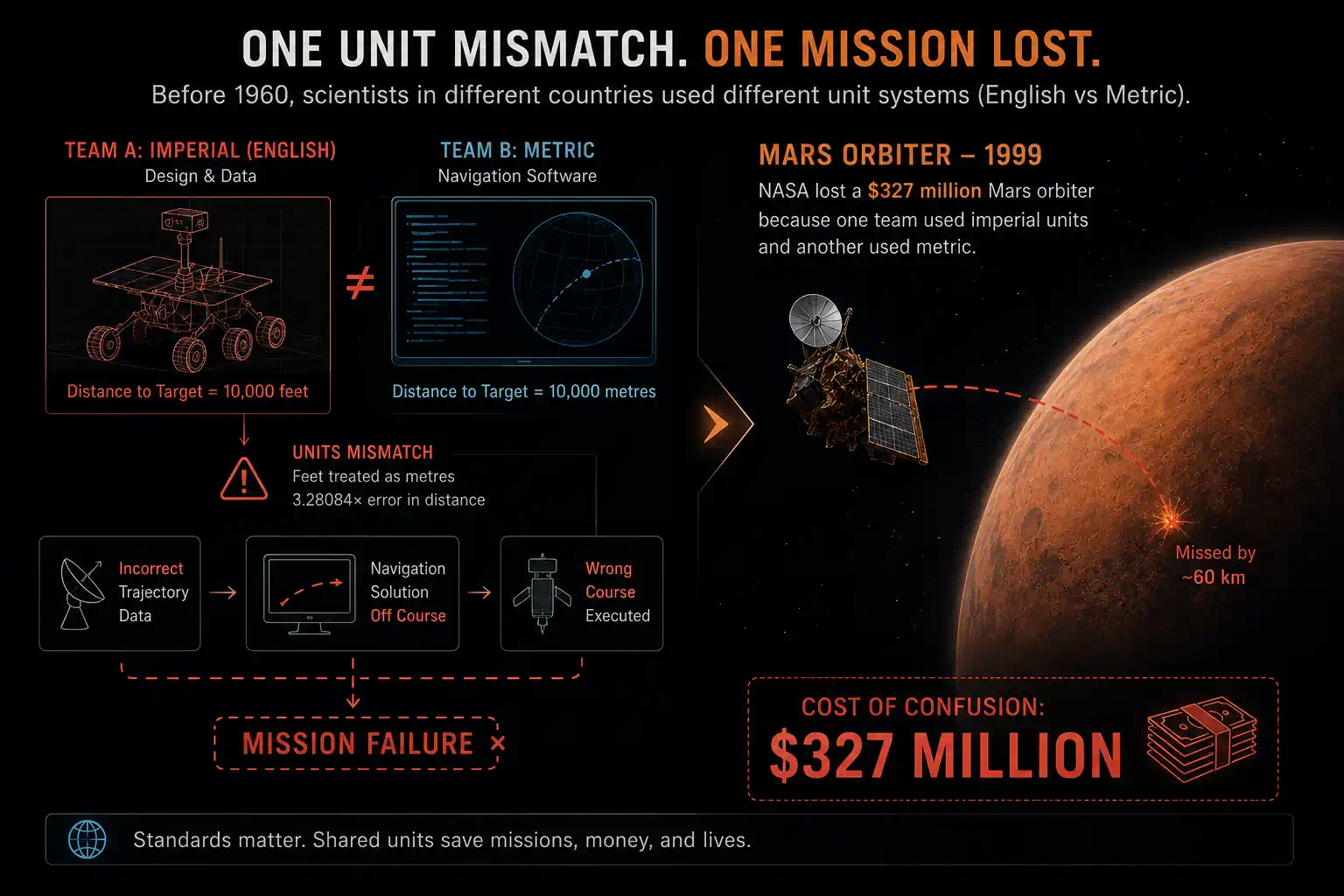
Before 1960, scientists in different countries used different unit systems (English vs Metric). Imagine sending a rover to Mars with measurements in feet while the navigation software uses metres. That actually happened — NASA lost a $327 million Mars orbiter in 1999 because one team used imperial units and another used metric.
The International System of Units (SI) — from the French Système International d'Unités — was established in 1960 to fix this. It has 7 base units from which all other units are derived.
Table 1.1 — The Seven SI Base Units
| Physical Quantity | Symbol | SI Unit | Unit Symbol |
|---|---|---|---|
| Length | metre | m | |
| Mass | kilogram | kg | |
| Time | second | s | |
| Electric current | ampere | A | |
| Thermodynamic temperature | kelvin | K | |
| Amount of substance | mole | mol | |
| Luminous intensity | candela | cd |
Table 1.2 — SI Prefixes You'll Use Most Often
| Prefix | Symbol | Multiplier | Example in Chemistry |
|---|---|---|---|
| giga | G | 1 GJ = joules (energy of explosions) | |
| mega | M | 1 MHz = Hz | |
| kilo | k | 1 kg = 1000 g (mass) | |
| deci | d | 1 dm = 0.1 m; 1 dm³ = 1 litre | |
| centi | c | 1 cm = 0.01 m; 1 cm³ = 1 mL | |
| milli | m | 1 mg = g; 1 mL = L | |
| micro | 1 g = g (drug dosing) | ||
| nano | n | 1 nm = m (wavelength of visible light: 400–700 nm) | |
| pico | p | 1 pm = m (bond lengths in molecules) |
Understanding SI prefixes and how to remember them
Listen to the audio explanation
Mass and Weight — Not the Same Thing
Mass is the amount of matter in a substance — it never changes.Take a 5 kg bag of rice to the Moon and it's still 5 kg.
Weight is the force gravity exerts on that mass ().That same rice bag on the Moon weighs only about 0.8 kg-force — the Moon's gravity is 1/6th of Earth's.
In everyday life we use "weight" loosely to mean mass. In chemistry and physics, always be precise:
- SI unit of mass: kilogram (kg)
- Lab unit: gram (g), where 1 kg = 1000 g
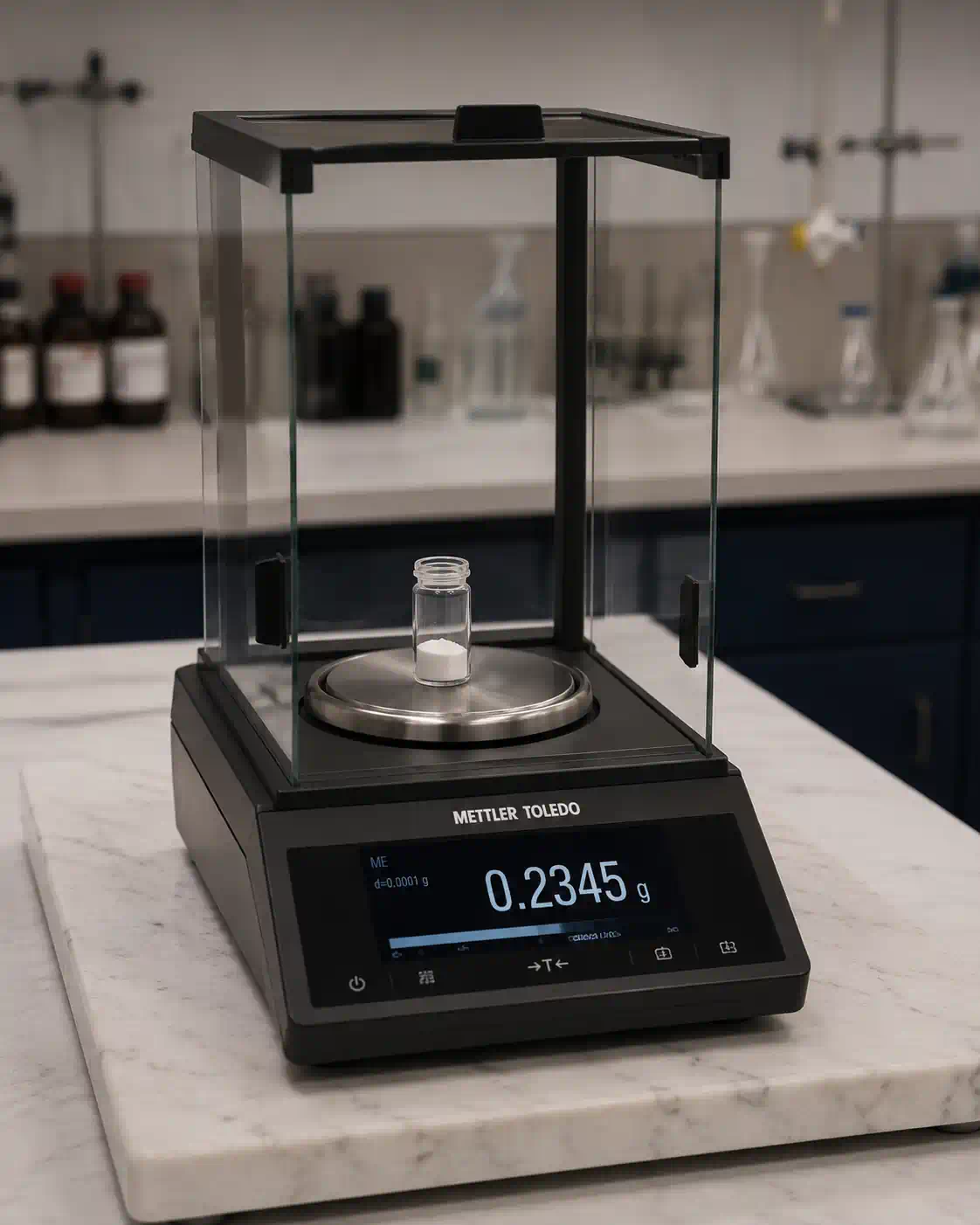
- Measured using: an analytical balance — accurate to 0.0001 g (0.1 mg)
Volume — How Much Space Does It Occupy?
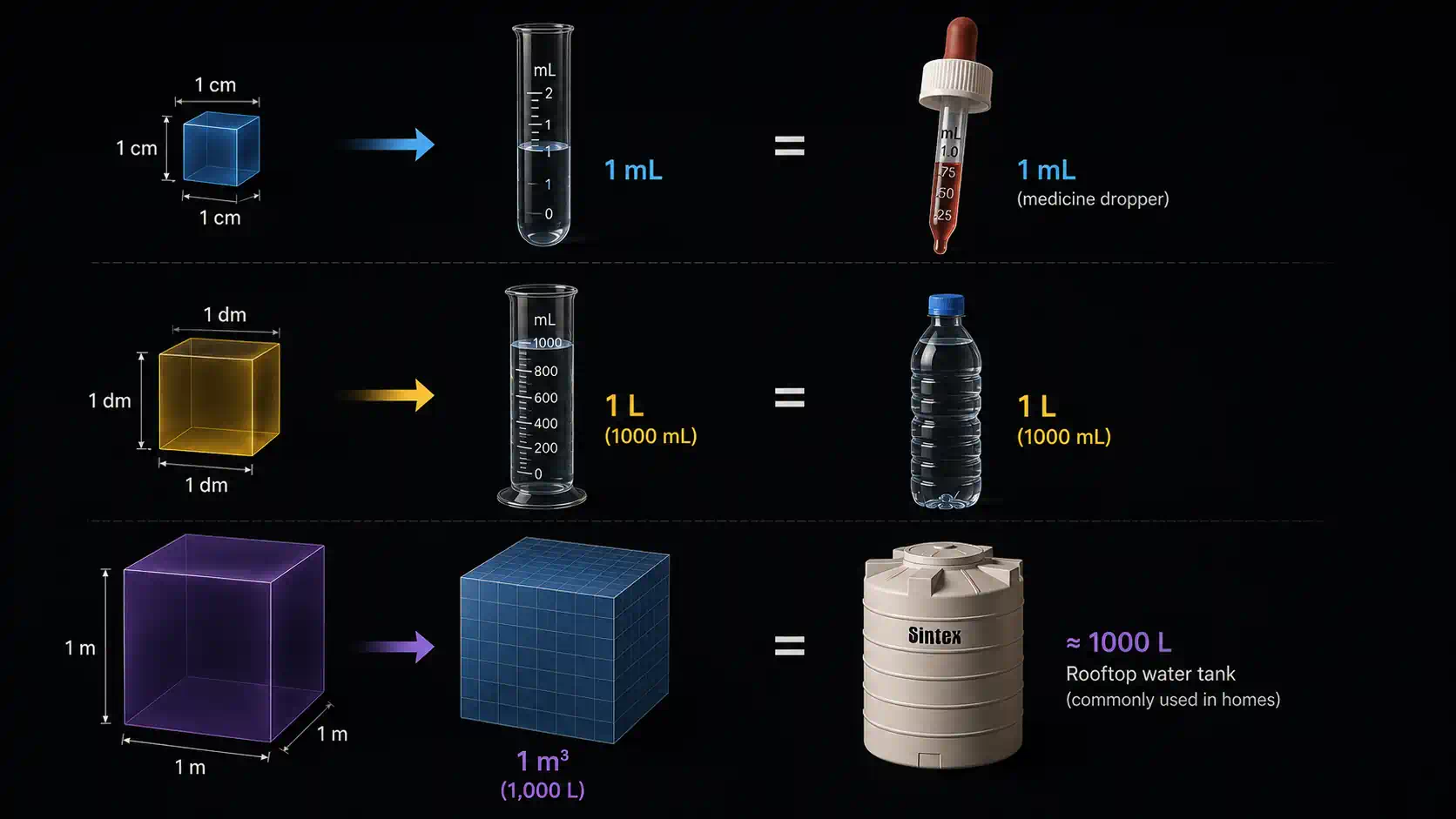
Volume is the amount of space a substance occupies. The SI unit is ,but that's too large for the lab — imagine measuring a reaction in cubic metres!Instead, chemists use:
| Unit | Equivalent | Used for |
|---|---|---|
| 1 litre (L) | 1 dm³ = 1000 cm³ = 1000 mL | Solutions, liquids |
| 1 mL | 1 cm³ | Small volumes |
| 1 m³ | 1000 L | Industrial scale |
Memory trick: 1 dm³ = 1 L. A decimetre is 10 cm, so 1 dm³ = 10 cm × 10 cm × 10 cm = 1000 cm³ = 1 L.
Simulator unit-conversion-arena not found.
Putting Units to Work — The Road-Map Method
Most numerical questions in chemistry are really unit conversions in disguise. The trick toppers use is to plan a road map before touching the calculator. Write the unit you are given on the left and the unit you want on the right, then fill the gap with conversion factors — fractions like that equal 1, so they change the unit without changing the quantity. Line them up so every unwanted unit cancels, and the answer drops out. Try each example yourself before you tap to reveal.
You are setting up speakers in your room and need 325 cm of speaker wire. At the shop it is sold by length at ₹15 per metre. How much will the wire cost?
A rhinovirus, one of the viruses that gives you the common cold, is about 30 nm across. If you could line these particles up touching each other, how many would fit along a 1.0 cm pencil mark?
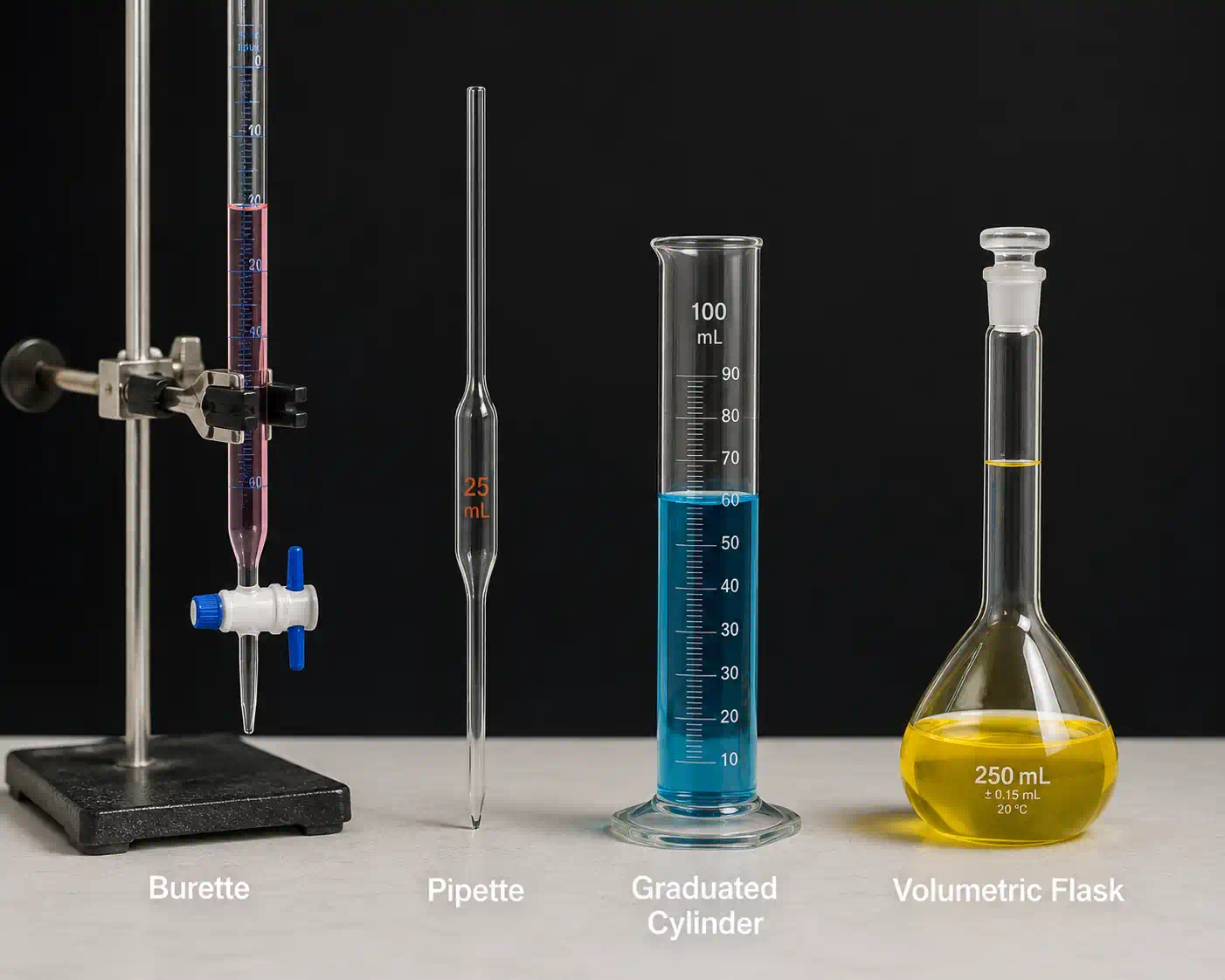
In a school lab a graduated (measuring) cylinder holds 19.9 mL of water. You gently drop in a small piece of galena (an ore of lead); it sinks and the water level rises to 24.5 mL. What is the volume of the galena piece in and in litres?
Density — How Tightly Packed Are the Particles?
Density tells you how much mass is packed into a given volume:
- SI unit: kg m⁻³
- Lab unit: g cm⁻³ (same as g mL⁻¹)
A higher density means particles are more tightly packed. This is why a small piece of lead feels much heavier than a large block of foam. Water has density 1.0 g cm⁻³. Gold is 19.3 g cm⁻³ — 19× denser than water. Lead is 11.3 g cm⁻³. This is why gold sinks in mercury (density 13.6 g cm⁻³) while most metals don't!
Temperature — Three Scales, One Quantity
Temperature is measured on three scales — and knowing how to convert between themsaves you in exams and in life:
| Scale | Symbol | Freezing point of water | Boiling point of water |
|---|---|---|---|
| Celsius | °C | 0°C | 100°C |
| Kelvin (SI) | K | 273.15 K | 373.15 K |
| Fahrenheit | °F | 32°F | 212°F |
Conversion formulas:
Why Kelvin in science? Because 0 K is absolute zero — the temperature where all molecular motionstops. You cannot have negative Kelvin. Celsius can go below zero, which causes problems in gas law equations.
For temperature, always use the Kelvin scale.
Listen to the audio explanation
You can now measure matter precisely — length, mass, volume, density, temperature — and move between their units without slipping. Next, you'll meet the laws of chemical combination: the exact rules that govern how these measured amounts of elements combine.
Q1.The density of gold is 19.3 g cm⁻³ and mercury is 13.6 g cm⁻³. What happens if you drop a gold coin into a dish of mercury?
On September 23, 1999, NASA’s Mars Climate Orbiter — a $327 million spacecraft — slammed into the Martian atmosphere instead of slipping into orbit around the planet. The craft burned up. The mission was lost.
The post-mortem found one cause, almost embarrassing in its simplicity: two engineering teams had been using different units. Lockheed Martin’s team had calculated thruster forces in pound-seconds (US customary). NASA’s navigation software read those numbers as newton-seconds (SI). The mismatch was never caught.
A factor-of-4.45 error in the most boring of details — a unit suffix — was enough to push a spacecraft into a planet.
Lesson for everything that follows in this chapter: a number without a unit is not a measurement. It’s just noise.
The SI System — One Language for All of Science
Before 1960, scientists in different countries used different unit systems (English vs Metric). Imagine sending a rover to Mars with measurements in feet while the navigation software uses metres. That actually happened — NASA lost a $327 million Mars orbiter in 1999 because one team used imperial units and another used metric.
The International System of Units (SI) — from the French Système International d'Unités — was established in 1960 to fix this. It has 7 base units from which all other units are derived.
Table 1.1 — The Seven SI Base Units
| Physical Quantity | Symbol | SI Unit | Unit Symbol |
|---|---|---|---|
| Length | metre | m | |
| Mass | kilogram | kg | |
| Time | second | s | |
| Electric current | ampere | A | |
| Thermodynamic temperature | kelvin | K | |
| Amount of substance | mole | mol | |
| Luminous intensity | candela | cd |
Table 1.2 — SI Prefixes You'll Use Most Often
| Prefix | Symbol | Multiplier | Example in Chemistry |
|---|---|---|---|
| giga | G | 1 GJ = joules (energy of explosions) | |
| mega | M | 1 MHz = Hz | |
| kilo | k | 1 kg = 1000 g (mass) | |
| deci | d | 1 dm = 0.1 m; 1 dm³ = 1 litre | |
| centi | c | 1 cm = 0.01 m; 1 cm³ = 1 mL | |
| milli | m | 1 mg = g; 1 mL = L | |
| micro | 1 g = g (drug dosing) | ||
| nano | n | 1 nm = m (wavelength of visible light: 400–700 nm) | |
| pico | p | 1 pm = m (bond lengths in molecules) |
Understanding SI prefixes and how to remember them
Listen to the audio explanation
Mass and Weight — Not the Same Thing
Mass is the amount of matter in a substance — it never changes.Take a 5 kg bag of rice to the Moon and it's still 5 kg.
Weight is the force gravity exerts on that mass ().That same rice bag on the Moon weighs only about 0.8 kg-force — the Moon's gravity is 1/6th of Earth's.
In everyday life we use "weight" loosely to mean mass. In chemistry and physics, always be precise:
- SI unit of mass: kilogram (kg)
- Lab unit: gram (g), where 1 kg = 1000 g
- Measured using: an analytical balance — accurate to 0.0001 g (0.1 mg)
Volume — How Much Space Does It Occupy?
Volume is the amount of space a substance occupies. The SI unit is ,but that's too large for the lab — imagine measuring a reaction in cubic metres!Instead, chemists use:
| Unit | Equivalent | Used for |
|---|---|---|
| 1 litre (L) | 1 dm³ = 1000 cm³ = 1000 mL | Solutions, liquids |
| 1 mL | 1 cm³ | Small volumes |
| 1 m³ | 1000 L | Industrial scale |
Memory trick: 1 dm³ = 1 L. A decimetre is 10 cm, so 1 dm³ = 10 cm × 10 cm × 10 cm = 1000 cm³ = 1 L.
Simulator unit-conversion-arena not found.
Putting Units to Work — The Road-Map Method
Most numerical questions in chemistry are really unit conversions in disguise. The trick toppers use is to plan a road map before touching the calculator. Write the unit you are given on the left and the unit you want on the right, then fill the gap with conversion factors — fractions like that equal 1, so they change the unit without changing the quantity. Line them up so every unwanted unit cancels, and the answer drops out. Try each example yourself before you tap to reveal.
You are setting up speakers in your room and need 325 cm of speaker wire. At the shop it is sold by length at ₹15 per metre. How much will the wire cost?
A rhinovirus, one of the viruses that gives you the common cold, is about 30 nm across. If you could line these particles up touching each other, how many would fit along a 1.0 cm pencil mark?
In a school lab a graduated (measuring) cylinder holds 19.9 mL of water. You gently drop in a small piece of galena (an ore of lead); it sinks and the water level rises to 24.5 mL. What is the volume of the galena piece in and in litres?
Density — How Tightly Packed Are the Particles?
Density tells you how much mass is packed into a given volume:
- SI unit: kg m⁻³
- Lab unit: g cm⁻³ (same as g mL⁻¹)
A higher density means particles are more tightly packed. This is why a small piece of lead feels much heavier than a large block of foam. Water has density 1.0 g cm⁻³. Gold is 19.3 g cm⁻³ — 19× denser than water. Lead is 11.3 g cm⁻³. This is why gold sinks in mercury (density 13.6 g cm⁻³) while most metals don't!
Temperature — Three Scales, One Quantity
Temperature is measured on three scales — and knowing how to convert between themsaves you in exams and in life:
| Scale | Symbol | Freezing point of water | Boiling point of water |
|---|---|---|---|
| Celsius | °C | 0°C | 100°C |
| Kelvin (SI) | K | 273.15 K | 373.15 K |
| Fahrenheit | °F | 32°F | 212°F |
Conversion formulas:
Why Kelvin in science? Because 0 K is absolute zero — the temperature where all molecular motionstops. You cannot have negative Kelvin. Celsius can go below zero, which causes problems in gas law equations.
For temperature, always use the Kelvin scale.
Listen to the audio explanation
You can now measure matter precisely — length, mass, volume, density, temperature — and move between their units without slipping. Next, you'll meet the laws of chemical combination: the exact rules that govern how these measured amounts of elements combine.
Q1.The density of gold is 19.3 g cm⁻³ and mercury is 13.6 g cm⁻³. What happens if you drop a gold coin into a dish of mercury?