Atoms, Molecules & Scientific Measurement
From atoms to kilograms — the building blocks and measuring tools every chemist needs
On September 23, 1999, NASA’s Mars Climate Orbiter — a $327 million spacecraft — slammed into the Martian atmosphere instead of slipping into orbit around the planet. The craft burned up. The mission was lost.
The post-mortem found one cause, almost embarrassing in its simplicity: two engineering teams had been using different units. Lockheed Martin’s team had calculated thruster forces in pound-seconds (US customary). NASA’s navigation software read those numbers as newton-seconds (SI). The mismatch was never caught.
A factor-of-4.45 error in the most boring of details — a unit suffix — was enough to push a spacecraft into a planet.
Lesson for everything that follows in this chapter: a number without a unit is not a measurement. It’s just noise.
Atoms, Molecules and Compounds
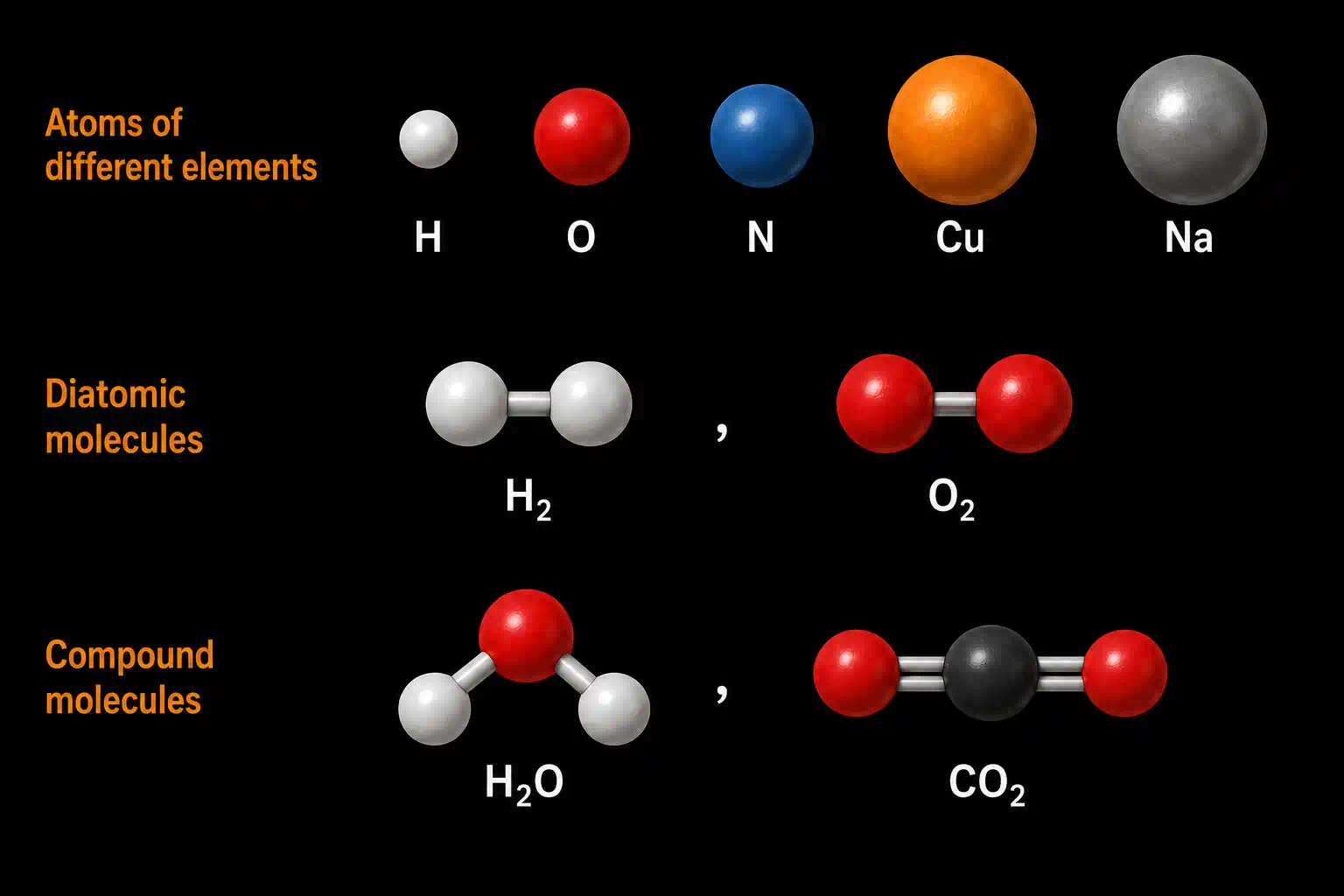
You already know that elements are pure substances made of one type of atom. But atoms don't always float around alone:
- Some elements exist as single atoms: sodium (), copper (), iron ()
- Some exist as diatomic molecules: hydrogen (), oxygen (), nitrogen ()
- Compounds form when atoms of different elements combine in a fixed, definite ratio
Here's the mind-bending part: a compound has completely different properties from its elements. burns. supports combustion. Combine them in a 2:1 ratio and you get — water, used to put out fires. The whole is nothing like its parts.
Physical vs Chemical Properties
Physical Properties
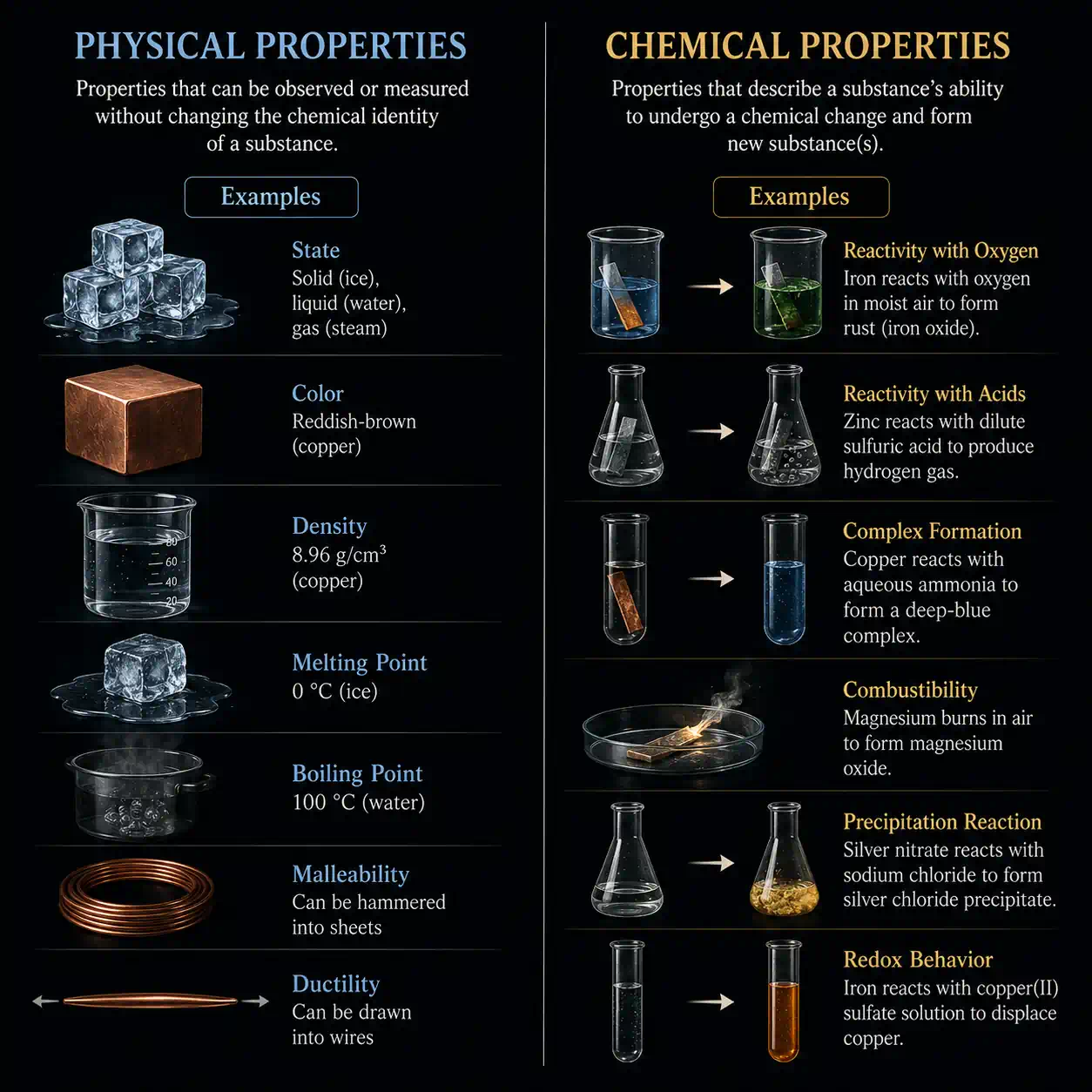
A physical property is something you can observe about a substance without changing what it is chemically. Colour, melting point, boiling point, density, solubility, pressure, volume — these are all physical properties.
When you observe these, the substance doesn’t become something else. Hold a copper wire under different lights and you see the same orange-brown gleam each time. Heat water in a kettle until it boils, then cool it all the way back to ice — at every point along the journey, it is still . The physical state changes from solid to liquid to gas, but the chemical identity stays put.
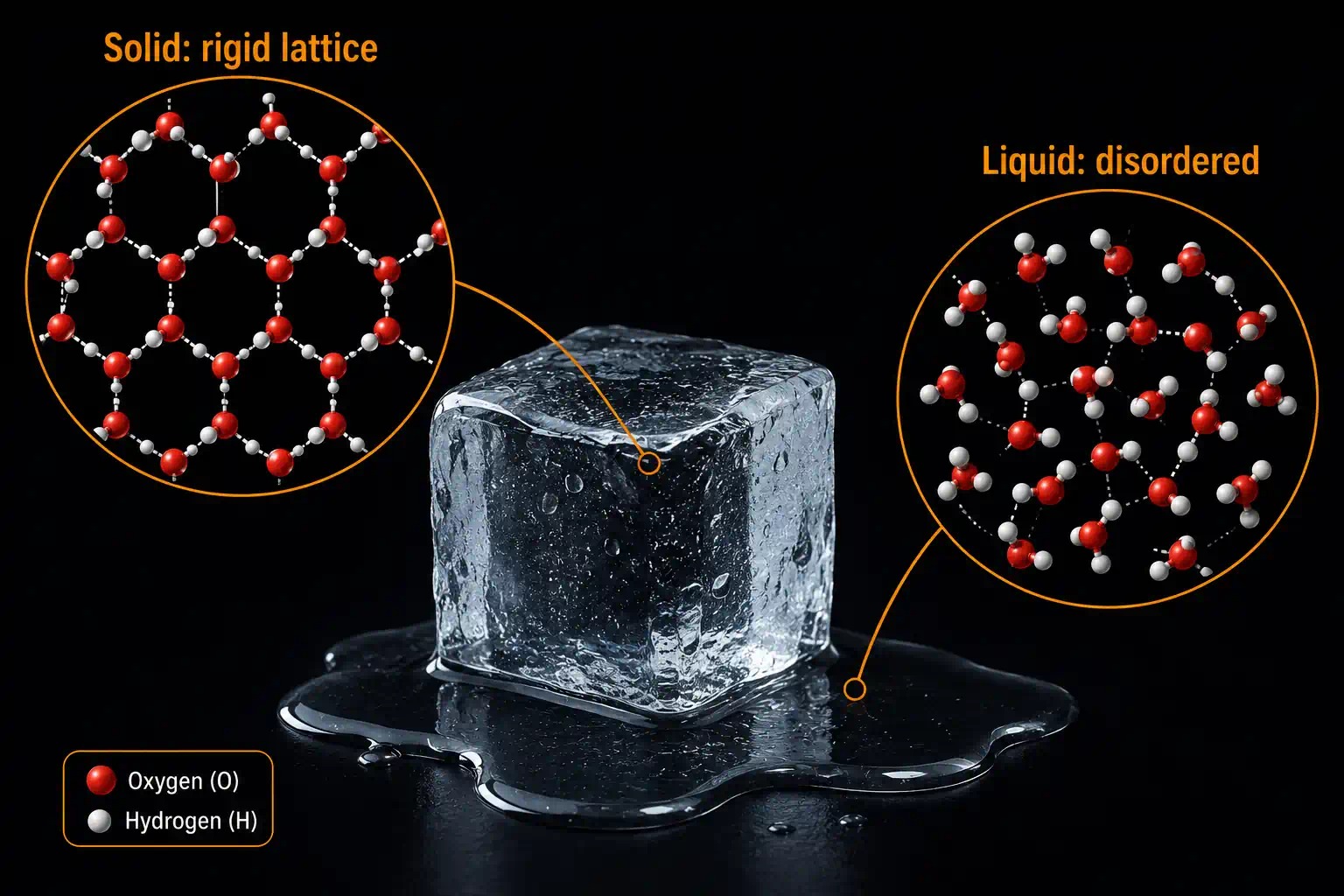
Melting an ice cube is the classic example. The cube goes from a rigid crystal lattice (solid) to a flowing mass of molecules (liquid), but every single molecule in the puddle on your table is the same it was inside the freezer. The change is physical — the chemistry is unchanged.
Chemical Properties
A chemical property describes a chemical change — a reaction — that a substance can undergo. The instant you observe a chemical property, the substance has become something different.
Take acidity. To check whether a substance is acidic, you have to see whether it reacts with a base, releases ions in water, or accepts a pair of electrons. Each of those tests changes the chemical composition of the substance. The act of observation is the act of transformation.
Other chemical properties include basicity, flammability, toxicity, heat of combustion, pH value, rate of radioactive decay, and chemical stability. Every one of them tells you what a substance turns into under specific conditions.
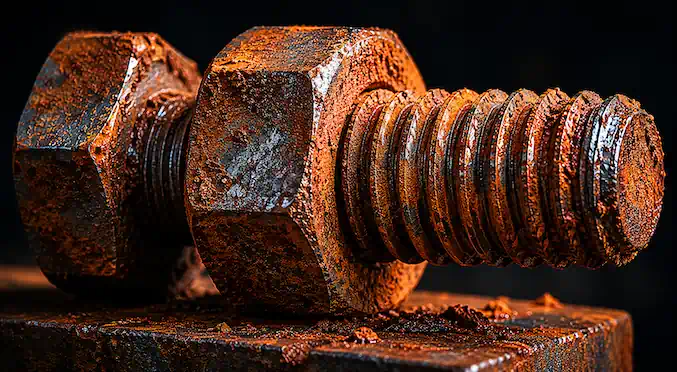
Rusting of iron is the textbook example. When iron is left exposed to moist air, it reacts with oxygen and water to form a hydrated iron oxide — what we call rust (). The substance you started with (shiny, malleable iron) is now genuinely a different substance (brittle, orange-brown oxide). That’s chemistry, not physics.
Physical vs Chemical Properties
Physical Properties
- Measured or observed **without** changing the chemical identity of the substance
- Examples: colour, odour, melting point, boiling point, density, solubility
- No new substance is formed during measurement
- Usually reversible — you can recover the original substance
- Measured by instruments: thermometer, balance, spectrophotometer
Chemical Properties
- Observed only when a **chemical change** occurs — the substance transforms
- Examples: acidity/basicity, combustibility, reactivity with acids, rusting
- A new substance with different properties is formed
- Usually irreversible — you can't recover the original substance easily
- Examples: iron rusts, wood burns, calcium reacts with water
Physical Properties
- Measured or observed **without** changing the chemical identity of the substance
- Examples: colour, odour, melting point, boiling point, density, solubility
- No new substance is formed during measurement
- Usually reversible — you can recover the original substance
- Measured by instruments: thermometer, balance, spectrophotometer
Chemical Properties
- Observed only when a **chemical change** occurs — the substance transforms
- Examples: acidity/basicity, combustibility, reactivity with acids, rusting
- A new substance with different properties is formed
- Usually irreversible — you can't recover the original substance easily
- Examples: iron rusts, wood burns, calcium reacts with water
Intensive vs Extensive Properties
There’s another way to slice up properties — and this one matters every time you do a calculation in a lab.
A property is either intensive or extensive, depending on whether it changes when you change the amount of substance.
Intensive properties don’t depend on how much you have. Take a 1-gram gold ring and a 100-gram gold biscuit. They have wildly different masses and volumes, but both gleam the same characteristic yellow, both melt at exactly , and both boil at exactly . Colour, melting point, boiling point, density, refractive index, viscosity, pressure, temperature — all intensive. Sample size doesn’t move them.
Extensive properties scale with the amount. Double the sample, double the value. Mass, volume, energy, total moles, heat capacity, length — all extensive.
Why this matters: identification. Because intensive properties stay fixed no matter the sample size, they are exactly what we use to identify a substance. Gold miners used this principle to separate real gold from fool’s gold — the mineral pyrite ().
The two look almost identical: same yellow metallic shine, similar density to the eye. But hold either one in a flame, and the truth comes out immediately. Gold sits there, unchanged. Pyrite sputters, smokes, and releases foul-smelling sulphur dioxide () as the iron sulphide reacts with atmospheric oxygen. The chemical property — reactivity with at flame temperature — is intensive. It doesn’t matter whether you tested a gram or a kilogram; the answer is the same.
That’s the deeper lesson: intensive properties are nature’s fingerprints. Extensive properties are just bookkeeping.
The SI System — One Language for All of Science
Before 1960, scientists in different countries used different unit systems (English vs Metric). Imagine sending a rover to Mars with measurements in feet while the navigation software uses metres. That actually happened — NASA lost a $327 million Mars orbiter in 1999 because one team used imperial units and another used metric.
The International System of Units (SI) — from the French Système International d'Unités — was established in 1960 to fix this. It has 7 base units from which all other units are derived.
Table 1.1 — The Seven SI Base Units
| Physical Quantity | Symbol | SI Unit | Unit Symbol |
|---|---|---|---|
| Length | metre | m | |
| Mass | kilogram | kg | |
| Time | second | s | |
| Electric current | ampere | A | |
| Thermodynamic temperature | kelvin | K | |
| Amount of substance | mole | mol | |
| Luminous intensity | candela | cd |
Table 1.3 — SI Prefixes You'll Use Most Often
| Prefix | Symbol | Multiplier | Example in Chemistry |
|---|---|---|---|
| giga | G | 1 GJ = joules (energy of explosions) | |
| mega | M | 1 MHz = Hz | |
| kilo | k | 1 kg = 1000 g (mass) | |
| deci | d | 1 dm = 0.1 m; 1 dm³ = 1 litre | |
| centi | c | 1 cm = 0.01 m; 1 cm³ = 1 mL | |
| milli | m | 1 mg = g; 1 mL = L | |
| micro | 1 g = g (drug dosing) | ||
| nano | n | 1 nm = m (wavelength of visible light: 400–700 nm) | |
| pico | p | 1 pm = m (bond lengths in molecules) |
Mass and Weight — Not the Same Thing
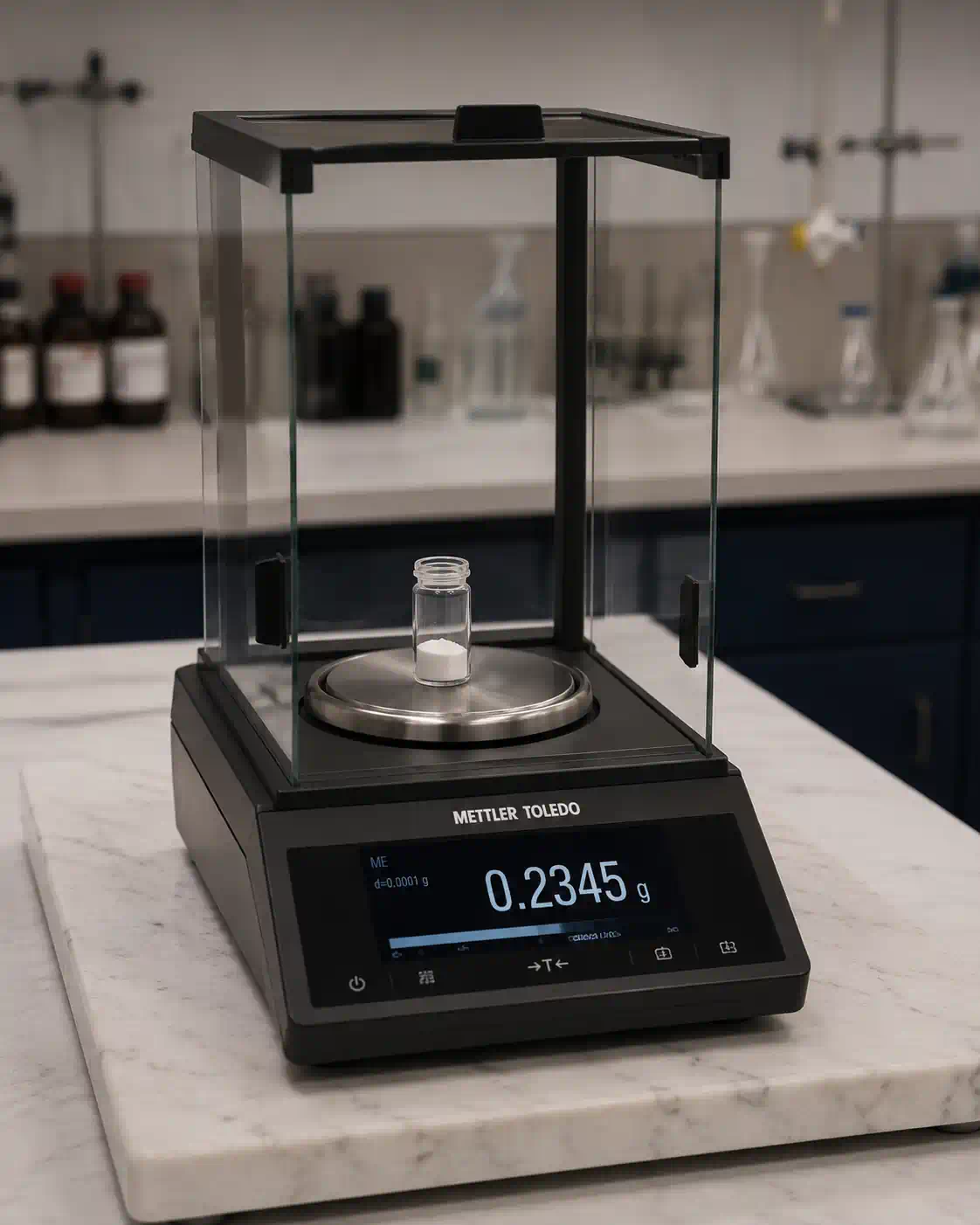
Mass is the amount of matter in a substance — it never changes.Take a 5 kg bag of rice to the Moon and it's still 5 kg.
Weight is the force gravity exerts on that mass ().That same rice bag on the Moon weighs only about 0.8 kg-force — the Moon's gravity is 1/6th of Earth's.
In everyday life we use "weight" loosely to mean mass. In chemistry and physics, always be precise:
- SI unit of mass: kilogram (kg)
- Lab unit: gram (g), where 1 kg = 1000 g
- Measured using: an analytical balance — accurate to 0.0001 g (0.1 mg)
Volume — How Much Space Does It Occupy?
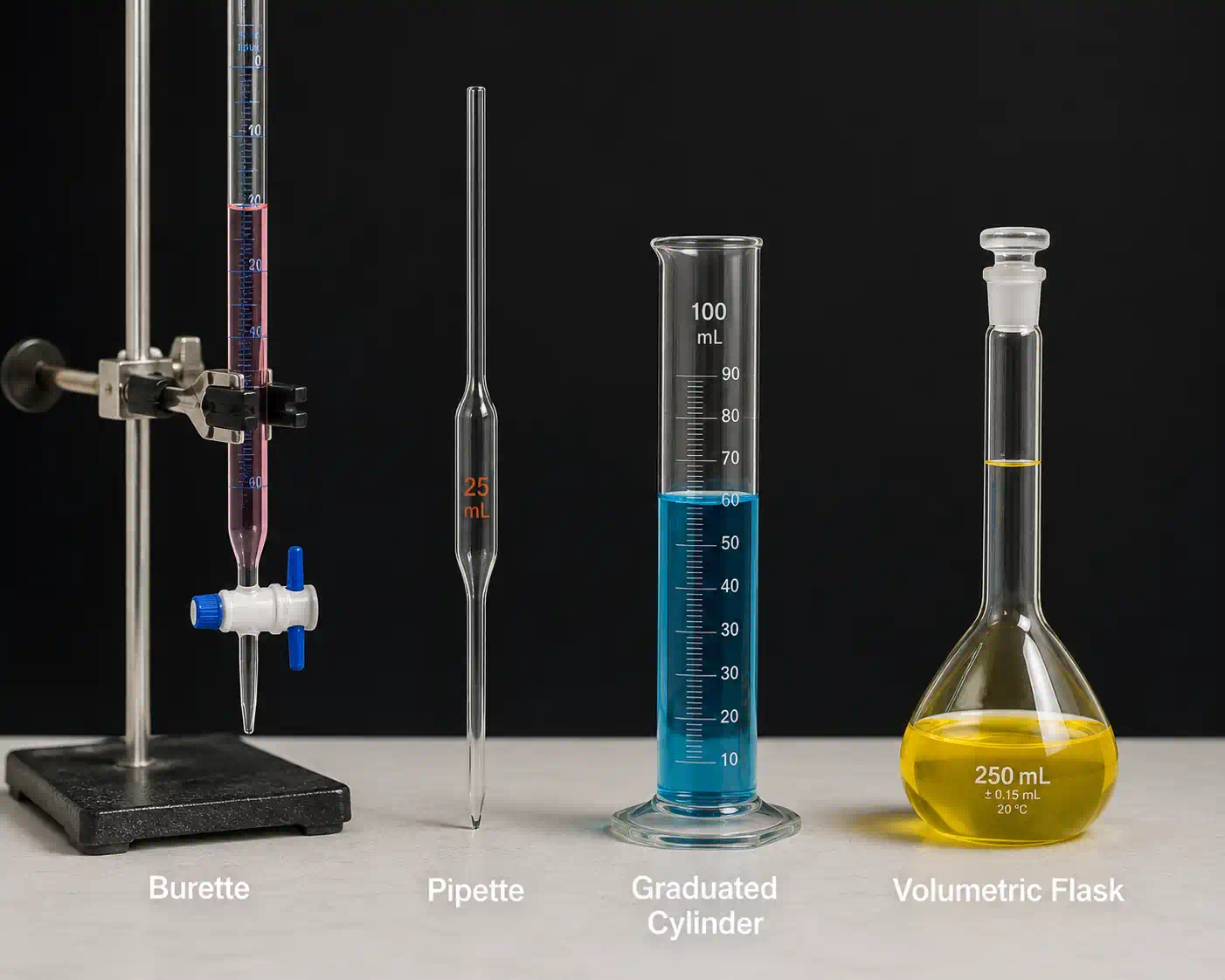
Volume is the amount of space a substance occupies. The SI unit is ,but that's too large for the lab — imagine measuring a reaction in cubic metres!Instead, chemists use:
| Unit | Equivalent | Used for |
|---|---|---|
| 1 litre (L) | 1 dm³ = 1000 cm³ = 1000 mL | Solutions, liquids |
| 1 mL | 1 cm³ | Small volumes |
| 1 m³ | 1000 L | Industrial scale |
Memory trick: 1 dm³ = 1 L. A decimetre is 10 cm, so 1 dm³ = 10 cm × 10 cm × 10 cm = 1000 cm³ = 1 L.
Density — How Tightly Packed Are the Particles?
Density tells you how much mass is packed into a given volume:
- SI unit: kg m⁻³
- Lab unit: g cm⁻³ (same as g mL⁻¹)
A higher density means particles are more tightly packed. This is why a small piece of lead feels much heavier than a large block of foam. Water has density 1.0 g cm⁻³. Gold is 19.3 g cm⁻³ — 19× denser than water. Lead is 11.3 g cm⁻³. This is why gold sinks in mercury (density 13.6 g cm⁻³) while most metals don't!
Temperature — Three Scales, One Quantity
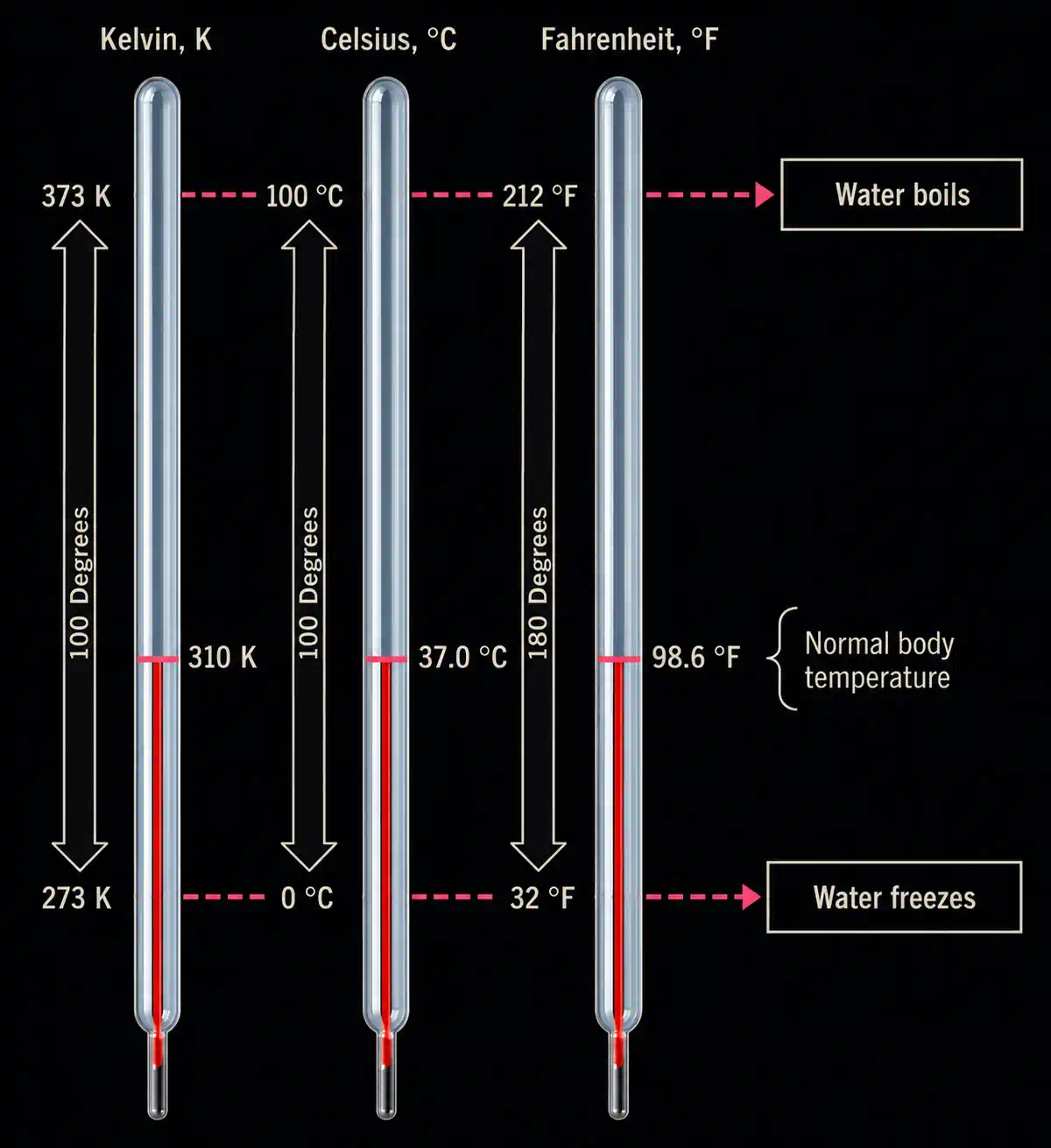
Temperature is measured on three scales — and knowing how to convert between themsaves you in exams and in life:
| Scale | Symbol | Freezing point of water | Boiling point of water |
|---|---|---|---|
| Celsius | °C | 0°C | 100°C |
| Kelvin (SI) | K | 273.15 K | 373.15 K |
| Fahrenheit | °F | 32°F | 212°F |
Conversion formulas:
Why Kelvin in science? Because 0 K is absolute zero — the temperature where all molecular motionstops. You cannot have negative Kelvin. Celsius can go below zero, which causes problems in gas law equations.
Q1.The density of gold is 19.3 g cm⁻³ and mercury is 13.6 g cm⁻³. What will happen if you drop a gold coin into mercury?
On September 23, 1999, NASA’s Mars Climate Orbiter — a $327 million spacecraft — slammed into the Martian atmosphere instead of slipping into orbit around the planet. The craft burned up. The mission was lost.
The post-mortem found one cause, almost embarrassing in its simplicity: two engineering teams had been using different units. Lockheed Martin’s team had calculated thruster forces in pound-seconds (US customary). NASA’s navigation software read those numbers as newton-seconds (SI). The mismatch was never caught.
A factor-of-4.45 error in the most boring of details — a unit suffix — was enough to push a spacecraft into a planet.
Lesson for everything that follows in this chapter: a number without a unit is not a measurement. It’s just noise.
Atoms, Molecules and Compounds
You already know that elements are pure substances made of one type of atom. But atoms don't always float around alone:
- Some elements exist as single atoms: sodium (), copper (), iron ()
- Some exist as diatomic molecules: hydrogen (), oxygen (), nitrogen ()
- Compounds form when atoms of different elements combine in a fixed, definite ratio
Here's the mind-bending part: a compound has completely different properties from its elements. burns. supports combustion. Combine them in a 2:1 ratio and you get — water, used to put out fires. The whole is nothing like its parts.
Physical vs Chemical Properties
Physical Properties
A physical property is something you can observe about a substance without changing what it is chemically. Colour, melting point, boiling point, density, solubility, pressure, volume — these are all physical properties.
When you observe these, the substance doesn’t become something else. Hold a copper wire under different lights and you see the same orange-brown gleam each time. Heat water in a kettle until it boils, then cool it all the way back to ice — at every point along the journey, it is still . The physical state changes from solid to liquid to gas, but the chemical identity stays put.
Melting an ice cube is the classic example. The cube goes from a rigid crystal lattice (solid) to a flowing mass of molecules (liquid), but every single molecule in the puddle on your table is the same it was inside the freezer. The change is physical — the chemistry is unchanged.
Chemical Properties
A chemical property describes a chemical change — a reaction — that a substance can undergo. The instant you observe a chemical property, the substance has become something different.
Take acidity. To check whether a substance is acidic, you have to see whether it reacts with a base, releases ions in water, or accepts a pair of electrons. Each of those tests changes the chemical composition of the substance. The act of observation is the act of transformation.
Other chemical properties include basicity, flammability, toxicity, heat of combustion, pH value, rate of radioactive decay, and chemical stability. Every one of them tells you what a substance turns into under specific conditions.
Rusting of iron is the textbook example. When iron is left exposed to moist air, it reacts with oxygen and water to form a hydrated iron oxide — what we call rust (). The substance you started with (shiny, malleable iron) is now genuinely a different substance (brittle, orange-brown oxide). That’s chemistry, not physics.
Physical vs Chemical Properties
Physical Properties
- Measured or observed **without** changing the chemical identity of the substance
- Examples: colour, odour, melting point, boiling point, density, solubility
- No new substance is formed during measurement
- Usually reversible — you can recover the original substance
- Measured by instruments: thermometer, balance, spectrophotometer
Chemical Properties
- Observed only when a **chemical change** occurs — the substance transforms
- Examples: acidity/basicity, combustibility, reactivity with acids, rusting
- A new substance with different properties is formed
- Usually irreversible — you can't recover the original substance easily
- Examples: iron rusts, wood burns, calcium reacts with water
Physical Properties
- Measured or observed **without** changing the chemical identity of the substance
- Examples: colour, odour, melting point, boiling point, density, solubility
- No new substance is formed during measurement
- Usually reversible — you can recover the original substance
- Measured by instruments: thermometer, balance, spectrophotometer
Chemical Properties
- Observed only when a **chemical change** occurs — the substance transforms
- Examples: acidity/basicity, combustibility, reactivity with acids, rusting
- A new substance with different properties is formed
- Usually irreversible — you can't recover the original substance easily
- Examples: iron rusts, wood burns, calcium reacts with water
Intensive vs Extensive Properties
There’s another way to slice up properties — and this one matters every time you do a calculation in a lab.
A property is either intensive or extensive, depending on whether it changes when you change the amount of substance.
Intensive properties don’t depend on how much you have. Take a 1-gram gold ring and a 100-gram gold biscuit. They have wildly different masses and volumes, but both gleam the same characteristic yellow, both melt at exactly , and both boil at exactly . Colour, melting point, boiling point, density, refractive index, viscosity, pressure, temperature — all intensive. Sample size doesn’t move them.
Extensive properties scale with the amount. Double the sample, double the value. Mass, volume, energy, total moles, heat capacity, length — all extensive.
Why this matters: identification. Because intensive properties stay fixed no matter the sample size, they are exactly what we use to identify a substance. Gold miners used this principle to separate real gold from fool’s gold — the mineral pyrite ().
The two look almost identical: same yellow metallic shine, similar density to the eye. But hold either one in a flame, and the truth comes out immediately. Gold sits there, unchanged. Pyrite sputters, smokes, and releases foul-smelling sulphur dioxide () as the iron sulphide reacts with atmospheric oxygen. The chemical property — reactivity with at flame temperature — is intensive. It doesn’t matter whether you tested a gram or a kilogram; the answer is the same.
That’s the deeper lesson: intensive properties are nature’s fingerprints. Extensive properties are just bookkeeping.
The SI System — One Language for All of Science
Before 1960, scientists in different countries used different unit systems (English vs Metric). Imagine sending a rover to Mars with measurements in feet while the navigation software uses metres. That actually happened — NASA lost a $327 million Mars orbiter in 1999 because one team used imperial units and another used metric.
The International System of Units (SI) — from the French Système International d'Unités — was established in 1960 to fix this. It has 7 base units from which all other units are derived.
Table 1.1 — The Seven SI Base Units
| Physical Quantity | Symbol | SI Unit | Unit Symbol |
|---|---|---|---|
| Length | metre | m | |
| Mass | kilogram | kg | |
| Time | second | s | |
| Electric current | ampere | A | |
| Thermodynamic temperature | kelvin | K | |
| Amount of substance | mole | mol | |
| Luminous intensity | candela | cd |
Table 1.3 — SI Prefixes You'll Use Most Often
| Prefix | Symbol | Multiplier | Example in Chemistry |
|---|---|---|---|
| giga | G | 1 GJ = joules (energy of explosions) | |
| mega | M | 1 MHz = Hz | |
| kilo | k | 1 kg = 1000 g (mass) | |
| deci | d | 1 dm = 0.1 m; 1 dm³ = 1 litre | |
| centi | c | 1 cm = 0.01 m; 1 cm³ = 1 mL | |
| milli | m | 1 mg = g; 1 mL = L | |
| micro | 1 g = g (drug dosing) | ||
| nano | n | 1 nm = m (wavelength of visible light: 400–700 nm) | |
| pico | p | 1 pm = m (bond lengths in molecules) |
Mass and Weight — Not the Same Thing
Mass is the amount of matter in a substance — it never changes.Take a 5 kg bag of rice to the Moon and it's still 5 kg.
Weight is the force gravity exerts on that mass ().That same rice bag on the Moon weighs only about 0.8 kg-force — the Moon's gravity is 1/6th of Earth's.
In everyday life we use "weight" loosely to mean mass. In chemistry and physics, always be precise:
- SI unit of mass: kilogram (kg)
- Lab unit: gram (g), where 1 kg = 1000 g
- Measured using: an analytical balance — accurate to 0.0001 g (0.1 mg)
Volume — How Much Space Does It Occupy?
Volume is the amount of space a substance occupies. The SI unit is ,but that's too large for the lab — imagine measuring a reaction in cubic metres!Instead, chemists use:
| Unit | Equivalent | Used for |
|---|---|---|
| 1 litre (L) | 1 dm³ = 1000 cm³ = 1000 mL | Solutions, liquids |
| 1 mL | 1 cm³ | Small volumes |
| 1 m³ | 1000 L | Industrial scale |
Memory trick: 1 dm³ = 1 L. A decimetre is 10 cm, so 1 dm³ = 10 cm × 10 cm × 10 cm = 1000 cm³ = 1 L.
Density — How Tightly Packed Are the Particles?
Density tells you how much mass is packed into a given volume:
- SI unit: kg m⁻³
- Lab unit: g cm⁻³ (same as g mL⁻¹)
A higher density means particles are more tightly packed. This is why a small piece of lead feels much heavier than a large block of foam. Water has density 1.0 g cm⁻³. Gold is 19.3 g cm⁻³ — 19× denser than water. Lead is 11.3 g cm⁻³. This is why gold sinks in mercury (density 13.6 g cm⁻³) while most metals don't!
Temperature — Three Scales, One Quantity
Temperature is measured on three scales — and knowing how to convert between themsaves you in exams and in life:
| Scale | Symbol | Freezing point of water | Boiling point of water |
|---|---|---|---|
| Celsius | °C | 0°C | 100°C |
| Kelvin (SI) | K | 273.15 K | 373.15 K |
| Fahrenheit | °F | 32°F | 212°F |
Conversion formulas:
Why Kelvin in science? Because 0 K is absolute zero — the temperature where all molecular motionstops. You cannot have negative Kelvin. Celsius can go below zero, which causes problems in gas law equations.
Q1.The density of gold is 19.3 g cm⁻³ and mercury is 13.6 g cm⁻³. What will happen if you drop a gold coin into mercury?