Describe a Garden, Choose a Garden
Paint a garden in words — and argue flower versus vegetable
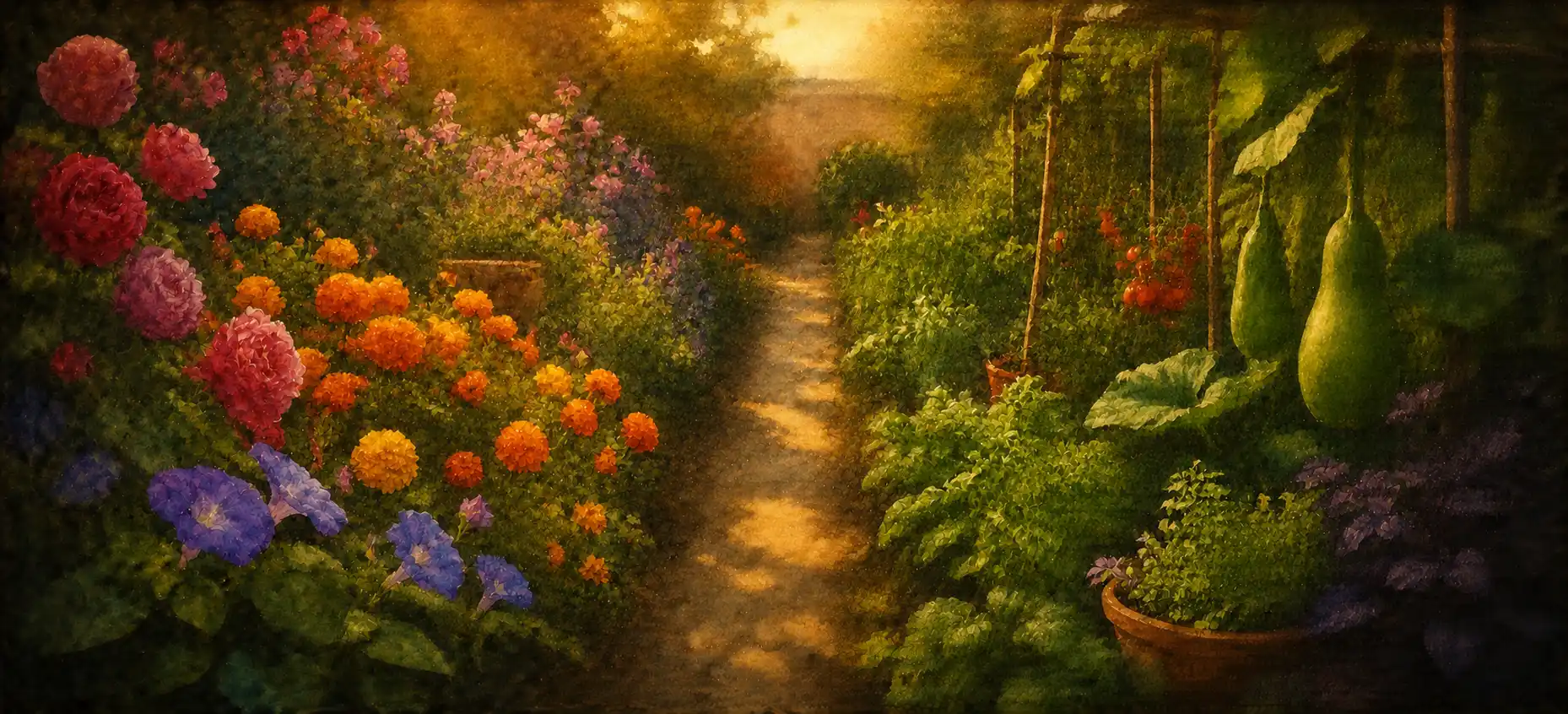
First, write your own 'canvas of soil' — a vivid description of a garden, paying attention to colour and light. Then take a side: if you had a home garden, would it be flowers or vegetables?
Four words from this poem-section. Tap to hear; read aloud twice.
Write a descriptive piece of two to three paragraphs about a garden you have visited. Focus on how shades of blue, red, and green interact and create contrast. Pay attention to the texture of petals, the varying greens of leaves, and how light changes the colours.
- ▸Make colours INTERACT (one cooling another, one framing the rest) — don't just list them.
- ▸Use precise shade-words: scarlet, crimson, cobalt, jade — not just 'red, blue, green'.
- ▸Show how LIGHT changes the colours from morning to noon — light is your real subject.
- ▸Include texture (smooth, rough, papery) — a garden is felt as well as seen.
A 19th-century garden in fourteen lines
Kaveri pairs this poem with a famous sonnet, A Sea of Foliage Girds Our Garden Round by Toru Dutt. Where Canvas of Soil is short and simple, Toru Dutt's poem is rich and grand — 'a sea of foliage,' light-green tamarinds, grey palms 'like pillars,' and seemul flowers 'Red-red, and startling like a trumpet's sound.' It ends gazing at the moonlit garden 'as on a primeval Eden, in amaze.' Two poems, two centuries apart, both finding a whole world of art inside a garden. You'll meet Toru Dutt properly on the next page.
Q1.In a garden description, the BEST way to handle colour is to:
First, write your own 'canvas of soil' — a vivid description of a garden, paying attention to colour and light. Then take a side: if you had a home garden, would it be flowers or vegetables?
Four words from this poem-section. Tap to hear; read aloud twice.
Write a descriptive piece of two to three paragraphs about a garden you have visited. Focus on how shades of blue, red, and green interact and create contrast. Pay attention to the texture of petals, the varying greens of leaves, and how light changes the colours.
- ▸Make colours INTERACT (one cooling another, one framing the rest) — don't just list them.
- ▸Use precise shade-words: scarlet, crimson, cobalt, jade — not just 'red, blue, green'.
- ▸Show how LIGHT changes the colours from morning to noon — light is your real subject.
- ▸Include texture (smooth, rough, papery) — a garden is felt as well as seen.
A 19th-century garden in fourteen lines
Kaveri pairs this poem with a famous sonnet, A Sea of Foliage Girds Our Garden Round by Toru Dutt. Where Canvas of Soil is short and simple, Toru Dutt's poem is rich and grand — 'a sea of foliage,' light-green tamarinds, grey palms 'like pillars,' and seemul flowers 'Red-red, and startling like a trumpet's sound.' It ends gazing at the moonlit garden 'as on a primeval Eden, in amaze.' Two poems, two centuries apart, both finding a whole world of art inside a garden. You'll meet Toru Dutt properly on the next page.
Q1.In a garden description, the BEST way to handle colour is to: