Part II — A Different Fan for Every Region
Rajasthan to Bengal, the map drawn in bamboo, cloth, and brass
Part II — The craft, state by state
Here the article becomes a journey across India. Notice how each fan's materials and design tell you exactly where it came from — the structure of each fan, as the writer says, 'reflects the cultural core of the region that crafts it.'
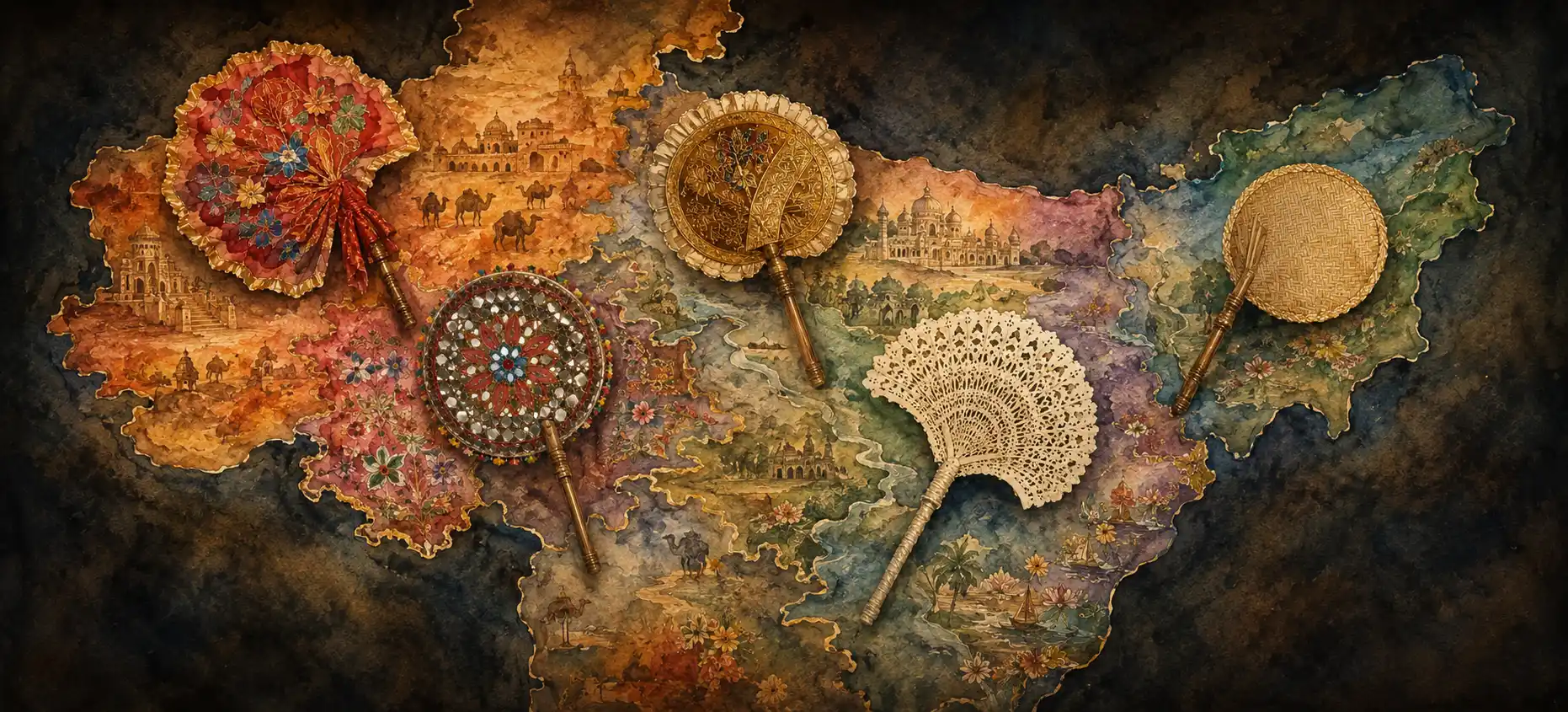
In modern times, the use of pankhas has been restricted to decorative purposes, and they have become traditional craft items in India. The structure of each fan reflects the cultural core of the region that crafts it. For instance, the hand fan of Rajasthan is an antique pankha made of pieces of fabric in different shapes and patterns sewn onto another cloth with the use of needlework. Furthermore, the hand fan of Rajasthan differs in its use of glittering ornate and gold threadwork. In Rajasthan, temple hand fans are popular too. These are made by brass and have a long handle. The painted hand fan, a cardboard pankha featuring various images, is usually offered to gods.
The state of Gujarat has its own indigenous take on pankhas. These hand fans are elegant pure cotton-based fans with mirror work. The beads hand fan is covered with colourful beads and has a silver handle. Gujarat is the centre for bead craft in India and these pankhas are commonly used as wall decorations. Kutch is recognised for its hand-stitched leather hand fans decorated with thread and wool at its . Gujarat's industrious home-based women workers have worked tirelessly in the handicraft of pankha-making to produce embroidered hand fans with traditional mirror work and cross-stitch embroidery in different shapes and sizes.
Artisans in Bengal make delicate pankhas from the beautiful milky-white spongy centre of the . The palm leaf hand fans are locally referred to as Tal Patar Pankha. They are easy to carry and are kept as an article of possession in Bengali households. Other states in India have their own variations of fans as well. The Phadh hand fans of Uttar Pradesh are with pure gold, silver , silk, and satin frills. The large palm leaf fans of Odisha as well as Bihar's colourful and sturdy bamboo hand fans, are all recognised across India due to their and rarity.
Many tribes in India have adopted this handicraft to make their own versions of the handheld fan. Materials such as grass and metal are into the fans using bamboo sticks and grass. Cane and palm leaves are used, with silk and brass being reserved for antique pieces of these hand fans. The use of geometrical patterns and the white ink and red background combinations have helped the tribes create multiple beautifully designed pankhas.
The same object — a hand fan — is made of leather in Kutch, sola pith in Bengal, gold zari in UP, and bamboo in Bihar. Why would the same need (moving air) produce such wildly different objects across India? What does each fan's material actually tell you about its region?
Take a moment to form your answer before reading further.
Q1.Bengal's delicate white pankhas are made from:
Part II — The craft, state by state
Here the article becomes a journey across India. Notice how each fan's materials and design tell you exactly where it came from — the structure of each fan, as the writer says, 'reflects the cultural core of the region that crafts it.'
In modern times, the use of pankhas has been restricted to decorative purposes, and they have become traditional craft items in India. The structure of each fan reflects the cultural core of the region that crafts it. For instance, the hand fan of Rajasthan is an antique pankha made of pieces of fabric in different shapes and patterns sewn onto another cloth with the use of needlework. Furthermore, the hand fan of Rajasthan differs in its use of glittering ornate and gold threadwork. In Rajasthan, temple hand fans are popular too. These are made by brass and have a long handle. The painted hand fan, a cardboard pankha featuring various images, is usually offered to gods.
The state of Gujarat has its own indigenous take on pankhas. These hand fans are elegant pure cotton-based fans with mirror work. The beads hand fan is covered with colourful beads and has a silver handle. Gujarat is the centre for bead craft in India and these pankhas are commonly used as wall decorations. Kutch is recognised for its hand-stitched leather hand fans decorated with thread and wool at its . Gujarat's industrious home-based women workers have worked tirelessly in the handicraft of pankha-making to produce embroidered hand fans with traditional mirror work and cross-stitch embroidery in different shapes and sizes.
Artisans in Bengal make delicate pankhas from the beautiful milky-white spongy centre of the . The palm leaf hand fans are locally referred to as Tal Patar Pankha. They are easy to carry and are kept as an article of possession in Bengali households. Other states in India have their own variations of fans as well. The Phadh hand fans of Uttar Pradesh are with pure gold, silver , silk, and satin frills. The large palm leaf fans of Odisha as well as Bihar's colourful and sturdy bamboo hand fans, are all recognised across India due to their and rarity.
Many tribes in India have adopted this handicraft to make their own versions of the handheld fan. Materials such as grass and metal are into the fans using bamboo sticks and grass. Cane and palm leaves are used, with silk and brass being reserved for antique pieces of these hand fans. The use of geometrical patterns and the white ink and red background combinations have helped the tribes create multiple beautifully designed pankhas.
The same object — a hand fan — is made of leather in Kutch, sola pith in Bengal, gold zari in UP, and bamboo in Bihar. Why would the same need (moving air) produce such wildly different objects across India? What does each fan's material actually tell you about its region?
Take a moment to form your answer before reading further.
Q1.Bengal's delicate white pankhas are made from: