Part I — Where the Pankha Comes From
From temple deities to royal courts to trade routes
Part I — A craft older than memory
Before you read about the many kinds of pankha, learn where the object itself comes from — its name, its age, and the people it once served.
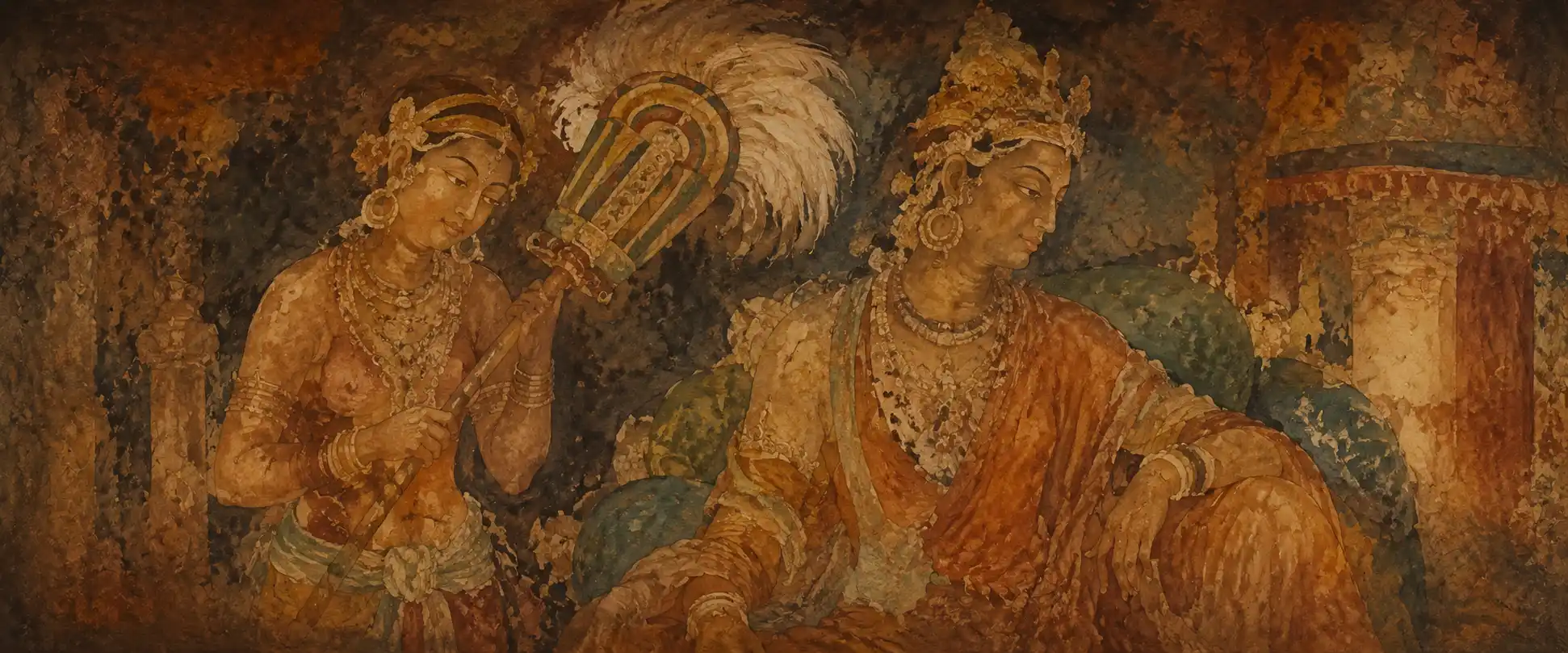
The word punkha or pankha from the word 'pankh', which means feather of a bird. Pankha is used to refer to all fans, whereas the word pankhi a small fan used in ancient India. Evidence of the existence and use of pankhi in India can be found in Buddhist wall paintings at Ajanta. These wall paintings date back to the 2nd century CE. Other of the punkha can be found in embroidery work, sculptures, and carvings. In ancient times, pankhas were used in temples to fan . They were also used in royal courts to fan kings. Pankhas varied in size from a tiny two inch one to large ones requiring a person's full arm strength to move them.
Over time, pankhas became significant cultural goods distributed through . They were considered and stylish. Although there was in their use across India, different villages and towns developed their own varieties of traditional pankhas. Each place developed pankhas with materials or a variety of intricate designs, that set them apart from one another. Bamboo, cane, palm leaf, silk, brass, leather, and silver pankhas, with decorative beads and stones were used depending on geographies, cultures, and traditional rituals.
Ancient rock-cut Buddhist caves in Maharashtra, famous for wall paintings from around the 2nd century BCE–6th century CE.
Pause and check.
In ancient times, what were pankhas used for (besides cooling)?
Why did different villages and towns each develop their OWN kind of pankha?
The article says pankhas were 'considered exotic and stylish.' Is that statement a fact or an opinion? How can you tell — and why does it matter when you're reading informational writing?
Take a moment to form your answer before reading further.
Q1.Which of these is a FACT (something that can be proven)?
Part I — A craft older than memory
Before you read about the many kinds of pankha, learn where the object itself comes from — its name, its age, and the people it once served.
The word punkha or pankha from the word 'pankh', which means feather of a bird. Pankha is used to refer to all fans, whereas the word pankhi a small fan used in ancient India. Evidence of the existence and use of pankhi in India can be found in Buddhist wall paintings at Ajanta. These wall paintings date back to the 2nd century CE. Other of the punkha can be found in embroidery work, sculptures, and carvings. In ancient times, pankhas were used in temples to fan . They were also used in royal courts to fan kings. Pankhas varied in size from a tiny two inch one to large ones requiring a person's full arm strength to move them.
Over time, pankhas became significant cultural goods distributed through . They were considered and stylish. Although there was in their use across India, different villages and towns developed their own varieties of traditional pankhas. Each place developed pankhas with materials or a variety of intricate designs, that set them apart from one another. Bamboo, cane, palm leaf, silk, brass, leather, and silver pankhas, with decorative beads and stones were used depending on geographies, cultures, and traditional rituals.
Ancient rock-cut Buddhist caves in Maharashtra, famous for wall paintings from around the 2nd century BCE–6th century CE.
Pause and check.
In ancient times, what were pankhas used for (besides cooling)?
Why did different villages and towns each develop their OWN kind of pankha?
The article says pankhas were 'considered exotic and stylish.' Is that statement a fact or an opinion? How can you tell — and why does it matter when you're reading informational writing?
Take a moment to form your answer before reading further.
Q1.Which of these is a FACT (something that can be proven)?