A hydrocarbon 'X' with formula C6H8 uses two moles of H2 on catalytic hydrogenation of its one mole. On ozonolysis, 'X'…
Hydrocarbons · Class 11 · JEE Main Previous Year Question
A hydrocarbon 'X' with formula uses two moles of on catalytic hydrogenation of its one mole. On ozonolysis, 'X' yields two moles of methane dicarbaldehyde (malonaldehyde). The hydrocarbon 'X' is:
- a
hexa-1,3,5-triene
- b
1-methylcyclopenta-1,4-diene
- c
cyclohexa-1,3-diene
- d✓
cyclohexa-1,4-diene
cyclohexa-1,4-diene
Step 1: Analyze the given information
- Formula: → DoU =
- Absorbs 2 mol → has 2 double bonds (accounts for 2 DoU)
- Remaining 1 DoU = 1 ring (cyclic compound)
- Ozonolysis gives 2 moles of malonaldehyde ()
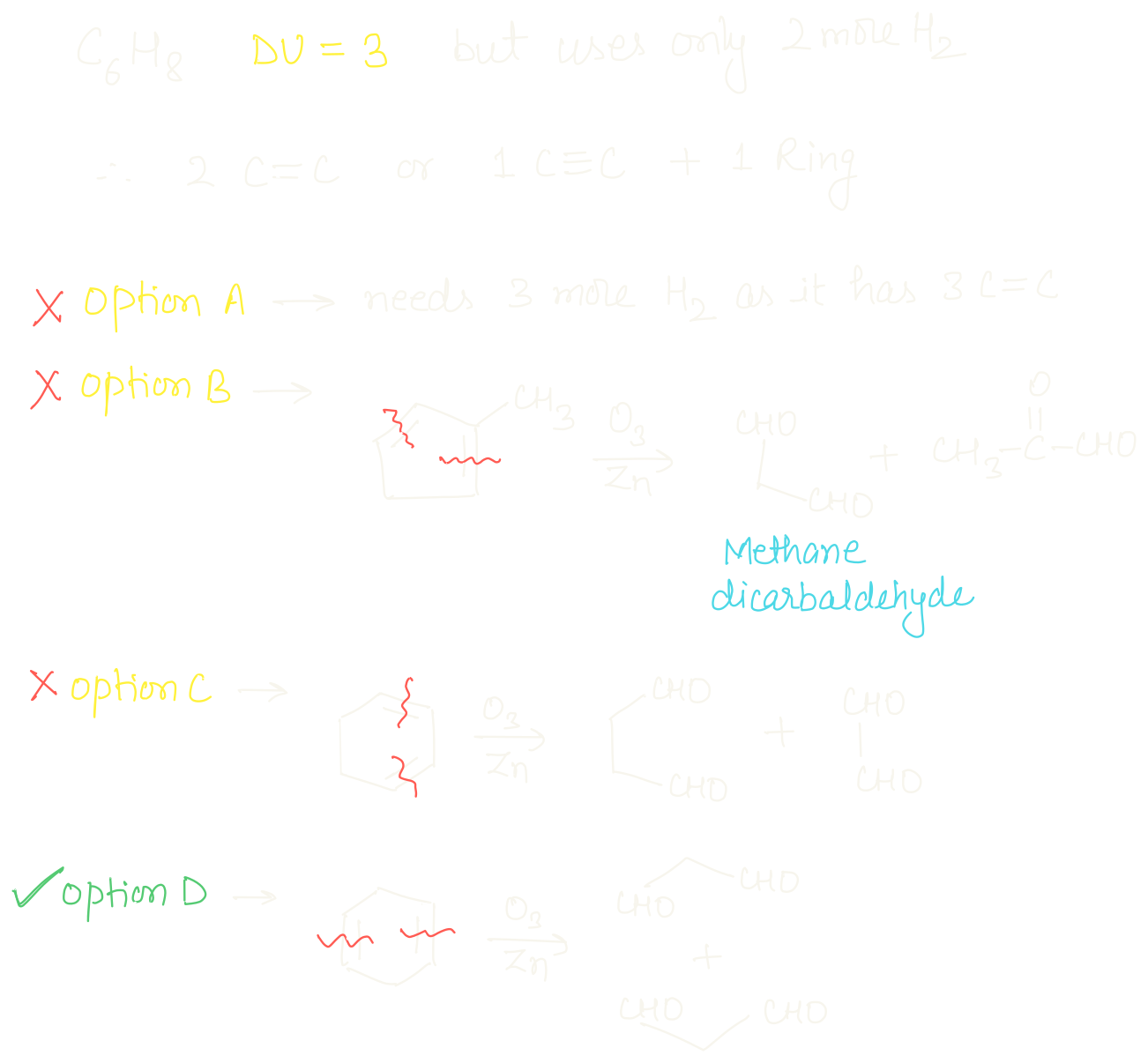 Answer: Option (d) — cyclohexa-1,4-diene
Key Points to Remember:
- Ozonolysis of cyclic dienes opens the ring at both bonds
- Count carbons: ozonolysis products must sum to starting material carbons
- Malonaldehyde from cyclohexa-1,4-diene: positions 1,4 give symmetric cleavage
Practice this question with progress tracking
Want timed practice with adaptive difficulty? Solve this question (and hundreds more from Hydrocarbons) inside The Crucible, our adaptive practice platform.
More JEE Main Hydrocarbons PYQs
The number of optically active products obtained from the complete ozonolysis of the given compound is:
Identify product [A], [B] and [C] in the following reaction sequence:
Consider the given chemical reaction: Product "A" is:
The two products formed in above reaction are:
Consider the following reactions: {({C7H14})}{{'A'}} {{ozonolysis}} {'B'} + {'C'}