The two products formed in above reaction are:
Hydrocarbons · Class 11 · JEE Main Previous Year Question
 The two products formed in above reaction are:
- a✓
Butanoic acid and acetic acid
- b
Butanal and acetic acid
- c
Butanal and acetaldehyde
- d
Butanoic acid and acetaldehyde
Butanoic acid and acetic acid
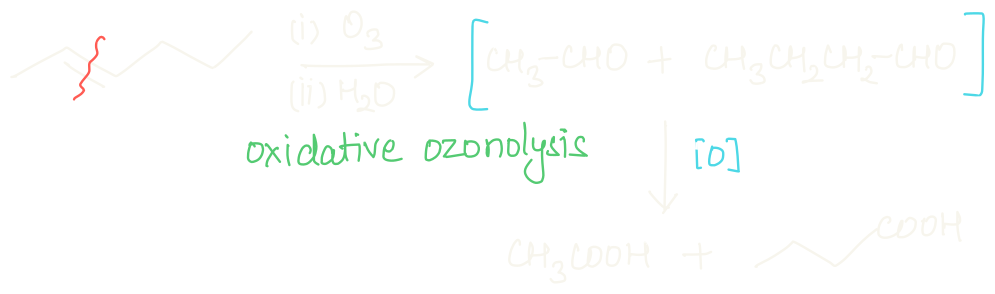 Step 1: Draw 2-hexene
2-Hexene:
The double bond is between C2 and C3.
Step 2: Apply ozonolysis conditions
The reagents are: (i) (ii)
workup is oxidative (no added) → this is oxidative ozonolysis. Oxidative workup conditions ( or ) convert:
- → (carboxylic acid)
- → (ketone, if no H on carbon)
Step 3: Identify the products
Cleavage of at C2=C3:
- C2 fragment () → (acetic acid)
- C3 fragment () → (butanoic acid)
Answer: Option (a) — Butanoic acid and acetic acid
Key Points to Remember:
- Oxidative ozonolysis ( + or ): →
- Reductive ozonolysis ( + ): →
- 2-Hexene cleaves between C2 and C3 giving acid (acetic) + acid (butanoic)
Practice this question with progress tracking
Want timed practice with adaptive difficulty? Solve this question (and hundreds more from Hydrocarbons) inside The Crucible, our adaptive practice platform.
More JEE Main Hydrocarbons PYQs
The number of optically active products obtained from the complete ozonolysis of the given compound is:
Identify product [A], [B] and [C] in the following reaction sequence:
Consider the given chemical reaction: Product "A" is:
A hydrocarbon 'X' with formula C6H8 uses two moles of H2 on catalytic hydrogenation of its one mole. On ozonolysis, 'X' yields two moles of methane dicarbaldehyde (malonaldehyde). The hydrocarbon 'X'…
Consider the following reactions: {({C7H14})}{{'A'}} {{ozonolysis}} {'B'} + {'C'}