Consider the following reactions: {({C7H14})}{{'A'}} {{ozonolysis}} {'B'} + {'C'}
Hydrocarbons · Class 11 · JEE Main Previous Year Question
Consider the following reactions:

- a

- b

- c

- d✓

A has molecular formula (MW = 98), which means DoU = 1 (one double bond). Ozonolysis gives B + C. The tests applied to B and C are:
- B gives iodoform test (positive) → B contains group (methyl ketone or acetaldehyde)
- C gives silver mirror test (positive) → C is an aldehyde
Step 2: Identify B and C From the reactions shown:
- B gives iodoform → B is a methyl ketone:
- C gives silver mirror → C is an aldehyde:
For with 1 double bond:
B + C must together have 7 carbons.
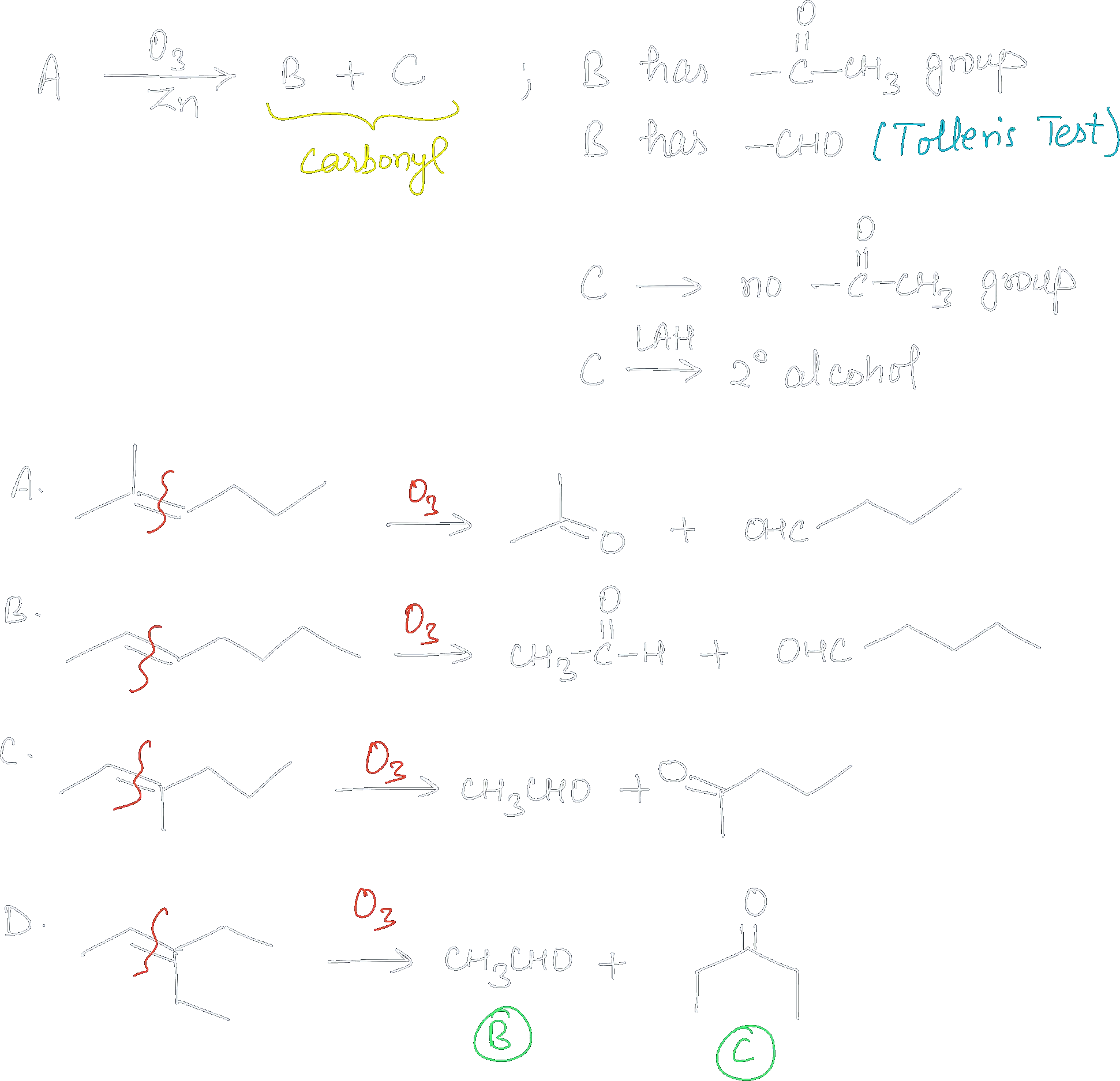 This is 3-methylhex-3-ene → molecular formula ✓
Answer: Option (d)
Key Points to Remember:
- Iodoform test: detects group (methyl ketones + ethanal)
- Silver mirror test: detects aldehydes ()
- Reconstruct alkene by replacing of both fragments with
Practice this question with progress tracking
Want timed practice with adaptive difficulty? Solve this question (and hundreds more from Hydrocarbons) inside The Crucible, our adaptive practice platform.
More JEE Main Hydrocarbons PYQs
The number of optically active products obtained from the complete ozonolysis of the given compound is:
Identify product [A], [B] and [C] in the following reaction sequence:
Consider the given chemical reaction: Product "A" is:
A hydrocarbon 'X' with formula C6H8 uses two moles of H2 on catalytic hydrogenation of its one mole. On ozonolysis, 'X' yields two moles of methane dicarbaldehyde (malonaldehyde). The hydrocarbon 'X'…
The two products formed in above reaction are: