Which of these factors does not govern the stability of a conformation in acyclic compounds?
Hydrocarbons · Class 11 · JEE Main Previous Year Question
Which of these factors does not govern the stability of a conformation in acyclic compounds?
- a
Torsional strain
- b✓
Angle strain
- c
Steric interactions
- d
Electrostatic forces of interaction
Angle strain
Step 1: Understand what governs conformational stability in acyclic compounds For open-chain (acyclic) compounds, the main factors affecting conformational stability are:
- Torsional strain — energy due to eclipsing of bonds; staggered conformations have less torsional strain
- Steric interactions — repulsion between bulky groups when they are close in space (e.g., gauche interactions)
- Electrostatic forces — attractive or repulsive interactions between polar groups
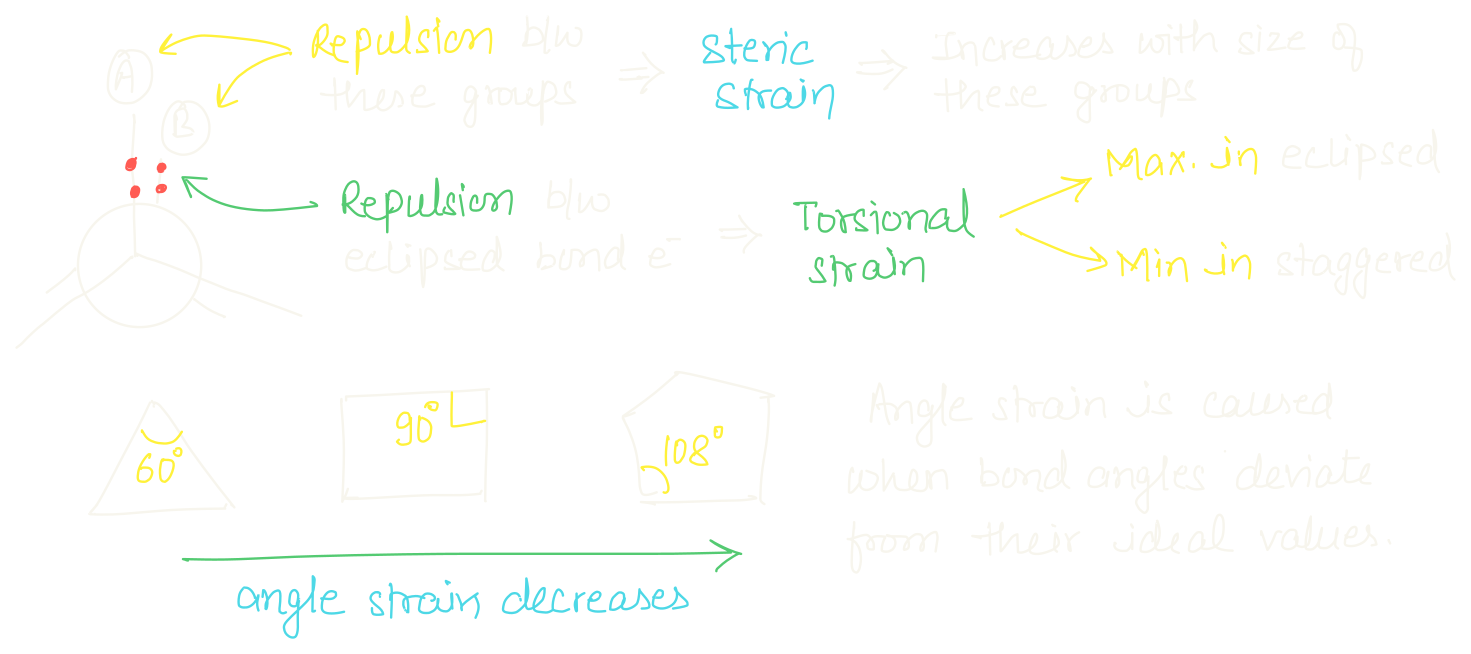 Step 2: Evaluate angle strain
Angle strain arises when bond angles deviate from their ideal values (e.g., 109.5° for C). This is a property of ring systems (cyclopropane, cyclobutane), NOT of acyclic compounds.
Step 2: Evaluate angle strain
Angle strain arises when bond angles deviate from their ideal values (e.g., 109.5° for C). This is a property of ring systems (cyclopropane, cyclobutane), NOT of acyclic compounds.
In acyclic compounds, bond angles freely adopt their optimal values — there is no angle strain in conformational analysis of open-chain molecules.
Step 3: Identify the answer The factor that does NOT govern conformational stability in acyclic compounds is Angle strain → Option (b)
Key Points to Remember:
- Angle strain = a ring property (cycloalkanes), NOT a conformational property
- Torsional strain, steric interactions, and electrostatics all affect acyclic conformations
- Cyclopropane has maximum angle strain (60° vs ideal 109.5°)
Practice this question with progress tracking
Want timed practice with adaptive difficulty? Solve this question (and hundreds more from Hydrocarbons) inside The Crucible, our adaptive practice platform.
More JEE Main Hydrocarbons PYQs
The alkane from below having two secondary hydrogens is:
The incorrect statement regarding ethyne is:
In the following reaction, 'X' is:
Arrange the following conformational isomers of n-butane in order of their increasing potential energy:
Identify A in the given chemical reaction.