Read Closely, Answer Carefully
Kaveri's comprehension questions — with model answers to compare against your own
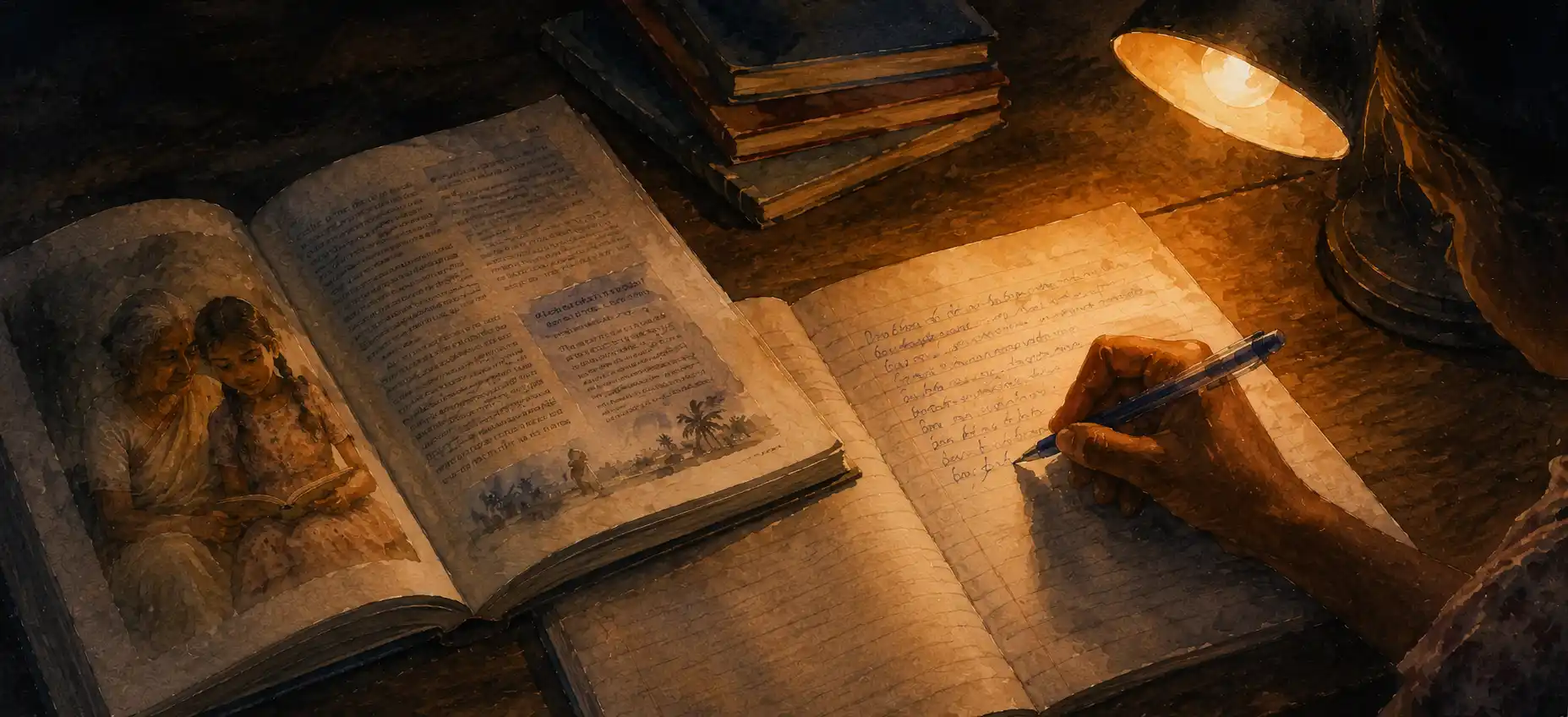
Read each question. Attempt the answer in your own words first — out loud, in your notebook, or just in your head. Only then tap Show solution to compare. The model is one of many good answers; yours might be just as strong if it is rooted in the text.
First — Kaveri's true/false warm-up. State whether each sentence is true or false.
T/F: The grandmother wanted to learn the Kannada alphabet to gain independence.
T/F: The grandmother asked someone else in the village to read Kashi Yatre to her while the narrator was away.
T/F: The narrator was the grandmother's first teacher and taught her how to read Kannada.
T/F: The grandmother believed that there was no age limit for learning.
T/F: The grandmother touched the narrator's feet as a mark of respect for her as a teacher.
T/F: The narrator was disappointed with the progress her grandmother made in learning to read.
Working with the Text — Kaveri's seven questions
Why do you think the grandmother felt embarrassed to ask someone else to read to her while the narrator was away?
Why does the narrator initially laugh at her grandmother's determination to learn at the age of sixty-two?
What significance does the story of Kashi Yatre have in both the grandmother's life and the story?
What does the grandmother's desire to learn the Kannada alphabet reflect about her?
What lessons can we infer from the grandmother's action of touching the narrator's feet?
What does the following line tell us about the broader theme of the story?
'For a good cause if you are determined, you can overcome any obstacle.'
How effectively does the story highlight the value of education in supporting personal independence?
Across all seven questions above, Sudha Murty's craft becomes visible. Which one writing choice by Sudha Murty does the most work in this story — and why? (No single correct answer; defend your pick from the text.)
Take a moment to form your answer before reading further.
Q1.What is the narrator's reason for laughing when her grandmother first announces her plan?
Read each question. Attempt the answer in your own words first — out loud, in your notebook, or just in your head. Only then tap Show solution to compare. The model is one of many good answers; yours might be just as strong if it is rooted in the text.
First — Kaveri's true/false warm-up. State whether each sentence is true or false.
T/F: The grandmother wanted to learn the Kannada alphabet to gain independence.
T/F: The grandmother asked someone else in the village to read Kashi Yatre to her while the narrator was away.
T/F: The narrator was the grandmother's first teacher and taught her how to read Kannada.
T/F: The grandmother believed that there was no age limit for learning.
T/F: The grandmother touched the narrator's feet as a mark of respect for her as a teacher.
T/F: The narrator was disappointed with the progress her grandmother made in learning to read.
Working with the Text — Kaveri's seven questions
Why do you think the grandmother felt embarrassed to ask someone else to read to her while the narrator was away?
Why does the narrator initially laugh at her grandmother's determination to learn at the age of sixty-two?
What significance does the story of Kashi Yatre have in both the grandmother's life and the story?
What does the grandmother's desire to learn the Kannada alphabet reflect about her?
What lessons can we infer from the grandmother's action of touching the narrator's feet?
What does the following line tell us about the broader theme of the story?
'For a good cause if you are determined, you can overcome any obstacle.'
How effectively does the story highlight the value of education in supporting personal independence?
Across all seven questions above, Sudha Murty's craft becomes visible. Which one writing choice by Sudha Murty does the most work in this story — and why? (No single correct answer; defend your pick from the text.)
Take a moment to form your answer before reading further.
Q1.What is the narrator's reason for laughing when her grandmother first announces her plan?