Before You Read: The Work of Hands
Who makes the things we use — and what do we owe them?
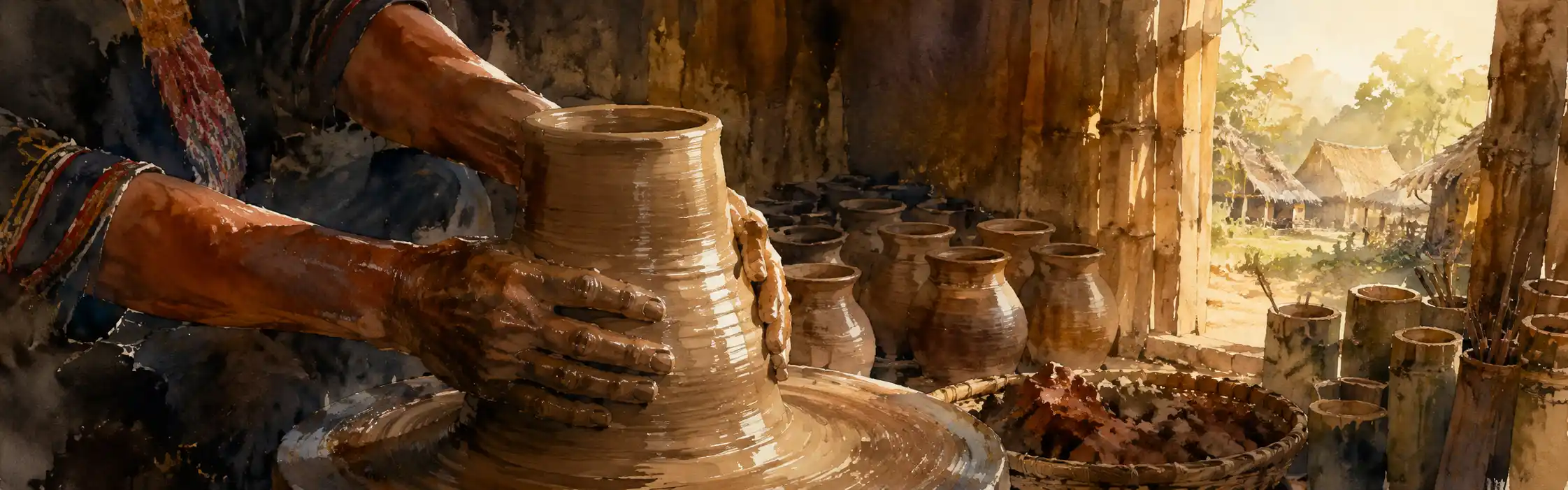
Look around the room you are in. Almost everything you can see — the cup, the cloth, the chair, the walls — was made by someone's hands or by a machine someone built. Pick one handmade thing in your life. Who made it? Do you know their name? What would be lost if no one knew how to make it any more?
Think of a clay matka, a handwoven shawl, a wooden stool, your grandmother's pickle — something not made in a factory.
The Pot Maker was written by Temsula Ao, one of the most important writers from Nagaland, in India's north-east. She wrote in English about the lives, crafts, and memory of the Ao Naga people. In her hills, pottery was traditionally made without a potter's wheel — shaped entirely by hand, beaten into form with a wooden spatula. The skill passed from mother to daughter, generation after generation. This story asks what happens when that chain is about to break.
A vocation is more than a job. It is skilled work that becomes part of who you are — pottery, weaving, carpentry, cooking, farming. In this story you'll meet Sentila, a girl who wants nothing more than to be a pot maker like her mother and grandmother — and Arenla, her mother, who would rather she did anything else. Before you read, here are the words the story will hand you.
Q1.Who wrote The Pot Maker?
Look around the room you are in. Almost everything you can see — the cup, the cloth, the chair, the walls — was made by someone's hands or by a machine someone built. Pick one handmade thing in your life. Who made it? Do you know their name? What would be lost if no one knew how to make it any more?
Think of a clay matka, a handwoven shawl, a wooden stool, your grandmother's pickle — something not made in a factory.
The Pot Maker was written by Temsula Ao, one of the most important writers from Nagaland, in India's north-east. She wrote in English about the lives, crafts, and memory of the Ao Naga people. In her hills, pottery was traditionally made without a potter's wheel — shaped entirely by hand, beaten into form with a wooden spatula. The skill passed from mother to daughter, generation after generation. This story asks what happens when that chain is about to break.
A vocation is more than a job. It is skilled work that becomes part of who you are — pottery, weaving, carpentry, cooking, farming. In this story you'll meet Sentila, a girl who wants nothing more than to be a pot maker like her mother and grandmother — and Arenla, her mother, who would rather she did anything else. Before you read, here are the words the story will hand you.
Q1.Who wrote The Pot Maker?