How Does Scientific Knowledge Grow?
From observation to theory
On the Purifying Power of Knowledge
न हि ज्ञानेन सदृशं पवित्रमिह विद्यते |
तत्स्वयं योगसंसिद्धः कालेनात्मनि विन्दति ||
ज्ञान के समान इस संसार में कोई पवित्र करने वाला नहीं है। योग में सिद्ध हुआ व्यक्ति कालान्तर में इसे अपने भीतर ही प्राप्त कर लेता है।
"There is nothing in this world as purifying as knowledge. One who is perfected in the yoga of action finds that knowledge within themselves, in time."
Science is humanity's most disciplined method of generating that knowledge — not by any single mind alone, but through a slow, self-correcting conversation spanning centuries.
The Opening Question
Scientists once believed the atom was indivisible. Then they believed electrons orbited the nucleus like planets orbit the sun. Both were wrong — and both were replaced.
It Always Starts with Something That Doesn't Fit
In science, knowledge never begins with a grand theory handed down complete. It begins with a crack — something small and strange that refuses to fit the existing explanation.
In the early 1800s, chemists believed the atom was the smallest possible unit of matter — indivisible, indestructible. Then J.J. Thomson passed electricity through a gas tube and noticed particles smaller than atoms shooting across it. The atom had parts. The supposedly indivisible was divisible.
This is how scientific progress actually works. Not through genius revelations delivered by solitary geniuses — but through anomalies. Strange results. Experiments that refuse to behave the way the theory predicts.
When a scientist notices something that doesn't fit and refuses to dismiss it as experimental error, the engine of knowledge starts running. The anomaly is not a problem. It is an invitation.
India's ancient scientists understood this deeply. Acharya Kanad, centuries before Thomson, reasoned from first principles: if you divide matter repeatedly, you must eventually reach a particle so small it can no longer be divided — the Parmanu (परमाणु). Different in method from modern particle physics, identical in spirit: there is always something more to discover beneath the surface of what we already know.
The Cycle: From Observation to Understanding
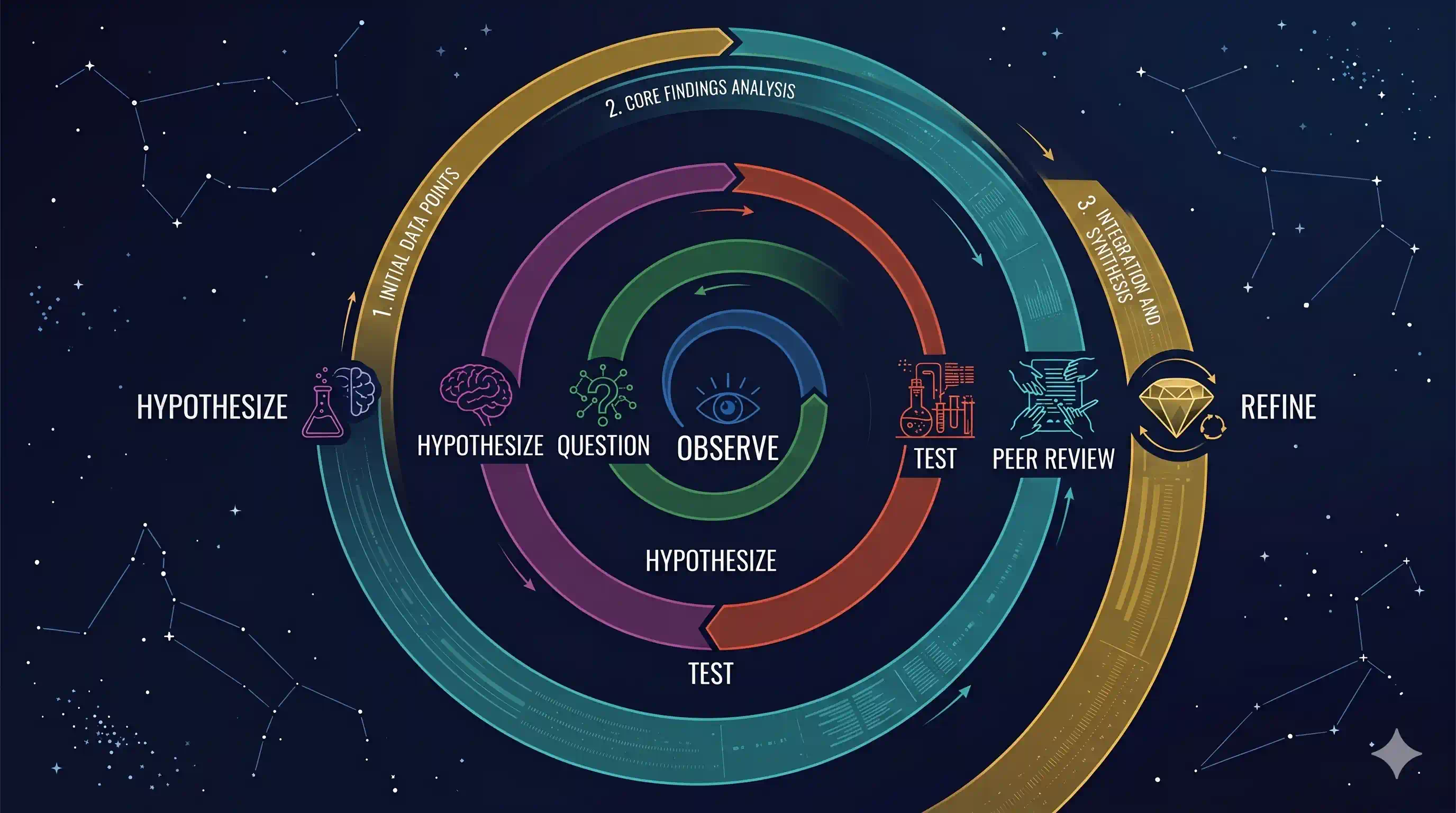
Scientific knowledge grows through a cycle — not a straight line, and not always a clean circle either, but a spiral that returns to the same kinds of questions with greater depth each time.
Observe — Something surprising happens. A measurement doesn't match the prediction. A plant grows in an unexpected direction. A compound behaves differently under heat.
Question — Why? What if the current explanation is incomplete or wrong?
Hypothesize — A testable answer is proposed. "If this hypothesis is correct, then this specific experiment should produce this result." Notice the precision required: a hypothesis that can't be tested isn't science — it's speculation.
Test — The experiment is designed and run. Multiple times. By the same researcher, and then by others in different laboratories with different equipment.
Publish and Critique — Other scientists examine the method, challenge the assumptions, and try to reproduce the result. This is peer review — not gatekeeping, but quality control. The hardest questions always come from other scientists. That is a feature, not a flaw.
Refine or Revise — If the experiment holds up under sustained scrutiny, the hypothesis gains the status of a theory — a well-tested, reliable explanation with predictive power. If it doesn't hold, it is revised or abandoned.
Then the spiral continues — deeper.
What is a Scientific Paradigm?
Paradigm is a term introduced by philosopher Thomas Kuhn to describe the dominant framework within which scientists work at any given time.
Science is a Conversation Across Time
No scientist works alone. Even Newton — who is often imagined as a solitary genius sitting under an apple tree — wrote in a letter to Robert Hooke: "If I have seen further, it is by standing on the shoulders of giants."
Every scientific paper ends with a section called References — a list of every other scientist whose work the author built upon. This is not a formality. It is an acknowledgment that knowledge is cumulative. Every experiment responds to a previous one. Every theory stands on the rubble of disproven alternatives.
This has a profound implication for how you should understand your own learning. When you encounter a formula in this book — Newton's second law, Aryabhata's value of pi, the mole concept — know that it represents the distilled result of centuries of human effort, argument, failure, and revision.
You are not memorizing a dead fact. You are joining an ongoing conversation.
And in India, that conversation is older than most people realize. The Vedic astronomers who calculated the positions of stars with geometric precision, the Ayurvedic physicians who classified the body's systems, the grammarians like Panini who built the first formal grammar in human history — they were all participants in this same conversation. Different vocabulary, different instruments, identical impulse: to understand how the world actually works.
Manana Moment
Contemplation before you continue
Think of a belief you hold — about yourself, about how the world works, about what is or isn't possible for you.
Now ask: What evidence do you actually have for that belief?
Most of our strongest beliefs were formed before we had the tools to examine them. We absorbed them from family, teachers, and experience — and they became invisible frameworks, like the geocentric paradigm that stood for 1,400 years.
A scientist's most powerful skill is not solving equations. It is the willingness to examine their own frameworks — and revise them — when the evidence starts to crack.
Before you continue: What would it genuinely take for you to change your mind about something important? Name the belief. Name the evidence that would move you.
Carry this question with you as you move through this chapter.
What This Page Teaches Us
-
Scientific knowledge does not arrive complete. It grows through a continuous cycle of observation, questioning, hypothesis, testing, peer review, and revision.
-
Anomalies — results that don't fit the current explanation — are not errors to be dismissed. They are the starting points of discovery.
-
A paradigm shift occurs when not just a theory changes, but the fundamental framework beneath all theories collapses and is replaced. This has happened repeatedly in science, and it will happen again.
-
No scientist works alone. Knowledge is cumulative and collaborative — every scientist builds on the work of those before them, including contributions from Indian scientists across millennia.
-
Science's willingness to change its mind is not a weakness. It is its greatest strength. A belief system that never updates is not more reliable — it is simply more resistant to truth.
On the Purifying Power of Knowledge
न हि ज्ञानेन सदृशं पवित्रमिह विद्यते |
तत्स्वयं योगसंसिद्धः कालेनात्मनि विन्दति ||
ज्ञान के समान इस संसार में कोई पवित्र करने वाला नहीं है। योग में सिद्ध हुआ व्यक्ति कालान्तर में इसे अपने भीतर ही प्राप्त कर लेता है।
"There is nothing in this world as purifying as knowledge. One who is perfected in the yoga of action finds that knowledge within themselves, in time."
Science is humanity's most disciplined method of generating that knowledge — not by any single mind alone, but through a slow, self-correcting conversation spanning centuries.
The Opening Question
Scientists once believed the atom was indivisible. Then they believed electrons orbited the nucleus like planets orbit the sun. Both were wrong — and both were replaced.
It Always Starts with Something That Doesn't Fit
In science, knowledge never begins with a grand theory handed down complete. It begins with a crack — something small and strange that refuses to fit the existing explanation.
In the early 1800s, chemists believed the atom was the smallest possible unit of matter — indivisible, indestructible. Then J.J. Thomson passed electricity through a gas tube and noticed particles smaller than atoms shooting across it. The atom had parts. The supposedly indivisible was divisible.
This is how scientific progress actually works. Not through genius revelations delivered by solitary geniuses — but through anomalies. Strange results. Experiments that refuse to behave the way the theory predicts.
When a scientist notices something that doesn't fit and refuses to dismiss it as experimental error, the engine of knowledge starts running. The anomaly is not a problem. It is an invitation.
India's ancient scientists understood this deeply. Acharya Kanad, centuries before Thomson, reasoned from first principles: if you divide matter repeatedly, you must eventually reach a particle so small it can no longer be divided — the Parmanu (परमाणु). Different in method from modern particle physics, identical in spirit: there is always something more to discover beneath the surface of what we already know.
The Cycle: From Observation to Understanding
Scientific knowledge grows through a cycle — not a straight line, and not always a clean circle either, but a spiral that returns to the same kinds of questions with greater depth each time.
Observe — Something surprising happens. A measurement doesn't match the prediction. A plant grows in an unexpected direction. A compound behaves differently under heat.
Question — Why? What if the current explanation is incomplete or wrong?
Hypothesize — A testable answer is proposed. "If this hypothesis is correct, then this specific experiment should produce this result." Notice the precision required: a hypothesis that can't be tested isn't science — it's speculation.
Test — The experiment is designed and run. Multiple times. By the same researcher, and then by others in different laboratories with different equipment.
Publish and Critique — Other scientists examine the method, challenge the assumptions, and try to reproduce the result. This is peer review — not gatekeeping, but quality control. The hardest questions always come from other scientists. That is a feature, not a flaw.
Refine or Revise — If the experiment holds up under sustained scrutiny, the hypothesis gains the status of a theory — a well-tested, reliable explanation with predictive power. If it doesn't hold, it is revised or abandoned.
Then the spiral continues — deeper.
What is a Scientific Paradigm?
Paradigm is a term introduced by philosopher Thomas Kuhn to describe the dominant framework within which scientists work at any given time.
Science is a Conversation Across Time
No scientist works alone. Even Newton — who is often imagined as a solitary genius sitting under an apple tree — wrote in a letter to Robert Hooke: "If I have seen further, it is by standing on the shoulders of giants."
Every scientific paper ends with a section called References — a list of every other scientist whose work the author built upon. This is not a formality. It is an acknowledgment that knowledge is cumulative. Every experiment responds to a previous one. Every theory stands on the rubble of disproven alternatives.
This has a profound implication for how you should understand your own learning. When you encounter a formula in this book — Newton's second law, Aryabhata's value of pi, the mole concept — know that it represents the distilled result of centuries of human effort, argument, failure, and revision.
You are not memorizing a dead fact. You are joining an ongoing conversation.
And in India, that conversation is older than most people realize. The Vedic astronomers who calculated the positions of stars with geometric precision, the Ayurvedic physicians who classified the body's systems, the grammarians like Panini who built the first formal grammar in human history — they were all participants in this same conversation. Different vocabulary, different instruments, identical impulse: to understand how the world actually works.
What This Page Teaches Us
-
Scientific knowledge does not arrive complete. It grows through a continuous cycle of observation, questioning, hypothesis, testing, peer review, and revision.
-
Anomalies — results that don't fit the current explanation — are not errors to be dismissed. They are the starting points of discovery.
-
A paradigm shift occurs when not just a theory changes, but the fundamental framework beneath all theories collapses and is replaced. This has happened repeatedly in science, and it will happen again.
-
No scientist works alone. Knowledge is cumulative and collaborative — every scientist builds on the work of those before them, including contributions from Indian scientists across millennia.
-
Science's willingness to change its mind is not a weakness. It is its greatest strength. A belief system that never updates is not more reliable — it is simply more resistant to truth.