How to Use This Book
Videos, simulations, activities, and practice — explained
The Architecture of Every Page
Every page in this book follows the same architecture. The structure is not arbitrary — each element is designed to do something specific.
Gita Verse (fun_fact block) — At the top of every page, a verse from the Bhagavad Gita or another text from India's knowledge tradition. Not as decoration, but as a question: where does this ancient observation intersect with what modern science has discovered?
Opening Question — A question designed not to be answered immediately, but to be carried through the page. It creates a small, productive sense of unresolved tension — and that tension is the engine of understanding.
Text and Heading blocks — The main narrative. These blocks explain the why and how behind the science, not just the what. They build an argument, not a list. Read them as you would read an essay: follow the reasoning.
Callout blocks — Highlighted cards with distinct borders. Depending on their type, they contain: supporting historical detail (note), exam-relevant patterns (exam_tip), cautionary flags (warning), or Vedic wisdom connections (fun_fact).
Manana Moment — From the Sanskrit manana (मनन), meaning to reflect, to chew on, to fully digest. This is the most important part of each page. It asks you to apply what you've read to your own thinking — not to demonstrate mastery, but to actually think.
What This Page Teaches Us — A concise summary of the page's key insights, in bullet form. Useful for review, but not a substitute for reading the narrative.
How to Actually Read This Book
Reading a textbook and understanding science are different activities. Here is how they differ — and how this book asks to be used.
Don't skim. The narrative in each text block builds an argument. Skimming gives you isolated words but misses the logic connecting them. And it is the logic — not the vocabulary — that makes the knowledge useful.
Pause at the Opening Question. Before reading the main content, sit with the opening question for thirty seconds. Let yourself not know the answer. That state of not-knowing is not a problem. It is the necessary starting condition for learning.
Engage with the Manana Moment. It is not a formality. The question it poses is the most important question on the page. If you read the page but skip the Manana Moment, you have absorbed information without transforming it into understanding.
Find the connection in the Gita verse. Even when the connection is not obvious at first, try to find it. The exercise of connecting ancient wisdom to modern science is a practice in integrative thinking — one of the rarest and most valuable cognitive skills you can develop.
Use this book alongside The Crucible. After reading each page, go to the practice platform and attempt questions on the same topic. The act of attempting — getting some wrong, reading the explanation, understanding why your thinking was incorrect — consolidates understanding far more effectively than re-reading the same page. This is called retrieval practice, and cognitive science is unambiguous about its effectiveness.
A Note on the Vedic-Science Connection
This book makes a choice that most science textbooks do not: it places India's ancient knowledge traditions alongside modern scientific discoveries.
This is not nostalgia. It is not nationalism. It is historical accuracy.
The Rishis — India's scientist-philosophers — made genuine, documented contributions to human knowledge. Aryabhata calculated the Earth's circumference and proposed heliocentrism a thousand years before Copernicus. Kanad articulated atomic theory nearly two thousand years before Dalton. Pingala developed binary mathematics long before Boolean algebra existed. Brahmagupta formalized arithmetic operations on zero. Panini's grammar of Sanskrit is considered the first formal generative grammar in human history — predating Chomsky by 2,500 years.
These are not myths. They are historical facts, documented in texts whose dates are established, whose mathematical content has been verified, and whose influence on subsequent scientific development is traceable.
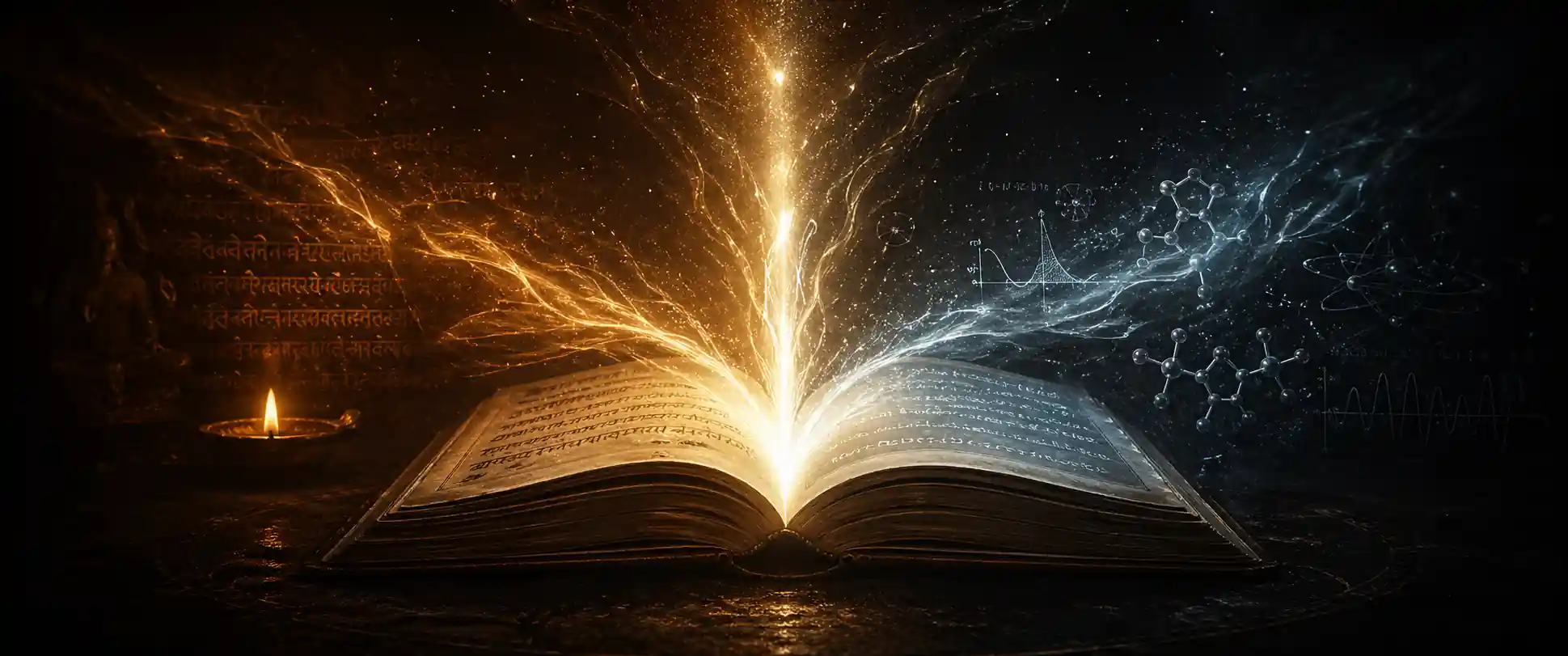
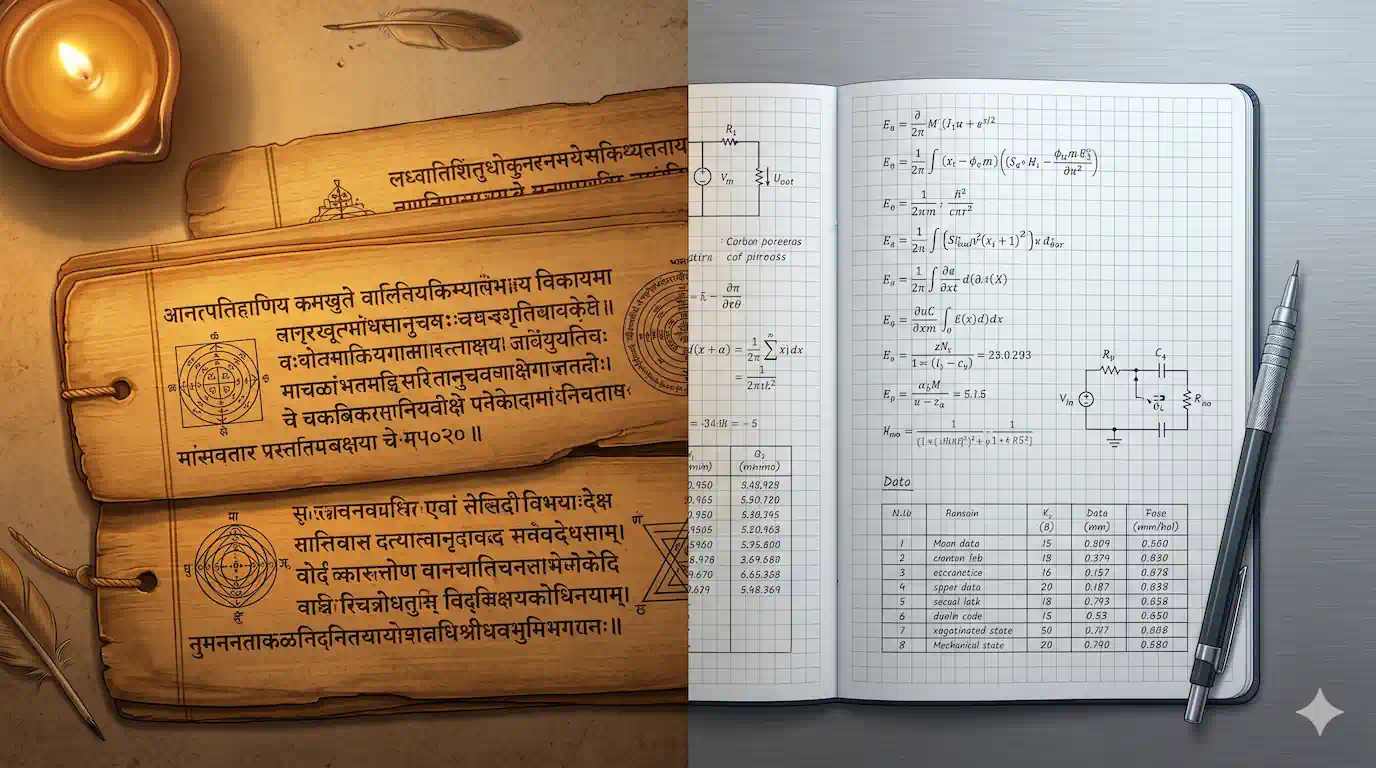
Placing this alongside modern science serves a specific purpose for Indian students: it makes science feel like a living part of your own intellectual inheritance, not something invented elsewhere and imported here. You are not trying to join a foreign conversation. You are continuing a conversation your civilization has been part of for thousands of years.
You don't have to choose between the ancient and the modern. The scientific temperament — curiosity, careful observation, rigorous testing, honest revision — is the thread that connects both. This book is woven from that thread.
What This Page Teaches Us
-
Every page in this book follows a consistent architecture: Gita verse, Opening Question, narrative content, callouts, Manana Moment, and summary. Each element serves a purpose — none is decoration.
-
The Manana Moment is the most important part of each page. It asks you to do the hardest thing in learning: apply what you've just read to your own thinking, rather than simply acknowledging it.
-
Reading science requires active engagement — following arguments, pausing at questions, finding connections. Skimming gives you words; reading gives you understanding.
-
The Crucible practice platform works best when used immediately after reading each page. Retrieval practice — attempting questions while the material is still slightly uncertain — is one of the most evidence-backed learning strategies in cognitive science.
-
This book places Indian knowledge traditions alongside modern science because the scientific temperament — curiosity, observation, rigorous testing, honest revision — is the thread connecting both. You are not joining a foreign tradition. You are continuing your own.
Embark on Your Journey
Science is not just a collection of facts, equations, or experiments. It is a human activity — shaped by curiosity, creativity, collaboration, and careful questioning. It grows as people ask honest questions, test their ideas, share their results, and learn from their mistakes.
Science develops across cultures, across centuries, across continents. Aryabhata in ancient Ujjain. Brahmagupta in Bhinmal. Newton in Cambridge. Marie Curie in Paris. Meghnad Saha in Allahabad. Charaka somewhere in north India two thousand years before Charaka's name appeared in any English book. Each one carrying the same flame: the willingness to ask honestly, observe carefully, revise when evidence demands.
Even if you do not become a professional scientist after Grade 10, scientific thinking will be one of the most valuable habits you will ever build. It will help you understand the technology that surrounds you. It will help you evaluate information critically — neither swallowing everything nor dismissing everything, but discerning. It will help you make sense of the world you live in, and contribute to it.
The Katha Upanishad has a verse that has guided seekers in India for thousands of years:
उत्तिष्ठत जाग्रत प्राप्य वरान्निबोधत।
uttiṣṭhata jāgrata prāpya varān nibodhata
"Arise. Awake. Learn from those who have seen the truth."
This is the spirit of every page that follows.
The chapters ahead will introduce you to cells, atoms, motion, force, energy, sound, the patterns of life, and the systems of the Earth. Each chapter is a doorway. Walk through each one with the magnifying glass of evidence in one hand and the compass of curiosity in the other.
Happy exploring.
The Architecture of Every Page
Every page in this book follows the same architecture. The structure is not arbitrary — each element is designed to do something specific.
Gita Verse (fun_fact block) — At the top of every page, a verse from the Bhagavad Gita or another text from India's knowledge tradition. Not as decoration, but as a question: where does this ancient observation intersect with what modern science has discovered?
Opening Question — A question designed not to be answered immediately, but to be carried through the page. It creates a small, productive sense of unresolved tension — and that tension is the engine of understanding.
Text and Heading blocks — The main narrative. These blocks explain the why and how behind the science, not just the what. They build an argument, not a list. Read them as you would read an essay: follow the reasoning.
Callout blocks — Highlighted cards with distinct borders. Depending on their type, they contain: supporting historical detail (note), exam-relevant patterns (exam_tip), cautionary flags (warning), or Vedic wisdom connections (fun_fact).
Manana Moment — From the Sanskrit manana (मनन), meaning to reflect, to chew on, to fully digest. This is the most important part of each page. It asks you to apply what you've read to your own thinking — not to demonstrate mastery, but to actually think.
What This Page Teaches Us — A concise summary of the page's key insights, in bullet form. Useful for review, but not a substitute for reading the narrative.
How to Actually Read This Book
Reading a textbook and understanding science are different activities. Here is how they differ — and how this book asks to be used.
Don't skim. The narrative in each text block builds an argument. Skimming gives you isolated words but misses the logic connecting them. And it is the logic — not the vocabulary — that makes the knowledge useful.
Pause at the Opening Question. Before reading the main content, sit with the opening question for thirty seconds. Let yourself not know the answer. That state of not-knowing is not a problem. It is the necessary starting condition for learning.
Engage with the Manana Moment. It is not a formality. The question it poses is the most important question on the page. If you read the page but skip the Manana Moment, you have absorbed information without transforming it into understanding.
Find the connection in the Gita verse. Even when the connection is not obvious at first, try to find it. The exercise of connecting ancient wisdom to modern science is a practice in integrative thinking — one of the rarest and most valuable cognitive skills you can develop.
Use this book alongside The Crucible. After reading each page, go to the practice platform and attempt questions on the same topic. The act of attempting — getting some wrong, reading the explanation, understanding why your thinking was incorrect — consolidates understanding far more effectively than re-reading the same page. This is called retrieval practice, and cognitive science is unambiguous about its effectiveness.
A Note on the Vedic-Science Connection
This book makes a choice that most science textbooks do not: it places India's ancient knowledge traditions alongside modern scientific discoveries.
This is not nostalgia. It is not nationalism. It is historical accuracy.
The Rishis — India's scientist-philosophers — made genuine, documented contributions to human knowledge. Aryabhata calculated the Earth's circumference and proposed heliocentrism a thousand years before Copernicus. Kanad articulated atomic theory nearly two thousand years before Dalton. Pingala developed binary mathematics long before Boolean algebra existed. Brahmagupta formalized arithmetic operations on zero. Panini's grammar of Sanskrit is considered the first formal generative grammar in human history — predating Chomsky by 2,500 years.
These are not myths. They are historical facts, documented in texts whose dates are established, whose mathematical content has been verified, and whose influence on subsequent scientific development is traceable.
Placing this alongside modern science serves a specific purpose for Indian students: it makes science feel like a living part of your own intellectual inheritance, not something invented elsewhere and imported here. You are not trying to join a foreign conversation. You are continuing a conversation your civilization has been part of for thousands of years.
You don't have to choose between the ancient and the modern. The scientific temperament — curiosity, careful observation, rigorous testing, honest revision — is the thread that connects both. This book is woven from that thread.
What This Page Teaches Us
-
Every page in this book follows a consistent architecture: Gita verse, Opening Question, narrative content, callouts, Manana Moment, and summary. Each element serves a purpose — none is decoration.
-
The Manana Moment is the most important part of each page. It asks you to do the hardest thing in learning: apply what you've just read to your own thinking, rather than simply acknowledging it.
-
Reading science requires active engagement — following arguments, pausing at questions, finding connections. Skimming gives you words; reading gives you understanding.
-
The Crucible practice platform works best when used immediately after reading each page. Retrieval practice — attempting questions while the material is still slightly uncertain — is one of the most evidence-backed learning strategies in cognitive science.
-
This book places Indian knowledge traditions alongside modern science because the scientific temperament — curiosity, observation, rigorous testing, honest revision — is the thread connecting both. You are not joining a foreign tradition. You are continuing your own.
Embark on Your Journey
Science is not just a collection of facts, equations, or experiments. It is a human activity — shaped by curiosity, creativity, collaboration, and careful questioning. It grows as people ask honest questions, test their ideas, share their results, and learn from their mistakes.
Science develops across cultures, across centuries, across continents. Aryabhata in ancient Ujjain. Brahmagupta in Bhinmal. Newton in Cambridge. Marie Curie in Paris. Meghnad Saha in Allahabad. Charaka somewhere in north India two thousand years before Charaka's name appeared in any English book. Each one carrying the same flame: the willingness to ask honestly, observe carefully, revise when evidence demands.
Even if you do not become a professional scientist after Grade 10, scientific thinking will be one of the most valuable habits you will ever build. It will help you understand the technology that surrounds you. It will help you evaluate information critically — neither swallowing everything nor dismissing everything, but discerning. It will help you make sense of the world you live in, and contribute to it.
The Katha Upanishad has a verse that has guided seekers in India for thousands of years:
उत्तिष्ठत जाग्रत प्राप्य वरान्निबोधत।
uttiṣṭhata jāgrata prāpya varān nibodhata
"Arise. Awake. Learn from those who have seen the truth."
This is the spirit of every page that follows.
The chapters ahead will introduce you to cells, atoms, motion, force, energy, sound, the patterns of life, and the systems of the Earth. Each chapter is a doorway. Walk through each one with the magnifying glass of evidence in one hand and the compass of curiosity in the other.
Happy exploring.