Patterns, Theories, and the Power of Prediction
How science moves from observation to law to prediction — and why theories are never the last word
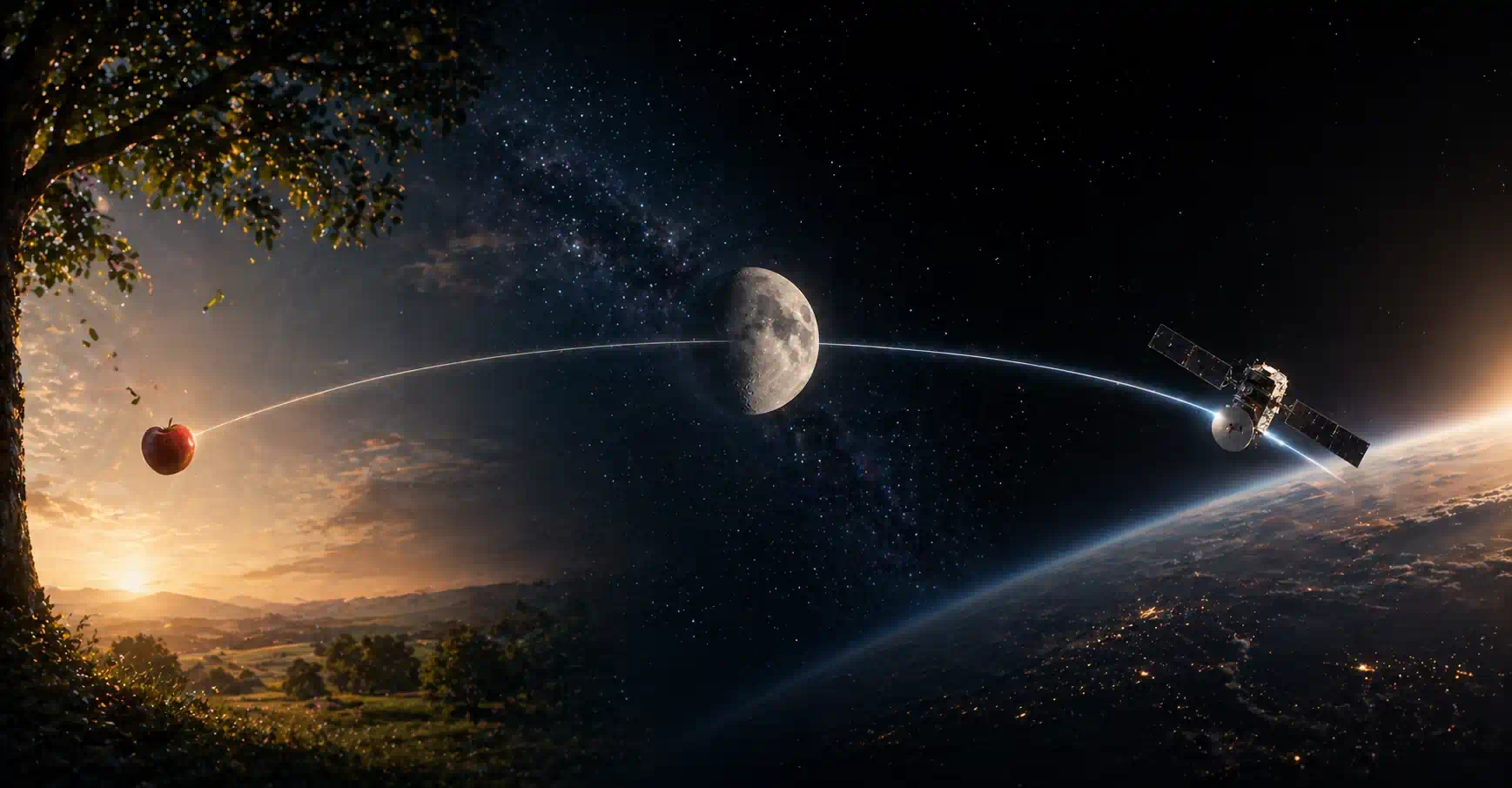
Notice how when a bus suddenly brakes, you jerk forward. Notice how, when a cricket ball is hit, it follows a curved path before falling. Notice how an apple, dropped from your hand, always falls down — never sideways, never up.
These are different events in different times and places. What if there were one underlying pattern beneath all of them?
Apples, cricket balls, satellites, the moon — all moving objects. Are they following different rules, or the same one?
The Verse on the One Truth Behind Many Names
एकं सद्विप्रा बहुधा वदन्ति।
अग्निं यमं मातरिश्वानमाहुः॥
'सच्चाई एक ही है — पर ज्ञानी लोग उसे अलग-अलग नामों से बुलाते हैं। कोई अग्नि कहता है, कोई यम, कोई मातरिश्वान।'
"Truth is one — the wise call it by many names. They speak of it as Agni, as Yama, as Mātariśvan."
This ancient verse names a habit of seeing: that beneath many different appearances, there often lies a single underlying reality. Scientists, in their own way, have been doing this ever since.
Laws, Theories, and Principles
Three words you will hear often this year are law, theory, and principle. They sound similar but mean quite different things in science.
A law describes a pattern observed in nature. It tells you what happens, often in a precise mathematical form. It does not necessarily explain why it happens.
For example, Newton's first law of motion is the reason you jerk forward when a bus suddenly brakes — your body tends to keep moving even when the bus has stopped. The law describes what every moving object does. It doesn't pretend to explain the deeper why.
A theory goes further — it explains why the pattern occurs. A scientific theory is built from many observations, careful tests, and the work of many scientists over time.
For example, atomic theory explains why substances combine in specific ratios to form compounds — because they are made of atoms that combine in fixed proportions. The pattern (compounds with fixed ratios) is the law. The explanation (atoms with definite masses combining) is the theory.
A principle is a broad idea that helps make sense of many situations.
For example, the principle of conservation of energy says that energy is never created or destroyed — only transformed. It applies when you climb stairs (chemical energy → mechanical energy → potential energy), when a phone charges, when a stone falls, and a thousand other situations. It is a unifying idea, not a single equation.
A Theory Is Not a Guess
There is a confusion in everyday speech that causes a great deal of harm: people say 'oh, that's just a theory' to mean a hunch or an unproven guess.
This is the opposite of what 'theory' means in science.
In science, a theory is one of the highest forms of knowledge — an explanation that has survived testing by many scientists, across many experiments, often across decades. Atomic theory, the theory of evolution, the germ theory of disease — these are not guesses. They are some of the most carefully tested, evidence-supported frameworks humans have ever built.
But — and this is crucial — even a strong theory is never declared 'final.' It remains open to revision if new evidence demands it. This is not a weakness of science. It is its deepest strength. A scientist's commitment is to the truth, not to a particular theory.
When a result contradicts a long-held theory, the response is not denial. It is investigation. Was the experiment done correctly? Has someone else replicated this? What does the contradiction mean? Does the theory need to be modified, or replaced?
This cycle — observation, theory, anomaly, revision — is how scientific knowledge has grown for centuries. It is slow, but it is honest, and it is one of the most reliable methods of knowing we have.
India's Scientific Contributions
Brahmagupta (598–668 CE), in his treatise Brahma-sphuṭa-siddhānta, wrote: "Bodies fall to the Earth as it is in the nature of the Earth to attract bodies, just as it is in the nature of water to flow."
The Power of Prediction
When laws, theories, and models are well established, they give us a remarkable power: the power to predict what will happen in situations we have not yet seen.
- Using the laws of motion, we can predict how far a kicked football will travel.
- Using chemical principles, we can predict how much carbon dioxide will be released when fuel is burned.
- Using biological understanding, we can predict how a person's breathing will change while running uphill.
Predictions are not guesses. They are reasoned expectations — built from evidence, careful observation, and the structure of theory. When a prediction matches what is observed, our confidence in the underlying theory grows. When a prediction fails — that is even more interesting. A failed prediction means a theory, a model, or a measurement needs re-examination. That re-examination is exactly how science moves forward.
Example: Testing a Prediction
Varsha tells her friend Meghna, "It will rain this afternoon, because the clouds look dark."
Meghna can ask Varsha some questions to turn this casual claim into a scientifically testable prediction:
- What was the sky like the last time it rained — was it like this?
- What is the humidity today? Was it above 80% the last time it rained?
- What is today's wind speed and direction?
- Is the temperature dropping as it usually does before rain?
These questions ask for measurable evidence and past patterns, not just appearances. They turn a feeling into a hypothesis that can be checked.
When Theories Change — Anomalies Pile Up
For nearly 1,400 years, astronomers across the world believed the Sun, Moon, planets, and stars all revolved around the Earth. The model worked well enough to navigate ships and predict eclipses. It was supported by observation — every day, the Sun seemed to rise in the east and set in the west.
A scientist has spent twenty years working on a theory. The theory has been confirmed by 50 different experiments. Now, on the 51st experiment, the result clearly contradicts the theory.
Scientist A says: "50 confirmations versus 1 contradiction — the contradiction is probably a measurement error. The theory is solid; let's continue."
Scientist B says: "A genuine anomaly that cannot be explained away tells us something. The theory might be incomplete, even though it has worked in 50 cases. We need to investigate carefully."
Which scientist is thinking more like a scientist — and why?
Why Weather Forecasts Sometimes Go Wrong
Weather depends on many changing factors at once — temperature, pressure, humidity, wind speed, wind direction, ocean currents, cloud cover, and more. Modern weather forecasts use sophisticated mathematical models of the atmosphere, fed with satellite measurements taken every few minutes.
Manana Moment
Contemplation before you continue
The Rigveda's ekam sad vipra bahudha vadanti — truth is one, the wise call it by many names — is the oldest version of an idea modern science calls unification. The same gravity in an apple, in the moon, in a satellite. The same atomic structure in oxygen, in iron, in the iron in your own blood.
Looking for the one truth behind many appearances is one of the deepest moves in science.
Before you continue, ask yourself:
What is one situation where you've changed your mind because evidence demanded it — even though admitting you were wrong was uncomfortable?
That moment — when you let evidence overrule what you wanted to believe — is the same moment a scientist has when an anomaly forces a theory to be revised. The willingness to revise, when the evidence demands it, is what makes any thinker — scientist or otherwise — trustworthy.
What This Page Teaches Us
-
A law in science describes a regular pattern observed in nature (e.g., Newton's laws of motion).
-
A theory explains why the pattern occurs, drawn from many observations and tests (e.g., atomic theory).
-
A principle is a broad unifying idea (e.g., conservation of energy).
-
Theory in science is not a guess. It is one of the highest forms of evidence-supported knowledge — but always open to revision if new evidence demands it.
-
Predictions are reasoned expectations, not guesses. They test theories. When predictions fail, scientists investigate — they don't deny.
-
Anomalies that refuse to fit the current theory are how science grows.
-
Brahmagupta described gravitational attraction a thousand years before Newton. Varahamihira insisted prediction must be grounded in observed pattern, not omen — a standard modern science still upholds.
-
The Rigveda's vision — one truth, many names — is the deepest ancestor of the scientific search for unifying patterns.
Q1.What is the difference between a law and a theory in science?
Notice how when a bus suddenly brakes, you jerk forward. Notice how, when a cricket ball is hit, it follows a curved path before falling. Notice how an apple, dropped from your hand, always falls down — never sideways, never up.
These are different events in different times and places. What if there were one underlying pattern beneath all of them?
Apples, cricket balls, satellites, the moon — all moving objects. Are they following different rules, or the same one?
The Verse on the One Truth Behind Many Names
एकं सद्विप्रा बहुधा वदन्ति।
अग्निं यमं मातरिश्वानमाहुः॥
'सच्चाई एक ही है — पर ज्ञानी लोग उसे अलग-अलग नामों से बुलाते हैं। कोई अग्नि कहता है, कोई यम, कोई मातरिश्वान।'
"Truth is one — the wise call it by many names. They speak of it as Agni, as Yama, as Mātariśvan."
This ancient verse names a habit of seeing: that beneath many different appearances, there often lies a single underlying reality. Scientists, in their own way, have been doing this ever since.
Laws, Theories, and Principles
Three words you will hear often this year are law, theory, and principle. They sound similar but mean quite different things in science.
A law describes a pattern observed in nature. It tells you what happens, often in a precise mathematical form. It does not necessarily explain why it happens.
For example, Newton's first law of motion is the reason you jerk forward when a bus suddenly brakes — your body tends to keep moving even when the bus has stopped. The law describes what every moving object does. It doesn't pretend to explain the deeper why.
A theory goes further — it explains why the pattern occurs. A scientific theory is built from many observations, careful tests, and the work of many scientists over time.
For example, atomic theory explains why substances combine in specific ratios to form compounds — because they are made of atoms that combine in fixed proportions. The pattern (compounds with fixed ratios) is the law. The explanation (atoms with definite masses combining) is the theory.
A principle is a broad idea that helps make sense of many situations.
For example, the principle of conservation of energy says that energy is never created or destroyed — only transformed. It applies when you climb stairs (chemical energy → mechanical energy → potential energy), when a phone charges, when a stone falls, and a thousand other situations. It is a unifying idea, not a single equation.
A Theory Is Not a Guess
There is a confusion in everyday speech that causes a great deal of harm: people say 'oh, that's just a theory' to mean a hunch or an unproven guess.
This is the opposite of what 'theory' means in science.
In science, a theory is one of the highest forms of knowledge — an explanation that has survived testing by many scientists, across many experiments, often across decades. Atomic theory, the theory of evolution, the germ theory of disease — these are not guesses. They are some of the most carefully tested, evidence-supported frameworks humans have ever built.
But — and this is crucial — even a strong theory is never declared 'final.' It remains open to revision if new evidence demands it. This is not a weakness of science. It is its deepest strength. A scientist's commitment is to the truth, not to a particular theory.
When a result contradicts a long-held theory, the response is not denial. It is investigation. Was the experiment done correctly? Has someone else replicated this? What does the contradiction mean? Does the theory need to be modified, or replaced?
This cycle — observation, theory, anomaly, revision — is how scientific knowledge has grown for centuries. It is slow, but it is honest, and it is one of the most reliable methods of knowing we have.
India's Scientific Contributions
Brahmagupta (598–668 CE), in his treatise Brahma-sphuṭa-siddhānta, wrote: "Bodies fall to the Earth as it is in the nature of the Earth to attract bodies, just as it is in the nature of water to flow."
The Power of Prediction
When laws, theories, and models are well established, they give us a remarkable power: the power to predict what will happen in situations we have not yet seen.
- Using the laws of motion, we can predict how far a kicked football will travel.
- Using chemical principles, we can predict how much carbon dioxide will be released when fuel is burned.
- Using biological understanding, we can predict how a person's breathing will change while running uphill.
Predictions are not guesses. They are reasoned expectations — built from evidence, careful observation, and the structure of theory. When a prediction matches what is observed, our confidence in the underlying theory grows. When a prediction fails — that is even more interesting. A failed prediction means a theory, a model, or a measurement needs re-examination. That re-examination is exactly how science moves forward.
Example: Testing a Prediction
Varsha tells her friend Meghna, "It will rain this afternoon, because the clouds look dark."
Meghna can ask Varsha some questions to turn this casual claim into a scientifically testable prediction:
- What was the sky like the last time it rained — was it like this?
- What is the humidity today? Was it above 80% the last time it rained?
- What is today's wind speed and direction?
- Is the temperature dropping as it usually does before rain?
These questions ask for measurable evidence and past patterns, not just appearances. They turn a feeling into a hypothesis that can be checked.
When Theories Change — Anomalies Pile Up
For nearly 1,400 years, astronomers across the world believed the Sun, Moon, planets, and stars all revolved around the Earth. The model worked well enough to navigate ships and predict eclipses. It was supported by observation — every day, the Sun seemed to rise in the east and set in the west.
A scientist has spent twenty years working on a theory. The theory has been confirmed by 50 different experiments. Now, on the 51st experiment, the result clearly contradicts the theory.
Scientist A says: "50 confirmations versus 1 contradiction — the contradiction is probably a measurement error. The theory is solid; let's continue."
Scientist B says: "A genuine anomaly that cannot be explained away tells us something. The theory might be incomplete, even though it has worked in 50 cases. We need to investigate carefully."
Which scientist is thinking more like a scientist — and why?
Why Weather Forecasts Sometimes Go Wrong
Weather depends on many changing factors at once — temperature, pressure, humidity, wind speed, wind direction, ocean currents, cloud cover, and more. Modern weather forecasts use sophisticated mathematical models of the atmosphere, fed with satellite measurements taken every few minutes.
What This Page Teaches Us
-
A law in science describes a regular pattern observed in nature (e.g., Newton's laws of motion).
-
A theory explains why the pattern occurs, drawn from many observations and tests (e.g., atomic theory).
-
A principle is a broad unifying idea (e.g., conservation of energy).
-
Theory in science is not a guess. It is one of the highest forms of evidence-supported knowledge — but always open to revision if new evidence demands it.
-
Predictions are reasoned expectations, not guesses. They test theories. When predictions fail, scientists investigate — they don't deny.
-
Anomalies that refuse to fit the current theory are how science grows.
-
Brahmagupta described gravitational attraction a thousand years before Newton. Varahamihira insisted prediction must be grounded in observed pattern, not omen — a standard modern science still upholds.
-
The Rigveda's vision — one truth, many names — is the deepest ancestor of the scientific search for unifying patterns.
Q1.What is the difference between a law and a theory in science?