The Language of Science
Why precise words, symbols, and units are the deepest scientific tools
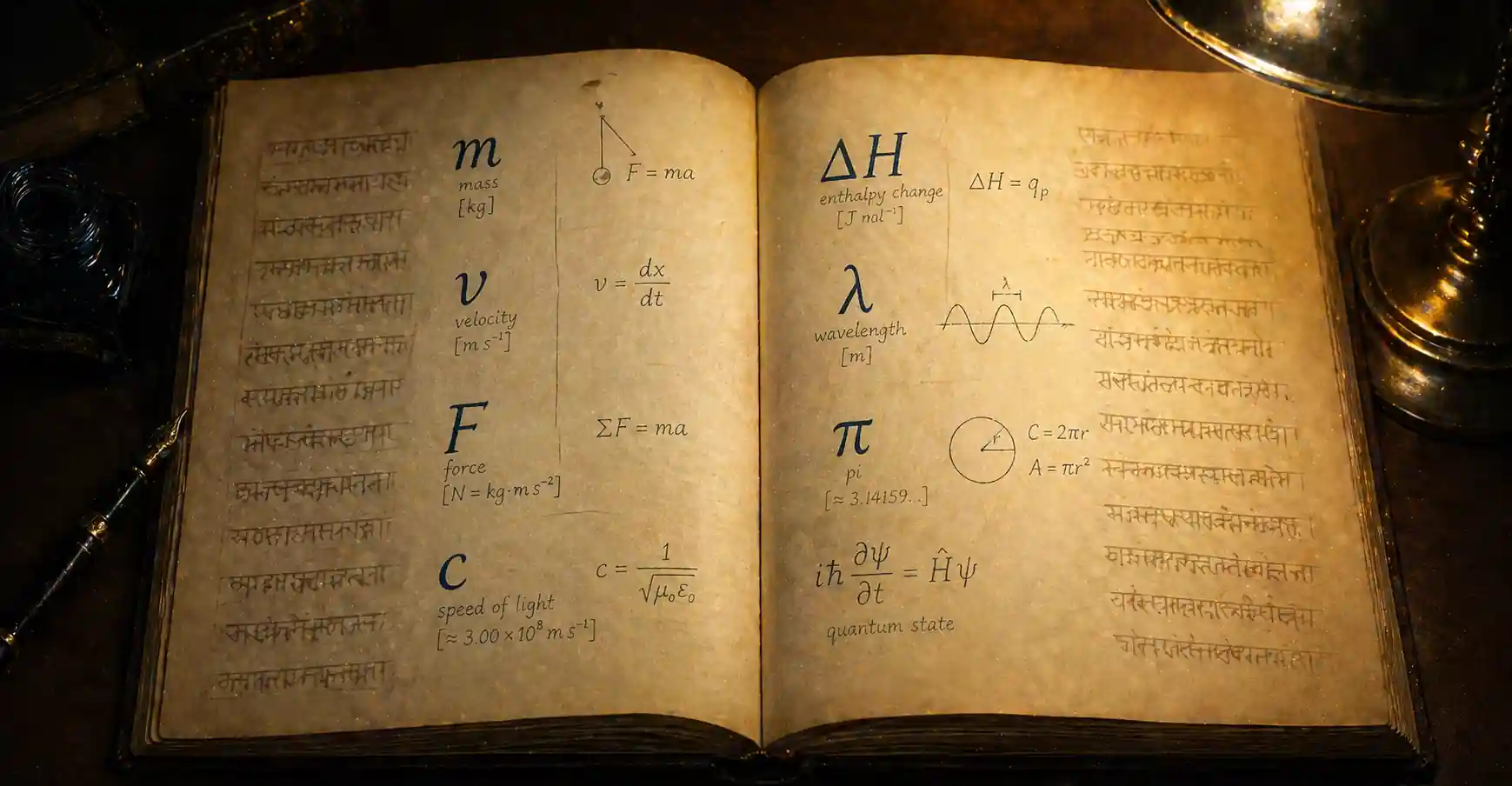
Pick a word you use every day — like force, work, cell, power, or energy. Now imagine a scientist standing next to you. Do you think they mean exactly the same thing by that word as you do?
Think about how 'force' sounds in everyday speech ('don't force me!') versus how a physics teacher uses it. Same word, but is it really the same idea?
The Verse on the Discipline of Speech
अनुद्वेगकरं वाक्यं सत्यं प्रियहितं च यत्।
स्वाध्यायाभ्यसनं चैव वाङ्मयं तप उच्यते॥
'ऐसा बोलना जिससे किसी का मन परेशान न हो — जो सच हो, जो काम का हो, जो प्यारा भी हो — और साथ में अपनी पढ़ाई-अभ्यास भी चलती रहे — यही जीभ की असली तपस्या है।'
"Speech that does not agitate, that is true, beneficial, and pleasant — together with the regular study of sacred texts — is called the austerity of speech."
Why Words in Science Are Different
Many words you already use — force, work, cell, power, reaction — also appear in science. But in science, they are not used loosely. Each one has a specific, agreed-upon meaning, often very different from everyday speech.
In everyday Hindi or English:
- Force might mean compulsion ("forced into a marriage").
- Work might mean effort or a job.
- Power might mean influence or strength.
In science:
- Force is a precisely defined push or pull, measured in newtons (N).
- Work is force multiplied by distance, measured in joules (J).
- Power is the rate of doing work, measured in watts (W).
Why this care? Because scientists across the world — in India, Brazil, Japan, Germany — must be able to read each other's results and understand exactly what was measured. If 'force' meant ten different things, no two experiments could be compared.
To make this even more precise, science uses symbols for quantities:
- for mass
- for velocity
- for force
- for electric current
- for temperature
- for the speed of light
Each symbol is paired with a defined unit: is in kilograms, is in newtons, is in amperes, is in kelvin. Together, these form a kind of universal vocabulary — one that lets a Class 9 student in Shimla and a researcher at CERN in Geneva talk about the same thing in the same way.
Why is the Speed of Light Denoted by 'c'?
Scientific symbols are often surprising. They don't always come from the first letter of the English word — they come from history.
Why a Kilogram Means a Kilogram — Everywhere
When you go to a vegetable seller in Dehradun and ask for one kilogram of tomatoes, you expect that the same kilogram would be measured if you went to a market in Chennai, Tokyo, or Paris. You take this for granted.
But imagine the chaos if it were not so. If 'kilogram' in one place meant 800 grams in another, every commercial transaction, every scientific measurement, every medical dose, every engineering calculation would become unreliable.
This is why the world's scientists agreed on a system of standard units called the SI system (from the French Système International) — a single, internationally agreed framework for measuring length (metre), mass (kilogram), time (second), electric current (ampere), temperature (kelvin), amount of substance (mole), and brightness (candela).
Every scientific result, every engineering specification, every medical prescription anywhere in the world rests on this agreement.
When Units Go Wrong — A Plane Almost Crashed
On 23 July 1983, Air Canada Flight 143 took off from Montreal carrying 69 people. It needed to refuel mid-route. The flight required 22,300 kilograms of fuel.
A student writes in their physics homework:
"The car was moving with a force of 60 kilometres per hour, so it had a lot of energy."
The teacher marks this as wrong — not because the student got the answer wrong, but because of the language used. Why is the language a problem?
Mathematics as a Language for Thinking
Many students treat mathematical equations as obstacles — formulas to memorise and put into a calculator. In science, an equation is something quite different. It is a compact statement about how certain things in the world relate to each other.
For example:
This short equation says: an object's final velocity () equals its initial velocity (), plus its acceleration () multiplied by the time () for which it accelerated.
In ordinary words, that idea would take a paragraph. In mathematical symbols, it takes seven characters — and it can be applied to a falling stone, a moving car, a rocket, or a dropped book.
Mathematics is not a barrier between you and science. It is a language that allows scientific ideas to be stated clearly, compared across contexts, and tested precisely. Learning to use mathematics in science does not mean memorising equations — it means understanding what each symbol stands for, what they mean together, and what new claim the equation is making about the world.
When you focus first on understanding the situation and identifying the relevant quantities, equations stop feeling like puzzles and start feeling like sharp, useful tools.
India's Scientific Contributions
Sanskrit was, for centuries, the most precise language ever constructed for stating scientific and mathematical ideas.
Manana Moment
Contemplation before you continue
The Bhagavad Gita verse describes vāk-tapa — the discipline of speech. Speech that is true, beneficial, and considered. Not careless. Not loose. Words chosen with the awareness that someone is listening.
Scientific language is the same discipline applied to the description of nature.
Before you move on, ask yourself:
When you say something — in class, to a friend, in a group chat — how often do you choose the exact word that says what you actually mean? And how often do you use a vague word because it's easier?
Language is not just a tool for science. The discipline of saying exactly what is true, no more and no less, is a habit that will serve you in every conversation you ever have.
What This Page Teaches Us
-
Words in science have specific, agreed meanings. Force, work, power, reaction — each is precisely defined.
-
Quantities are represented by symbols (m, v, F, I, T, c) paired with defined units (kilogram, metre per second, newton, ampere, kelvin).
-
The SI system is the world's shared framework for measurement. Every scientific result, engineering specification, and medical prescription rests on it.
-
Mistaking units can have catastrophic consequences — as Air Canada Flight 143 nearly proved.
-
Mathematics is a language, not a barrier. An equation is a compact statement about how the world relates.
-
Sanskrit, through scholars like Pingala and Aryabhata, was historically a language of similar mathematical precision — proof that the discipline of careful expression has deep roots in Indian thought.
Q1.Why does science use a small number of agreed-upon symbols (like m, v, F, I) for physical quantities?
Pick a word you use every day — like force, work, cell, power, or energy. Now imagine a scientist standing next to you. Do you think they mean exactly the same thing by that word as you do?
Think about how 'force' sounds in everyday speech ('don't force me!') versus how a physics teacher uses it. Same word, but is it really the same idea?
The Verse on the Discipline of Speech
अनुद्वेगकरं वाक्यं सत्यं प्रियहितं च यत्।
स्वाध्यायाभ्यसनं चैव वाङ्मयं तप उच्यते॥
'ऐसा बोलना जिससे किसी का मन परेशान न हो — जो सच हो, जो काम का हो, जो प्यारा भी हो — और साथ में अपनी पढ़ाई-अभ्यास भी चलती रहे — यही जीभ की असली तपस्या है।'
"Speech that does not agitate, that is true, beneficial, and pleasant — together with the regular study of sacred texts — is called the austerity of speech."
Why Words in Science Are Different
Many words you already use — force, work, cell, power, reaction — also appear in science. But in science, they are not used loosely. Each one has a specific, agreed-upon meaning, often very different from everyday speech.
In everyday Hindi or English:
- Force might mean compulsion ("forced into a marriage").
- Work might mean effort or a job.
- Power might mean influence or strength.
In science:
- Force is a precisely defined push or pull, measured in newtons (N).
- Work is force multiplied by distance, measured in joules (J).
- Power is the rate of doing work, measured in watts (W).
Why this care? Because scientists across the world — in India, Brazil, Japan, Germany — must be able to read each other's results and understand exactly what was measured. If 'force' meant ten different things, no two experiments could be compared.
To make this even more precise, science uses symbols for quantities:
- for mass
- for velocity
- for force
- for electric current
- for temperature
- for the speed of light
Each symbol is paired with a defined unit: is in kilograms, is in newtons, is in amperes, is in kelvin. Together, these form a kind of universal vocabulary — one that lets a Class 9 student in Shimla and a researcher at CERN in Geneva talk about the same thing in the same way.
Why is the Speed of Light Denoted by 'c'?
Scientific symbols are often surprising. They don't always come from the first letter of the English word — they come from history.
Why a Kilogram Means a Kilogram — Everywhere
When you go to a vegetable seller in Dehradun and ask for one kilogram of tomatoes, you expect that the same kilogram would be measured if you went to a market in Chennai, Tokyo, or Paris. You take this for granted.
But imagine the chaos if it were not so. If 'kilogram' in one place meant 800 grams in another, every commercial transaction, every scientific measurement, every medical dose, every engineering calculation would become unreliable.
This is why the world's scientists agreed on a system of standard units called the SI system (from the French Système International) — a single, internationally agreed framework for measuring length (metre), mass (kilogram), time (second), electric current (ampere), temperature (kelvin), amount of substance (mole), and brightness (candela).
Every scientific result, every engineering specification, every medical prescription anywhere in the world rests on this agreement.
When Units Go Wrong — A Plane Almost Crashed
On 23 July 1983, Air Canada Flight 143 took off from Montreal carrying 69 people. It needed to refuel mid-route. The flight required 22,300 kilograms of fuel.
A student writes in their physics homework:
"The car was moving with a force of 60 kilometres per hour, so it had a lot of energy."
The teacher marks this as wrong — not because the student got the answer wrong, but because of the language used. Why is the language a problem?
Mathematics as a Language for Thinking
Many students treat mathematical equations as obstacles — formulas to memorise and put into a calculator. In science, an equation is something quite different. It is a compact statement about how certain things in the world relate to each other.
For example:
This short equation says: an object's final velocity () equals its initial velocity (), plus its acceleration () multiplied by the time () for which it accelerated.
In ordinary words, that idea would take a paragraph. In mathematical symbols, it takes seven characters — and it can be applied to a falling stone, a moving car, a rocket, or a dropped book.
Mathematics is not a barrier between you and science. It is a language that allows scientific ideas to be stated clearly, compared across contexts, and tested precisely. Learning to use mathematics in science does not mean memorising equations — it means understanding what each symbol stands for, what they mean together, and what new claim the equation is making about the world.
When you focus first on understanding the situation and identifying the relevant quantities, equations stop feeling like puzzles and start feeling like sharp, useful tools.
India's Scientific Contributions
Sanskrit was, for centuries, the most precise language ever constructed for stating scientific and mathematical ideas.
What This Page Teaches Us
-
Words in science have specific, agreed meanings. Force, work, power, reaction — each is precisely defined.
-
Quantities are represented by symbols (m, v, F, I, T, c) paired with defined units (kilogram, metre per second, newton, ampere, kelvin).
-
The SI system is the world's shared framework for measurement. Every scientific result, engineering specification, and medical prescription rests on it.
-
Mistaking units can have catastrophic consequences — as Air Canada Flight 143 nearly proved.
-
Mathematics is a language, not a barrier. An equation is a compact statement about how the world relates.
-
Sanskrit, through scholars like Pingala and Aryabhata, was historically a language of similar mathematical precision — proof that the discipline of careful expression has deep roots in Indian thought.
Q1.Why does science use a small number of agreed-upon symbols (like m, v, F, I) for physical quantities?