The Cell Interior: A Coordinated Living Factory
Why every cell is a city of organelles — and how the deepest division in biology is between cells with rooms and cells without
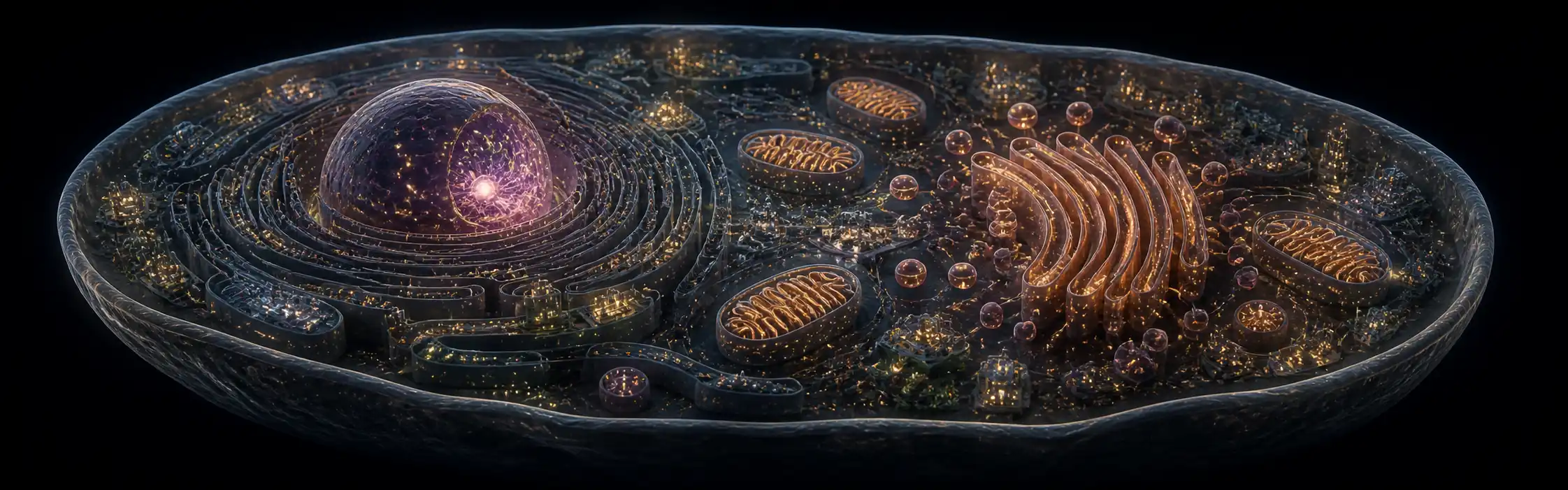
Imagine a tiny city — about a thousandth of a millimetre wide. Inside it, there are factories, power plants, garbage disposals, libraries, postal services, and walls. Goods are constantly being made, packaged, shipped, used, and recycled. Energy is being generated. Information is being stored and copied.
Now imagine 30 trillion of these cities working together at once — coordinated, communicating, dying and replacing each other on schedule.
That's roughly what your body is doing, right now, as you read this. What kind of organisation could possibly run inside something so small?
Think about what jobs a city has to do continuously. Then ask: what would the smallest version of each job look like?
The Verse on Diversity Rooted in Unity
यदा भूतपृथग्भावमेकस्थमनुपश्यति।
तत एव च विस्तारं ब्रह्म सम्पद्यते तदा॥
'जब कोई इंसान देखता है कि अलग-अलग दिखने वाले सारे जीव-रूप एक ही जगह में टिके हुए हैं — और सब उसी एक से फैले हैं — तब वही ब्रह्म तक पहुँच जाता है।'
"When one sees the variety of beings rooted in One, and all of them as expanding from That, then one attains Brahman."
The verse names a way of seeing: many parts, one whole. A cell, with its dozens of organelles each doing a different job, is exactly such a structure — many distinct functions, one living unit. Wherever something is alive, it is many becoming one.
The Three Basic Parts of Every Cell
Every cell — whether bacterial, plant, or animal — is built around the same three essential elements:
1. The plasma membrane. The selectively permeable boundary you met on the previous page. It defines the cell, and controls everything that crosses in or out.
2. The cytoplasm. The semi-fluid, jelly-like substance that fills the cell's interior. Cytoplasm is mostly water, but with thousands of dissolved proteins, enzymes, salts, sugars, and other molecules. It is the cellular medium — the workshop in which most reactions of life happen. The structures we are about to meet (organelles) sit suspended in cytoplasm.
3. The nucleus (or, in simpler cells, a nucleus-like region). The information centre of the cell. Inside the nucleus is the DNA — the cell's blueprint. The nucleus is the focus of the next page entirely.
In addition to these three, the cytoplasm contains many smaller specialised structures called organelles — meaning little organs. Each organelle does a specific job: producing energy, manufacturing proteins, packaging goods, recycling waste, storing materials. We will meet each one in detail in the pages ahead.
For now, the central insight: a cell is a community of organelles working together, suspended in cytoplasm, enclosed by a membrane. That community is what we call life.
Two Great Kinds of Cells — Prokaryotic and Eukaryotic
All living cells on Earth fall into two great categories, based on a single deep difference: does the cell have a true nucleus, with the DNA enclosed in a membrane?
Prokaryotic cells (from the Greek pro = primitive or before, karyon = nucleus) do not have a well-defined nucleus. Their DNA floats in a region of the cytoplasm called the nucleoid, with no membrane around it. They also lack other membrane-bound organelles. Cellular activities take place directly in the cytoplasm. Examples: bacteria of every kind. Prokaryotic cells are smaller (typically 1–10 μm) and almost always unicellular.
Eukaryotic cells (Greek eu = true, karyon = nucleus) have a true, well-defined nucleus — DNA enclosed by a nuclear membrane. They also have many other membrane-bound organelles: mitochondria, endoplasmic reticulum, Golgi apparatus, lysosomes (in animals), chloroplasts and large vacuoles (in plants). Eukaryotic cells are larger (typically 10–100 μm) and can be either unicellular (e.g., yeast, Amoeba) or multicellular (plants, animals, fungi).
Every cell in your body is eukaryotic. Every bacterium that ever caused you a stomach ache is prokaryotic. The line between these two cell types is one of the deepest divisions in biology — older than the line between animals and plants. Plants and animals are both eukaryotes; bacteria stand on the other side of an ancient evolutionary fork.
Why does it matter? Compartmentalisation. A eukaryotic cell, by enclosing its parts in membranes, can run many different chemical processes simultaneously without interfering with each other. The nucleus can copy DNA while the mitochondria release energy and the Golgi packages proteins — all in separate rooms of the same cellular city. A prokaryotic cell does everything in one open space — efficient, but limited in complexity.
This difference is why all complex multicellular life on Earth — every plant, every animal, every fungus — is built from eukaryotic cells. Compartments enable complexity.
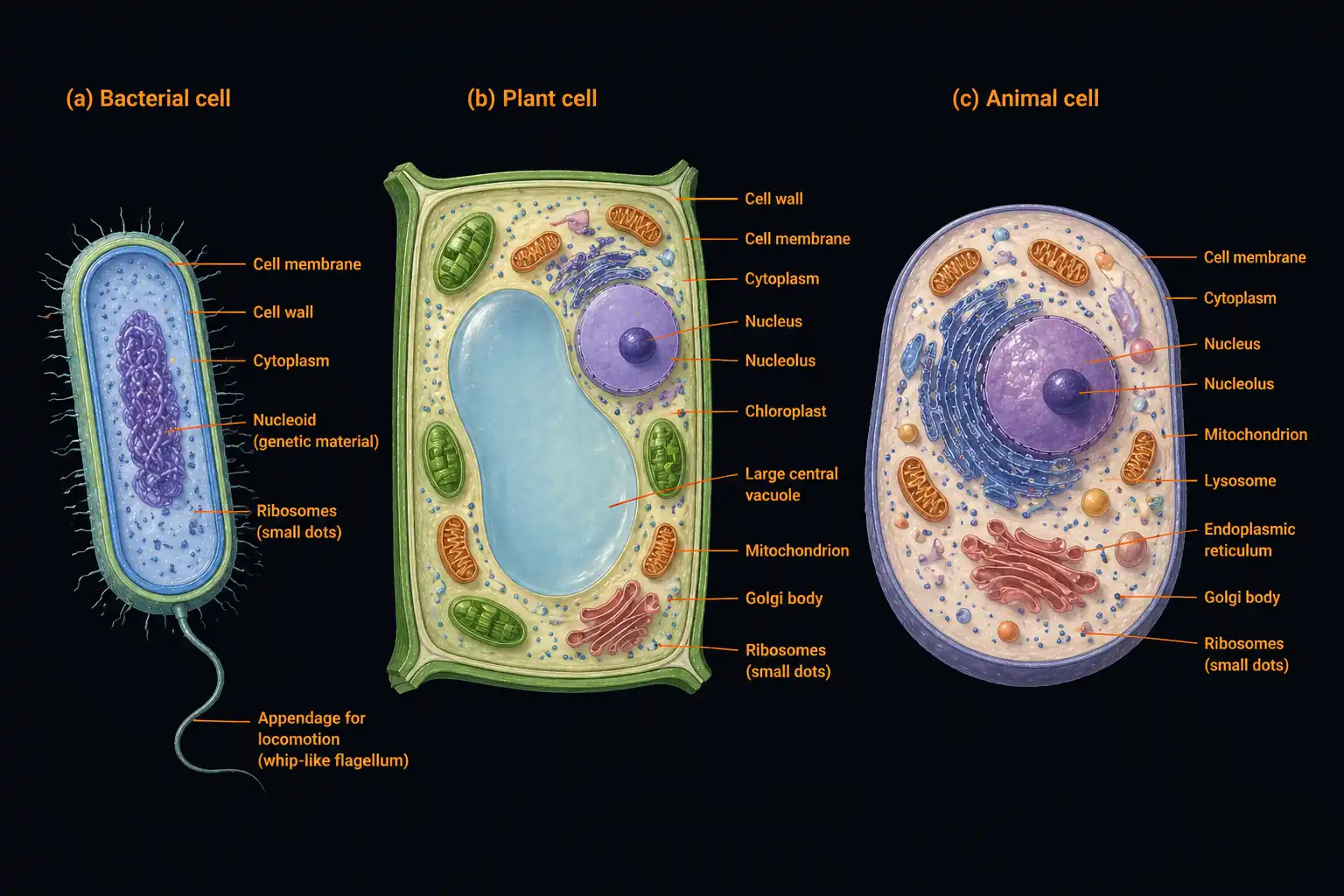
Now look carefully at the three cells side by side.
Notice what is shared. All three have a cell membrane. All three have cytoplasm. All three have ribosomes — tiny structures that make proteins. The basic recipe for being a cell is the same everywhere.
Notice what is different.
- The bacterial cell has no true nucleus — its DNA is loose in the cytoplasm. There are no membrane-bound organelles. There is a cell wall (in many bacteria, made of a different material than plant cellulose).
- The plant cell has a true nucleus, chloroplasts (for making food from sunlight — the next page covers this), a large central vacuole (for storage), and an outer cell wall of cellulose.
- The animal cell has a true nucleus, no chloroplasts, no large central vacuole, no cell wall — but it has lysosomes (which plant cells generally do not).
The table below summarises:
| Feature | Bacterial cell | Plant cell | Animal cell |
|---|---|---|---|
| Cell membrane | ✓ | ✓ | ✓ |
| Cell wall | ✓ (different material) | ✓ (cellulose) | ✗ |
| Cytoplasm | ✓ | ✓ | ✓ |
| Well-defined nucleus | ✗ | ✓ | ✓ |
| Primitive nucleus (nucleoid) | ✓ | — | — |
| Membrane-bound organelles | ✗ | ✓ | ✓ |
And a sharper comparison of just the two great cell types:
| Characteristic | Prokaryotic | Eukaryotic |
|---|---|---|
| True nucleus | Absent | Present |
| Typical diameter | 1–10 μm | 10–100 μm |
| Organisation | Usually unicellular | Unicellular OR multicellular |
| Membrane-bound organelles | Absent | Present |
The shape, size, and contents of the three cells differ — but the underlying principle is shared. Each is a community of structures, working together, enclosed in a membrane. Many becoming one.
Ready to Go Beyond — The Cell Has a Skeleton Too
Look closely at any eukaryotic cell under a powerful electron microscope and you will see something surprising: a network of fine fibres running through the cytoplasm, like the steel framework inside a building.
What About Viruses? The Strange Borderlands of Life
If a cell is the basic unit of life, then what about viruses — those tiny things that make us sick? Are they cells? Are they alive?
The answer puts us in genuinely strange territory.
Viruses, viroids, and prions are infectious agents — they can invade living cells and reproduce themselves — but they are not made of cells. They are acellular. None of them has a cell membrane, cytoplasm, or organelles of any kind. They are also far too small to see under a light microscope; they were only confirmed to exist after the electron microscope was invented in the 20th century.
Viruses are the largest of the three. A virus is essentially a piece of genetic material (DNA or RNA) wrapped in a protein coat. By itself, a virus does almost nothing — it cannot eat, grow, or reproduce. It can only multiply by infecting a living cell and hijacking the cell's machinery to copy its own genetic material.
Viroids are even simpler. They are just naked strands of genetic material — no protein coat at all. They mostly infect plants.
Prions are the strangest. A prion is just a misfolded protein — no genetic material at all. It causes disease by inducing other proteins to misfold the same way, like a contagious shape. Mad cow disease and certain rare brain disorders are caused by prions.
None of them is a cell. None of them has the basic three-part structure (membrane, cytoplasm, nucleus). Yet they reproduce, evolve, and can devastate living organisms. Where do we draw the line between living and non-living?
The Quest Continues…
Are viruses alive?
Compare these two systems:
-
A bacterium — a prokaryotic cell. All its activities happen in one open space (the cytoplasm). Its DNA, ribosomes, energy reactions, waste breakdown — all jumbled together in the same compartment.
-
A modern hospital — has separate rooms: an operating theatre, a pathology lab, a kitchen, a laundry, a pharmacy, an ICU. Each room is dedicated to one kind of activity, with its own equipment, sterility, and rules.
A eukaryotic cell is built more like the hospital than like the bacterium — separate membrane-bound rooms (organelles) for different tasks.
Why does this kind of compartmentalisation matter? What does the eukaryotic cell gain from it that the bacterium cannot?
Manana Moment
Contemplation before you continue
The Bhagavad Gita names a way of seeing — the variety of beings rooted in One. A single cell is exactly such a structure: dozens of distinct organelles, each doing entirely different work, all rooted in the same living unit. Many becoming one.
Notice this pattern in your own life:
You are made of 30 trillion cells, each with its own organelles — at least trillions of trillions of organelles, all coordinated into a single you.
You belong to a family — a household with its own roles and rooms — that functions only because the parts cooperate. A family is many becoming one.
You live in a community, a city, a country — billions of separate people, each with their own tiny life, somehow weaving into a single shared existence.
Before you continue, ask yourself:
Where in your own life are you the bacterium — doing everything yourself, in one undifferentiated rush — when you might serve yourself better by becoming the eukaryotic cell, with separate quiet rooms for separate kinds of work?
The cell teaches a way of organising: separate rooms for separate tasks. Coordination through boundaries. Complexity through compartments. It is a lesson worth carrying beyond biology.
What This Page Teaches Us
-
Every cell has three basic parts: the plasma membrane, the cytoplasm (semi-fluid medium), and the nucleus (or nucleus-like region). Inside the cytoplasm sit specialised structures called organelles.
-
All cells fall into two great categories. Prokaryotic cells (bacteria) lack a true nucleus and membrane-bound organelles. Their DNA sits in the cytoplasm in a region called the nucleoid.
-
Eukaryotic cells have a true membrane-bound nucleus and many membrane-bound organelles. They are usually larger (10–100 μm) and may be unicellular or multicellular. Plants, animals, fungi are all eukaryotic.
-
The deep advantage of eukaryotic cells is compartmentalisation — separate organelles for separate tasks. This is what enabled multicellular life and complex biology to emerge.
-
The cytoskeleton is the cell's internal framework — provides shape, transports organelles, enables movement.
-
Viruses, viroids, and prions are acellular — not made of cells. They reproduce only inside living cells. Whether they are alive is a genuinely open question in biology.
-
The Bhagavad Gita's vision — the variety rooted in One — describes the cell exactly: many parts, one living unit. Many becoming one.
Q1.What are the three basic parts of every cell?
Imagine a tiny city — about a thousandth of a millimetre wide. Inside it, there are factories, power plants, garbage disposals, libraries, postal services, and walls. Goods are constantly being made, packaged, shipped, used, and recycled. Energy is being generated. Information is being stored and copied.
Now imagine 30 trillion of these cities working together at once — coordinated, communicating, dying and replacing each other on schedule.
That's roughly what your body is doing, right now, as you read this. What kind of organisation could possibly run inside something so small?
Think about what jobs a city has to do continuously. Then ask: what would the smallest version of each job look like?
The Verse on Diversity Rooted in Unity
यदा भूतपृथग्भावमेकस्थमनुपश्यति।
तत एव च विस्तारं ब्रह्म सम्पद्यते तदा॥
'जब कोई इंसान देखता है कि अलग-अलग दिखने वाले सारे जीव-रूप एक ही जगह में टिके हुए हैं — और सब उसी एक से फैले हैं — तब वही ब्रह्म तक पहुँच जाता है।'
"When one sees the variety of beings rooted in One, and all of them as expanding from That, then one attains Brahman."
The verse names a way of seeing: many parts, one whole. A cell, with its dozens of organelles each doing a different job, is exactly such a structure — many distinct functions, one living unit. Wherever something is alive, it is many becoming one.
The Three Basic Parts of Every Cell
Every cell — whether bacterial, plant, or animal — is built around the same three essential elements:
1. The plasma membrane. The selectively permeable boundary you met on the previous page. It defines the cell, and controls everything that crosses in or out.
2. The cytoplasm. The semi-fluid, jelly-like substance that fills the cell's interior. Cytoplasm is mostly water, but with thousands of dissolved proteins, enzymes, salts, sugars, and other molecules. It is the cellular medium — the workshop in which most reactions of life happen. The structures we are about to meet (organelles) sit suspended in cytoplasm.
3. The nucleus (or, in simpler cells, a nucleus-like region). The information centre of the cell. Inside the nucleus is the DNA — the cell's blueprint. The nucleus is the focus of the next page entirely.
In addition to these three, the cytoplasm contains many smaller specialised structures called organelles — meaning little organs. Each organelle does a specific job: producing energy, manufacturing proteins, packaging goods, recycling waste, storing materials. We will meet each one in detail in the pages ahead.
For now, the central insight: a cell is a community of organelles working together, suspended in cytoplasm, enclosed by a membrane. That community is what we call life.
Two Great Kinds of Cells — Prokaryotic and Eukaryotic
All living cells on Earth fall into two great categories, based on a single deep difference: does the cell have a true nucleus, with the DNA enclosed in a membrane?
Prokaryotic cells (from the Greek pro = primitive or before, karyon = nucleus) do not have a well-defined nucleus. Their DNA floats in a region of the cytoplasm called the nucleoid, with no membrane around it. They also lack other membrane-bound organelles. Cellular activities take place directly in the cytoplasm. Examples: bacteria of every kind. Prokaryotic cells are smaller (typically 1–10 μm) and almost always unicellular.
Eukaryotic cells (Greek eu = true, karyon = nucleus) have a true, well-defined nucleus — DNA enclosed by a nuclear membrane. They also have many other membrane-bound organelles: mitochondria, endoplasmic reticulum, Golgi apparatus, lysosomes (in animals), chloroplasts and large vacuoles (in plants). Eukaryotic cells are larger (typically 10–100 μm) and can be either unicellular (e.g., yeast, Amoeba) or multicellular (plants, animals, fungi).
Every cell in your body is eukaryotic. Every bacterium that ever caused you a stomach ache is prokaryotic. The line between these two cell types is one of the deepest divisions in biology — older than the line between animals and plants. Plants and animals are both eukaryotes; bacteria stand on the other side of an ancient evolutionary fork.
Why does it matter? Compartmentalisation. A eukaryotic cell, by enclosing its parts in membranes, can run many different chemical processes simultaneously without interfering with each other. The nucleus can copy DNA while the mitochondria release energy and the Golgi packages proteins — all in separate rooms of the same cellular city. A prokaryotic cell does everything in one open space — efficient, but limited in complexity.
This difference is why all complex multicellular life on Earth — every plant, every animal, every fungus — is built from eukaryotic cells. Compartments enable complexity.
Now look carefully at the three cells side by side.
Notice what is shared. All three have a cell membrane. All three have cytoplasm. All three have ribosomes — tiny structures that make proteins. The basic recipe for being a cell is the same everywhere.
Notice what is different.
- The bacterial cell has no true nucleus — its DNA is loose in the cytoplasm. There are no membrane-bound organelles. There is a cell wall (in many bacteria, made of a different material than plant cellulose).
- The plant cell has a true nucleus, chloroplasts (for making food from sunlight — the next page covers this), a large central vacuole (for storage), and an outer cell wall of cellulose.
- The animal cell has a true nucleus, no chloroplasts, no large central vacuole, no cell wall — but it has lysosomes (which plant cells generally do not).
The table below summarises:
| Feature | Bacterial cell | Plant cell | Animal cell |
|---|---|---|---|
| Cell membrane | ✓ | ✓ | ✓ |
| Cell wall | ✓ (different material) | ✓ (cellulose) | ✗ |
| Cytoplasm | ✓ | ✓ | ✓ |
| Well-defined nucleus | ✗ | ✓ | ✓ |
| Primitive nucleus (nucleoid) | ✓ | — | — |
| Membrane-bound organelles | ✗ | ✓ | ✓ |
And a sharper comparison of just the two great cell types:
| Characteristic | Prokaryotic | Eukaryotic |
|---|---|---|
| True nucleus | Absent | Present |
| Typical diameter | 1–10 μm | 10–100 μm |
| Organisation | Usually unicellular | Unicellular OR multicellular |
| Membrane-bound organelles | Absent | Present |
The shape, size, and contents of the three cells differ — but the underlying principle is shared. Each is a community of structures, working together, enclosed in a membrane. Many becoming one.
Ready to Go Beyond — The Cell Has a Skeleton Too
Look closely at any eukaryotic cell under a powerful electron microscope and you will see something surprising: a network of fine fibres running through the cytoplasm, like the steel framework inside a building.
What About Viruses? The Strange Borderlands of Life
If a cell is the basic unit of life, then what about viruses — those tiny things that make us sick? Are they cells? Are they alive?
The answer puts us in genuinely strange territory.
Viruses, viroids, and prions are infectious agents — they can invade living cells and reproduce themselves — but they are not made of cells. They are acellular. None of them has a cell membrane, cytoplasm, or organelles of any kind. They are also far too small to see under a light microscope; they were only confirmed to exist after the electron microscope was invented in the 20th century.
Viruses are the largest of the three. A virus is essentially a piece of genetic material (DNA or RNA) wrapped in a protein coat. By itself, a virus does almost nothing — it cannot eat, grow, or reproduce. It can only multiply by infecting a living cell and hijacking the cell's machinery to copy its own genetic material.
Viroids are even simpler. They are just naked strands of genetic material — no protein coat at all. They mostly infect plants.
Prions are the strangest. A prion is just a misfolded protein — no genetic material at all. It causes disease by inducing other proteins to misfold the same way, like a contagious shape. Mad cow disease and certain rare brain disorders are caused by prions.
None of them is a cell. None of them has the basic three-part structure (membrane, cytoplasm, nucleus). Yet they reproduce, evolve, and can devastate living organisms. Where do we draw the line between living and non-living?
The Quest Continues…
Are viruses alive?
Compare these two systems:
-
A bacterium — a prokaryotic cell. All its activities happen in one open space (the cytoplasm). Its DNA, ribosomes, energy reactions, waste breakdown — all jumbled together in the same compartment.
-
A modern hospital — has separate rooms: an operating theatre, a pathology lab, a kitchen, a laundry, a pharmacy, an ICU. Each room is dedicated to one kind of activity, with its own equipment, sterility, and rules.
A eukaryotic cell is built more like the hospital than like the bacterium — separate membrane-bound rooms (organelles) for different tasks.
Why does this kind of compartmentalisation matter? What does the eukaryotic cell gain from it that the bacterium cannot?
What This Page Teaches Us
-
Every cell has three basic parts: the plasma membrane, the cytoplasm (semi-fluid medium), and the nucleus (or nucleus-like region). Inside the cytoplasm sit specialised structures called organelles.
-
All cells fall into two great categories. Prokaryotic cells (bacteria) lack a true nucleus and membrane-bound organelles. Their DNA sits in the cytoplasm in a region called the nucleoid.
-
Eukaryotic cells have a true membrane-bound nucleus and many membrane-bound organelles. They are usually larger (10–100 μm) and may be unicellular or multicellular. Plants, animals, fungi are all eukaryotic.
-
The deep advantage of eukaryotic cells is compartmentalisation — separate organelles for separate tasks. This is what enabled multicellular life and complex biology to emerge.
-
The cytoskeleton is the cell's internal framework — provides shape, transports organelles, enables movement.
-
Viruses, viroids, and prions are acellular — not made of cells. They reproduce only inside living cells. Whether they are alive is a genuinely open question in biology.
-
The Bhagavad Gita's vision — the variety rooted in One — describes the cell exactly: many parts, one living unit. Many becoming one.
Q1.What are the three basic parts of every cell?