The Nucleus: House of Coded Instructions
How a tiny double-membraned organelle stores the instructions for an entire living being
You started life as a single cell — a fertilised egg, the size of a grain of sand. Today you are roughly 30 trillion cells. Skin, bone, brain, blood, muscle, hair, fingernails. Each one different. Each one carefully placed.
Where was the plan for all of this written? Not in your mother. Not in your father. Inside that one starting cell, somewhere, was a complete set of instructions — for the entire you that was about to exist. Where? Stored how?
Think about the kind of information storage that could fit inside something the size of a grain of sand and yet contain enough detail to specify a whole human being.
The Verse on the Spider and the Imperishable
यथोर्णनाभिः सृजते गृह्णते च
यथा पृथिव्यामोषधयः सम्भवन्ति।
यथा सतः पुरुषात् केशलोमानि
तथाक्षरात् सम्भवतीह विश्वम्॥
'जैसे मकड़ी अपने अंदर से धागा निकालती है और फिर उसे वापस खींच लेती है, जैसे ज़मीन से पेड़-पौधे उग आते हैं, जैसे इंसान के सिर पर बाल उग आते हैं — वैसे ही पूरी सृष्टि उस एक 'अक्षर' (अविनाशी) से निकलती है।'
"As a spider weaves and withdraws its web, as plants grow from the earth, as hair grows on a person's body — so the entire universe arises from the Imperishable (Akṣara)."
The verse names a remarkable pattern: that all visible complexity unfolds from a single quiet, imperishable source. Modern biology has discovered the same pattern at the cellular level — in every nucleus sits a long, imperishable archive (DNA) from which the entire activity of the cell, and indeed of the whole organism, quietly unspools.
The Cell's Control Centre
The nucleus is, in most eukaryotic cells, the largest and most prominent organelle. Look at almost any cell under a microscope and the nucleus is usually the first thing you notice — a dark, dense, rounded body inside a sea of cytoplasm.
Its structure is precise and beautiful:
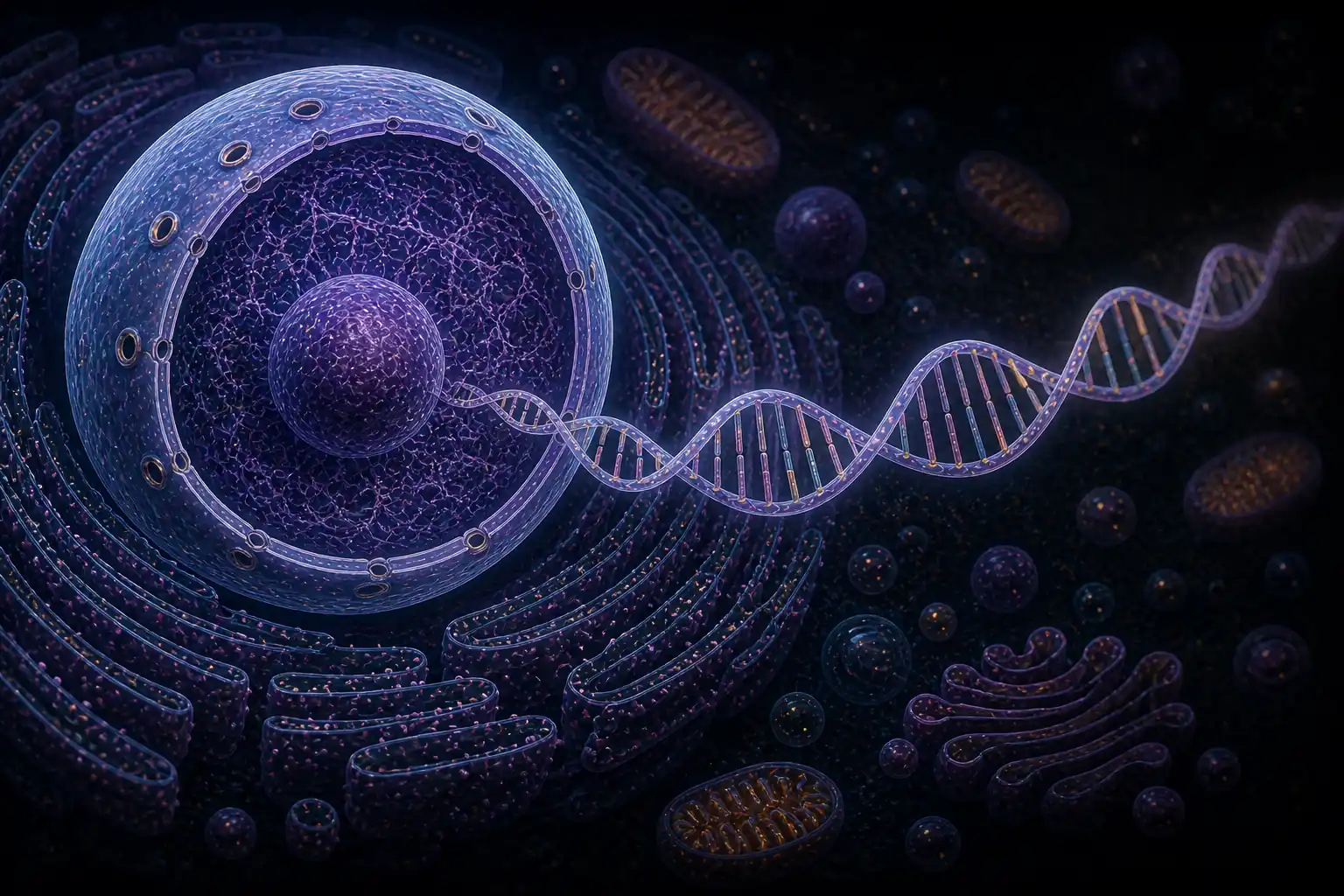
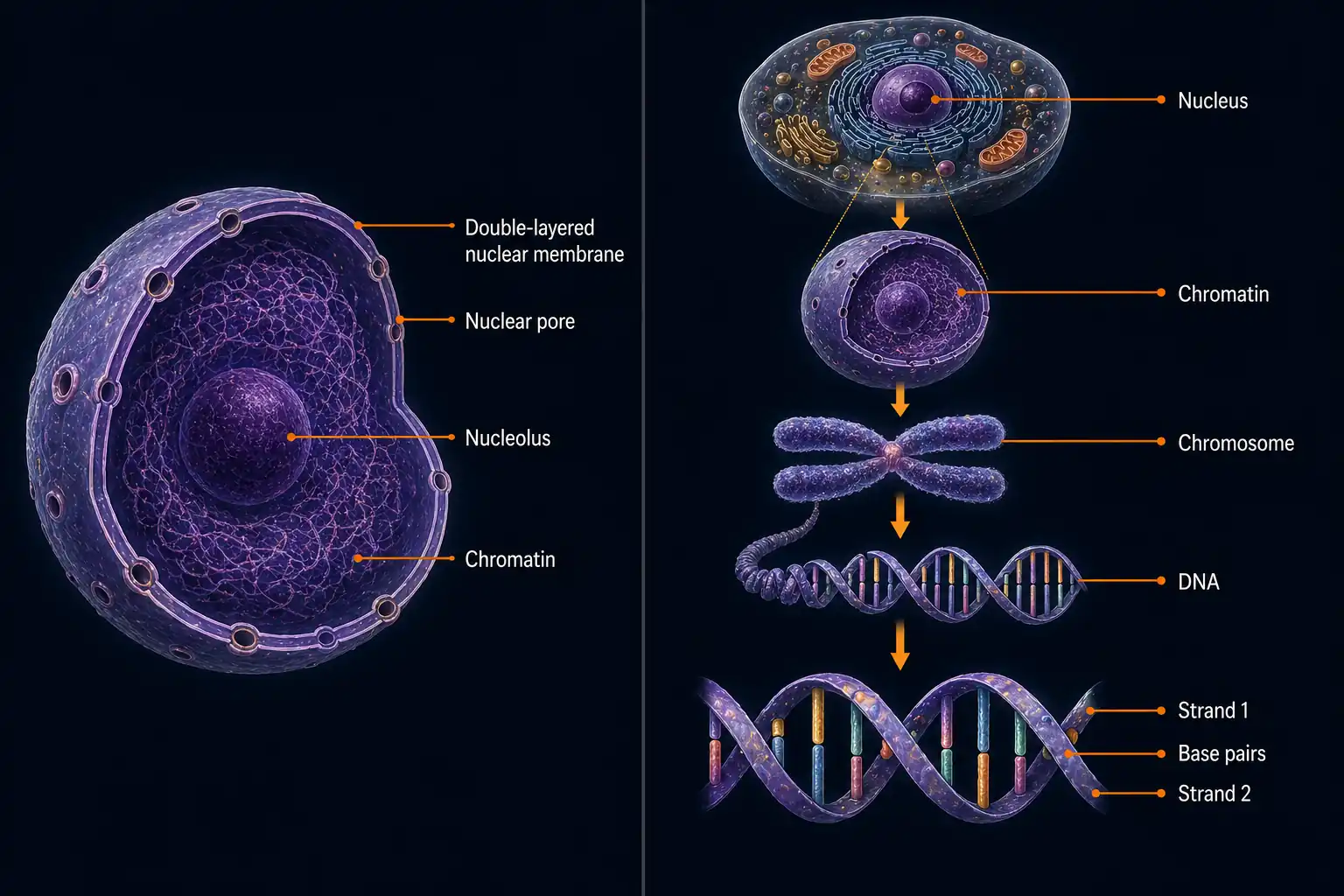
The nuclear membrane is a double-layered envelope surrounding the nucleus. Two membranes — one inside the other, with a tiny gap between. The double layer is studded with nuclear pores — small openings that allow controlled traffic of molecules between the nucleus and the rest of the cell. Like the borders of a sensitive archive: not sealed, but carefully monitored.
The nucleolus is a dense round body visible inside the nucleus. (Notice the slightly different word: nucleus vs. nucleolus, little nucleus.) The nucleolus is a busy factory — it produces the subunits of ribosomes. Once made, these ribosomal subunits exit the nucleus through the nuclear pores into the cytoplasm. There, they assemble into complete ribosomes — the protein-making machines you'll meet on the next page.
Why does the nucleus need a separate membrane at all? Because of what it contains. The nucleus is the cell's archive of inherited instructions. The DNA inside cannot be allowed to mix freely with the rest of the cell's chemistry — it must be protected, copied carefully, and read with discipline. The double membrane and controlled pores are how the cell achieves that protection.
Chromatin, Chromosomes, and the Genes Within
Let's now zoom in. Inside the nucleus, the great molecule of inheritance — DNA (Deoxyribonucleic Acid) — is stored. DNA is what carries the instructions for everything from the colour of your eyes to the shape of your earlobes to the rhythm of your heartbeat. It is passed from parents to offspring, generation after generation.
DNA does not float freely in the nucleus. It is wound around proteins, organised carefully. The exact arrangement depends on what the cell is doing:
When a cell is not about to divide — which is most of the time — the DNA appears as an entangled mass of fine, thread-like material called chromatin. Under the microscope, it looks like a tangled pile of fibres filling the nucleus.
When a cell is about to divide, the chromatin organises itself dramatically. The fine threads condense and coil into thick, distinct, rod-shaped structures called chromosomes. Each chromosome is a tightly packaged single long molecule of DNA. Chromosomes are visible under a light microscope only during cell division — that is when they take on their famous rod-like form.
What exactly is on the DNA? Genes.
A gene is a functional segment of DNA — a stretch of the molecule that codes for a specific instruction (typically, the recipe for making one protein). A single chromosome contains many genes, in fixed positions along its length. A complete set of all the chromosomes in a cell — and therefore all the genes — is called a genome.
When the cell divides, it copies all of this — every chromosome, every gene — and sends a complete copy to each daughter cell. This is how genetic information is preserved across generations of cells, and across generations of organisms.
A simple way to picture the hierarchy:
Genes → DNA → Chromatin (loose) → Chromosomes (condensed) → Nucleus → Cell
From a single segment of code, all the way up to a living cell. Many becoming one — exactly as the Mundaka Upanishad describes.
What About Prokaryotes? The Nucleoid
What about bacteria — prokaryotic cells with no true nucleus? Where do they keep their DNA?
A prokaryotic cell does have DNA — every living thing does. But its DNA is not enclosed by a membrane. Instead, it sits in a region of the cytoplasm called the nucleoid — literally, nucleus-like.
Also, the DNA in a bacterium is structured differently:
- A eukaryotic cell typically has several long, linear chromosomes (you have 46).
- A bacterial cell typically has one single, circular DNA molecule — like a closed loop — associated with specific proteins.
The nucleoid is not a primitive failure to evolve a nucleus. It is just a different solution to the same problem of storing genetic information. Bacterial cells, being smaller and simpler, evolved a more streamlined arrangement: one circular DNA molecule, freely accessible in the cytoplasm, no membrane enclosure needed.
Different solutions, same essential function: store the code; copy it accurately; pass it on. That requirement is universal. The architecture varies.
The Cells That Threw Away Their Nucleus
If the nucleus is so essential, what happens to a cell that doesn't have one? Surely such a cell could not survive?
When Reading the Code Saves Lives
The discovery that all heritable information is encoded in DNA was made in the mid-20th century. Today, that knowledge has rewritten medicine, agriculture, and even the justice system.
Every cell in your body — a skin cell, a liver cell, a muscle cell, a neuron in your brain — contains exactly the same set of DNA. Your skin cell has the same genes as your brain cell.
But these cells look completely different and do completely different jobs.
A skin cell makes keratin (a tough, protective protein). A liver cell makes detoxifying enzymes. A muscle cell makes contractile proteins (actin and myosin). A pancreatic cell makes insulin. Yet all share an identical DNA library.
How can the same set of instructions produce such different cells? What must be happening?
Manana Moment
Contemplation before you continue
The Mundaka Upanishad's image is striking: as the spider weaves the entire web from inside itself, all of life arises from the Akṣara — the imperishable. Modern biology has found this image stunningly literal at the level of the cell. Every cell carries within it an imperishable archive — DNA, copied faithfully through millennia, passed from parent to offspring across countless generations. From this archive the entire organism is woven, day by day, breath by breath.
You — the person reading this sentence — are a slow weaving of an ancient code. Your mother's grandmother's grandmother carried versions of the same genes. The hair on your head, the colour of your eyes, the height you will grow to, the shape of your smile — all written, in part, in a molecule no one can see without an electron microscope.
Before you continue, ask yourself:
If the imperishable code in you was written across thousands of generations — and it is the same kind of code that wrote every other living thing on Earth — what does that say about your relationship to a tree, a bird, a bacterium?
This is not a poetic exaggeration. It is a fact. All life on Earth uses the same DNA chemistry. Every living thing you have ever seen reads from the same alphabet. The depth of that family resemblance is something biology has only just learned to see — but Indian thought has been hinting at it for thousands of years.
What This Page Teaches Us
-
The nucleus is the control centre of the eukaryotic cell. It has a double-layered nuclear membrane with nuclear pores for controlled traffic.
-
The nucleolus is a dense round body inside the nucleus. It manufactures the subunits of ribosomes, which are then assembled into ribosomes in the cytoplasm.
-
The nucleus contains DNA — long molecules carrying inherited instructions. DNA does not float freely; it is structured.
-
In a non-dividing cell, DNA is loose, thread-like — called chromatin. When a cell is about to divide, chromatin condenses into thick, rod-shaped chromosomes.
-
A gene is a functional segment of DNA — typically the recipe for one protein. Many genes lie along each chromosome.
-
In prokaryotic cells, DNA is not enclosed in a membrane. It sits in a region called the nucleoid, often as a single circular molecule.
-
Mature human RBCs have no nucleus — they trade away the ability to repair or divide in exchange for more haemoglobin space. Their lifespan is about 120 days.
-
Modern DNA-based technologies — forensics, genetic medicine, vaccines (including India's Zydus-D), crop improvement — all rest on the discovery that the cell's nucleus holds a readable, writable code.
-
The Mundaka Upanishad's vision — all complexity arising from a single imperishable source — describes the cell with surprising precision. The nucleus is biology's Akṣara.
Q1.What is the function of the nucleolus (the dense round body inside the nucleus)?
You started life as a single cell — a fertilised egg, the size of a grain of sand. Today you are roughly 30 trillion cells. Skin, bone, brain, blood, muscle, hair, fingernails. Each one different. Each one carefully placed.
Where was the plan for all of this written? Not in your mother. Not in your father. Inside that one starting cell, somewhere, was a complete set of instructions — for the entire you that was about to exist. Where? Stored how?
Think about the kind of information storage that could fit inside something the size of a grain of sand and yet contain enough detail to specify a whole human being.
The Verse on the Spider and the Imperishable
यथोर्णनाभिः सृजते गृह्णते च
यथा पृथिव्यामोषधयः सम्भवन्ति।
यथा सतः पुरुषात् केशलोमानि
तथाक्षरात् सम्भवतीह विश्वम्॥
'जैसे मकड़ी अपने अंदर से धागा निकालती है और फिर उसे वापस खींच लेती है, जैसे ज़मीन से पेड़-पौधे उग आते हैं, जैसे इंसान के सिर पर बाल उग आते हैं — वैसे ही पूरी सृष्टि उस एक 'अक्षर' (अविनाशी) से निकलती है।'
"As a spider weaves and withdraws its web, as plants grow from the earth, as hair grows on a person's body — so the entire universe arises from the Imperishable (Akṣara)."
The verse names a remarkable pattern: that all visible complexity unfolds from a single quiet, imperishable source. Modern biology has discovered the same pattern at the cellular level — in every nucleus sits a long, imperishable archive (DNA) from which the entire activity of the cell, and indeed of the whole organism, quietly unspools.
The Cell's Control Centre
The nucleus is, in most eukaryotic cells, the largest and most prominent organelle. Look at almost any cell under a microscope and the nucleus is usually the first thing you notice — a dark, dense, rounded body inside a sea of cytoplasm.
Its structure is precise and beautiful:
The nuclear membrane is a double-layered envelope surrounding the nucleus. Two membranes — one inside the other, with a tiny gap between. The double layer is studded with nuclear pores — small openings that allow controlled traffic of molecules between the nucleus and the rest of the cell. Like the borders of a sensitive archive: not sealed, but carefully monitored.
The nucleolus is a dense round body visible inside the nucleus. (Notice the slightly different word: nucleus vs. nucleolus, little nucleus.) The nucleolus is a busy factory — it produces the subunits of ribosomes. Once made, these ribosomal subunits exit the nucleus through the nuclear pores into the cytoplasm. There, they assemble into complete ribosomes — the protein-making machines you'll meet on the next page.
Why does the nucleus need a separate membrane at all? Because of what it contains. The nucleus is the cell's archive of inherited instructions. The DNA inside cannot be allowed to mix freely with the rest of the cell's chemistry — it must be protected, copied carefully, and read with discipline. The double membrane and controlled pores are how the cell achieves that protection.
Chromatin, Chromosomes, and the Genes Within
Let's now zoom in. Inside the nucleus, the great molecule of inheritance — DNA (Deoxyribonucleic Acid) — is stored. DNA is what carries the instructions for everything from the colour of your eyes to the shape of your earlobes to the rhythm of your heartbeat. It is passed from parents to offspring, generation after generation.
DNA does not float freely in the nucleus. It is wound around proteins, organised carefully. The exact arrangement depends on what the cell is doing:
When a cell is not about to divide — which is most of the time — the DNA appears as an entangled mass of fine, thread-like material called chromatin. Under the microscope, it looks like a tangled pile of fibres filling the nucleus.
When a cell is about to divide, the chromatin organises itself dramatically. The fine threads condense and coil into thick, distinct, rod-shaped structures called chromosomes. Each chromosome is a tightly packaged single long molecule of DNA. Chromosomes are visible under a light microscope only during cell division — that is when they take on their famous rod-like form.
What exactly is on the DNA? Genes.
A gene is a functional segment of DNA — a stretch of the molecule that codes for a specific instruction (typically, the recipe for making one protein). A single chromosome contains many genes, in fixed positions along its length. A complete set of all the chromosomes in a cell — and therefore all the genes — is called a genome.
When the cell divides, it copies all of this — every chromosome, every gene — and sends a complete copy to each daughter cell. This is how genetic information is preserved across generations of cells, and across generations of organisms.
A simple way to picture the hierarchy:
Genes → DNA → Chromatin (loose) → Chromosomes (condensed) → Nucleus → Cell
From a single segment of code, all the way up to a living cell. Many becoming one — exactly as the Mundaka Upanishad describes.
What About Prokaryotes? The Nucleoid
What about bacteria — prokaryotic cells with no true nucleus? Where do they keep their DNA?
A prokaryotic cell does have DNA — every living thing does. But its DNA is not enclosed by a membrane. Instead, it sits in a region of the cytoplasm called the nucleoid — literally, nucleus-like.
Also, the DNA in a bacterium is structured differently:
- A eukaryotic cell typically has several long, linear chromosomes (you have 46).
- A bacterial cell typically has one single, circular DNA molecule — like a closed loop — associated with specific proteins.
The nucleoid is not a primitive failure to evolve a nucleus. It is just a different solution to the same problem of storing genetic information. Bacterial cells, being smaller and simpler, evolved a more streamlined arrangement: one circular DNA molecule, freely accessible in the cytoplasm, no membrane enclosure needed.
Different solutions, same essential function: store the code; copy it accurately; pass it on. That requirement is universal. The architecture varies.
The Cells That Threw Away Their Nucleus
If the nucleus is so essential, what happens to a cell that doesn't have one? Surely such a cell could not survive?
When Reading the Code Saves Lives
The discovery that all heritable information is encoded in DNA was made in the mid-20th century. Today, that knowledge has rewritten medicine, agriculture, and even the justice system.
Every cell in your body — a skin cell, a liver cell, a muscle cell, a neuron in your brain — contains exactly the same set of DNA. Your skin cell has the same genes as your brain cell.
But these cells look completely different and do completely different jobs.
A skin cell makes keratin (a tough, protective protein). A liver cell makes detoxifying enzymes. A muscle cell makes contractile proteins (actin and myosin). A pancreatic cell makes insulin. Yet all share an identical DNA library.
How can the same set of instructions produce such different cells? What must be happening?
What This Page Teaches Us
-
The nucleus is the control centre of the eukaryotic cell. It has a double-layered nuclear membrane with nuclear pores for controlled traffic.
-
The nucleolus is a dense round body inside the nucleus. It manufactures the subunits of ribosomes, which are then assembled into ribosomes in the cytoplasm.
-
The nucleus contains DNA — long molecules carrying inherited instructions. DNA does not float freely; it is structured.
-
In a non-dividing cell, DNA is loose, thread-like — called chromatin. When a cell is about to divide, chromatin condenses into thick, rod-shaped chromosomes.
-
A gene is a functional segment of DNA — typically the recipe for one protein. Many genes lie along each chromosome.
-
In prokaryotic cells, DNA is not enclosed in a membrane. It sits in a region called the nucleoid, often as a single circular molecule.
-
Mature human RBCs have no nucleus — they trade away the ability to repair or divide in exchange for more haemoglobin space. Their lifespan is about 120 days.
-
Modern DNA-based technologies — forensics, genetic medicine, vaccines (including India's Zydus-D), crop improvement — all rest on the discovery that the cell's nucleus holds a readable, writable code.
-
The Mundaka Upanishad's vision — all complexity arising from a single imperishable source — describes the cell with surprising precision. The nucleus is biology's Akṣara.
Q1.What is the function of the nucleolus (the dense round body inside the nucleus)?