Cell Theory and the Cycles of Life
How three nineteenth-century scientists named the unifying principle of biology — and what modern cell biology has discovered about the deep balance of birth and death
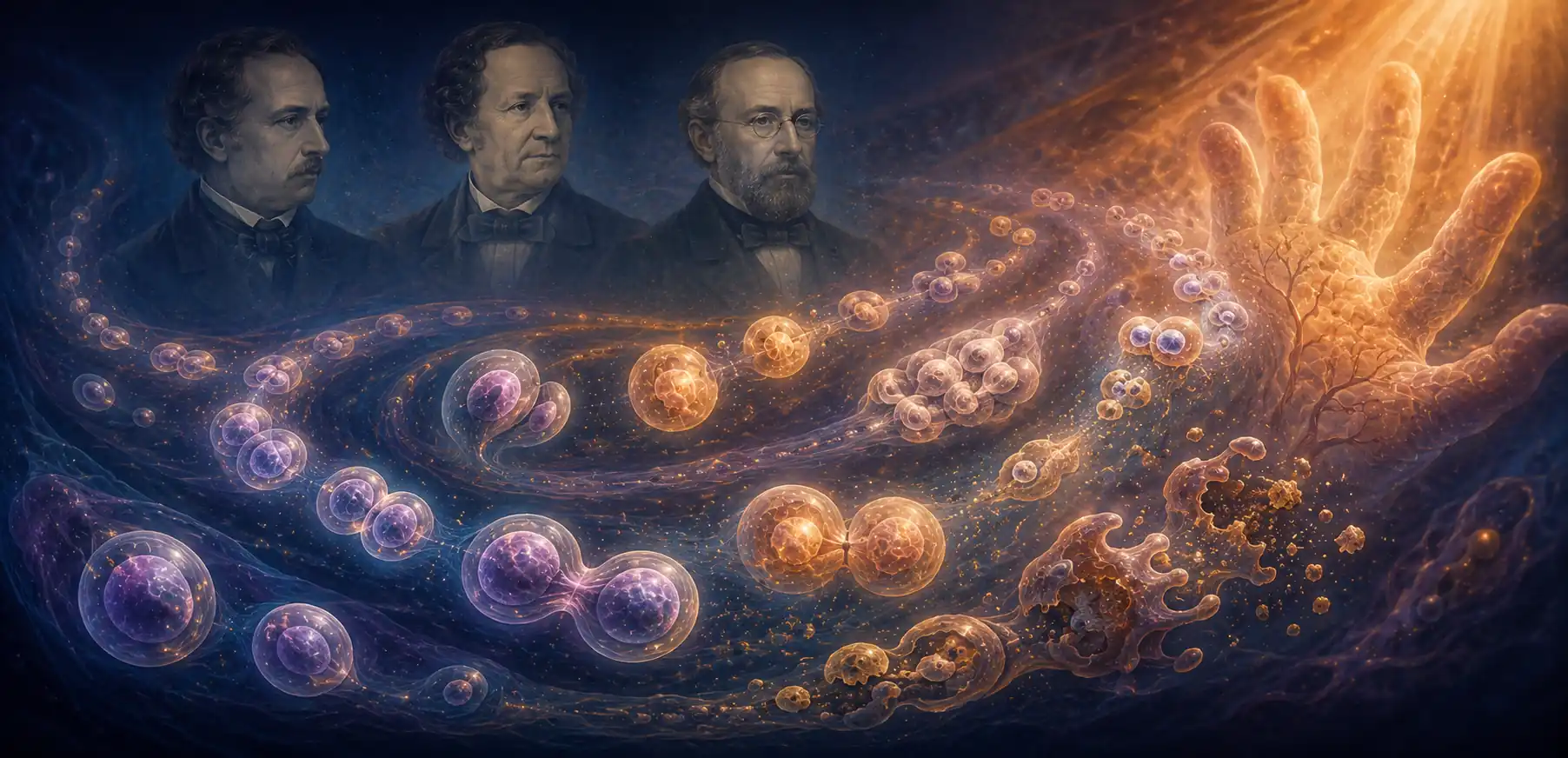
Eight pages ago, this chapter started with a question: what is the basic unit of life?
We have travelled through hot springs and microscopes, through membranes and nuclei, through factories and powerhouses, through cell division and the very first cells. Across all of this, one principle has quietly held everything together — the principle that all living organisms are made of cells, that the cell is the basic unit of life, and that all cells come from pre-existing cells.
This principle has a name: the Cell Theory. It is one of the great unifying ideas in all of science. But it raises a question this chapter has been waiting to ask:
If every cell came from a previous cell — where did the very first cell come from? And how does life keep itself going by birth and by death, generation after generation?
Look back at this chapter's earlier pages. Hot springs. The first membranes. Mitosis. Meiosis. They are all part of the same continuous story.
The Verse on the Inevitability of Cycles
जातस्य हि ध्रुवो मृत्युर्ध्रुवं जन्म मृतस्य च।
तस्मादपरिहार्येऽर्थे न त्वं शोचितुमर्हसि॥
'जो पैदा हुआ है, उसकी मृत्यु निश्चित है। जो मरा है, उसका जन्म निश्चित है। तो जिस बात को टाला नहीं जा सकता, उसके लिए दुख क्यों करना?'
"For one who has been born, death is certain. For one who has died, birth is certain. Therefore, for that which is unavoidable, you should not grieve."
The verse names the deepest pattern of biology with stark clarity: birth and death are not opposites — they are the same continuous cycle. Every cell that is born will die. Every part of you alive today will eventually be replaced. And yet life continues — not despite the cycle, but through it. This page is about that cycle, both when it works beautifully and when it fails.
Cell Theory — The Unifying Principle of Biology
The story of how scientists came to recognise the cell as the universal unit of life unfolded over about two decades in the 19th century, in three crucial steps.
1838 — Matthias Schleiden (German botanist). After years of careful microscopic observation of plant tissues, Schleiden announced what would have seemed an extravagant claim: all plants are made up of cells. Not just some plants. All of them. From mosses to trees, from leaves to roots, from petals to seeds — every living plant tissue is a community of cells.
1839 — Theodor Schwann (German zoologist), Schleiden's friend and colleague, extended the claim to the animal kingdom: all animals are made up of cells, too. With this step, plants and animals — which had long been thought of as fundamentally different kinds of life — were recognised as built from the same basic unit.
1855 — Rudolf Virchow (German doctor and pathologist) added the third and most powerful piece of the theory. He argued, on the basis of studying diseases, that all cells arise from pre-existing cells. Omnis cellula e cellula — 'every cell from a cell.' New cells do not appear from non-living matter spontaneously; they always come from older cells dividing. This statement settled a centuries-old debate about whether life could arise spontaneously from dead matter, and laid the foundation for understanding inheritance, growth, and disease.
Together, these three insights make up the classical Cell Theory:
- All living organisms are made up of one or more cells.
- The cell is the basic unit of structure and function in living beings.
- All cells arise from pre-existing cells.
These three statements are the deepest unifying principle in biology. They tie together a bacterium in a hot spring, a leaf on a tree, a fish in the sea, a child born last week, and you reading this sentence. All of you are made of cells. All your cells came from previous cells. And those cells came from cells before them — back, and back, and back, in an unbroken chain stretching for billions of years.
From one beginning, all life. Many becoming one — the same theme this chapter has returned to, again and again.
Do Cells Live Forever?
If new cells always come from old cells dividing — does that mean cells never die? Far from it.
Every cell in your body has a definite lifespan. Some cells, like skin cells, live only about a month. Others, like red blood cells, live ~120 days. Liver cells live a year or more. Some neurons in your brain may live as long as you do. After their useful lifespan, cells are meant to die — and to be replaced by new ones produced through mitosis.
This death-and-replacement cycle is carefully regulated. Cells do not just divide whenever they want to. They check signals from their surroundings, ensure conditions are right, and only divide when needed. One of the most important regulatory mechanisms is called contact inhibition.
Contact inhibition. When animal cells grow in a tissue and come into contact with neighbouring cells on all sides, they receive signals to stop dividing. This prevents over-crowding and keeps tissues neat and properly shaped. A wound heals only until the new skin cells touch each other — and then division stops. The wound closes; the skin is restored; growth ceases.
Plant cells, with their rigid cell walls, do not show contact inhibition the same way. They follow different rules of growth — which is why plants can keep growing taller and broader for years, sometimes for centuries.
When contact inhibition fails, however, the consequences are devastating. Cancer is, in essence, exactly this failure: cells that have lost their control over when to divide and when to stop. They keep multiplying, ignoring all the signals that should tell them to stop. They form lumps called tumours that disrupt the normal functioning of tissues and organs.
Understanding cell division — and what stops it — is therefore not just an academic question. It is the foundation of cancer biology, and of every effort to treat one of the most serious diseases of our time.
How Do Cancer Cells Grow and Spread?
Normal cells grow, age, and die in a controlled manner. Sometimes, this regulatory system breaks down. Abnormal cells start growing and dividing uncontrollably, ignoring every signal that should slow them down.
When Death Builds Life — Programmed Cell Death
Cancer is what happens when cells refuse to die when they should. But there is an equally remarkable phenomenon in the opposite direction: cells that die exactly when and where they should — and by doing so, build the structure of a living body.
This controlled, deliberate death is called Programmed Cell Death (PCD).
PCD is not damage. It is not failure. It is a genetically regulated process — written into the DNA of every cell — by which the cell selectively destroys itself when its time has come or when its survival would interfere with the larger organism. PCD is essential for:
- Normal development — building the body during growth
- Cellular quality control — eliminating damaged or defective cells before they cause problems
- Immune function — removing immune cells once they have done their job, to prevent uncontrolled inflammation
The most striking example of PCD comes from human embryonic development.
Why do you have separate fingers? A growing human embryo, at one stage of development, has paddle-like hands and feet — the digits are not yet separated. The cells that connect one finger to the next are present, alive, and dividing.
Then something extraordinary happens. The cells between the developing fingers receive a genetic signal: die now. And they obey. These cells initiate Programmed Cell Death — they dismantle themselves cleanly, and are absorbed by the body. The digits separate. You have fingers, not webbed hands, because of millions of cells that died exactly when and where they were supposed to.
The same process sculpts your toes. It removes unnecessary nerve cells in your developing brain. It eliminates the tail of a tadpole as it transforms into a frog. It carves the petal patterns of certain flowers.
Death, in short, is not the opposite of life — it is one of life's most powerful tools. Without controlled cell death, an embryo cannot develop. Without controlled cell death, damaged cells accumulate and become cancer. Without controlled cell death, immune responses spiral out of control.
The Bhagavad Gita's verse — birth is certain for the dead; death is certain for the born — is not just philosophy. It is, at the cellular level, a literal description of how a body builds and maintains itself.
A 1902 Idea That Now Feeds India
It took a century for Haberlandt's idea of totipotency to become a working technology — but when it did, the impact was profound.
Two cells in your body are misbehaving in different ways:
-
Cell X is supposed to die at the end of its 30-day life span — but it refuses to die. It just keeps living, dividing, and producing more cells like itself.
-
Cell Y is supposed to keep functioning for years — but it dies prematurely, taking a small piece of healthy tissue with it.
Both situations are bad for the body — but they cause different kinds of disease. Based on this chapter:
Which scenario describes the cellular failure behind cancer? And why does the other scenario also cause health problems?
Manana Moment — Closing the Chapter
A contemplation as the chapter ends
Nine pages ago, this chapter began in a hot spring in Ladakh, contemplating how the very first cell may have come to be.
It has now ended in a different place: with the recognition that death itself, when controlled and timely, is one of life's most precious tools. Without programmed cell death, your fingers would not have separated. Without natural cell death, tissues would not be renewed. Without orderly cellular endings, there would be no orderly cellular beginnings.
The Bhagavad Gita's verse said it directly: birth is certain for the dead; death is certain for the born. Modern cell biology has discovered, with stunning precision, that the cycle is not just metaphysical — it is physical, chemical, observable, and essential.
Before you close this chapter, sit for a moment with a question that the next nine years of your life will return to many times:
If your body is constantly being remade — old cells dying, new cells being born — what is it that is constant about you? What is the one thread that runs through all this becoming and unbecoming, that lets you call yourself "me"?
The ancient Indian sages and modern cell biologists have, in their different languages, both pointed to the same wonder: you are not a thing. You are a process. A pattern that maintains itself by constant cellular renewal — held together by the imperishable code in your nucleus, the cooperative offering of your organelles, the careful boundary of your membranes. Many becoming one. Many becoming one. Many becoming one — every second, in every breath, for as long as you live.
What This Page (and This Chapter) Teaches Us
The Cell Theory. Three statements, formulated by Schleiden (1838), Schwann (1839), and Virchow (1855):
- All living organisms are made up of one or more cells.
- The cell is the basic unit of structure and function in living beings.
- All cells arise from pre-existing cells.
Cells have lifespans. Cells grow, divide, function, and die in regulated cycles. Contact inhibition is one mechanism that stops cell division when cells touch each other — preventing over-crowding.
Cancer is the failure of regulated cell division. Cells lose contact inhibition and other controls, multiplying without restraint. Tumours can be benign (stays put) or malignant (cancerous, can invade and metastasise).
Programmed Cell Death (PCD) is the genetically controlled, deliberate death of cells. Without PCD, your fingers would not have separated from each other during embryonic development. PCD is essential for normal growth, immune function, and quality control.
Gottlieb Haberlandt (1902) proposed totipotency — the idea that any plant cell can grow into a complete new plant. His idea is now the foundation of Plant Tissue Culture, which has transformed Indian agriculture (bananas, sugarcane, orchids, medicinal plants).
Looking back across the chapter: Life began ~3.5 billion years ago in mineral-rich pools. The first protective membranes formed boundaries that defined a 'self'. Cells diversified into prokaryotic and eukaryotic types. Eukaryotic cells developed compartmentalisation through membrane-bound organelles — nucleus, ER, Golgi, lysosomes, mitochondria, plastids, vacuoles. Cells multiplied through mitosis and (for sexual reproduction) meiosis. Cells died in regulated ways through programmed cell death. And through this entire long story, the cell remained the basic unit at every level of life on Earth.
You are part of this story. Right now, in your body, all of it is happening — cells dividing, organelles cooperating, membranes deciding, mitochondria producing, nuclei archiving, lysosomes recycling, programmed deaths sculpting your tissues. The chapter that closes here is, in another sense, the chapter you are made of.
Q1.Which scientists are credited with formulating the Cell Theory?
Eight pages ago, this chapter started with a question: what is the basic unit of life?
We have travelled through hot springs and microscopes, through membranes and nuclei, through factories and powerhouses, through cell division and the very first cells. Across all of this, one principle has quietly held everything together — the principle that all living organisms are made of cells, that the cell is the basic unit of life, and that all cells come from pre-existing cells.
This principle has a name: the Cell Theory. It is one of the great unifying ideas in all of science. But it raises a question this chapter has been waiting to ask:
If every cell came from a previous cell — where did the very first cell come from? And how does life keep itself going by birth and by death, generation after generation?
Look back at this chapter's earlier pages. Hot springs. The first membranes. Mitosis. Meiosis. They are all part of the same continuous story.
The Verse on the Inevitability of Cycles
जातस्य हि ध्रुवो मृत्युर्ध्रुवं जन्म मृतस्य च।
तस्मादपरिहार्येऽर्थे न त्वं शोचितुमर्हसि॥
'जो पैदा हुआ है, उसकी मृत्यु निश्चित है। जो मरा है, उसका जन्म निश्चित है। तो जिस बात को टाला नहीं जा सकता, उसके लिए दुख क्यों करना?'
"For one who has been born, death is certain. For one who has died, birth is certain. Therefore, for that which is unavoidable, you should not grieve."
The verse names the deepest pattern of biology with stark clarity: birth and death are not opposites — they are the same continuous cycle. Every cell that is born will die. Every part of you alive today will eventually be replaced. And yet life continues — not despite the cycle, but through it. This page is about that cycle, both when it works beautifully and when it fails.
Cell Theory — The Unifying Principle of Biology
The story of how scientists came to recognise the cell as the universal unit of life unfolded over about two decades in the 19th century, in three crucial steps.
1838 — Matthias Schleiden (German botanist). After years of careful microscopic observation of plant tissues, Schleiden announced what would have seemed an extravagant claim: all plants are made up of cells. Not just some plants. All of them. From mosses to trees, from leaves to roots, from petals to seeds — every living plant tissue is a community of cells.
1839 — Theodor Schwann (German zoologist), Schleiden's friend and colleague, extended the claim to the animal kingdom: all animals are made up of cells, too. With this step, plants and animals — which had long been thought of as fundamentally different kinds of life — were recognised as built from the same basic unit.
1855 — Rudolf Virchow (German doctor and pathologist) added the third and most powerful piece of the theory. He argued, on the basis of studying diseases, that all cells arise from pre-existing cells. Omnis cellula e cellula — 'every cell from a cell.' New cells do not appear from non-living matter spontaneously; they always come from older cells dividing. This statement settled a centuries-old debate about whether life could arise spontaneously from dead matter, and laid the foundation for understanding inheritance, growth, and disease.
Together, these three insights make up the classical Cell Theory:
- All living organisms are made up of one or more cells.
- The cell is the basic unit of structure and function in living beings.
- All cells arise from pre-existing cells.
These three statements are the deepest unifying principle in biology. They tie together a bacterium in a hot spring, a leaf on a tree, a fish in the sea, a child born last week, and you reading this sentence. All of you are made of cells. All your cells came from previous cells. And those cells came from cells before them — back, and back, and back, in an unbroken chain stretching for billions of years.
From one beginning, all life. Many becoming one — the same theme this chapter has returned to, again and again.
Do Cells Live Forever?
If new cells always come from old cells dividing — does that mean cells never die? Far from it.
Every cell in your body has a definite lifespan. Some cells, like skin cells, live only about a month. Others, like red blood cells, live ~120 days. Liver cells live a year or more. Some neurons in your brain may live as long as you do. After their useful lifespan, cells are meant to die — and to be replaced by new ones produced through mitosis.
This death-and-replacement cycle is carefully regulated. Cells do not just divide whenever they want to. They check signals from their surroundings, ensure conditions are right, and only divide when needed. One of the most important regulatory mechanisms is called contact inhibition.
Contact inhibition. When animal cells grow in a tissue and come into contact with neighbouring cells on all sides, they receive signals to stop dividing. This prevents over-crowding and keeps tissues neat and properly shaped. A wound heals only until the new skin cells touch each other — and then division stops. The wound closes; the skin is restored; growth ceases.
Plant cells, with their rigid cell walls, do not show contact inhibition the same way. They follow different rules of growth — which is why plants can keep growing taller and broader for years, sometimes for centuries.
When contact inhibition fails, however, the consequences are devastating. Cancer is, in essence, exactly this failure: cells that have lost their control over when to divide and when to stop. They keep multiplying, ignoring all the signals that should tell them to stop. They form lumps called tumours that disrupt the normal functioning of tissues and organs.
Understanding cell division — and what stops it — is therefore not just an academic question. It is the foundation of cancer biology, and of every effort to treat one of the most serious diseases of our time.
How Do Cancer Cells Grow and Spread?
Normal cells grow, age, and die in a controlled manner. Sometimes, this regulatory system breaks down. Abnormal cells start growing and dividing uncontrollably, ignoring every signal that should slow them down.
When Death Builds Life — Programmed Cell Death
Cancer is what happens when cells refuse to die when they should. But there is an equally remarkable phenomenon in the opposite direction: cells that die exactly when and where they should — and by doing so, build the structure of a living body.
This controlled, deliberate death is called Programmed Cell Death (PCD).
PCD is not damage. It is not failure. It is a genetically regulated process — written into the DNA of every cell — by which the cell selectively destroys itself when its time has come or when its survival would interfere with the larger organism. PCD is essential for:
- Normal development — building the body during growth
- Cellular quality control — eliminating damaged or defective cells before they cause problems
- Immune function — removing immune cells once they have done their job, to prevent uncontrolled inflammation
The most striking example of PCD comes from human embryonic development.
Why do you have separate fingers? A growing human embryo, at one stage of development, has paddle-like hands and feet — the digits are not yet separated. The cells that connect one finger to the next are present, alive, and dividing.
Then something extraordinary happens. The cells between the developing fingers receive a genetic signal: die now. And they obey. These cells initiate Programmed Cell Death — they dismantle themselves cleanly, and are absorbed by the body. The digits separate. You have fingers, not webbed hands, because of millions of cells that died exactly when and where they were supposed to.
The same process sculpts your toes. It removes unnecessary nerve cells in your developing brain. It eliminates the tail of a tadpole as it transforms into a frog. It carves the petal patterns of certain flowers.
Death, in short, is not the opposite of life — it is one of life's most powerful tools. Without controlled cell death, an embryo cannot develop. Without controlled cell death, damaged cells accumulate and become cancer. Without controlled cell death, immune responses spiral out of control.
The Bhagavad Gita's verse — birth is certain for the dead; death is certain for the born — is not just philosophy. It is, at the cellular level, a literal description of how a body builds and maintains itself.
A 1902 Idea That Now Feeds India
It took a century for Haberlandt's idea of totipotency to become a working technology — but when it did, the impact was profound.
Two cells in your body are misbehaving in different ways:
-
Cell X is supposed to die at the end of its 30-day life span — but it refuses to die. It just keeps living, dividing, and producing more cells like itself.
-
Cell Y is supposed to keep functioning for years — but it dies prematurely, taking a small piece of healthy tissue with it.
Both situations are bad for the body — but they cause different kinds of disease. Based on this chapter:
Which scenario describes the cellular failure behind cancer? And why does the other scenario also cause health problems?
What This Page (and This Chapter) Teaches Us
The Cell Theory. Three statements, formulated by Schleiden (1838), Schwann (1839), and Virchow (1855):
- All living organisms are made up of one or more cells.
- The cell is the basic unit of structure and function in living beings.
- All cells arise from pre-existing cells.
Cells have lifespans. Cells grow, divide, function, and die in regulated cycles. Contact inhibition is one mechanism that stops cell division when cells touch each other — preventing over-crowding.
Cancer is the failure of regulated cell division. Cells lose contact inhibition and other controls, multiplying without restraint. Tumours can be benign (stays put) or malignant (cancerous, can invade and metastasise).
Programmed Cell Death (PCD) is the genetically controlled, deliberate death of cells. Without PCD, your fingers would not have separated from each other during embryonic development. PCD is essential for normal growth, immune function, and quality control.
Gottlieb Haberlandt (1902) proposed totipotency — the idea that any plant cell can grow into a complete new plant. His idea is now the foundation of Plant Tissue Culture, which has transformed Indian agriculture (bananas, sugarcane, orchids, medicinal plants).
Looking back across the chapter: Life began ~3.5 billion years ago in mineral-rich pools. The first protective membranes formed boundaries that defined a 'self'. Cells diversified into prokaryotic and eukaryotic types. Eukaryotic cells developed compartmentalisation through membrane-bound organelles — nucleus, ER, Golgi, lysosomes, mitochondria, plastids, vacuoles. Cells multiplied through mitosis and (for sexual reproduction) meiosis. Cells died in regulated ways through programmed cell death. And through this entire long story, the cell remained the basic unit at every level of life on Earth.
You are part of this story. Right now, in your body, all of it is happening — cells dividing, organelles cooperating, membranes deciding, mitochondria producing, nuclei archiving, lysosomes recycling, programmed deaths sculpting your tissues. The chapter that closes here is, in another sense, the chapter you are made of.
Q1.Which scientists are credited with formulating the Cell Theory?