Powerhouses and Food Centres — Mitochondria, Plastids, Vacuoles
Where animal cells get their energy, where plant cells make their food, and the ancient cooperation that made both possible
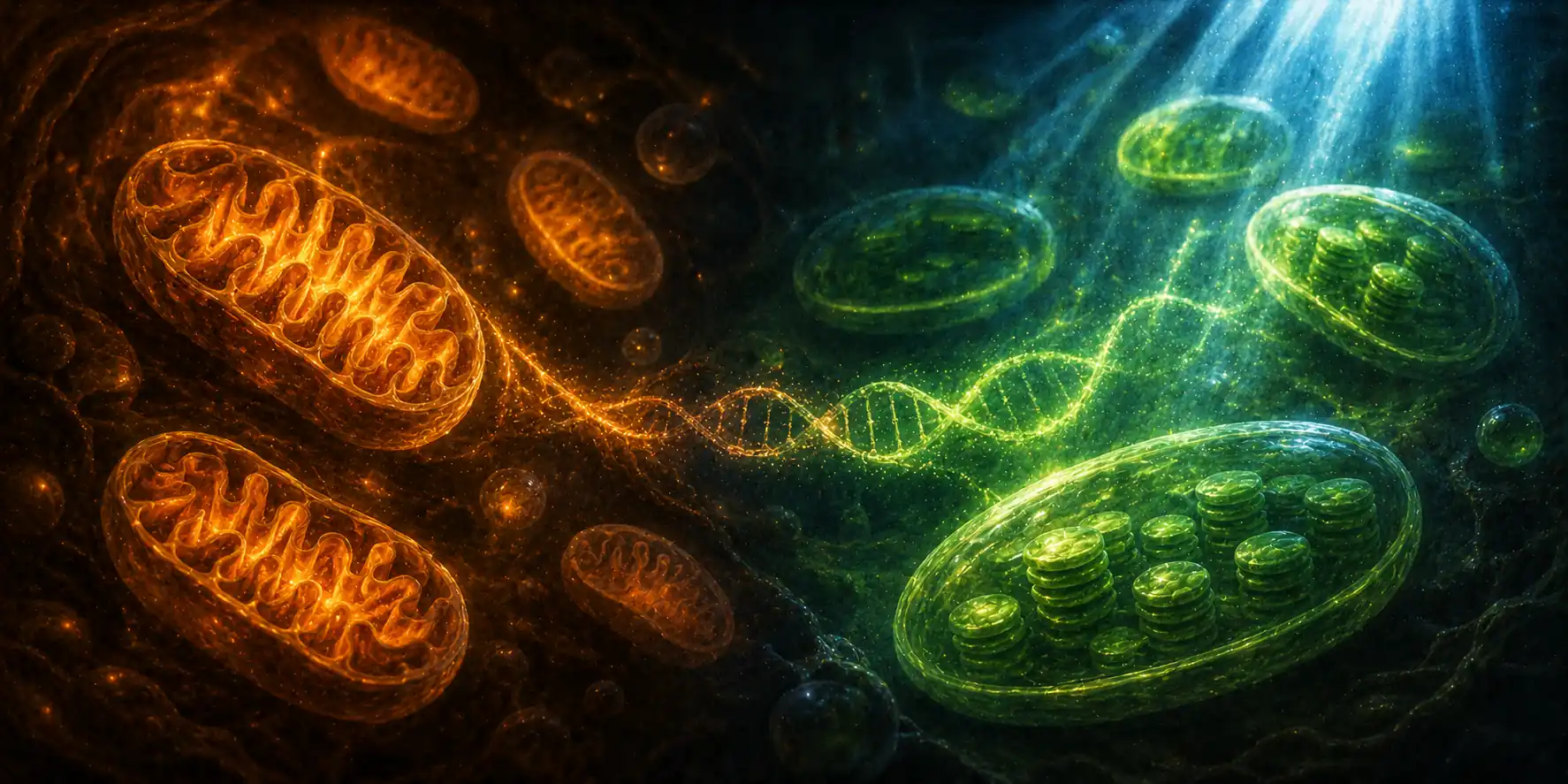
Right now, as you read this sentence, your body is continuously burning the food you ate at your last meal. Not in any visible flame — quietly, at the level of your cells. Trillions of tiny chemical reactions are converting sugars and fats into the energy that lets your eyes track these letters and your heart pump and your brain understand.
Where is this happening? And — even stranger — where do plants get their energy, since they don't eat anything at all?
Animals eat. Plants make their food from sunlight. Where, inside their cells, do these utterly different processes take place?
The Verse on the Two Cosmic Energies
गामाविश्य च भूतानि धारयाम्यहमोजसा।
पुष्णामि चौषधीः सर्वाः सोमो भूत्वा रसात्मकः॥
'मैं ही पृथ्वी में जाकर अपनी ऊर्जा से सब जीवों को संभालता हूं। और चंद्रमा बनकर — रस-रूप में — सभी पेड़-पौधों को पोषण देता हूं।'
"Entering the earth, I support all living beings with my energy. Becoming the moon — the essence of nourishment — I feed all plants."
The verse names the two great cosmic flows that biology has now mapped at the cellular level: the energy that sustains animal life (handled by mitochondria) and the nourishment that feeds plant life (handled by chloroplasts). The Indian seer saw these as two faces of the same supporting principle. Modern cell biology shows they are, remarkably, two faces of organelles that share a common ancient ancestor.
Mitochondria — The Powerhouse of the Cell
Of all the organelles in your cells, the mitochondria are the most famous — and rightly so. Without them, you would have no usable energy at all. Every breath you take, every step you walk, every thought you have, is powered by chemistry happening inside these tiny structures.
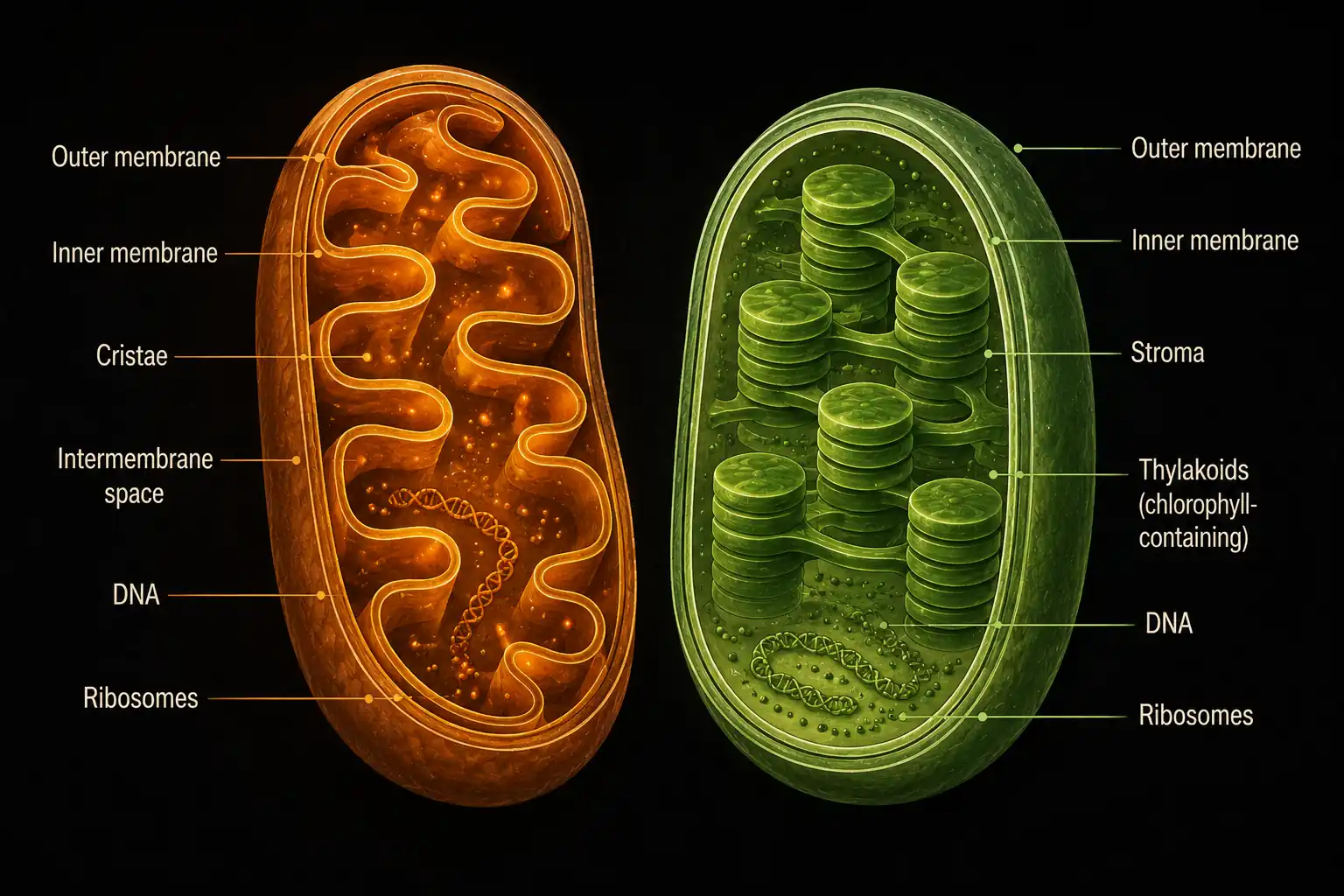
The structure of a mitochondrion is unusual: it has two membranes, one inside the other.
- The outer membrane is smooth and porous — letting most small molecules pass through freely.
- The inner membrane is dramatically folded into finger-like projections called cristae (singular: crista). These folds increase the surface area of the inner membrane enormously — packing far more functional area into the small organelle than a smooth surface ever could.
What happens inside? Cellular respiration. Glucose molecules from your food (and other fuel molecules) are broken down step by step in a series of carefully controlled chemical reactions. The energy released is captured and stored in a special molecule called ATP (Adenosine Triphosphate).
ATP is the cell's universal energy currency. Every time a cell needs to do work — contracting a muscle, building a protein, transmitting a nerve signal, copying DNA — it spends ATP. Mitochondria are constantly producing fresh ATP to fund all this work. Your body produces and consumes roughly your own body weight in ATP every single day. The molecules don't stay long; they are made and used and recycled in moments.
Why all those folds? The cristae are where most of the actual ATP-making happens. By folding the inner membrane, the mitochondrion creates more reaction surface — and more reaction surface means more ATP per second. It is the same principle as folding a small towel many times to fit it inside a cup: you get more material in the same volume.
Cells with high energy demand have many mitochondria. Heart muscle cells (which contract endlessly) and nerve cells (which fire signals constantly) are packed with thousands of mitochondria each. A mature red blood cell, by contrast, has none.
Plastids — Where Plants Make Their Food
Animals eat to get their food. Plants don't eat — they make their food from sunlight, water, and carbon dioxide, using a process called photosynthesis.
Where does this happen? In specialised plant organelles called plastids. The most important plastids — and the ones that do photosynthesis — are called chloroplasts.
Like mitochondria, chloroplasts are double-membrane-bound — outer and inner membranes. Their interior is filled with a semi-fluid substance called the stroma. Suspended inside the stroma are stacks of disc-shaped membrane structures, which contain the green pigment chlorophyll.
Chlorophyll is what makes plants green. More importantly, chlorophyll is what captures sunlight — converting the energy of light into chemical energy that the plant can use. The captured energy is then used in the stroma to combine carbon dioxide (from the air) and water (from the roots) into sugars.
Those sugars are the plant's food. Some are used immediately. Others are stored — often as starch granules — right there in the stroma, for use later or by other parts of the plant.
So the same cosmic energy that the Bhagavad Gita describes the moon as bringing to plants — rasa (essence of nourishment) — modern biology calls photosynthesis. Light becomes life. And it becomes life specifically inside the chloroplast.
Chromoplasts and Leucoplasts — The Other Plastids
Chloroplasts are the most famous plastids — but they are not the only kind. Plants have two other important plastid types, each beautifully named in Greek for what it does.
Chromoplasts (Greek chroma = colour). When you bite into a ripe mango, why is it bright yellow? When you cut open a tomato, why is it red? When you look at a marigold or a hibiscus, why are the petals such striking colours?
The answer is chromoplasts. These plastids contain pigments other than chlorophyll — yellows, oranges, reds — and they are responsible for almost every bright non-green colour you see in fruits, vegetables, and flowers.
Why does the plant bother making such bright colours? Because the colours have purposes. The bright colours of flowers attract pollinators — bees, butterflies, birds. The bright colours of ripe fruits attract animals that will eat the fruit and disperse the seeds far from the parent plant. Plants use colour as a signalling system to recruit other living things to help them reproduce and spread.
Leucoplasts (Greek leukos = white). These plastids have no pigment at all — they are colourless. Their job is simply storage.
Leucoplasts come in different sub-types depending on what they store:
- Amyloplasts store starch — a long-term carbohydrate reserve. The white starchy interior of a potato is packed with amyloplasts. The same is true of taro (Colocasia, arbi in Hindi) cells.
- Elaioplasts store oils — common in oil-bearing seeds.
- Proteinoplasts store proteins — common in seeds like beans and pulses.
When you eat a potato, you are eating the contents of millions of amyloplasts. When you eat almonds, you are eating elaioplasts. When you eat chana (chickpeas) or moong dal, you are eating proteinoplasts. The vegetarian Indian diet, in fact, relies heavily on three different kinds of leucoplast.
All three plastid types — chloroplast, chromoplast, leucoplast — are related. Plants can sometimes convert one kind into another. As a tomato ripens from green to red, its chloroplasts transform into chromoplasts. The cellular machinery is shared; only the contents change.
Vacuoles — Storage and Support
There is one more organelle to meet — and it is especially important for plants.
A vacuole is a fluid-filled sac inside a cell, surrounded by a single selectively permeable membrane. In plant cells, there is usually one large central vacuole that takes up much of the cell's interior — sometimes more than 50% of the cell's volume.
The central vacuole is filled with a watery fluid called cell sap, which contains:
- Water
- Dissolved minerals
- Sugars
- Pigments (in some cells)
- Waste materials
The vacuole has two main jobs:
Storage. It holds water, food, and waste materials safely inside its membrane.
Support. A full vacuole presses against the cell wall from inside, creating a kind of internal pressure (called turgor pressure). This pressure keeps the plant cell firm.
Ever noticed how a plant looks wilted after a hot day without water? That is the vacuoles losing their water — the cells losing their internal pressure — and the whole plant losing its firmness. Water the plant, and within hours the vacuoles refill, the cells become firm again, and the plant stands upright. The plant's posture is, quite literally, the posture of its vacuoles.
In animal cells, vacuoles also exist — but they are usually much smaller, and there can be several of them rather than one big one. They serve mainly for short-term storage of materials. Animals don't need vacuoles for structural support because animal cells lack cell walls anyway, and animals support themselves through skeletons, muscles, and skins.
The Strangest Story in Cell Biology
Here is something genuinely strange about mitochondria and chloroplasts that biologists have only fully understood in the last 50 years.
Compare two cells:
- A plant cell in the leaf of a mango tree.
- An animal cell in the muscle of a cheetah's leg.
The plant cell contains many chloroplasts but only a moderate number of mitochondria. The cheetah muscle cell contains no chloroplasts at all, but is packed with thousands of mitochondria.
Why do these two cells have such different organelle profiles? And what does this tell you about how the structure of a cell relates to its function in the wider body?
Manana Moment
Contemplation before you continue
The Bhagavad Gita's verse says: I support beings with my energy. I nourish plants as the moon, the essence of taste. Two cosmic flows — one of energising support, one of nourishing care.
Modern biology has located these two flows precisely:
- The energy that supports animal life is generated in mitochondria, which were probably once free-living bacteria, now living inside us.
- The nourishment that feeds plants is captured in chloroplasts, which were probably once free-living photosynthetic bacteria, now living inside plant cells.
This means the energy that powers your body right now, and the food you eat that came from plants — both arise from cooperative arrangements that began two billion years ago. Every mouthful of food, every breath of oxygen, depends on a friendship between organisms older than any human civilisation.
Before you continue, ask yourself:
What is one cooperation in your own life — with a friend, a family member, a stranger, a teacher, even a tree near your home — that has become so familiar that you have stopped noticing it as cooperation? Whose work is quietly making your life possible right now?
The Indian tradition has a beautiful instruction: do not eat without first acknowledging where the food came from. The cell biology of mitochondria and chloroplasts gives that instruction a much wider meaning. Almost everything alive depends, in some way, on cooperations so ancient that we have forgotten they are cooperations at all.
What This Page Teaches Us
-
Mitochondria are the powerhouses of the cell. They have a smooth outer membrane and an inner membrane folded into cristae, which dramatically increase the reaction surface area. They produce ATP (the cell's energy currency) through cellular respiration — breaking down glucose and other fuels.
-
Cells with high energy demand (heart muscle, nerve cells) contain thousands of mitochondria; mature red blood cells have none.
-
Plastids are organelles unique to plants. The three main types:
- Chloroplasts contain chlorophyll (green) and carry out photosynthesis — capturing sunlight to make sugars from CO₂ and water.
- Chromoplasts contain non-green pigments (yellow, orange, red) — responsible for the bright colours of flowers and fruits, which attract pollinators and seed dispersers.
- Leucoplasts are colourless storage plastids — amyloplasts (starch), elaioplasts (oils), proteinoplasts (proteins).
-
Vacuoles are fluid-filled sacs. Plants typically have one large central vacuole filled with cell sap — providing storage and turgor pressure (which keeps plants firm). Animal cells have smaller vacuoles for short-term storage.
-
The strangest discovery of all: mitochondria and chloroplasts have their own DNA, ribosomes, and reproduce by splitting — strongly suggesting they were once free-living bacteria that became permanently embedded in larger cells about 2 billion years ago. This is the endosymbiotic theory.
-
The Bhagavad Gita's vision of the two cosmic flows — energy supporting beings, the moon nourishing plants — corresponds remarkably to modern biology's two energy-handling organelles. Both, biology reveals, are descendants of an ancient cooperation. Nothing alive today lives entirely alone.
Q1.Why is the inner membrane of a mitochondrion folded into cristae?
Right now, as you read this sentence, your body is continuously burning the food you ate at your last meal. Not in any visible flame — quietly, at the level of your cells. Trillions of tiny chemical reactions are converting sugars and fats into the energy that lets your eyes track these letters and your heart pump and your brain understand.
Where is this happening? And — even stranger — where do plants get their energy, since they don't eat anything at all?
Animals eat. Plants make their food from sunlight. Where, inside their cells, do these utterly different processes take place?
The Verse on the Two Cosmic Energies
गामाविश्य च भूतानि धारयाम्यहमोजसा।
पुष्णामि चौषधीः सर्वाः सोमो भूत्वा रसात्मकः॥
'मैं ही पृथ्वी में जाकर अपनी ऊर्जा से सब जीवों को संभालता हूं। और चंद्रमा बनकर — रस-रूप में — सभी पेड़-पौधों को पोषण देता हूं।'
"Entering the earth, I support all living beings with my energy. Becoming the moon — the essence of nourishment — I feed all plants."
The verse names the two great cosmic flows that biology has now mapped at the cellular level: the energy that sustains animal life (handled by mitochondria) and the nourishment that feeds plant life (handled by chloroplasts). The Indian seer saw these as two faces of the same supporting principle. Modern cell biology shows they are, remarkably, two faces of organelles that share a common ancient ancestor.
Mitochondria — The Powerhouse of the Cell
Of all the organelles in your cells, the mitochondria are the most famous — and rightly so. Without them, you would have no usable energy at all. Every breath you take, every step you walk, every thought you have, is powered by chemistry happening inside these tiny structures.
The structure of a mitochondrion is unusual: it has two membranes, one inside the other.
- The outer membrane is smooth and porous — letting most small molecules pass through freely.
- The inner membrane is dramatically folded into finger-like projections called cristae (singular: crista). These folds increase the surface area of the inner membrane enormously — packing far more functional area into the small organelle than a smooth surface ever could.
What happens inside? Cellular respiration. Glucose molecules from your food (and other fuel molecules) are broken down step by step in a series of carefully controlled chemical reactions. The energy released is captured and stored in a special molecule called ATP (Adenosine Triphosphate).
ATP is the cell's universal energy currency. Every time a cell needs to do work — contracting a muscle, building a protein, transmitting a nerve signal, copying DNA — it spends ATP. Mitochondria are constantly producing fresh ATP to fund all this work. Your body produces and consumes roughly your own body weight in ATP every single day. The molecules don't stay long; they are made and used and recycled in moments.
Why all those folds? The cristae are where most of the actual ATP-making happens. By folding the inner membrane, the mitochondrion creates more reaction surface — and more reaction surface means more ATP per second. It is the same principle as folding a small towel many times to fit it inside a cup: you get more material in the same volume.
Cells with high energy demand have many mitochondria. Heart muscle cells (which contract endlessly) and nerve cells (which fire signals constantly) are packed with thousands of mitochondria each. A mature red blood cell, by contrast, has none.
Plastids — Where Plants Make Their Food
Animals eat to get their food. Plants don't eat — they make their food from sunlight, water, and carbon dioxide, using a process called photosynthesis.
Where does this happen? In specialised plant organelles called plastids. The most important plastids — and the ones that do photosynthesis — are called chloroplasts.
Like mitochondria, chloroplasts are double-membrane-bound — outer and inner membranes. Their interior is filled with a semi-fluid substance called the stroma. Suspended inside the stroma are stacks of disc-shaped membrane structures, which contain the green pigment chlorophyll.
Chlorophyll is what makes plants green. More importantly, chlorophyll is what captures sunlight — converting the energy of light into chemical energy that the plant can use. The captured energy is then used in the stroma to combine carbon dioxide (from the air) and water (from the roots) into sugars.
Those sugars are the plant's food. Some are used immediately. Others are stored — often as starch granules — right there in the stroma, for use later or by other parts of the plant.
So the same cosmic energy that the Bhagavad Gita describes the moon as bringing to plants — rasa (essence of nourishment) — modern biology calls photosynthesis. Light becomes life. And it becomes life specifically inside the chloroplast.
Chromoplasts and Leucoplasts — The Other Plastids
Chloroplasts are the most famous plastids — but they are not the only kind. Plants have two other important plastid types, each beautifully named in Greek for what it does.
Chromoplasts (Greek chroma = colour). When you bite into a ripe mango, why is it bright yellow? When you cut open a tomato, why is it red? When you look at a marigold or a hibiscus, why are the petals such striking colours?
The answer is chromoplasts. These plastids contain pigments other than chlorophyll — yellows, oranges, reds — and they are responsible for almost every bright non-green colour you see in fruits, vegetables, and flowers.
Why does the plant bother making such bright colours? Because the colours have purposes. The bright colours of flowers attract pollinators — bees, butterflies, birds. The bright colours of ripe fruits attract animals that will eat the fruit and disperse the seeds far from the parent plant. Plants use colour as a signalling system to recruit other living things to help them reproduce and spread.
Leucoplasts (Greek leukos = white). These plastids have no pigment at all — they are colourless. Their job is simply storage.
Leucoplasts come in different sub-types depending on what they store:
- Amyloplasts store starch — a long-term carbohydrate reserve. The white starchy interior of a potato is packed with amyloplasts. The same is true of taro (Colocasia, arbi in Hindi) cells.
- Elaioplasts store oils — common in oil-bearing seeds.
- Proteinoplasts store proteins — common in seeds like beans and pulses.
When you eat a potato, you are eating the contents of millions of amyloplasts. When you eat almonds, you are eating elaioplasts. When you eat chana (chickpeas) or moong dal, you are eating proteinoplasts. The vegetarian Indian diet, in fact, relies heavily on three different kinds of leucoplast.
All three plastid types — chloroplast, chromoplast, leucoplast — are related. Plants can sometimes convert one kind into another. As a tomato ripens from green to red, its chloroplasts transform into chromoplasts. The cellular machinery is shared; only the contents change.
Vacuoles — Storage and Support
There is one more organelle to meet — and it is especially important for plants.
A vacuole is a fluid-filled sac inside a cell, surrounded by a single selectively permeable membrane. In plant cells, there is usually one large central vacuole that takes up much of the cell's interior — sometimes more than 50% of the cell's volume.
The central vacuole is filled with a watery fluid called cell sap, which contains:
- Water
- Dissolved minerals
- Sugars
- Pigments (in some cells)
- Waste materials
The vacuole has two main jobs:
Storage. It holds water, food, and waste materials safely inside its membrane.
Support. A full vacuole presses against the cell wall from inside, creating a kind of internal pressure (called turgor pressure). This pressure keeps the plant cell firm.
Ever noticed how a plant looks wilted after a hot day without water? That is the vacuoles losing their water — the cells losing their internal pressure — and the whole plant losing its firmness. Water the plant, and within hours the vacuoles refill, the cells become firm again, and the plant stands upright. The plant's posture is, quite literally, the posture of its vacuoles.
In animal cells, vacuoles also exist — but they are usually much smaller, and there can be several of them rather than one big one. They serve mainly for short-term storage of materials. Animals don't need vacuoles for structural support because animal cells lack cell walls anyway, and animals support themselves through skeletons, muscles, and skins.
The Strangest Story in Cell Biology
Here is something genuinely strange about mitochondria and chloroplasts that biologists have only fully understood in the last 50 years.
Compare two cells:
- A plant cell in the leaf of a mango tree.
- An animal cell in the muscle of a cheetah's leg.
The plant cell contains many chloroplasts but only a moderate number of mitochondria. The cheetah muscle cell contains no chloroplasts at all, but is packed with thousands of mitochondria.
Why do these two cells have such different organelle profiles? And what does this tell you about how the structure of a cell relates to its function in the wider body?
What This Page Teaches Us
-
Mitochondria are the powerhouses of the cell. They have a smooth outer membrane and an inner membrane folded into cristae, which dramatically increase the reaction surface area. They produce ATP (the cell's energy currency) through cellular respiration — breaking down glucose and other fuels.
-
Cells with high energy demand (heart muscle, nerve cells) contain thousands of mitochondria; mature red blood cells have none.
-
Plastids are organelles unique to plants. The three main types:
- Chloroplasts contain chlorophyll (green) and carry out photosynthesis — capturing sunlight to make sugars from CO₂ and water.
- Chromoplasts contain non-green pigments (yellow, orange, red) — responsible for the bright colours of flowers and fruits, which attract pollinators and seed dispersers.
- Leucoplasts are colourless storage plastids — amyloplasts (starch), elaioplasts (oils), proteinoplasts (proteins).
-
Vacuoles are fluid-filled sacs. Plants typically have one large central vacuole filled with cell sap — providing storage and turgor pressure (which keeps plants firm). Animal cells have smaller vacuoles for short-term storage.
-
The strangest discovery of all: mitochondria and chloroplasts have their own DNA, ribosomes, and reproduce by splitting — strongly suggesting they were once free-living bacteria that became permanently embedded in larger cells about 2 billion years ago. This is the endosymbiotic theory.
-
The Bhagavad Gita's vision of the two cosmic flows — energy supporting beings, the moon nourishing plants — corresponds remarkably to modern biology's two energy-handling organelles. Both, biology reveals, are descendants of an ancient cooperation. Nothing alive today lives entirely alone.
Q1.Why is the inner membrane of a mitochondrion folded into cristae?