Where Life Began: The First Cell
How life on Earth may have begun in mineral-rich pools — and what every cell still owes to that beginning
Where Did the First Cell Come From?
Most scientists today agree on one thing about the origin of life: it began in water. But where exactly?
For a long time, the popular picture was of life beginning in the open oceans. Recently, more researchers have come to suspect that the truth is something stranger and more specific — that life may have begun in small water pools with rapidly changing chemistry, not in the calm vastness of the sea.
Hot springs are exactly such places. They are pools of water heated from below by volcanic activity, often rich in dissolved minerals. The water bubbles, evaporates, cools, mixes, and changes constantly.
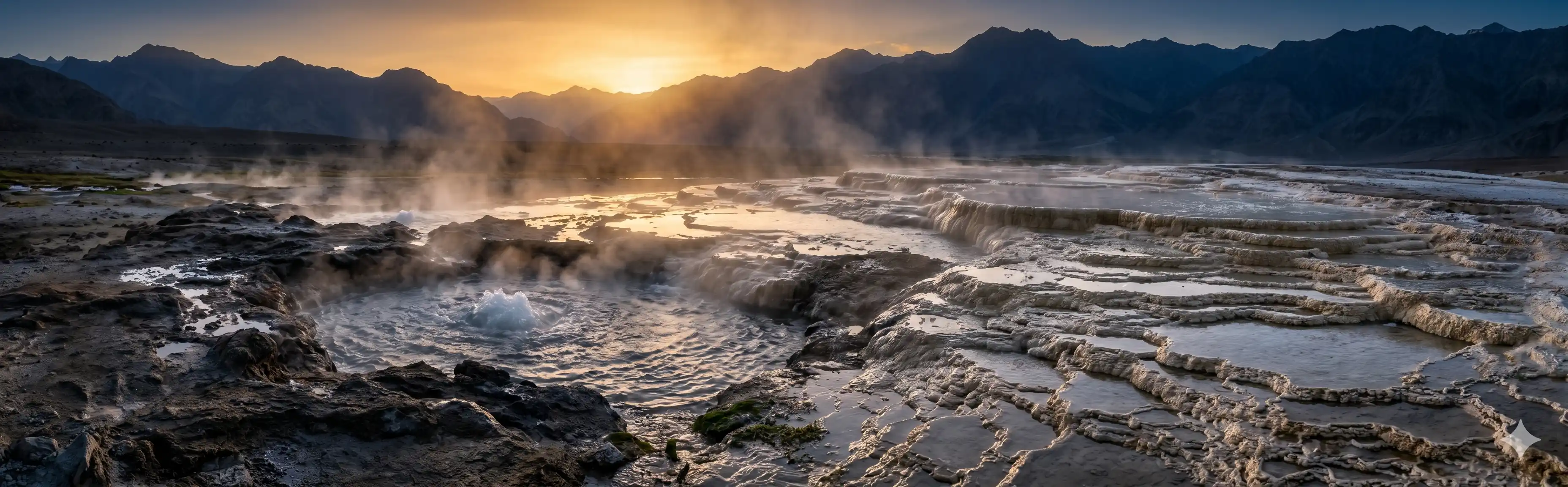
In the cold, high-altitude region of Ladakh, India, lies the Puga Valley. Even when the surrounding landscape is freezing, the water in Puga's hot springs remains close to the boiling point of water. The conditions there today are remarkably similar to those scientists believe existed on early Earth, about 3.5 billion years ago.
What lives in such places? You might think nothing — most living things would be cooked. But there are organisms called thermophiles (literally, heat-lovers) — single-celled bacteria that thrive at temperatures most life cannot survive. These are some of the simplest, oldest forms of life still around today.
What Is a Cell, Really?
Whatever the exact origin, one fact is now beyond doubt: all living organisms are made up of cells. From a single bacterium drifting in a hot spring to a banyan tree spreading across acres, from a microscopic amoeba to a blue whale — every form of life is built from cells.
The cell is the basic unit at which life exists. No smaller part of an organism — not a protein, not a strand of DNA, not even an organelle inside a cell — is alive on its own. Life begins at the level of the cell.
Some organisms are unicellular — they consist of just one cell. Bacteria are unicellular. So is yeast (used in baking bread). The single cell does everything needed to stay alive: takes in nutrients, releases waste, responds to its surroundings, and reproduces.
Most organisms you can see with your eye are multicellular — they are built from millions, billions, even trillions of cells working together. A small plant. A fish. A bird. You. Each of these is a vast coordinated community of cells.
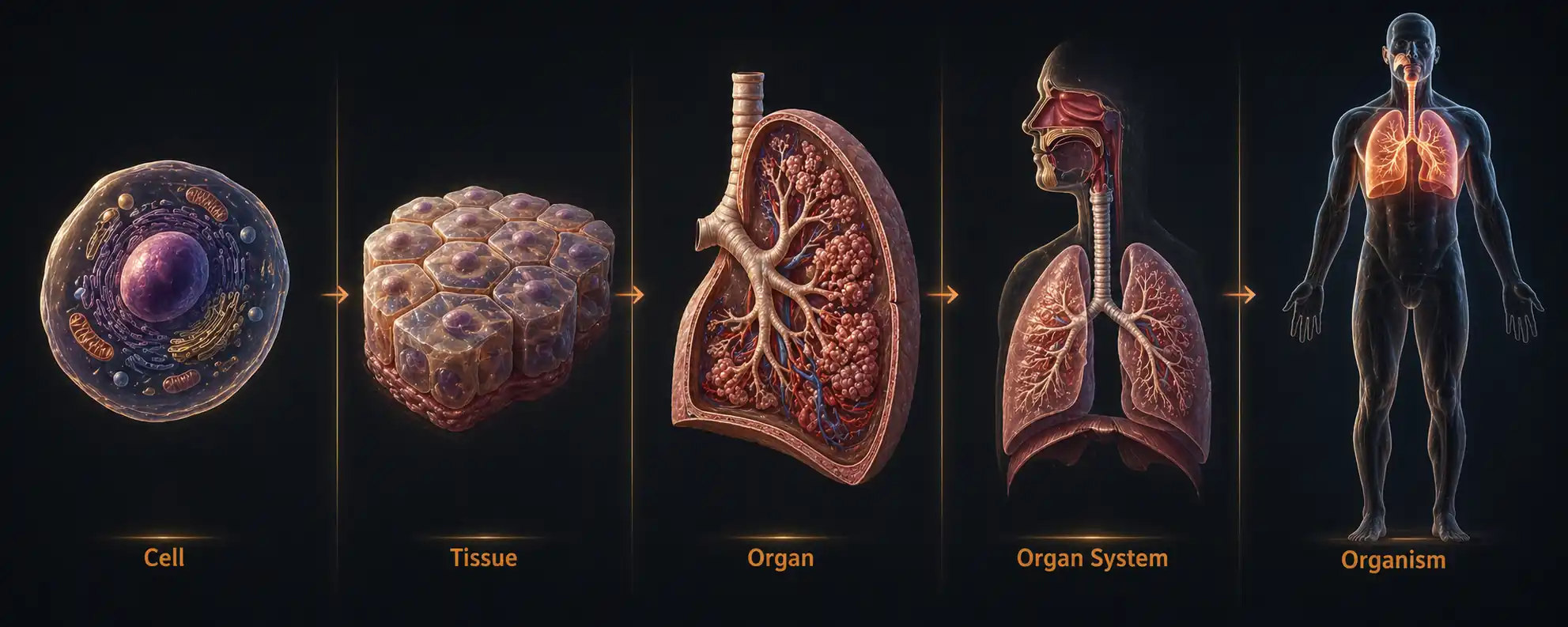
In multicellular organisms, similar cells gather to do similar jobs. A group of similar cells doing a similar function is called a tissue. Different tissues organise into an organ (like the heart, or a leaf). Several organs working together form an organ system — for example, your nose, throat, windpipe, and lungs together make up your respiratory system.
But even in this elaborate organisation, the cell remains the fundamental unit. Without working cells, no tissue can function. Without working tissues, no organ can function. Life rests, at every level, on the cell.
What This Page Teaches Us
-
Life began in water. Most scientists now think the first cells formed not in open oceans but in small, mineral-rich pools — possibly resembling today's hot springs.
-
The hot springs of Puga Valley, Ladakh preserve conditions strikingly similar to those of early Earth ~3.5 billion years ago, and host thermophiles — heat-loving single-celled organisms.
-
Scientists at the Birbal Sahni Institute of Palaeosciences, Lucknow have shown that calcium carbonate deposits around such springs may have helped shield early organic molecules and form the first cell membranes.
-
The cell is the basic unit of life. Nothing smaller than a cell is alive on its own.
-
Unicellular organisms (bacteria, yeast) are made of one cell. Multicellular organisms (plants, animals, humans) are vast cooperatives of trillions of cells.
-
In multicellular organisms, cells organise into tissues → organs → organ systems — but the cell remains the fundamental unit at every level.
-
The Brihadaranyaka Upanishad's vision — Apo vā idam agre āsīt (in the beginning, this was water) — and modern biology's account of life's origin are saying, in different languages, the same thing: complex life rises, in time, from simple watery beginnings.
Where Did the First Cell Come From?
Most scientists today agree on one thing about the origin of life: it began in water. But where exactly?
For a long time, the popular picture was of life beginning in the open oceans. Recently, more researchers have come to suspect that the truth is something stranger and more specific — that life may have begun in small water pools with rapidly changing chemistry, not in the calm vastness of the sea.
Hot springs are exactly such places. They are pools of water heated from below by volcanic activity, often rich in dissolved minerals. The water bubbles, evaporates, cools, mixes, and changes constantly.
In the cold, high-altitude region of Ladakh, India, lies the Puga Valley. Even when the surrounding landscape is freezing, the water in Puga's hot springs remains close to the boiling point of water. The conditions there today are remarkably similar to those scientists believe existed on early Earth, about 3.5 billion years ago.
What lives in such places? You might think nothing — most living things would be cooked. But there are organisms called thermophiles (literally, heat-lovers) — single-celled bacteria that thrive at temperatures most life cannot survive. These are some of the simplest, oldest forms of life still around today.
What Is a Cell, Really?
Whatever the exact origin, one fact is now beyond doubt: all living organisms are made up of cells. From a single bacterium drifting in a hot spring to a banyan tree spreading across acres, from a microscopic amoeba to a blue whale — every form of life is built from cells.
The cell is the basic unit at which life exists. No smaller part of an organism — not a protein, not a strand of DNA, not even an organelle inside a cell — is alive on its own. Life begins at the level of the cell.
Some organisms are unicellular — they consist of just one cell. Bacteria are unicellular. So is yeast (used in baking bread). The single cell does everything needed to stay alive: takes in nutrients, releases waste, responds to its surroundings, and reproduces.
Most organisms you can see with your eye are multicellular — they are built from millions, billions, even trillions of cells working together. A small plant. A fish. A bird. You. Each of these is a vast coordinated community of cells.
In multicellular organisms, similar cells gather to do similar jobs. A group of similar cells doing a similar function is called a tissue. Different tissues organise into an organ (like the heart, or a leaf). Several organs working together form an organ system — for example, your nose, throat, windpipe, and lungs together make up your respiratory system.
But even in this elaborate organisation, the cell remains the fundamental unit. Without working cells, no tissue can function. Without working tissues, no organ can function. Life rests, at every level, on the cell.
What This Page Teaches Us
-
Life began in water. Most scientists now think the first cells formed not in open oceans but in small, mineral-rich pools — possibly resembling today's hot springs.
-
The hot springs of Puga Valley, Ladakh preserve conditions strikingly similar to those of early Earth ~3.5 billion years ago, and host thermophiles — heat-loving single-celled organisms.
-
Scientists at the Birbal Sahni Institute of Palaeosciences, Lucknow have shown that calcium carbonate deposits around such springs may have helped shield early organic molecules and form the first cell membranes.
-
The cell is the basic unit of life. Nothing smaller than a cell is alive on its own.
-
Unicellular organisms (bacteria, yeast) are made of one cell. Multicellular organisms (plants, animals, humans) are vast cooperatives of trillions of cells.
-
In multicellular organisms, cells organise into tissues → organs → organ systems — but the cell remains the fundamental unit at every level.
-
The Brihadaranyaka Upanishad's vision — Apo vā idam agre āsīt (in the beginning, this was water) — and modern biology's account of life's origin are saying, in different languages, the same thing: complex life rises, in time, from simple watery beginnings.