The Cell's Living Boundary: Membrane and Wall
How a film thinner than a fingernail decides what enters, what leaves, and what holds a cell together
A piece of dried fruit sits in a glass of water. Half an hour later, you check on it — and it has swelled up, plumper than when you put it in.
A piece of fresh cucumber sits in a bowl of salted water. Half an hour later — it has shrivelled, gone limp, lost its juice.
In both cases, water moved. Without you stirring, without anyone pouring. Why does water sometimes go into something and sometimes come out? And what is it actually crossing?
Both pieces — the fruit and the cucumber — are made of cells. The water is moving across the boundary of every single cell.
The Verse on the Tortoise and the Senses
यदा संहरते चायं कूर्मोऽङ्गानीव सर्वशः।
इन्द्रियाणीन्द्रियार्थेभ्यस्तस्य प्रज्ञा प्रतिष्ठिता॥
'जैसे कछुआ अपने सारे अंग अपने अंदर समेट लेता है, वैसे ही जब इंसान अपनी इंद्रियों को बाहर के विषयों से अंदर खींच लेता है — तब उसकी समझ ठहर जाती है।'
"As a tortoise withdraws its limbs from all sides, when one withdraws the senses from sense-objects — one's wisdom is firmly established."
The tortoise teaches a lesson the cell membrane already knows: the strength of a living thing is in its ability to choose what crosses its boundary. Not everything that touches you should enter you. Not everything inside should leak out. The discerning boundary is what makes a self possible.
The Boundary That Defines a Cell
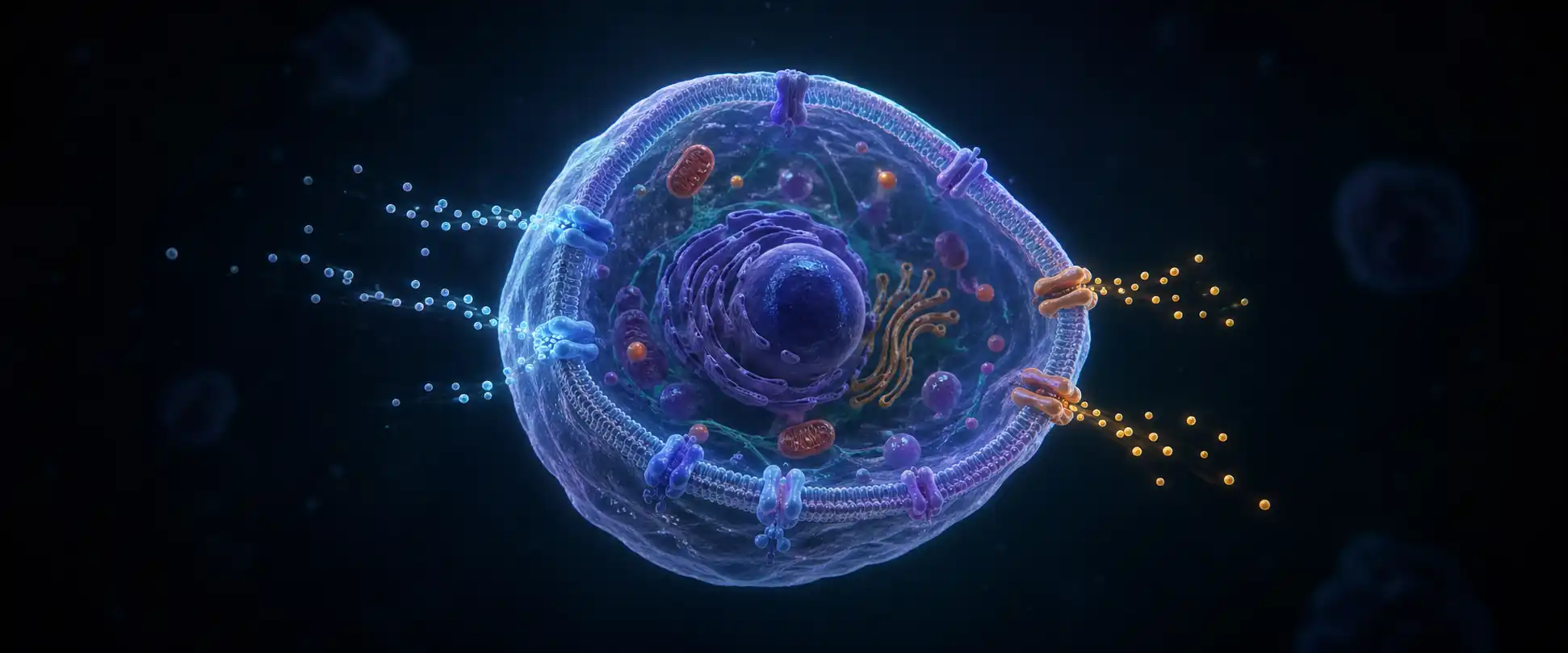
Every living cell — without exception — has a thin boundary surrounding it. It is called the cell membrane, also known as the plasma membrane.
This membrane is the universal feature of life. Bacteria have it. Plants have it. Fungi have it. Every one of your 30 trillion cells has it.
What does the membrane do?
-
It defines the cell. Inside is the cell. Outside is the world. Without the membrane, there would be no inside and no outside — just a smear of biological material. The membrane is what makes a cell a self.
-
It protects the cell's contents. The fragile chemistry of life — proteins, DNA, organelles — needs a stable internal environment. The membrane keeps the inner chemistry in and the outer disturbances out.
-
It controls what enters and exits. This is the most remarkable property. The membrane is selectively permeable — it allows some substances to pass through (water, oxygen, carbon dioxide, certain nutrients) while blocking others (large molecules, harmful chemicals, most ions).
Without selective permeability, no cell could survive. Too much salt would kill it. Too little water would dry it out. The wrong chemicals would poison it. The membrane is constantly choosing what to let through — like the tortoise choosing what to expose.
Watching the Membrane in Action — An Osmosis Experiment
Here is a simple kitchen experiment that lets you watch a cell membrane at work — without a microscope, just two beakers and a potato.
Activity: The Two Potato Pieces
-
Take a potato. With a knife, cut two pieces of roughly equal size and shape.
-
Weigh both pieces carefully on a kitchen balance and write down the starting weights.
-
Fill Beaker A with plain water. Fill Beaker B with water mixed with 20% salt or sugar (heavily salty/sweet — much more concentrated than the inside of the potato cells).
-
Place one potato piece in each beaker. Leave them undisturbed for about one hour.
-
After an hour, take both pieces out, dry them gently, and weigh them again.
What you observe:
- The potato piece in Beaker A (plain water) has gained weight. It looks plump, firm, slightly larger.
- The potato piece in Beaker B (salt/sugar water) has lost weight. It looks shrunken, soft, slightly smaller.
No one stirred either beaker. The salt didn't 'pull' anything physically. What changed? Water moved — and it moved in opposite directions in the two beakers.
The potato piece in plain water absorbed water from the beaker. The potato piece in salt water lost water into the beaker. In both cases, water crossed the cell membranes of the potato cells. The salt and sugar molecules — much larger — could not cross the membrane. Only water did. This selective movement of water is what we call osmosis.
What Just Happened? Diffusion and Osmosis
To understand the potato experiment, we need two ideas — closely related, but not the same.
Diffusion is the natural movement of particles from a region of higher concentration to a region of lower concentration until the two regions become equal. You see this every day: a drop of ink slowly spreading through water; the smell of food drifting from kitchen to next room. Diffusion does not require a membrane. It happens wherever there is a concentration difference.
Osmosis is a special case of diffusion — specifically, the diffusion of water across a selectively permeable membrane. The membrane lets water through but blocks the dissolved substances (the solutes — salt, sugar, minerals, etc.).
Water moves from the side with less solute (more water) to the side with more solute (less water) — until concentrations on the two sides become equal.
In the potato experiment:
-
Beaker A: Plain water has very little solute. The inside of the potato cells has more solute (sugars, ions, etc.). So water flowed from the beaker into the cells. The cells swelled, the potato gained weight.
-
Beaker B: The 20% salt water has far more solute than the inside of the potato cells. So water flowed from the cells out into the beaker. The cells shrank, the potato lost weight.
This is the same process by which water from soil enters the roots of plants. It is the same process by which your body absorbs water in the intestine. Without osmosis, plants could not drink and animals could not stay hydrated. It is one of the most important processes in all of biology.
Three Kinds of Solutions a Cell Can Sit In
Scientists have a precise vocabulary for what happens to a cell in different surroundings. Three terms — all comparing the outside to the inside of the cell:
Inside the Membrane — The Fluid-Mosaic Model
Now we get to a truly remarkable structure. The cell membrane is incredibly thin — only 7 to 10 nanometres across. (One nanometre is one-millionth of a millimetre. Ten nanometres is roughly 10,000 times thinner than a human hair.) And yet this microscopic film does the entire job of selective permeability.
How? The answer is the fluid-mosaic model, proposed in 1972 and confirmed by countless experiments since.
The membrane is built from two main ingredients: lipids (fats) and proteins.
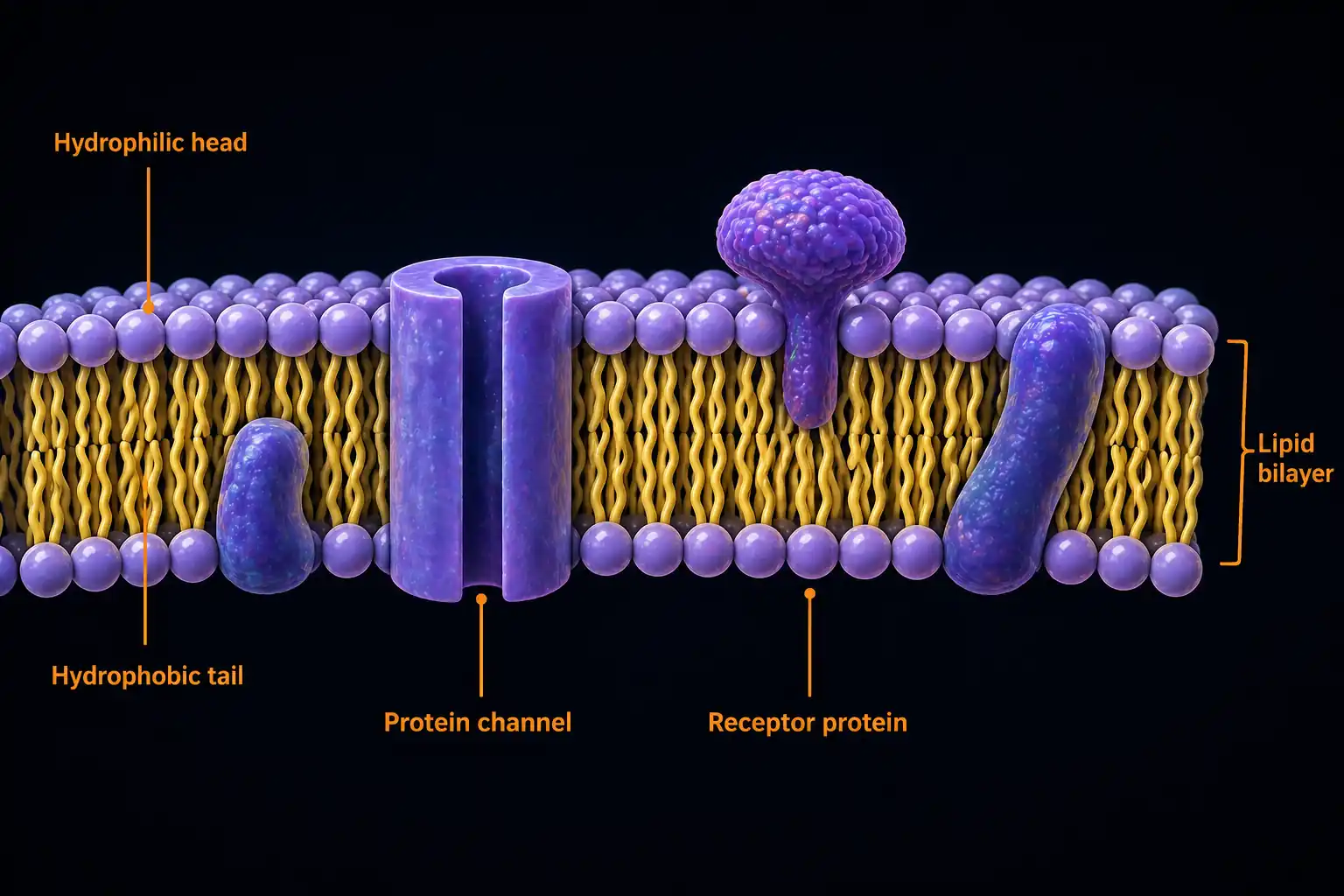
The lipid bilayer. The membrane is made of two layers of special fat molecules called phospholipids. Each phospholipid has a head that is attracted to water (hydrophilic — 'water-loving') and two tails that are repelled by water (hydrophobic — 'water-fearing').
In the membrane, the lipids arrange themselves brilliantly: heads outward (facing the watery inside of the cell, and the watery outside) and tails inward (tucked safely away from water, against the tails of the other layer). Two layers of lipids, sandwiched tail-to-tail. This creates a stable barrier that water cannot easily cross — except through specific gates.
Embedded proteins. Scattered throughout the lipid bilayer are protein molecules of many shapes. Some are channels — gateways that selectively let particular substances pass. Others receive signals from outside the cell. Others communicate with neighbouring cells.
Why is it 'fluid'? The lipid molecules are not locked in place. They drift sideways, flip, rotate. The membrane is liquid at body temperature — like olive oil — not solid. Why 'mosaic'? The proteins are arranged in the lipid bilayer like differently-shaped tiles in a Roman mosaic. Hence the name: fluid-mosaic model.
This design — a fluid barrier with selective protein gates — is what makes the membrane such an extraordinary boundary. It is firm enough to hold the cell together, fluid enough to repair itself, and intelligent enough to choose what comes in and what goes out.
Why Plants Have an Extra Layer — The Cell Wall
Animal cells have only the cell membrane as their outer boundary. But plant cells, fungi, and bacteria have an additional layer outside the cell membrane — a thicker, more rigid structure called the cell wall.
Why? Think about the difference between a plant and an animal. An animal can move. When threatened, it runs. When the climate changes, it migrates. Animal cells stay flexible and shape-changing because the whole organism can take care of itself by moving.
A plant cannot move. A mango tree must endure whatever weather, wind, and stress comes to its location for its entire life. To survive, it needs a rigid structure — and that rigidity comes, at the cellular level, from the cell wall.
The plant cell wall is made primarily of cellulose — a tough carbohydrate built from many glucose units chained together. Cellulose forms long, strong fibres that crisscross and bind into a mesh, giving the cell wall its strength.
The cell wall has two important properties:
-
It is rigid. It supports the plant against gravity and wind. It is why a leaf is firm, a stem stands upright, and a flower holds its shape.
-
It is permeable (unlike the cell membrane, which is selectively permeable). Water and dissolved minerals pass through the cell wall freely. The selective control happens at the membrane inside the wall.
An everyday consequence. When a plant cell sits in a very salty/sugary solution, it loses water by osmosis (just like the potato). But because the cell wall is rigid, the plant cell does not collapse — only the membrane inside pulls inward, the cell shrinks slightly within its wall. An animal cell in the same situation has no such reinforcement. It simply shrivels.
This is exactly what the onion-peel-vs-cheek-cell experiment in your school lab will show you. The plant cells keep their box-like outer shape while their insides withdraw; the animal cells lose their shape entirely.
The Cell Wall on Your Plate
The same cellulose that makes plant cell walls rigid is also the main component of dietary fibre — what your grandmother might have called roughage.
A famous home remedy: when a person has a sore throat, gargle with warm salt water. Many traditions say this helps reduce throat inflammation and irritation.
Using what you have learned about osmosis and the cell membrane on this page, can you explain biologically why this works?
Manana Moment
Contemplation before you continue
The Bhagavad Gita's image of the tortoise — drawing in its limbs to protect itself — is the same idea biology calls selective permeability. A living cell is constantly choosing what to admit, what to release, what to hold inside.
You are doing this too — every moment.
You are deciding what news to absorb. What conversations to engage with. What thoughts to dwell on. What feelings to let in. What to share, what to keep private. You may not always do it consciously, but you are constantly practising selective permeability at the level of your mind and your relationships.
Before you continue, ask yourself:
What is something — a piece of information, a conversation pattern, a worry — that you are letting cross your boundary too easily? And what is something you should be letting in more, but are walling off out of fear?
The cell membrane is wise: it admits what nourishes, releases what is toxic, and holds firm against what would harm. So is the tortoise. So can you be.
What This Page Teaches Us
-
The cell membrane (also called plasma membrane) is the universal feature of every living cell. It defines the cell, protects its contents, and selectively controls what enters and exits.
-
Diffusion is the spreading of particles from higher to lower concentration. Osmosis is the diffusion of water across a selectively permeable membrane.
-
The Activity 2.2 potato experiment shows osmosis directly: a potato gains weight in plain water (water enters cells), loses weight in salty water (water leaves cells).
-
Isotonic / Hypotonic / Hypertonic describe the relationship of an outside solution to the inside of a cell. Cells stay normal in isotonic; swell in hypotonic; shrink in hypertonic.
-
The fluid-mosaic model explains the membrane's structure: a fluid lipid bilayer with embedded protein gates arranged like a mosaic.
-
Plant cells, fungi, and bacteria have an additional outer layer — the cell wall, made primarily of cellulose. The cell wall is rigid (provides structural support) and freely permeable (selectivity is left to the membrane inside).
-
Cellulose in the diet (roughage) is essential for digestive health — the same molecule that holds plants upright also keeps your gut healthy.
-
The Bhagavad Gita's image of the tortoise — withdrawing what should not be exposed, choosing what to admit — is the deeper philosophical name for what every cell quietly does at every moment of every day.
Q1.What does it mean to say the cell membrane is selectively permeable?
A piece of dried fruit sits in a glass of water. Half an hour later, you check on it — and it has swelled up, plumper than when you put it in.
A piece of fresh cucumber sits in a bowl of salted water. Half an hour later — it has shrivelled, gone limp, lost its juice.
In both cases, water moved. Without you stirring, without anyone pouring. Why does water sometimes go into something and sometimes come out? And what is it actually crossing?
Both pieces — the fruit and the cucumber — are made of cells. The water is moving across the boundary of every single cell.
The Verse on the Tortoise and the Senses
यदा संहरते चायं कूर्मोऽङ्गानीव सर्वशः।
इन्द्रियाणीन्द्रियार्थेभ्यस्तस्य प्रज्ञा प्रतिष्ठिता॥
'जैसे कछुआ अपने सारे अंग अपने अंदर समेट लेता है, वैसे ही जब इंसान अपनी इंद्रियों को बाहर के विषयों से अंदर खींच लेता है — तब उसकी समझ ठहर जाती है।'
"As a tortoise withdraws its limbs from all sides, when one withdraws the senses from sense-objects — one's wisdom is firmly established."
The tortoise teaches a lesson the cell membrane already knows: the strength of a living thing is in its ability to choose what crosses its boundary. Not everything that touches you should enter you. Not everything inside should leak out. The discerning boundary is what makes a self possible.
The Boundary That Defines a Cell
Every living cell — without exception — has a thin boundary surrounding it. It is called the cell membrane, also known as the plasma membrane.
This membrane is the universal feature of life. Bacteria have it. Plants have it. Fungi have it. Every one of your 30 trillion cells has it.
What does the membrane do?
-
It defines the cell. Inside is the cell. Outside is the world. Without the membrane, there would be no inside and no outside — just a smear of biological material. The membrane is what makes a cell a self.
-
It protects the cell's contents. The fragile chemistry of life — proteins, DNA, organelles — needs a stable internal environment. The membrane keeps the inner chemistry in and the outer disturbances out.
-
It controls what enters and exits. This is the most remarkable property. The membrane is selectively permeable — it allows some substances to pass through (water, oxygen, carbon dioxide, certain nutrients) while blocking others (large molecules, harmful chemicals, most ions).
Without selective permeability, no cell could survive. Too much salt would kill it. Too little water would dry it out. The wrong chemicals would poison it. The membrane is constantly choosing what to let through — like the tortoise choosing what to expose.
Watching the Membrane in Action — An Osmosis Experiment
Here is a simple kitchen experiment that lets you watch a cell membrane at work — without a microscope, just two beakers and a potato.
Activity: The Two Potato Pieces
-
Take a potato. With a knife, cut two pieces of roughly equal size and shape.
-
Weigh both pieces carefully on a kitchen balance and write down the starting weights.
-
Fill Beaker A with plain water. Fill Beaker B with water mixed with 20% salt or sugar (heavily salty/sweet — much more concentrated than the inside of the potato cells).
-
Place one potato piece in each beaker. Leave them undisturbed for about one hour.
-
After an hour, take both pieces out, dry them gently, and weigh them again.
What you observe:
- The potato piece in Beaker A (plain water) has gained weight. It looks plump, firm, slightly larger.
- The potato piece in Beaker B (salt/sugar water) has lost weight. It looks shrunken, soft, slightly smaller.
No one stirred either beaker. The salt didn't 'pull' anything physically. What changed? Water moved — and it moved in opposite directions in the two beakers.
The potato piece in plain water absorbed water from the beaker. The potato piece in salt water lost water into the beaker. In both cases, water crossed the cell membranes of the potato cells. The salt and sugar molecules — much larger — could not cross the membrane. Only water did. This selective movement of water is what we call osmosis.
What Just Happened? Diffusion and Osmosis
To understand the potato experiment, we need two ideas — closely related, but not the same.
Diffusion is the natural movement of particles from a region of higher concentration to a region of lower concentration until the two regions become equal. You see this every day: a drop of ink slowly spreading through water; the smell of food drifting from kitchen to next room. Diffusion does not require a membrane. It happens wherever there is a concentration difference.
Osmosis is a special case of diffusion — specifically, the diffusion of water across a selectively permeable membrane. The membrane lets water through but blocks the dissolved substances (the solutes — salt, sugar, minerals, etc.).
Water moves from the side with less solute (more water) to the side with more solute (less water) — until concentrations on the two sides become equal.
In the potato experiment:
-
Beaker A: Plain water has very little solute. The inside of the potato cells has more solute (sugars, ions, etc.). So water flowed from the beaker into the cells. The cells swelled, the potato gained weight.
-
Beaker B: The 20% salt water has far more solute than the inside of the potato cells. So water flowed from the cells out into the beaker. The cells shrank, the potato lost weight.
This is the same process by which water from soil enters the roots of plants. It is the same process by which your body absorbs water in the intestine. Without osmosis, plants could not drink and animals could not stay hydrated. It is one of the most important processes in all of biology.
Three Kinds of Solutions a Cell Can Sit In
Scientists have a precise vocabulary for what happens to a cell in different surroundings. Three terms — all comparing the outside to the inside of the cell:
Inside the Membrane — The Fluid-Mosaic Model
Now we get to a truly remarkable structure. The cell membrane is incredibly thin — only 7 to 10 nanometres across. (One nanometre is one-millionth of a millimetre. Ten nanometres is roughly 10,000 times thinner than a human hair.) And yet this microscopic film does the entire job of selective permeability.
How? The answer is the fluid-mosaic model, proposed in 1972 and confirmed by countless experiments since.
The membrane is built from two main ingredients: lipids (fats) and proteins.
The lipid bilayer. The membrane is made of two layers of special fat molecules called phospholipids. Each phospholipid has a head that is attracted to water (hydrophilic — 'water-loving') and two tails that are repelled by water (hydrophobic — 'water-fearing').
In the membrane, the lipids arrange themselves brilliantly: heads outward (facing the watery inside of the cell, and the watery outside) and tails inward (tucked safely away from water, against the tails of the other layer). Two layers of lipids, sandwiched tail-to-tail. This creates a stable barrier that water cannot easily cross — except through specific gates.
Embedded proteins. Scattered throughout the lipid bilayer are protein molecules of many shapes. Some are channels — gateways that selectively let particular substances pass. Others receive signals from outside the cell. Others communicate with neighbouring cells.
Why is it 'fluid'? The lipid molecules are not locked in place. They drift sideways, flip, rotate. The membrane is liquid at body temperature — like olive oil — not solid. Why 'mosaic'? The proteins are arranged in the lipid bilayer like differently-shaped tiles in a Roman mosaic. Hence the name: fluid-mosaic model.
This design — a fluid barrier with selective protein gates — is what makes the membrane such an extraordinary boundary. It is firm enough to hold the cell together, fluid enough to repair itself, and intelligent enough to choose what comes in and what goes out.
Why Plants Have an Extra Layer — The Cell Wall
Animal cells have only the cell membrane as their outer boundary. But plant cells, fungi, and bacteria have an additional layer outside the cell membrane — a thicker, more rigid structure called the cell wall.
Why? Think about the difference between a plant and an animal. An animal can move. When threatened, it runs. When the climate changes, it migrates. Animal cells stay flexible and shape-changing because the whole organism can take care of itself by moving.
A plant cannot move. A mango tree must endure whatever weather, wind, and stress comes to its location for its entire life. To survive, it needs a rigid structure — and that rigidity comes, at the cellular level, from the cell wall.
The plant cell wall is made primarily of cellulose — a tough carbohydrate built from many glucose units chained together. Cellulose forms long, strong fibres that crisscross and bind into a mesh, giving the cell wall its strength.
The cell wall has two important properties:
-
It is rigid. It supports the plant against gravity and wind. It is why a leaf is firm, a stem stands upright, and a flower holds its shape.
-
It is permeable (unlike the cell membrane, which is selectively permeable). Water and dissolved minerals pass through the cell wall freely. The selective control happens at the membrane inside the wall.
An everyday consequence. When a plant cell sits in a very salty/sugary solution, it loses water by osmosis (just like the potato). But because the cell wall is rigid, the plant cell does not collapse — only the membrane inside pulls inward, the cell shrinks slightly within its wall. An animal cell in the same situation has no such reinforcement. It simply shrivels.
This is exactly what the onion-peel-vs-cheek-cell experiment in your school lab will show you. The plant cells keep their box-like outer shape while their insides withdraw; the animal cells lose their shape entirely.
The Cell Wall on Your Plate
The same cellulose that makes plant cell walls rigid is also the main component of dietary fibre — what your grandmother might have called roughage.
A famous home remedy: when a person has a sore throat, gargle with warm salt water. Many traditions say this helps reduce throat inflammation and irritation.
Using what you have learned about osmosis and the cell membrane on this page, can you explain biologically why this works?
What This Page Teaches Us
-
The cell membrane (also called plasma membrane) is the universal feature of every living cell. It defines the cell, protects its contents, and selectively controls what enters and exits.
-
Diffusion is the spreading of particles from higher to lower concentration. Osmosis is the diffusion of water across a selectively permeable membrane.
-
The Activity 2.2 potato experiment shows osmosis directly: a potato gains weight in plain water (water enters cells), loses weight in salty water (water leaves cells).
-
Isotonic / Hypotonic / Hypertonic describe the relationship of an outside solution to the inside of a cell. Cells stay normal in isotonic; swell in hypotonic; shrink in hypertonic.
-
The fluid-mosaic model explains the membrane's structure: a fluid lipid bilayer with embedded protein gates arranged like a mosaic.
-
Plant cells, fungi, and bacteria have an additional outer layer — the cell wall, made primarily of cellulose. The cell wall is rigid (provides structural support) and freely permeable (selectivity is left to the membrane inside).
-
Cellulose in the diet (roughage) is essential for digestive health — the same molecule that holds plants upright also keeps your gut healthy.
-
The Bhagavad Gita's image of the tortoise — withdrawing what should not be exposed, choosing what to admit — is the deeper philosophical name for what every cell quietly does at every moment of every day.
Q1.What does it mean to say the cell membrane is selectively permeable?