How Cells Multiply — Mitosis and Meiosis
How a single cell becomes two — and why the body of every living thing is constantly remaking itself
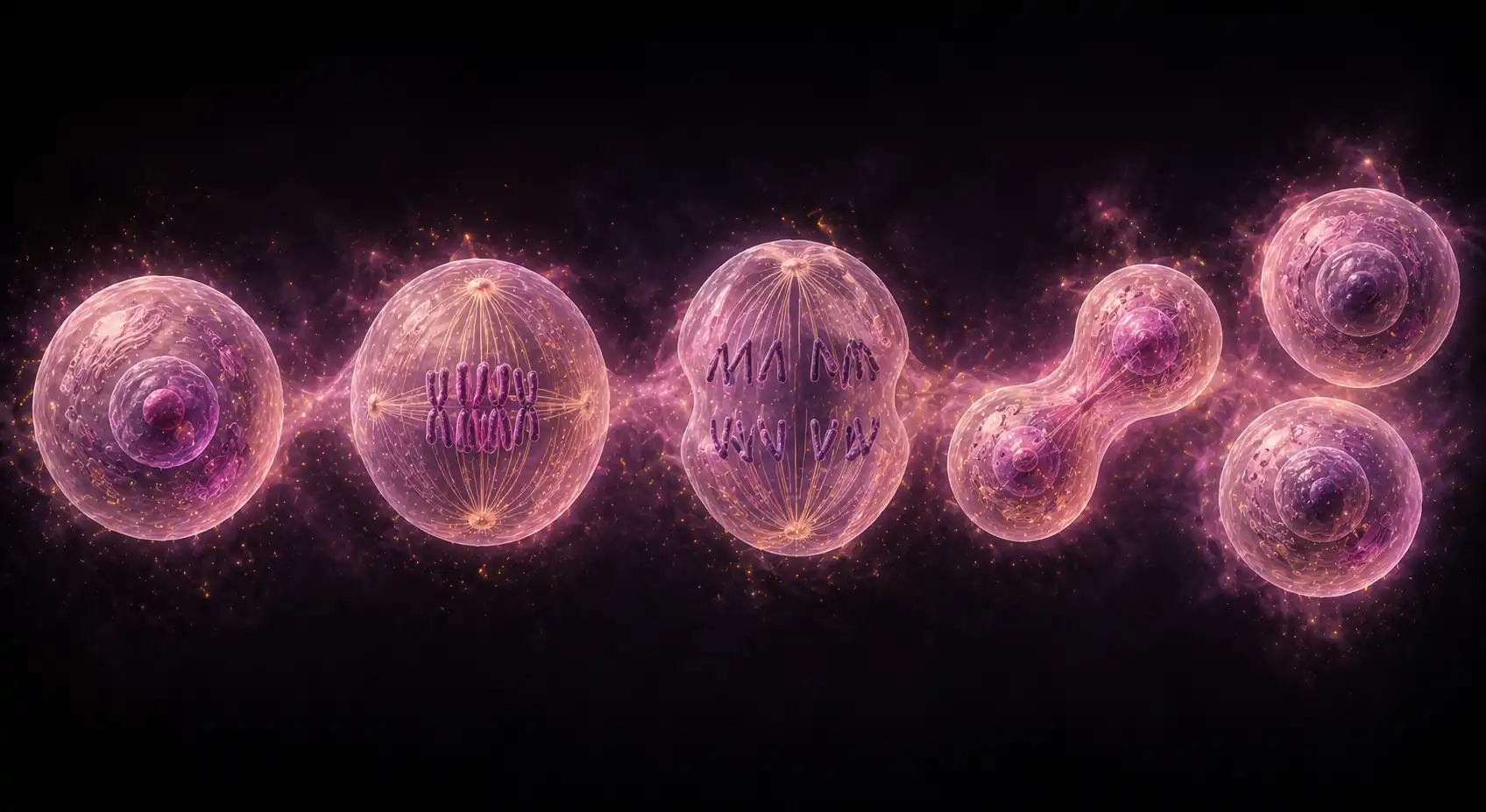
Right now — in your skin, in your gut, in your bone marrow — about 2 million cells per second are being born. In a single day, your body replaces roughly 1% of all its cells. Hair grows. Cuts heal. The lining of your gut renews itself entirely every 5 days.
But wait — where do the new cells come from? They aren't appearing from nothing. So what is the biological process by which one cell becomes two?
Think about what would have to happen inside a single cell for it to faithfully duplicate itself — including its DNA, its organelles, everything.
The Verse on the Body Renewing Itself
वासांसि जीर्णानि यथा विहाय नवानि गृह्णाति नरोऽपराणि।
तथा शरीराणि विहाय जीर्णान्यन्यानि संयाति नवानि देही॥
'जैसे एक इंसान पुराने, फटे हुए कपड़े उतारकर नए कपड़े पहन लेता है — वैसे ही आत्मा पुराने शरीर को छोड़कर नए शरीर में चली जाती है।'
"As a person sheds worn-out clothes and puts on new ones, so the embodied self leaves worn-out bodies and enters new ones."
The verse describes a deep pattern: renewal through replacement. What seems permanent is, in truth, constantly being shed and remade. Modern biology has discovered the same pattern at the cellular level — your body is literally shedding worn-out cells and putting on new ones, all the time, by the millions per second.
Why Cells Must Divide
Cells divide for three deep reasons:
1. Growth. When you grow taller, when a baby grows from a fertilised egg into a fully formed infant, when a sapling grows into a tree — cells are dividing. Crucially, you don't grow because each cell gets bigger. Cells can only enlarge to a certain size. Past that, the only way to grow is to make more cells.
2. Repair. When you cut your finger, the wound heals because new skin cells divide and replace the damaged ones. When you break a bone, new bone cells divide and rebuild the structure. Almost every healing in your body comes down to cell division.
3. Replacement. Many cells in your body are short-lived. Skin cells live ~30 days. The cells lining your gut live ~5 days. Red blood cells live ~120 days. Each must be constantly replaced. Without continuous cell division, your body would simply wear out in weeks.
Why can't a single cell just keep growing instead? Because of an inescapable problem of surface area. As a cell gets bigger, its volume grows faster than its surface area. The cell membrane (where all exchange of materials happens) cannot keep up with the demands of an enormous interior. So at a certain size, the cell has only one option: divide into two smaller cells, each with a fresh, manageable surface-to-volume ratio.
Cell division is therefore not a luxury or an occasional event. It is constant, going on right now in dozens of places in your body. Both prokaryotic and eukaryotic cells divide — but eukaryotic cells do it through a more carefully controlled process called the cell cycle, ensuring that DNA and organelles are correctly distributed to the daughter cells. (You will study the detailed stages of the cell cycle in higher grades.)
There are two main types of cell division in eukaryotes:
- Mitosis — for normal growth, repair, and asexual reproduction. Produces two cells genetically identical to the parent.
- Meiosis — only in cells that produce gametes (sperm or eggs). Produces four cells with half the chromosomes of the parent.
Let's meet each.
Mitosis — Making More of the Same
Mitosis is by far the most common kind of cell division in your body. Every time a cell needs to grow, repair, or replace, mitosis is the process used.
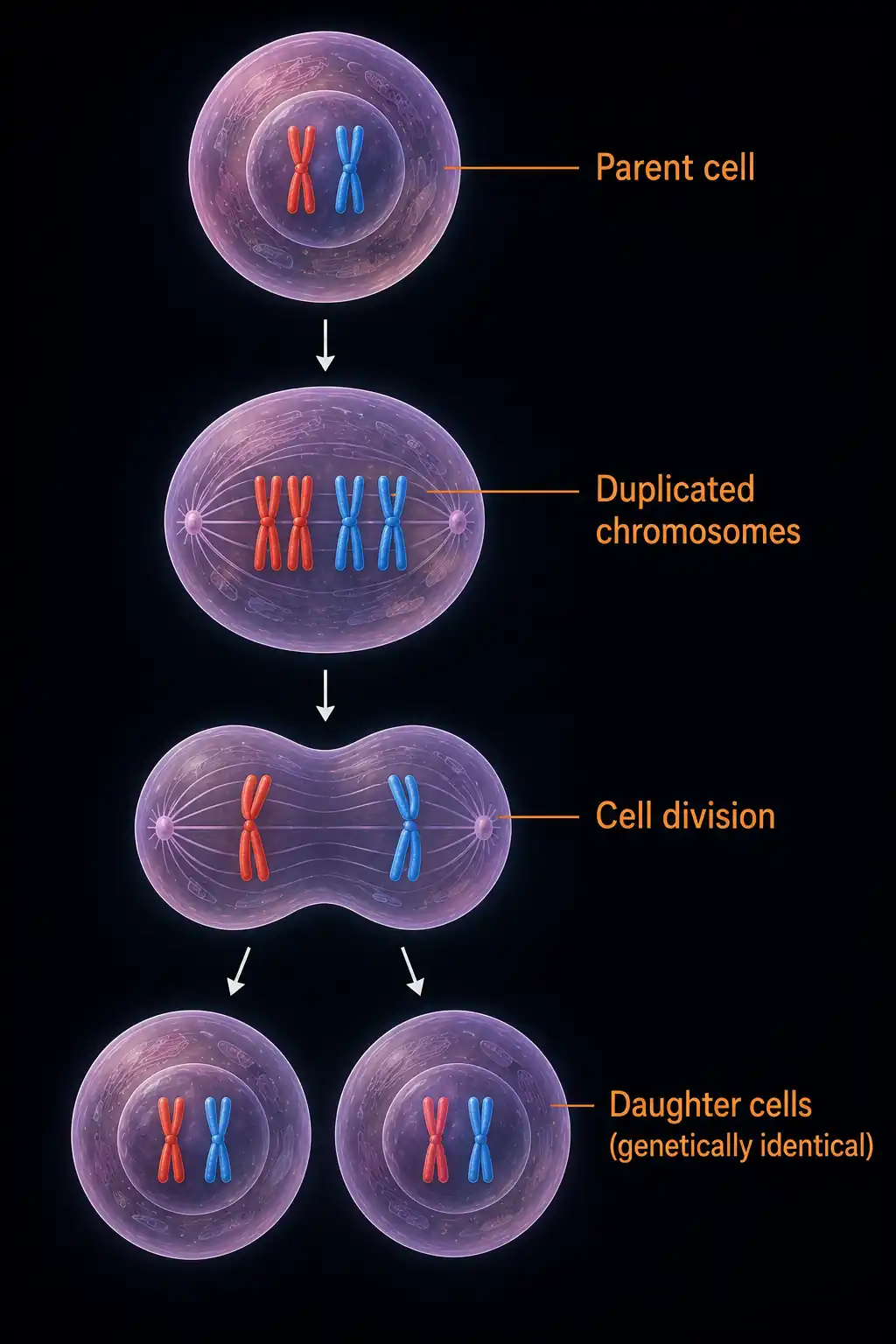
The basic principle of mitosis is exact copying. The parent cell:
- Duplicates all its DNA (every chromosome is copied exactly).
- Lines up the duplicated chromosomes in the middle of the cell.
- Pulls one full set of chromosomes to each end of the cell.
- Splits down the middle, forming two daughter cells.
The result: two daughter cells, each with the same DNA and the same number of chromosomes as the original parent cell. They are genetically identical — to each other, and to the parent.
This is what allows your body to grow without changing. When skin cells divide to heal a cut, the new cells must be exactly like the surrounding skin cells. When liver cells divide to replace damaged ones, the new cells must inherit the same identity — same DNA, same instructions. Mitosis preserves identity.
Every human being begins life as a single fertilised egg. By the time a person is fully grown, that single cell has divided — through mitosis — into approximately 30 trillion cells. From one cell, by patient repeated mitosis, an entire human body emerges.
Mitosis is the foundation of growth, healing, and the simple maintenance of being alive.
Meiosis — Making Cells for the Next Generation
Mitosis is enough for almost everything your body needs. But there is one job mitosis cannot do: producing the cells that begin a new life.
When a man and a woman together produce a child, two cells must combine: a sperm cell from the father and an egg cell from the mother. Together, they form a single fertilised egg — which then divides by mitosis to grow into a complete new human being.
But here is the puzzle: every human cell has 46 chromosomes (23 from each parent). If both sperm and egg had the full 46 chromosomes, then their fusion would produce a cell with 92 chromosomes — and that number would double every generation. Within a few generations, cells would be unable to function.
The solution: a special kind of cell division — meiosis — that halves the chromosome number when making gametes (sperm and egg cells). Sperm cells have 23 chromosomes. Egg cells have 23 chromosomes. When they fuse at fertilisation, the original 46 is restored.
Where does meiosis happen?
- In animals (including humans): in the testes (which produce sperm) and ovaries (which produce eggs).
- In plants: in the anthers (which produce pollen, carrying sperm cells) and ovaries (which produce egg cells).
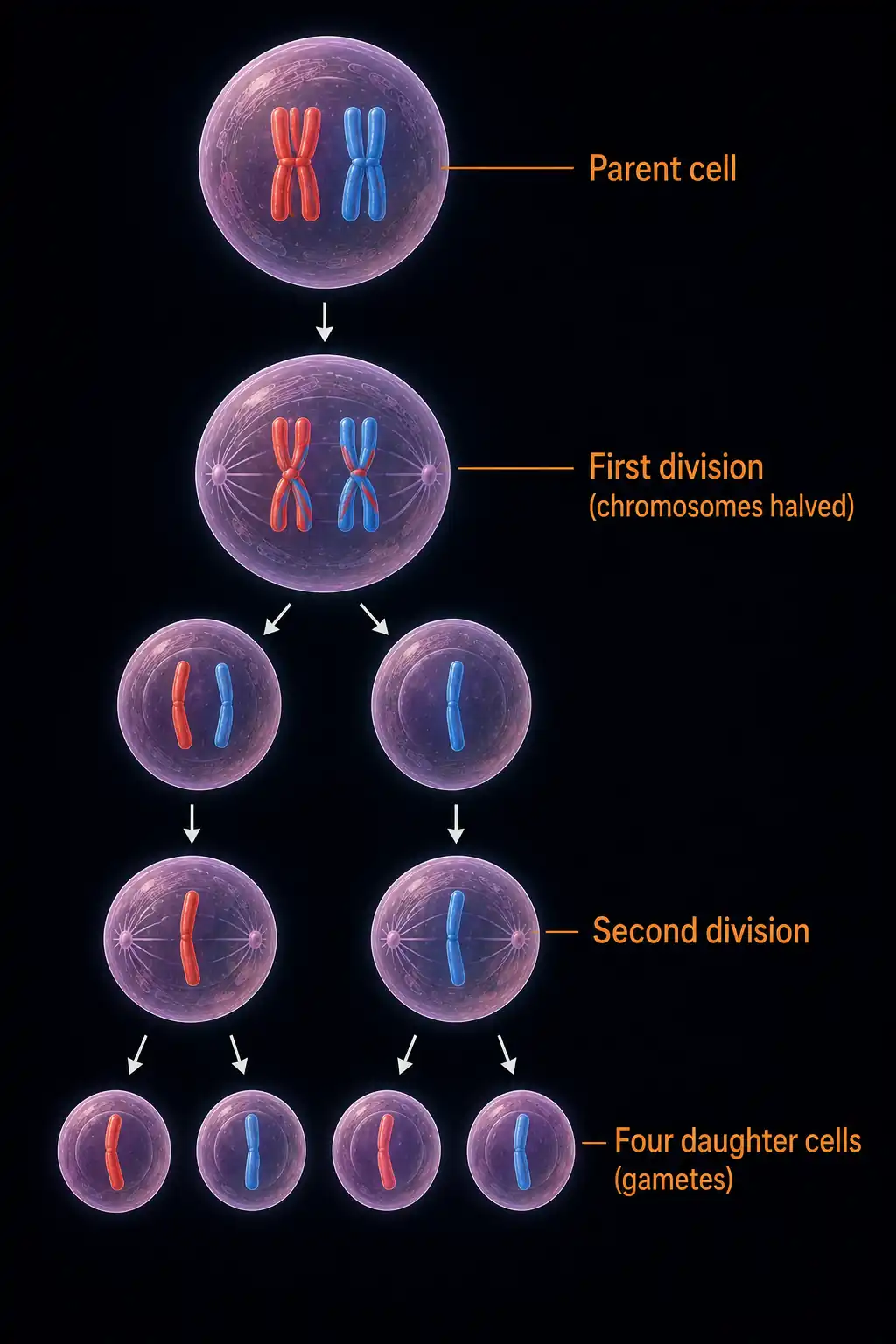
Meiosis differs from mitosis in three big ways:
-
Two divisions instead of one. The parent cell divides twice in a row, producing four daughter cells instead of two.
-
Chromosome number is halved. Each daughter cell has half the number of chromosomes of the parent — the haploid number, in technical language.
-
Genetic mixing. During meiosis, chromosomes from the two parents (mother and father, originally combined when you were conceived) are shuffled and recombined in your gametes. This means every sperm or egg you produce is genetically unique. No two siblings (except identical twins) have the same chromosome combination — and no two of your future children would either.
The deeper purpose of meiosis is variation. By shuffling parental DNA into novel combinations, meiosis ensures that every new individual is genetically distinct. This is why children resemble their parents — but are never identical to them. Meiosis is biology's mechanism for keeping species fresh, adaptive, and able to respond to a changing world.
Growing Cells Outside the Body — Cell Culture
Once scientists understood how cells divide, a remarkable possibility opened up: could we grow cells outside the body, in a laboratory?
Building a Cell from Scratch?
In 2010, a team led by J. Craig Venter announced something stunning. They had taken a simple bacterium called Mycoplasma mycoides, fully sequenced its DNA using computers, and then synthesised an exact chemical copy of that DNA from scratch in the laboratory.
Imagine an alternate biology in which all cell division was by mitosis (producing identical copies) and there was no meiosis at all.
In this alternate world, every child would be conceived from sperm and egg cells that had the full chromosome number — but otherwise, all cell division would proceed normally.
What problem would this cause? What does meiosis prevent that mitosis cannot?
Manana Moment
Contemplation before you continue
The Bhagavad Gita's image of worn-out clothes shed for new ones takes on a startling literal meaning when you understand cell division. Every day, your body produces about 1% of itself in fresh cells — and discards roughly the same amount of older cells. In a sense, you are not the same person you were two months ago. Most of your skin, your gut lining, the cells of your immune system — all of these have been replaced.
And yet something about you persists. Your memories. Your habits. Your sense of being yourself. The DNA in every new cell carries the same instructions — copied faithfully from the cell before — and the same you emerges, made of new matter.
Before you continue, ask yourself:
If your body's matter is constantly being replaced, what is it that makes you 'you' across time?
This is one of the oldest questions in Indian philosophy — and modern biology now adds a precise twist to it. You are not a fixed substance. You are a pattern that perpetuates itself by constant renewal. A wave on the surface of the ocean is not the water that is in it at any moment — the wave keeps moving, while the water that is the wave changes constantly. You are a wave of life, made new every day.*
What This Page Teaches Us
-
Cells divide for three reasons: growth, repair, and replacement. About 1% of your body's cells are replaced every day.
-
Cells cannot grow indefinitely — their surface-to-volume ratio sets a limit. Past that, the only way to keep going is to divide.
-
Mitosis is the most common cell division. Produces two genetically identical daughter cells. Used for growth, repair, asexual reproduction. Every human grows from a single fertilised egg into ~30 trillion cells through patient mitosis.
-
Meiosis happens only in cells that produce gametes (sperm in testes/anthers, egg in ovaries). The parent cell divides twice, producing four daughter cells with half the chromosomes. Fertilisation (sperm + egg) restores the original number.
-
Meiosis serves two deep purposes: (a) keeping the chromosome number constant across generations, and (b) shuffling parental DNA to produce genetically unique offspring. Mitosis preserves identity; meiosis creates variation.
-
Arun Kumar Sharma developed many of the standard laboratory techniques used worldwide for studying plant chromosomes. He received both the Shanti Swarup Bhatnagar Prize and the Padma Bhushan.
-
Cell culture — growing cells in nutrient media outside the body — is now central to vaccines, medicines, cancer research, and modern agriculture. Plant tissue culture lets farmers grow thousands of identical plants from one starting cell.
-
In 2010, J. Craig Venter's team replaced a bacterium's DNA with a fully synthetic copy and the cell continued to live and divide — a striking demonstration that DNA controls cellular structure and activity.
-
The Bhagavad Gita's vision — worn-out clothes shed and replaced with new — describes the cellular reality of being alive. You are a continuous pattern that maintains itself through constant cellular renewal.
Q1.Why must cells divide rather than just continuing to grow?
Right now — in your skin, in your gut, in your bone marrow — about 2 million cells per second are being born. In a single day, your body replaces roughly 1% of all its cells. Hair grows. Cuts heal. The lining of your gut renews itself entirely every 5 days.
But wait — where do the new cells come from? They aren't appearing from nothing. So what is the biological process by which one cell becomes two?
Think about what would have to happen inside a single cell for it to faithfully duplicate itself — including its DNA, its organelles, everything.
The Verse on the Body Renewing Itself
वासांसि जीर्णानि यथा विहाय नवानि गृह्णाति नरोऽपराणि।
तथा शरीराणि विहाय जीर्णान्यन्यानि संयाति नवानि देही॥
'जैसे एक इंसान पुराने, फटे हुए कपड़े उतारकर नए कपड़े पहन लेता है — वैसे ही आत्मा पुराने शरीर को छोड़कर नए शरीर में चली जाती है।'
"As a person sheds worn-out clothes and puts on new ones, so the embodied self leaves worn-out bodies and enters new ones."
The verse describes a deep pattern: renewal through replacement. What seems permanent is, in truth, constantly being shed and remade. Modern biology has discovered the same pattern at the cellular level — your body is literally shedding worn-out cells and putting on new ones, all the time, by the millions per second.
Why Cells Must Divide
Cells divide for three deep reasons:
1. Growth. When you grow taller, when a baby grows from a fertilised egg into a fully formed infant, when a sapling grows into a tree — cells are dividing. Crucially, you don't grow because each cell gets bigger. Cells can only enlarge to a certain size. Past that, the only way to grow is to make more cells.
2. Repair. When you cut your finger, the wound heals because new skin cells divide and replace the damaged ones. When you break a bone, new bone cells divide and rebuild the structure. Almost every healing in your body comes down to cell division.
3. Replacement. Many cells in your body are short-lived. Skin cells live ~30 days. The cells lining your gut live ~5 days. Red blood cells live ~120 days. Each must be constantly replaced. Without continuous cell division, your body would simply wear out in weeks.
Why can't a single cell just keep growing instead? Because of an inescapable problem of surface area. As a cell gets bigger, its volume grows faster than its surface area. The cell membrane (where all exchange of materials happens) cannot keep up with the demands of an enormous interior. So at a certain size, the cell has only one option: divide into two smaller cells, each with a fresh, manageable surface-to-volume ratio.
Cell division is therefore not a luxury or an occasional event. It is constant, going on right now in dozens of places in your body. Both prokaryotic and eukaryotic cells divide — but eukaryotic cells do it through a more carefully controlled process called the cell cycle, ensuring that DNA and organelles are correctly distributed to the daughter cells. (You will study the detailed stages of the cell cycle in higher grades.)
There are two main types of cell division in eukaryotes:
- Mitosis — for normal growth, repair, and asexual reproduction. Produces two cells genetically identical to the parent.
- Meiosis — only in cells that produce gametes (sperm or eggs). Produces four cells with half the chromosomes of the parent.
Let's meet each.
Mitosis — Making More of the Same
Mitosis is by far the most common kind of cell division in your body. Every time a cell needs to grow, repair, or replace, mitosis is the process used.
The basic principle of mitosis is exact copying. The parent cell:
- Duplicates all its DNA (every chromosome is copied exactly).
- Lines up the duplicated chromosomes in the middle of the cell.
- Pulls one full set of chromosomes to each end of the cell.
- Splits down the middle, forming two daughter cells.
The result: two daughter cells, each with the same DNA and the same number of chromosomes as the original parent cell. They are genetically identical — to each other, and to the parent.
This is what allows your body to grow without changing. When skin cells divide to heal a cut, the new cells must be exactly like the surrounding skin cells. When liver cells divide to replace damaged ones, the new cells must inherit the same identity — same DNA, same instructions. Mitosis preserves identity.
Every human being begins life as a single fertilised egg. By the time a person is fully grown, that single cell has divided — through mitosis — into approximately 30 trillion cells. From one cell, by patient repeated mitosis, an entire human body emerges.
Mitosis is the foundation of growth, healing, and the simple maintenance of being alive.
Meiosis — Making Cells for the Next Generation
Mitosis is enough for almost everything your body needs. But there is one job mitosis cannot do: producing the cells that begin a new life.
When a man and a woman together produce a child, two cells must combine: a sperm cell from the father and an egg cell from the mother. Together, they form a single fertilised egg — which then divides by mitosis to grow into a complete new human being.
But here is the puzzle: every human cell has 46 chromosomes (23 from each parent). If both sperm and egg had the full 46 chromosomes, then their fusion would produce a cell with 92 chromosomes — and that number would double every generation. Within a few generations, cells would be unable to function.
The solution: a special kind of cell division — meiosis — that halves the chromosome number when making gametes (sperm and egg cells). Sperm cells have 23 chromosomes. Egg cells have 23 chromosomes. When they fuse at fertilisation, the original 46 is restored.
Where does meiosis happen?
- In animals (including humans): in the testes (which produce sperm) and ovaries (which produce eggs).
- In plants: in the anthers (which produce pollen, carrying sperm cells) and ovaries (which produce egg cells).
Meiosis differs from mitosis in three big ways:
-
Two divisions instead of one. The parent cell divides twice in a row, producing four daughter cells instead of two.
-
Chromosome number is halved. Each daughter cell has half the number of chromosomes of the parent — the haploid number, in technical language.
-
Genetic mixing. During meiosis, chromosomes from the two parents (mother and father, originally combined when you were conceived) are shuffled and recombined in your gametes. This means every sperm or egg you produce is genetically unique. No two siblings (except identical twins) have the same chromosome combination — and no two of your future children would either.
The deeper purpose of meiosis is variation. By shuffling parental DNA into novel combinations, meiosis ensures that every new individual is genetically distinct. This is why children resemble their parents — but are never identical to them. Meiosis is biology's mechanism for keeping species fresh, adaptive, and able to respond to a changing world.
Growing Cells Outside the Body — Cell Culture
Once scientists understood how cells divide, a remarkable possibility opened up: could we grow cells outside the body, in a laboratory?
Building a Cell from Scratch?
In 2010, a team led by J. Craig Venter announced something stunning. They had taken a simple bacterium called Mycoplasma mycoides, fully sequenced its DNA using computers, and then synthesised an exact chemical copy of that DNA from scratch in the laboratory.
Imagine an alternate biology in which all cell division was by mitosis (producing identical copies) and there was no meiosis at all.
In this alternate world, every child would be conceived from sperm and egg cells that had the full chromosome number — but otherwise, all cell division would proceed normally.
What problem would this cause? What does meiosis prevent that mitosis cannot?
What This Page Teaches Us
-
Cells divide for three reasons: growth, repair, and replacement. About 1% of your body's cells are replaced every day.
-
Cells cannot grow indefinitely — their surface-to-volume ratio sets a limit. Past that, the only way to keep going is to divide.
-
Mitosis is the most common cell division. Produces two genetically identical daughter cells. Used for growth, repair, asexual reproduction. Every human grows from a single fertilised egg into ~30 trillion cells through patient mitosis.
-
Meiosis happens only in cells that produce gametes (sperm in testes/anthers, egg in ovaries). The parent cell divides twice, producing four daughter cells with half the chromosomes. Fertilisation (sperm + egg) restores the original number.
-
Meiosis serves two deep purposes: (a) keeping the chromosome number constant across generations, and (b) shuffling parental DNA to produce genetically unique offspring. Mitosis preserves identity; meiosis creates variation.
-
Arun Kumar Sharma developed many of the standard laboratory techniques used worldwide for studying plant chromosomes. He received both the Shanti Swarup Bhatnagar Prize and the Padma Bhushan.
-
Cell culture — growing cells in nutrient media outside the body — is now central to vaccines, medicines, cancer research, and modern agriculture. Plant tissue culture lets farmers grow thousands of identical plants from one starting cell.
-
In 2010, J. Craig Venter's team replaced a bacterium's DNA with a fully synthetic copy and the cell continued to live and divide — a striking demonstration that DNA controls cellular structure and activity.
-
The Bhagavad Gita's vision — worn-out clothes shed and replaced with new — describes the cellular reality of being alive. You are a continuous pattern that maintains itself through constant cellular renewal.
Q1.Why must cells divide rather than just continuing to grow?