Acceleration
The lurch you feel — and the rate at which velocity changes

You're sitting in an auto-rickshaw moving steadily down a Bengaluru road. Suddenly, the driver slams the brakes.
Without thinking, your body lurches forward. You almost hit the dashboard.
What exactly changed in that one second to make you lurch?
It wasn't your speed alone. The auto was already moving. So what changed?
The Verse on Change Itself
मात्रास्पर्शास्तु कौन्तेय शीतोष्णसुखदुःखदाः ।
आगमापायिनोऽनित्यास्तांस्तितिक्षस्व भारत ॥
"गर्मी-सर्दी, सुख-दुख — ये सब आते-जाते रहते हैं। ये कभी टिकते नहीं। बस इन्हें देखते रहो, इनके आने-जाने को सहना सीखो।"
"Sensations of heat and cold, of pleasure and pain — they come, and they go. They are never permanent. Learn simply to watch them rise and pass."
— Krishna's point is that the world is not made of fixed states; it is made of changes between states. Acceleration is exactly that — not where the object is, not even how fast it is going, but how its motion is changing. The Gita's framing is the right mental posture for this entire page.
What Your Body Already Knows
When a vehicle starts from rest, you feel pushed back into your seat. When it brakes, you lurch forward. When a lift starts going up, you feel heavier for a moment; when it stops at your floor, you feel lighter. Each of these feelings is your body responding to acceleration — the quantity that captures how velocity is changing. Constant velocity feels like nothing. Change in velocity is what you feel.
Defining acceleration
Average acceleration is the change in velocity divided by the time over which the change happened.
Here is the initial velocity (at the start of the interval), is the final velocity (at the end), and is the time it took for the change. We usually write the average acceleration with the symbol :
SI unit: metres per second squared, written as or . Why "per second per second"? Because acceleration tells you how much the velocity (already a 'per second' quantity) changes every second.
- An acceleration of means: each second, the velocity grows by 2 m/s. So an object starting at would be at after 1 second, after 2 seconds, after 3 seconds, and so on.
- An acceleration of means: each second, the velocity drops by 3 m/s. The negative sign tells you the direction of acceleration is opposite to the chosen positive direction.
Like velocity, acceleration is a vector — it has both magnitude and direction. Along a straight line, we capture its direction with a or sign.
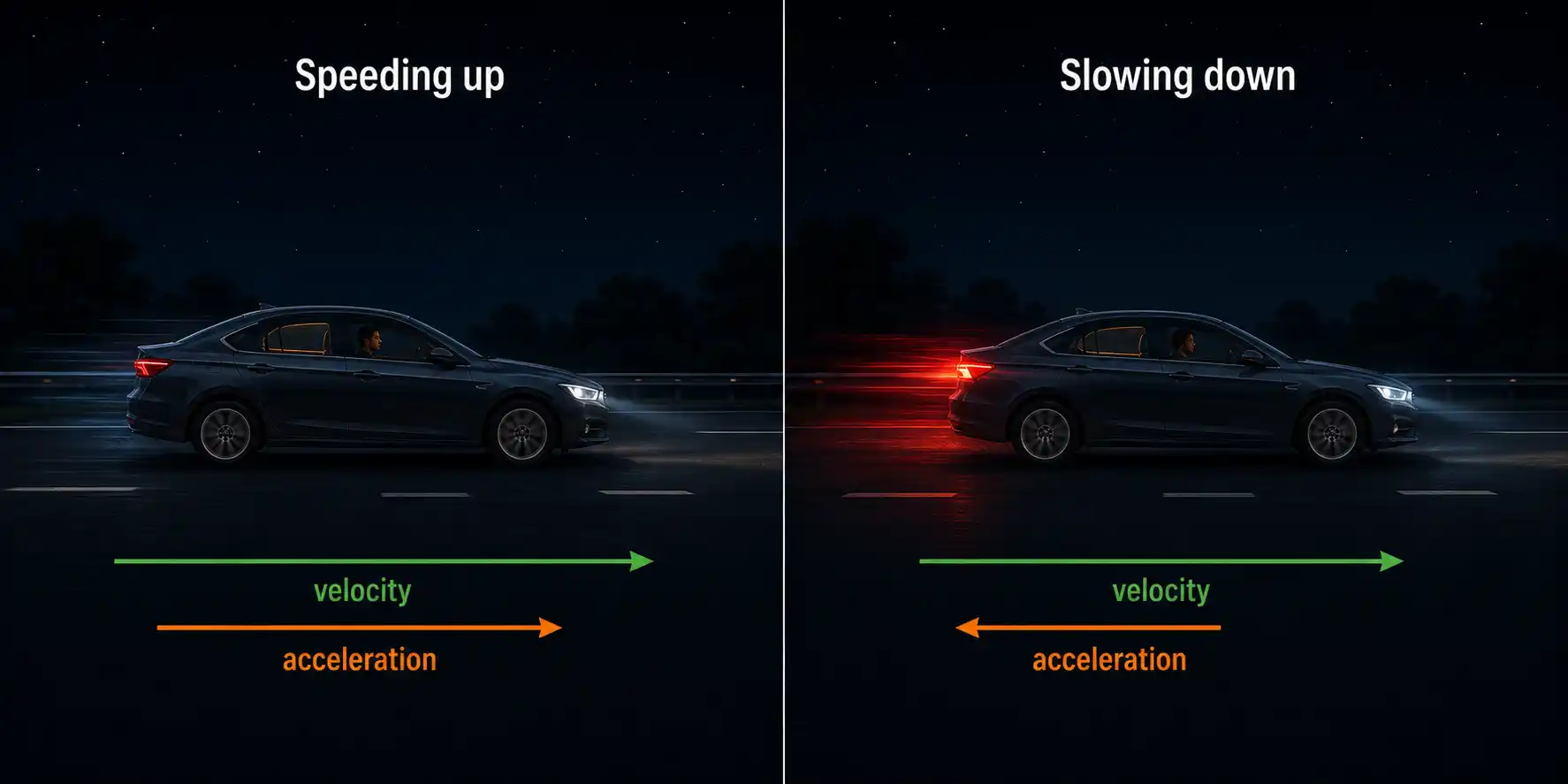
Speeding up vs slowing down
Whether acceleration speeds an object up or slows it down depends on a single comparison: does the acceleration point in the same direction as the velocity, or in the opposite direction?
- Same direction → speeding up. The acceleration is adding to the velocity. Magnitude of velocity grows.
- Opposite direction → slowing down. The acceleration is subtracting from the velocity. Magnitude of velocity shrinks.
In straight-line motion, the sign of tells you which case you're in:
| Velocity sign | Acceleration sign | What's happening |
|---|---|---|
| Moving in direction, speeding up | ||
| Moving in direction, slowing down | ||
| Moving in direction, speeding up (in the negative direction) | ||
| Moving in direction, slowing down |
Notice the trap: a negative acceleration does not automatically mean "slowing down." It means "acceleration in the negative direction." Whether that speeds an object up or slows it down depends entirely on which way the velocity is pointing.
Bus driver, accelerator, brake. When the bus driver presses the accelerator on a forward-moving bus, the velocity is positive and the acceleration is positive — the bus speeds up. When the driver presses the brake, the velocity is still positive but the acceleration becomes negative — the bus slows down. Same bus, same instruments. Just opposite signs.
A bus is moving on a long straight highway at . The driver presses the accelerator for s and the bus's speed rises to . After cruising for some time, the driver spots an obstacle and presses the brake; the bus comes to a stop in s.
Find the average acceleration in (i) the speeding-up phase, and (ii) the braking phase.
A Vande Bharat express is cruising on a perfectly straight track at a steady . A passenger argues with her friend: "At 160 km/h, the train must have huge acceleration!" Her friend disagrees: "It has zero acceleration."
Who is right, and why?
Remember — Three Things That Can Cause Acceleration
An object is accelerating if any of these is true at a given instant:
- Its speed is changing (faster or slower) while moving in a straight line.
- Its direction is changing, even if the speed is constant — a car turning a corner at steady 30 km/h is accelerating.
- Both are changing at once — a car speeding up around a corner.
In this chapter we focus mostly on case 1 (straight-line motion with changing speed) and we will meet case 2 (uniform circular motion) later in §4.4. The big surprise of case 2: an object moving at constant speed in a circle is constantly accelerating — because its direction is always changing.
Threads of Curiosity — What Acceleration Feels Like, Numerically
Some real accelerations to put numbers in context:
Q1.What is acceleration?
You're sitting in an auto-rickshaw moving steadily down a Bengaluru road. Suddenly, the driver slams the brakes.
Without thinking, your body lurches forward. You almost hit the dashboard.
What exactly changed in that one second to make you lurch?
It wasn't your speed alone. The auto was already moving. So what changed?
The Verse on Change Itself
मात्रास्पर्शास्तु कौन्तेय शीतोष्णसुखदुःखदाः ।
आगमापायिनोऽनित्यास्तांस्तितिक्षस्व भारत ॥
"गर्मी-सर्दी, सुख-दुख — ये सब आते-जाते रहते हैं। ये कभी टिकते नहीं। बस इन्हें देखते रहो, इनके आने-जाने को सहना सीखो।"
"Sensations of heat and cold, of pleasure and pain — they come, and they go. They are never permanent. Learn simply to watch them rise and pass."
— Krishna's point is that the world is not made of fixed states; it is made of changes between states. Acceleration is exactly that — not where the object is, not even how fast it is going, but how its motion is changing. The Gita's framing is the right mental posture for this entire page.
What Your Body Already Knows
When a vehicle starts from rest, you feel pushed back into your seat. When it brakes, you lurch forward. When a lift starts going up, you feel heavier for a moment; when it stops at your floor, you feel lighter. Each of these feelings is your body responding to acceleration — the quantity that captures how velocity is changing. Constant velocity feels like nothing. Change in velocity is what you feel.
Defining acceleration
Average acceleration is the change in velocity divided by the time over which the change happened.
Here is the initial velocity (at the start of the interval), is the final velocity (at the end), and is the time it took for the change. We usually write the average acceleration with the symbol :
SI unit: metres per second squared, written as or . Why "per second per second"? Because acceleration tells you how much the velocity (already a 'per second' quantity) changes every second.
- An acceleration of means: each second, the velocity grows by 2 m/s. So an object starting at would be at after 1 second, after 2 seconds, after 3 seconds, and so on.
- An acceleration of means: each second, the velocity drops by 3 m/s. The negative sign tells you the direction of acceleration is opposite to the chosen positive direction.
Like velocity, acceleration is a vector — it has both magnitude and direction. Along a straight line, we capture its direction with a or sign.
Speeding up vs slowing down
Whether acceleration speeds an object up or slows it down depends on a single comparison: does the acceleration point in the same direction as the velocity, or in the opposite direction?
- Same direction → speeding up. The acceleration is adding to the velocity. Magnitude of velocity grows.
- Opposite direction → slowing down. The acceleration is subtracting from the velocity. Magnitude of velocity shrinks.
In straight-line motion, the sign of tells you which case you're in:
| Velocity sign | Acceleration sign | What's happening |
|---|---|---|
| Moving in direction, speeding up | ||
| Moving in direction, slowing down | ||
| Moving in direction, speeding up (in the negative direction) | ||
| Moving in direction, slowing down |
Notice the trap: a negative acceleration does not automatically mean "slowing down." It means "acceleration in the negative direction." Whether that speeds an object up or slows it down depends entirely on which way the velocity is pointing.
Bus driver, accelerator, brake. When the bus driver presses the accelerator on a forward-moving bus, the velocity is positive and the acceleration is positive — the bus speeds up. When the driver presses the brake, the velocity is still positive but the acceleration becomes negative — the bus slows down. Same bus, same instruments. Just opposite signs.
A bus is moving on a long straight highway at . The driver presses the accelerator for s and the bus's speed rises to . After cruising for some time, the driver spots an obstacle and presses the brake; the bus comes to a stop in s.
Find the average acceleration in (i) the speeding-up phase, and (ii) the braking phase.
A Vande Bharat express is cruising on a perfectly straight track at a steady . A passenger argues with her friend: "At 160 km/h, the train must have huge acceleration!" Her friend disagrees: "It has zero acceleration."
Who is right, and why?
Threads of Curiosity — What Acceleration Feels Like, Numerically
Some real accelerations to put numbers in context:
Q1.What is acceleration?