Distance vs Displacement
Same journey, two very different numbers — and why physics needs both
The same journey, two different numbers
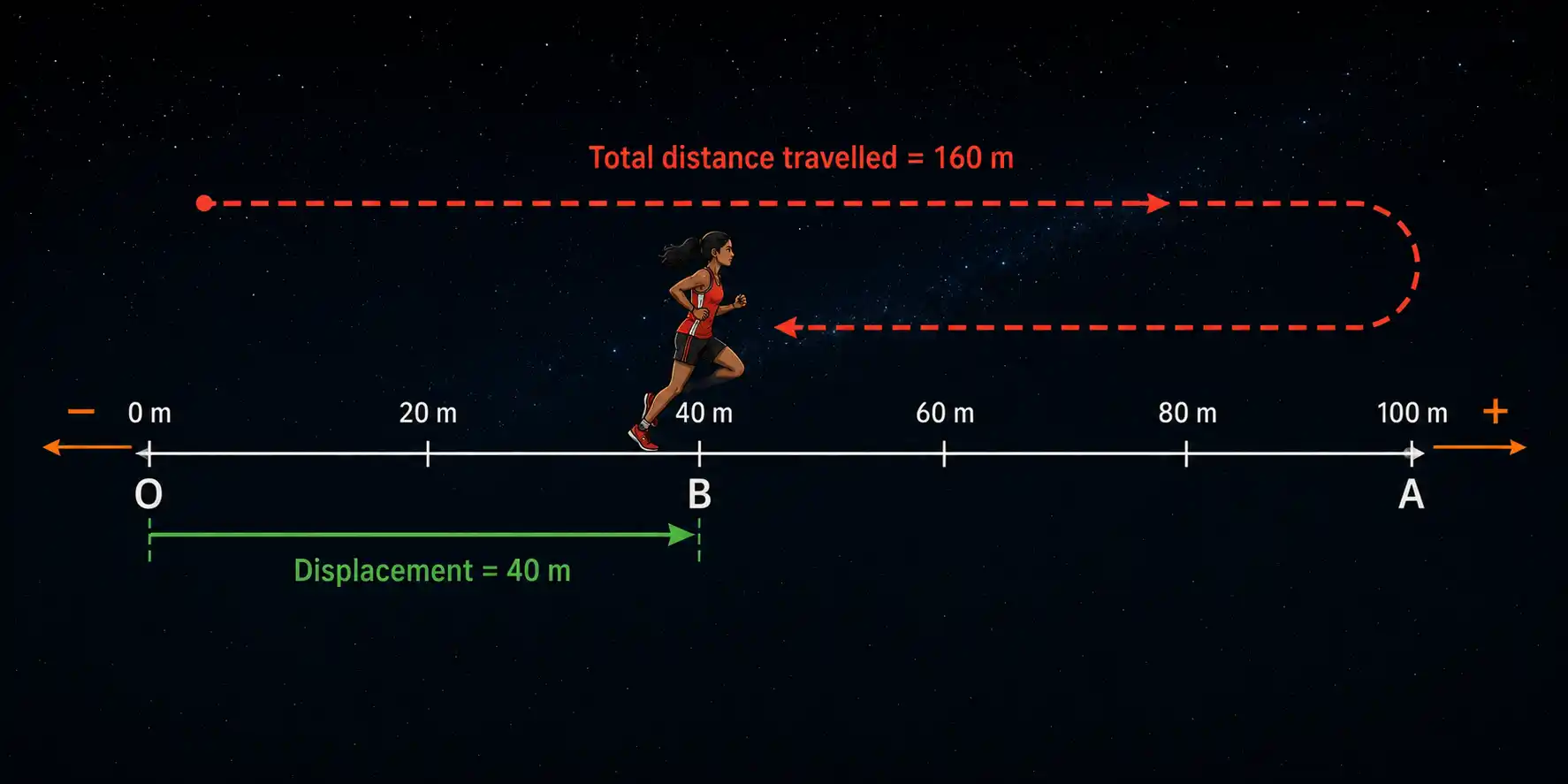
Meet Neena, an athlete training on a straight running track. We pick her starting point as the origin O on the number line, and the rightward direction as positive.
- At s, Neena is at O — that's m.
- She runs steadily and reaches the 100 m mark at s — that's the point we'll call A.
- Then she turns around and jogs back. At s, she has reached the 40 m mark — point B.
Now ask two different questions about her motion between s and s.
Question 1: How much ground did her feet cover?
She ran 100 m forward (O → A), then 60 m backward (A → B). Her feet touched the ground for a total of m. This is the total distance travelled — it counts every metre, regardless of direction.
Question 2: Where did she end up, compared to where she started?
She ended at point B, which is 40 m to the right of O. Her net change in position is just 40 m in the positive direction. This is the displacement — it cares only about the start and the end, not the path between.
Distance = total path length covered. Always positive. A scalar — direction is not part of it.
Displacement = net change in position. Has both magnitude (the size of the change) and direction (which way). A vector.
Notice: . The two numbers describe the same 16 seconds of running, but they answer different questions. Both are correct. Both are needed. Confusing them is what trips students up.
When are they equal? When is one of them zero?
There are two clean special cases worth knowing.
1. When you don't turn back, distance = magnitude of displacement.
If an object moves in a straight line without ever reversing direction, every metre you cover is also a metre away from where you started. So distance and the magnitude of displacement come out equal. Example: a car driving from Delhi to Karnal on a straight highway — 125 km of distance, 125 km of displacement (north).
2. When you return to your starting point, displacement is zero.
The net change in position is calculated as (final position) − (initial position). If you end where you started, that subtraction gives zero — even if your feet covered kilometres. The clearest case: a sprinter who runs 400 m around the stadium and finishes exactly where they started has displacement = 0, but distance = 400 m.
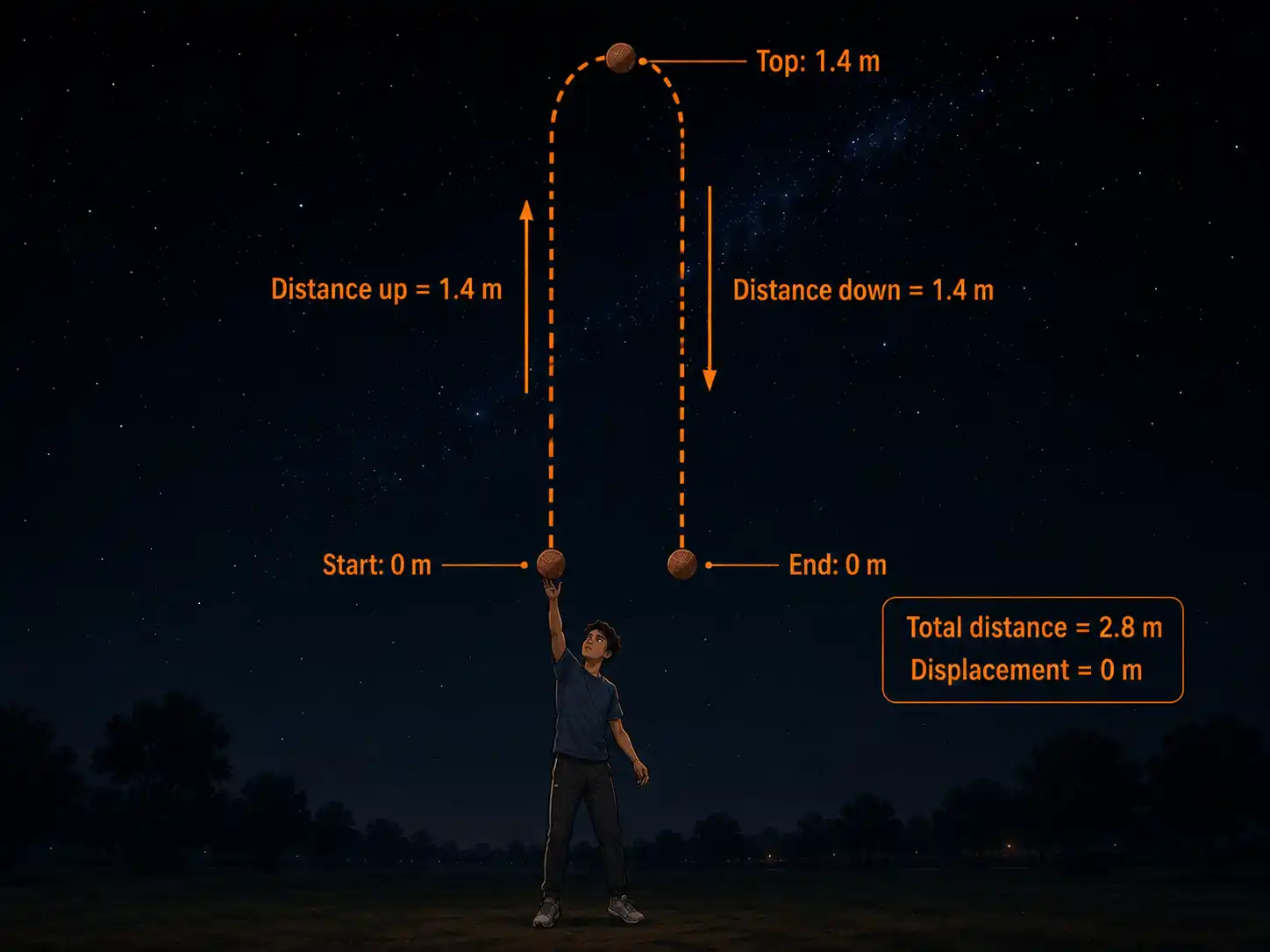
A vertical example. Throw a ball straight up from your hand to a height of 1.4 m. It rises, slows, stops at the top, and falls back into your hand. The ball has covered m of total distance. But its displacement is — it ended exactly where it started.
From these two rules together: the magnitude of displacement is always less than or equal to the total distance. It can never be more. A straight line is the shortest path between two points — there is no way to cover less ground than the displacement itself.
The same journey, two different numbers
Meet Neena, an athlete training on a straight running track. We pick her starting point as the origin O on the number line, and the rightward direction as positive.
- At s, Neena is at O — that's m.
- She runs steadily and reaches the 100 m mark at s — that's the point we'll call A.
- Then she turns around and jogs back. At s, she has reached the 40 m mark — point B.
Now ask two different questions about her motion between s and s.
Question 1: How much ground did her feet cover?
She ran 100 m forward (O → A), then 60 m backward (A → B). Her feet touched the ground for a total of m. This is the total distance travelled — it counts every metre, regardless of direction.
Question 2: Where did she end up, compared to where she started?
She ended at point B, which is 40 m to the right of O. Her net change in position is just 40 m in the positive direction. This is the displacement — it cares only about the start and the end, not the path between.
Distance = total path length covered. Always positive. A scalar — direction is not part of it.
Displacement = net change in position. Has both magnitude (the size of the change) and direction (which way). A vector.
Notice: . The two numbers describe the same 16 seconds of running, but they answer different questions. Both are correct. Both are needed. Confusing them is what trips students up.
When are they equal? When is one of them zero?
There are two clean special cases worth knowing.
1. When you don't turn back, distance = magnitude of displacement.
If an object moves in a straight line without ever reversing direction, every metre you cover is also a metre away from where you started. So distance and the magnitude of displacement come out equal. Example: a car driving from Delhi to Karnal on a straight highway — 125 km of distance, 125 km of displacement (north).
2. When you return to your starting point, displacement is zero.
The net change in position is calculated as (final position) − (initial position). If you end where you started, that subtraction gives zero — even if your feet covered kilometres. The clearest case: a sprinter who runs 400 m around the stadium and finishes exactly where they started has displacement = 0, but distance = 400 m.
A vertical example. Throw a ball straight up from your hand to a height of 1.4 m. It rises, slows, stops at the top, and falls back into your hand. The ball has covered m of total distance. But its displacement is — it ended exactly where it started.
From these two rules together: the magnitude of displacement is always less than or equal to the total distance. It can never be more. A straight line is the shortest path between two points — there is no way to cover less ground than the displacement itself.