The Three Kinematic Equations
Three formulas, one underlying principle — and the toolkit for every motion problem
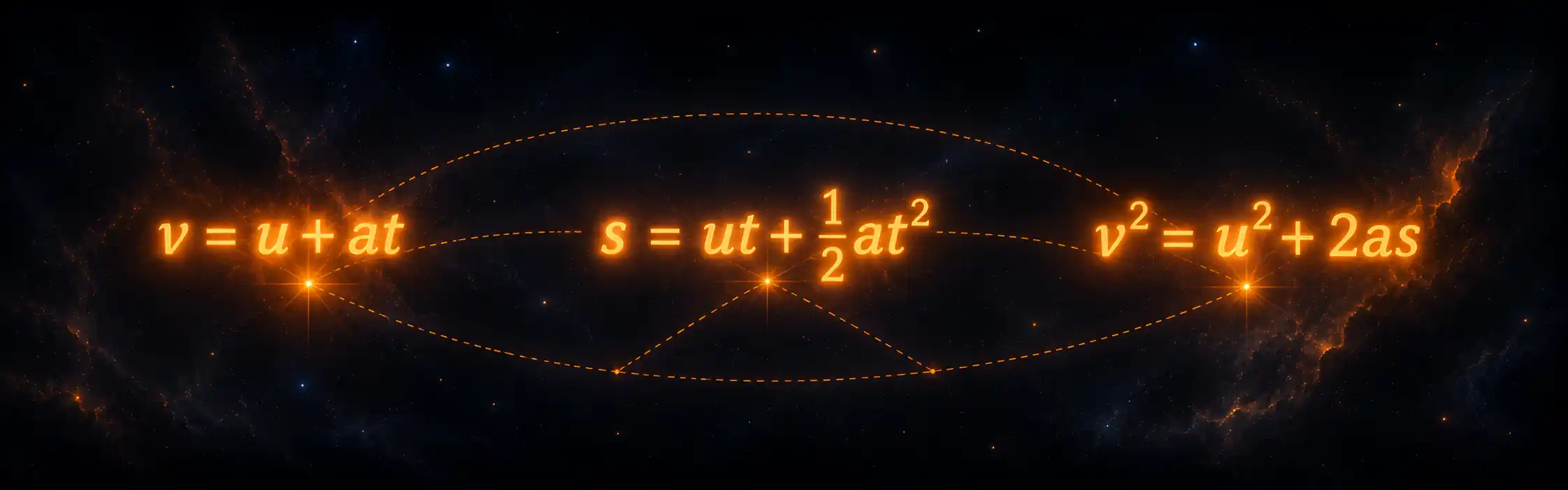
Imagine you have a magic notebook. You hand me any three numbers about a moving object — its starting speed, its acceleration, the time, the displacement, the final speed — any three. The notebook then tells you the other two, exactly.
Does such a notebook exist? And if it does, how could three numbers possibly be enough to determine the rest?
Think about what stays the same throughout the motion. If acceleration is constant, that's a powerful constraint.
The Verse on the Single Thread
मत्तः परतरं नान्यत्किञ्चिदस्ति धनञ्जय ।
मयि सर्वमिदं प्रोतं सूत्रे मणिगणा इव ॥
"मुझसे ऊपर कुछ नहीं, अर्जुन। यह सब कुछ मुझ पर ऐसे पिरोया हुआ है जैसे धागे पर मोती।"
"There is nothing higher than this, Arjuna — all that you see is strung on a single thread, like beads on a string."
— Krishna's image is precise: many separate-looking things share one hidden thread. The three kinematic equations look different, but they all hang on a single thread — acceleration is constant. Once you grasp the thread, the three equations stop feeling like three things to memorise and become three views of one underlying truth.
Five Quantities, Three Equations
Every constant-acceleration motion is described by exactly five physical quantities:
Equation 1 — velocity changes uniformly with time
Recall the definition of acceleration from §4.1.4:
This is the foundation of everything that follows. Multiply both sides by , then move to the right:
What this equation tells you. Given the initial velocity and the constant acceleration , the velocity at any later time is just . If is positive, the velocity grows linearly. If is negative, it shrinks. If is zero, stays equal to forever — uniform motion.
Quick test. A scooter accelerating at from rest () reaches at . After 10 s? . The equation does not lie.
Equation 1 connects — but it does not mention . For displacement, we need a second equation.
Equation 2 — displacement from the area under a v–t graph
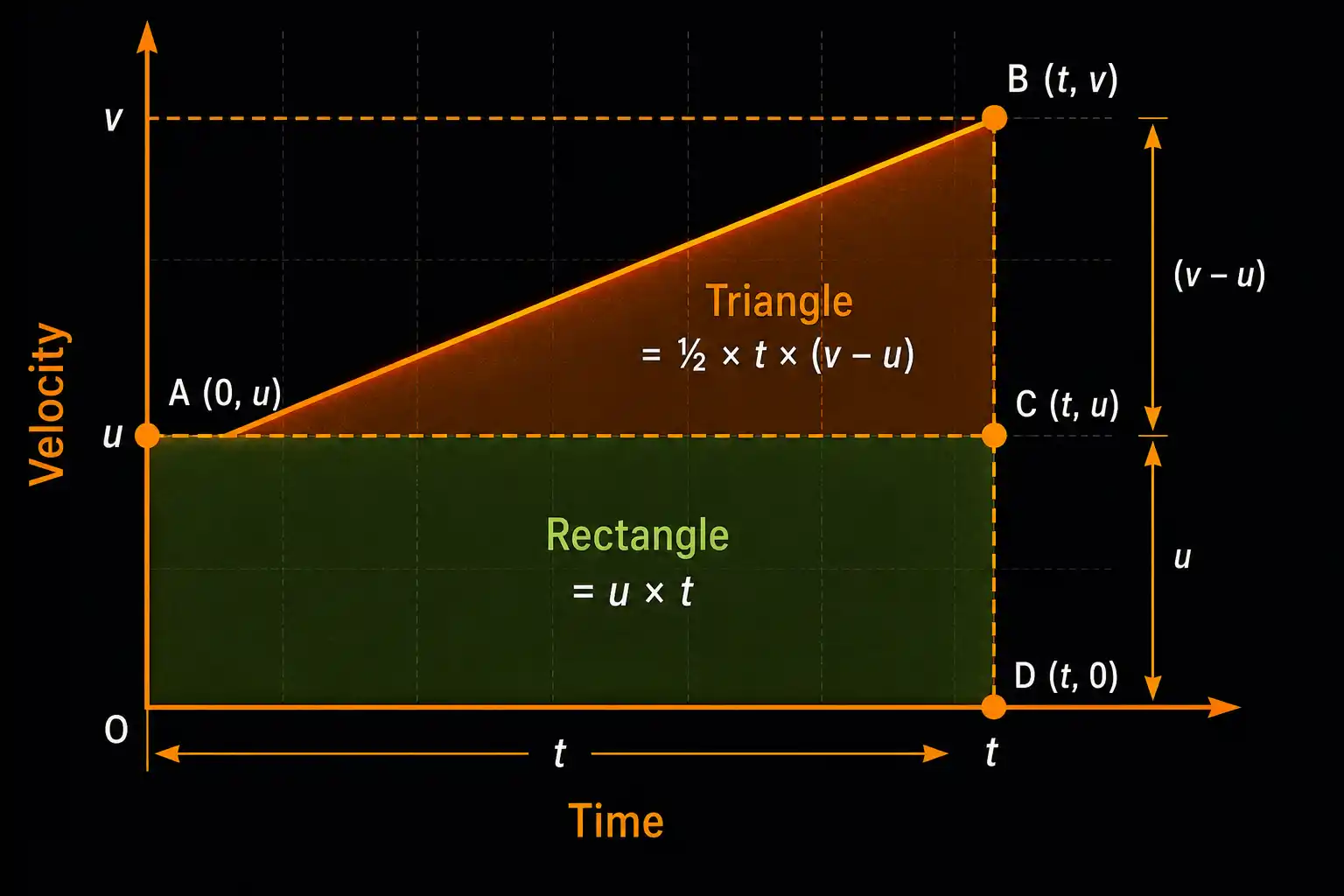
We learned on the previous page that displacement equals the area under a velocity-time graph. For an object with initial velocity at and final velocity at time (constant acceleration), the v–t graph is a straight line from to .
The shape under that line is a trapezium that we can split into a rectangle (height , width ) plus a triangle (base , height ).
Now substitute from Equation 1:
What this equation tells you. It gives you the displacement directly from — without needing to know the final velocity. Notice the two terms: the first () is the displacement you would have if there were no acceleration. The second () is the extra displacement that the acceleration produces. The split tells the story: it is the constant-velocity displacement plus the acceleration's contribution.
For a free-falling object dropped from rest (): . After 1 s: m. After 2 s: m. After 3 s: m. These are exactly the numbers from the free-fall table on Page 5 — the equation reproduces them.
Equation 3 — when time is not given
Equations 1 and 2 are the two primary equations. The third is derived by combining them — specifically, by eliminating , which is useful when a problem doesn't give you the time.
From Equation 1, . Substitute into Equation 2:
Simplify (combining over ):
Multiplying both sides by :
What this equation tells you. It connects velocities and displacement directly, with no in sight. So if you know any three of , you can find the fourth — even if you have no idea how long the motion took. This is the equation you reach for in stopping-distance problems (next page) and in problems where the question gives velocities and distances but no times.
The full set, in one box:
| Equation | What's missing | When to use it |
|---|---|---|
| When you don't need displacement | ||
| When you don't know final velocity | ||
| When you don't have time |
Memorise these three lines and you are equipped for almost every numerical question in this chapter.
A car is moving on a highway and brakes are applied, producing an acceleration of . How far does the car travel before coming to rest, if its initial velocity was (i) , and (ii) ?
A bike accelerates uniformly from rest. It covers in the first second of its motion. Approximately how much distance will it cover in the first three seconds?
Bridging Science and Society — The Equations Inside Every Modern Car
When a modern car detects a sudden deceleration consistent with a crash, an internal airbag controller has roughly milliseconds to decide whether to fire the airbags. The decision is made by a chip that, in essence, runs the kinematic equations against accelerometer readings hundreds of times per second. If the deceleration crosses a threshold consistent with a real impact (and not a pothole), it triggers ignition. The airbag inflates in another ms — exactly enough time to cushion the driver before the body slams forward.
Q1.Which kinematic equation does NOT involve the variable (time)?
Imagine you have a magic notebook. You hand me any three numbers about a moving object — its starting speed, its acceleration, the time, the displacement, the final speed — any three. The notebook then tells you the other two, exactly.
Does such a notebook exist? And if it does, how could three numbers possibly be enough to determine the rest?
Think about what stays the same throughout the motion. If acceleration is constant, that's a powerful constraint.
The Verse on the Single Thread
मत्तः परतरं नान्यत्किञ्चिदस्ति धनञ्जय ।
मयि सर्वमिदं प्रोतं सूत्रे मणिगणा इव ॥
"मुझसे ऊपर कुछ नहीं, अर्जुन। यह सब कुछ मुझ पर ऐसे पिरोया हुआ है जैसे धागे पर मोती।"
"There is nothing higher than this, Arjuna — all that you see is strung on a single thread, like beads on a string."
— Krishna's image is precise: many separate-looking things share one hidden thread. The three kinematic equations look different, but they all hang on a single thread — acceleration is constant. Once you grasp the thread, the three equations stop feeling like three things to memorise and become three views of one underlying truth.
Five Quantities, Three Equations
Every constant-acceleration motion is described by exactly five physical quantities:
Equation 1 — velocity changes uniformly with time
Recall the definition of acceleration from §4.1.4:
This is the foundation of everything that follows. Multiply both sides by , then move to the right:
What this equation tells you. Given the initial velocity and the constant acceleration , the velocity at any later time is just . If is positive, the velocity grows linearly. If is negative, it shrinks. If is zero, stays equal to forever — uniform motion.
Quick test. A scooter accelerating at from rest () reaches at . After 10 s? . The equation does not lie.
Equation 1 connects — but it does not mention . For displacement, we need a second equation.
Equation 2 — displacement from the area under a v–t graph
We learned on the previous page that displacement equals the area under a velocity-time graph. For an object with initial velocity at and final velocity at time (constant acceleration), the v–t graph is a straight line from to .
The shape under that line is a trapezium that we can split into a rectangle (height , width ) plus a triangle (base , height ).
Now substitute from Equation 1:
What this equation tells you. It gives you the displacement directly from — without needing to know the final velocity. Notice the two terms: the first () is the displacement you would have if there were no acceleration. The second () is the extra displacement that the acceleration produces. The split tells the story: it is the constant-velocity displacement plus the acceleration's contribution.
For a free-falling object dropped from rest (): . After 1 s: m. After 2 s: m. After 3 s: m. These are exactly the numbers from the free-fall table on Page 5 — the equation reproduces them.
Equation 3 — when time is not given
Equations 1 and 2 are the two primary equations. The third is derived by combining them — specifically, by eliminating , which is useful when a problem doesn't give you the time.
From Equation 1, . Substitute into Equation 2:
Simplify (combining over ):
Multiplying both sides by :
What this equation tells you. It connects velocities and displacement directly, with no in sight. So if you know any three of , you can find the fourth — even if you have no idea how long the motion took. This is the equation you reach for in stopping-distance problems (next page) and in problems where the question gives velocities and distances but no times.
The full set, in one box:
| Equation | What's missing | When to use it |
|---|---|---|
| When you don't need displacement | ||
| When you don't know final velocity | ||
| When you don't have time |
Memorise these three lines and you are equipped for almost every numerical question in this chapter.
A car is moving on a highway and brakes are applied, producing an acceleration of . How far does the car travel before coming to rest, if its initial velocity was (i) , and (ii) ?
A bike accelerates uniformly from rest. It covers in the first second of its motion. Approximately how much distance will it cover in the first three seconds?
Bridging Science and Society — The Equations Inside Every Modern Car
When a modern car detects a sudden deceleration consistent with a crash, an internal airbag controller has roughly milliseconds to decide whether to fire the airbags. The decision is made by a chip that, in essence, runs the kinematic equations against accelerometer readings hundreds of times per second. If the deceleration crosses a threshold consistent with a real impact (and not a pothole), it triggers ignition. The airbag inflates in another ms — exactly enough time to cushion the driver before the body slams forward.
Q1.Which kinematic equation does NOT involve the variable (time)?