Uniform Circular Motion
The surprising case where speed never changes — but acceleration is always there
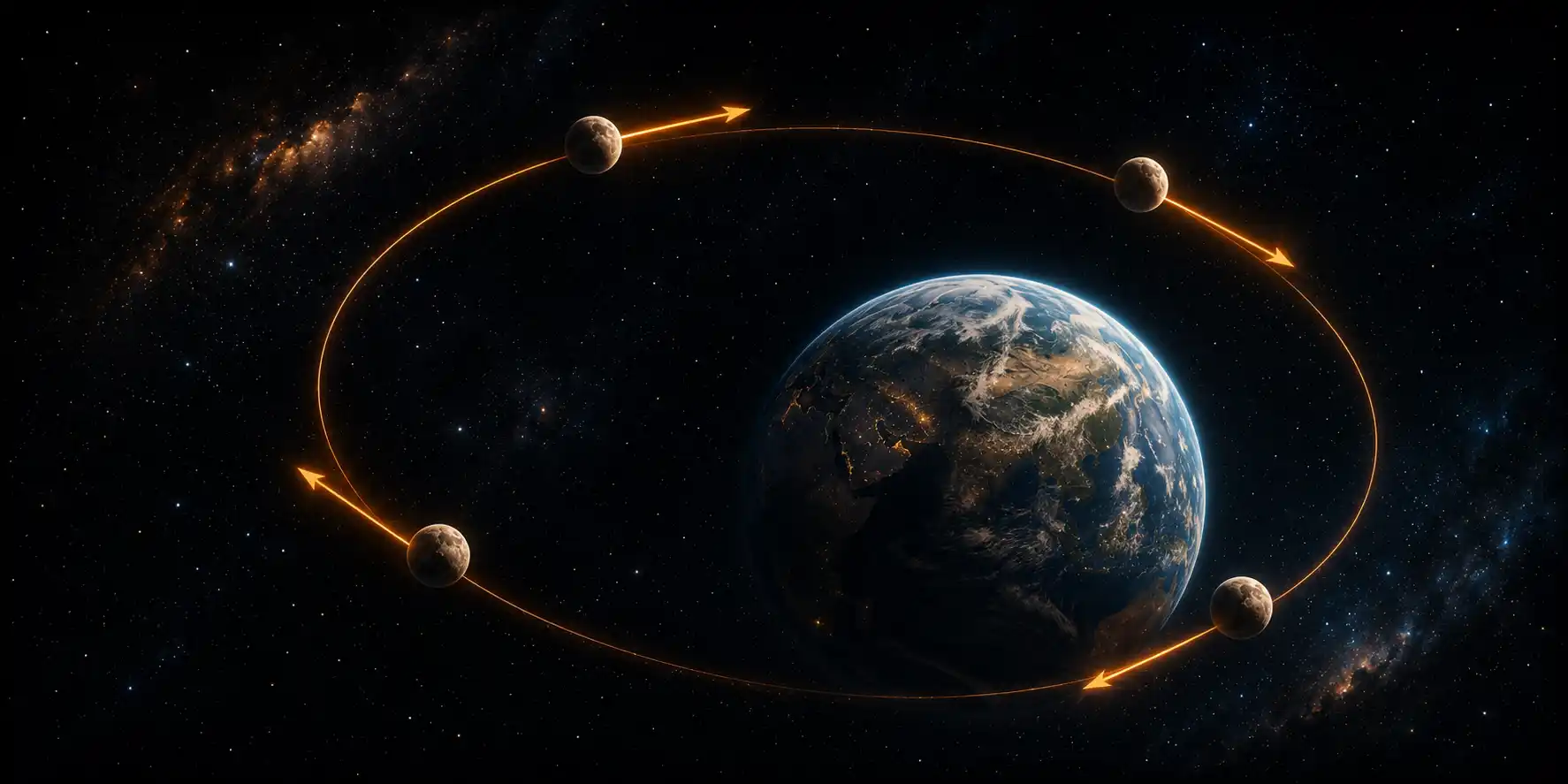
A child sits on a merry-go-round at a Lucknow fair. The merry-go-round spins at a perfectly constant speed — never slowing, never speeding up. The child laughs and grips the handlebar, feeling herself pulled outward.
Question. If her speed is constant — never changing — is she still accelerating?
Acceleration is the rate of change of velocity. And velocity has two parts: magnitude and direction.
The Verse on the Wheel That Turns
एवं प्रवर्तितं चक्रं नानुवर्तयतीह यः ।
अघायुरिन्द्रियारामो मोघं पार्थ स जीवति ॥
"यह जो चक्र चल रहा है — पीछे न रहो, इसमें शामिल हो। जो इस बहाव के साथ नहीं चलता, अर्जुन, उसका जीना बेकार ही जाता है।"
"This wheel of motion is forever turning — those who step into its rhythm find their life. Those who stand outside it, Arjuna, live in vain."
— Krishna's image is the cakra — the wheel — turning eternally. The wheel does not arrive anywhere; it returns. Yet it is always in motion. Uniform circular motion is exactly this paradox in physics: an object that goes nowhere new, yet is constantly moving, constantly turning, constantly accelerating. The Indian thinkers who composed this verse already knew the wheel was never truly still — even when its speed was constant.
Where We Are Going
Until now, every motion in this chapter has been on a straight line. Now we step into two dimensions. The simplest 2D motion is uniform circular motion — moving in a circle at constant speed. It looks easy at first; it has a deeply counter-intuitive consequence at the end. By the time you finish this page, you will see why the Moon, satellites, washing-machine drums, and a stone tied to a string all share the same physics.
One full revolution: distance vs displacement on a circle
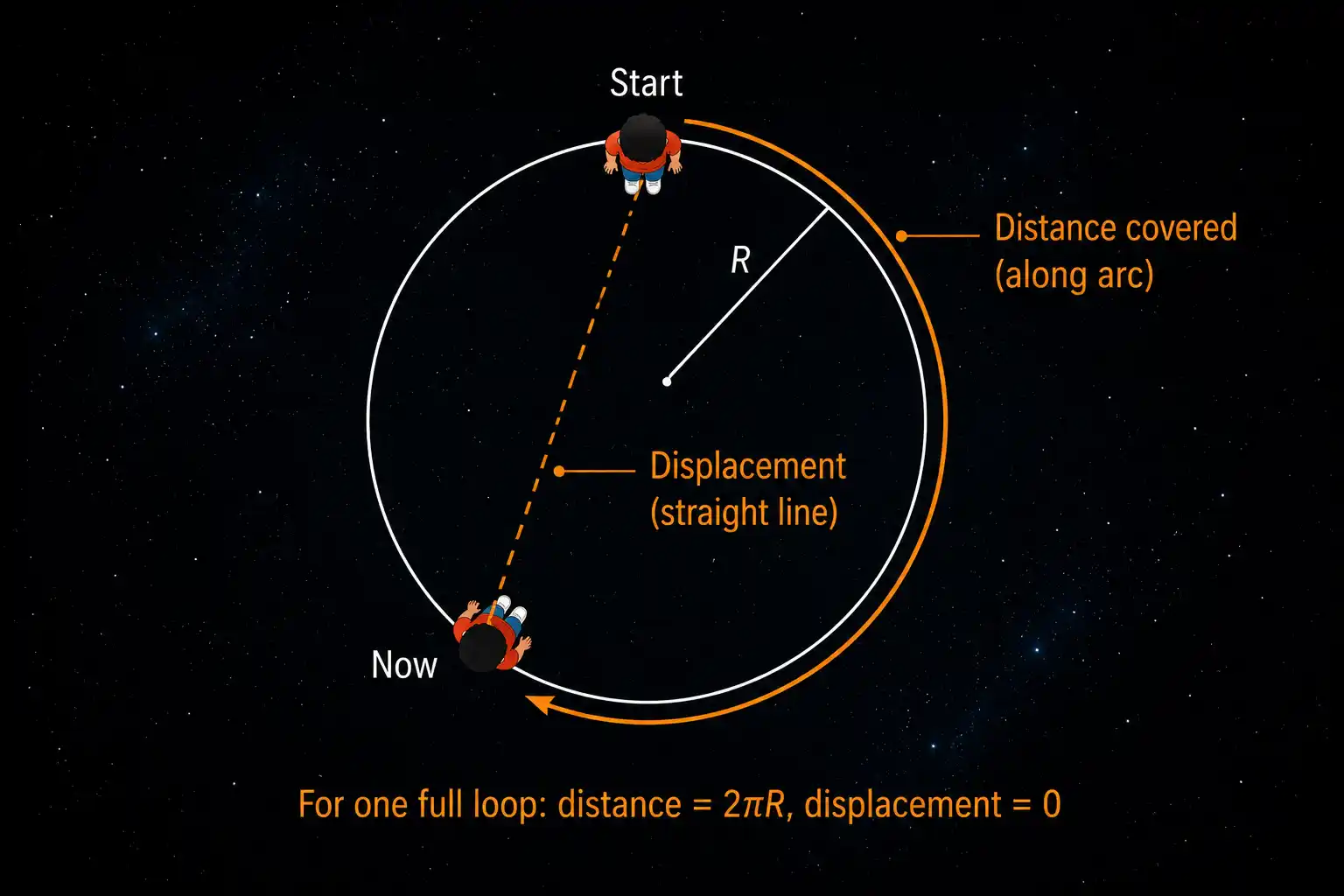
Imagine a child on a merry-go-round that has been simplified to a perfect circle of radius . The child sits at one point on the rim. The merry-go-round spins steadily, taking time to complete one full revolution.
How much distance does she travel in one revolution?
In one full loop, her feet (well, her seat) trace out the entire circumference of the circle. From geometry, the circumference of a circle of radius is . So
What is her displacement after one full revolution?
After one complete loop, she is back at exactly the same point she started from. Her start position and end position are the same. Therefore her displacement is zero.
This already tells you something: distance () and displacement () can be wildly different — exactly the lesson of Page 2. Average speed and average velocity follow:
A child travelling at around a radius merry-go-round has an average velocity over one full revolution of zero — even though she's moving the whole time. Once again, distance and displacement quietly tell different stories.
Constant speed, constantly turning velocity
Uniform circular motion is defined cleanly: an object moves along a circular path at a constant speed. The numerical value of how fast it is moving — the speedometer reading, in our analogy — does not change.
But velocity is not just speed. Velocity is speed with a direction. And on a circle, the direction of motion is constantly changing.
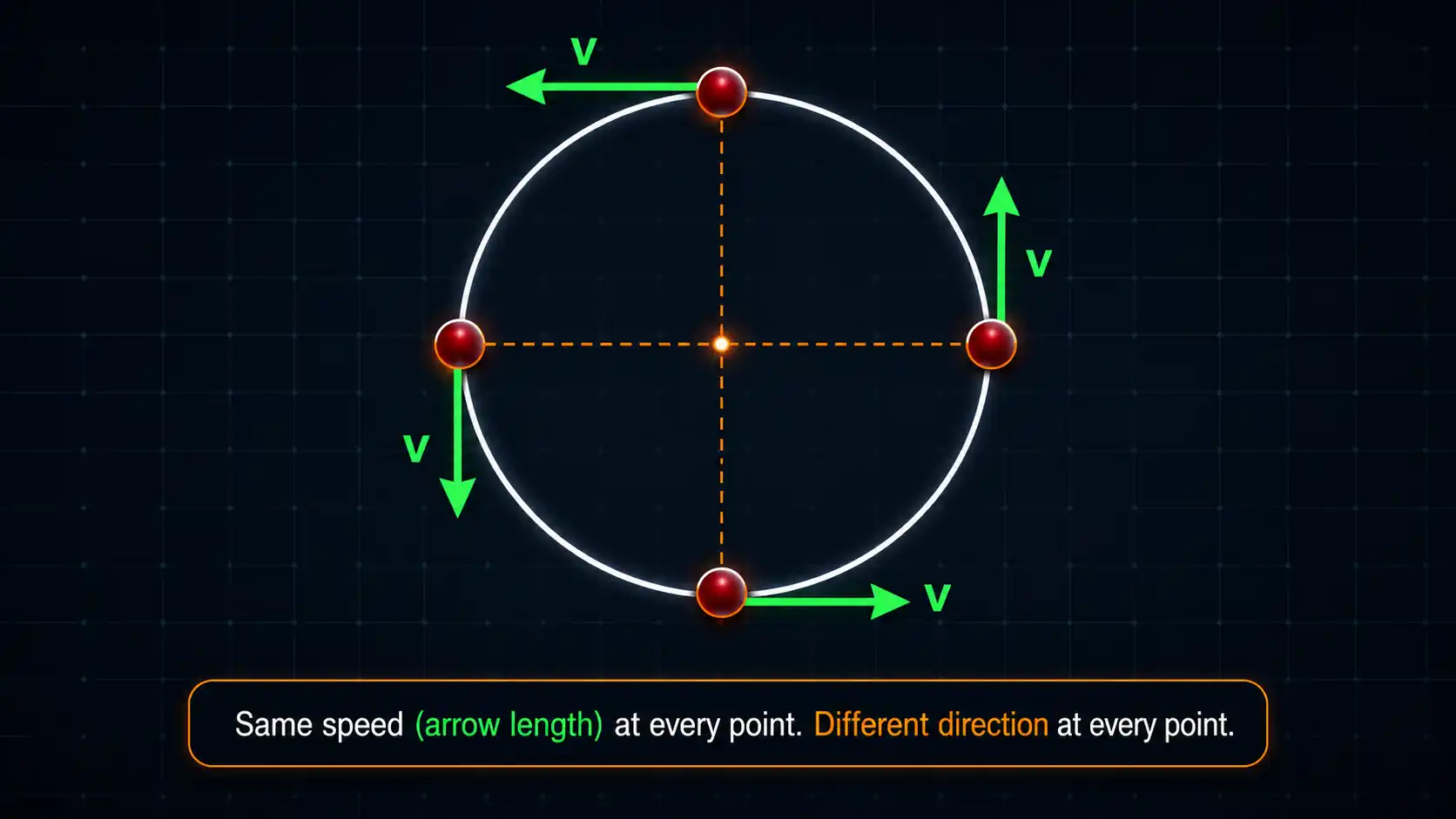
Direction at a point: the tangent. At any single instant, the object is moving in the direction tangent to the circle at that point — the direction it would fly off in if the circle suddenly disappeared. A second later, the tangent direction at the new point is different. A second after that, different again. Every instant, a new direction.
If you imagine an athlete running first along a square track, then a hexagonal one, then a 12-sided polygon, then a 100-sided polygon, you can see the picture: the number of times they have to redirect themselves increases each step. As the track becomes more and more circular, the redirects happen more and more frequently. In the limit — a perfect circle — the redirection is continuous. The direction changes at every single instant.
Speed: constant. Direction: continuously changing. Velocity: continuously changing.
And if velocity is changing, then by definition, the object is accelerating — even though it never speeds up or slows down.
Activity 4.5 — the marble in the ring
Try this — it takes 30 seconds.
- Take a flat ring (an adhesive-tape ring works perfectly) and place it on a smooth table.
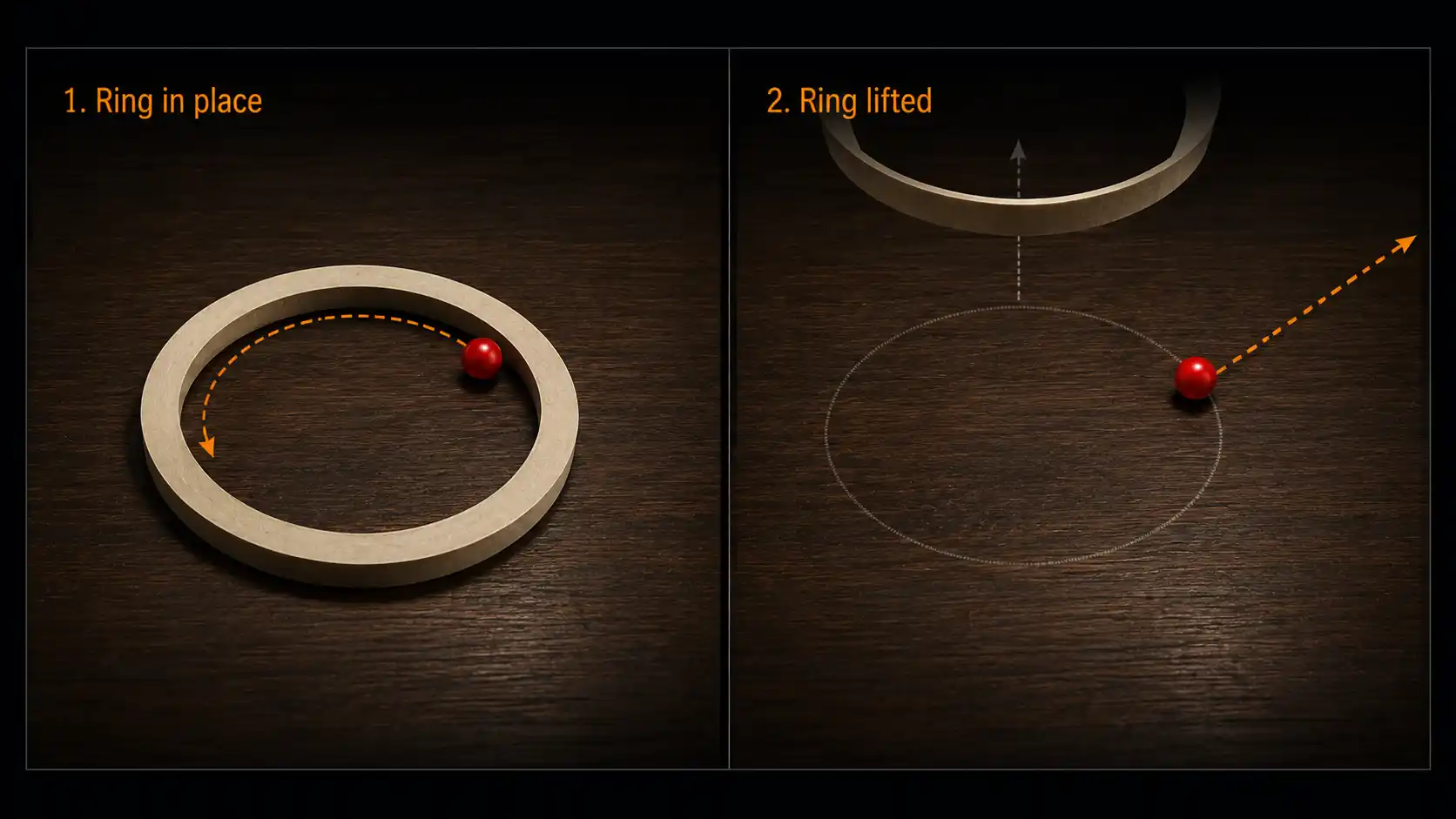
- Flick a marble inside the ring so that it rolls along the inside wall, going round and round.
- Predict what will happen if you suddenly lift the ring off the table while the marble is mid-circle.
Most students predict the marble will continue in a curve, or curl back. Try it. What actually happens: the moment the ring is lifted, the marble shoots off in a perfectly straight line — and the line is tangent to the circle at the point where the ring was removed. Repeat the experiment. The exit direction depends only on where the marble was when the ring left.
Why does this matter? It tells you that during the circular motion, the marble was 'wanting' to go in a straight line tangentially — but the inside wall of the ring kept curving its path back into the circle. The marble was being continuously redirected. The thing redirecting it was the ring's wall, providing an inward push.
Conclusion. In uniform circular motion, the velocity vector is constantly being changed — it is constantly being accelerated. The acceleration always points toward the centre of the circle (which is exactly where the wall pushes the marble). The speed never changes; only the direction does. But that direction-change is enough to count as a real, measurable acceleration.
This is why every uniform circular motion has, hidden inside it, an acceleration directed toward the centre. You will name this in higher classes — it is called centripetal acceleration. For now, just take this away: uniform circular motion is accelerated motion. Constant speed. Constant turning. Constant acceleration.
India's Scientific Contributions — Aryabhata's Planets
Long before the formal vocabulary of "uniform circular motion" existed, Aryabhata in the Aryabhatiya (5th century CE) calculated the orbital periods of the planets — Mercury, Venus, Mars, Jupiter, Saturn — by treating their motions as approximately circular at constant speed. From these calculated periods, he could predict planetary positions decades in advance, and predict eclipses with remarkable accuracy.
A satellite orbits the Earth in a perfectly circular orbit at a constant speed of about . A student says: "Since its speed isn't changing, the satellite has zero acceleration."
Is the student correct?
Bridging Science and Society — Where Uniform Circular Motion Hides
Once you can recognise it, uniform circular motion is everywhere:
Q1.What is the distance covered by an object moving once around a circular track of radius ?
A child sits on a merry-go-round at a Lucknow fair. The merry-go-round spins at a perfectly constant speed — never slowing, never speeding up. The child laughs and grips the handlebar, feeling herself pulled outward.
Question. If her speed is constant — never changing — is she still accelerating?
Acceleration is the rate of change of velocity. And velocity has two parts: magnitude and direction.
The Verse on the Wheel That Turns
एवं प्रवर्तितं चक्रं नानुवर्तयतीह यः ।
अघायुरिन्द्रियारामो मोघं पार्थ स जीवति ॥
"यह जो चक्र चल रहा है — पीछे न रहो, इसमें शामिल हो। जो इस बहाव के साथ नहीं चलता, अर्जुन, उसका जीना बेकार ही जाता है।"
"This wheel of motion is forever turning — those who step into its rhythm find their life. Those who stand outside it, Arjuna, live in vain."
— Krishna's image is the cakra — the wheel — turning eternally. The wheel does not arrive anywhere; it returns. Yet it is always in motion. Uniform circular motion is exactly this paradox in physics: an object that goes nowhere new, yet is constantly moving, constantly turning, constantly accelerating. The Indian thinkers who composed this verse already knew the wheel was never truly still — even when its speed was constant.
Where We Are Going
Until now, every motion in this chapter has been on a straight line. Now we step into two dimensions. The simplest 2D motion is uniform circular motion — moving in a circle at constant speed. It looks easy at first; it has a deeply counter-intuitive consequence at the end. By the time you finish this page, you will see why the Moon, satellites, washing-machine drums, and a stone tied to a string all share the same physics.
One full revolution: distance vs displacement on a circle
Imagine a child on a merry-go-round that has been simplified to a perfect circle of radius . The child sits at one point on the rim. The merry-go-round spins steadily, taking time to complete one full revolution.
How much distance does she travel in one revolution?
In one full loop, her feet (well, her seat) trace out the entire circumference of the circle. From geometry, the circumference of a circle of radius is . So
What is her displacement after one full revolution?
After one complete loop, she is back at exactly the same point she started from. Her start position and end position are the same. Therefore her displacement is zero.
This already tells you something: distance () and displacement () can be wildly different — exactly the lesson of Page 2. Average speed and average velocity follow:
A child travelling at around a radius merry-go-round has an average velocity over one full revolution of zero — even though she's moving the whole time. Once again, distance and displacement quietly tell different stories.
Constant speed, constantly turning velocity
Uniform circular motion is defined cleanly: an object moves along a circular path at a constant speed. The numerical value of how fast it is moving — the speedometer reading, in our analogy — does not change.
But velocity is not just speed. Velocity is speed with a direction. And on a circle, the direction of motion is constantly changing.
Direction at a point: the tangent. At any single instant, the object is moving in the direction tangent to the circle at that point — the direction it would fly off in if the circle suddenly disappeared. A second later, the tangent direction at the new point is different. A second after that, different again. Every instant, a new direction.
If you imagine an athlete running first along a square track, then a hexagonal one, then a 12-sided polygon, then a 100-sided polygon, you can see the picture: the number of times they have to redirect themselves increases each step. As the track becomes more and more circular, the redirects happen more and more frequently. In the limit — a perfect circle — the redirection is continuous. The direction changes at every single instant.
Speed: constant. Direction: continuously changing. Velocity: continuously changing.
And if velocity is changing, then by definition, the object is accelerating — even though it never speeds up or slows down.
Activity 4.5 — the marble in the ring
Try this — it takes 30 seconds.
- Take a flat ring (an adhesive-tape ring works perfectly) and place it on a smooth table.
- Flick a marble inside the ring so that it rolls along the inside wall, going round and round.
- Predict what will happen if you suddenly lift the ring off the table while the marble is mid-circle.
Most students predict the marble will continue in a curve, or curl back. Try it. What actually happens: the moment the ring is lifted, the marble shoots off in a perfectly straight line — and the line is tangent to the circle at the point where the ring was removed. Repeat the experiment. The exit direction depends only on where the marble was when the ring left.
Why does this matter? It tells you that during the circular motion, the marble was 'wanting' to go in a straight line tangentially — but the inside wall of the ring kept curving its path back into the circle. The marble was being continuously redirected. The thing redirecting it was the ring's wall, providing an inward push.
Conclusion. In uniform circular motion, the velocity vector is constantly being changed — it is constantly being accelerated. The acceleration always points toward the centre of the circle (which is exactly where the wall pushes the marble). The speed never changes; only the direction does. But that direction-change is enough to count as a real, measurable acceleration.
This is why every uniform circular motion has, hidden inside it, an acceleration directed toward the centre. You will name this in higher classes — it is called centripetal acceleration. For now, just take this away: uniform circular motion is accelerated motion. Constant speed. Constant turning. Constant acceleration.
India's Scientific Contributions — Aryabhata's Planets
Long before the formal vocabulary of "uniform circular motion" existed, Aryabhata in the Aryabhatiya (5th century CE) calculated the orbital periods of the planets — Mercury, Venus, Mars, Jupiter, Saturn — by treating their motions as approximately circular at constant speed. From these calculated periods, he could predict planetary positions decades in advance, and predict eclipses with remarkable accuracy.
A satellite orbits the Earth in a perfectly circular orbit at a constant speed of about . A student says: "Since its speed isn't changing, the satellite has zero acceleration."
Is the student correct?
Bridging Science and Society — Where Uniform Circular Motion Hides
Once you can recognise it, uniform circular motion is everywhere:
Q1.What is the distance covered by an object moving once around a circular track of radius ?