Stopping Distance & Safe Driving
Why doubling your speed quadruples the gap you need — the chapter's payoff
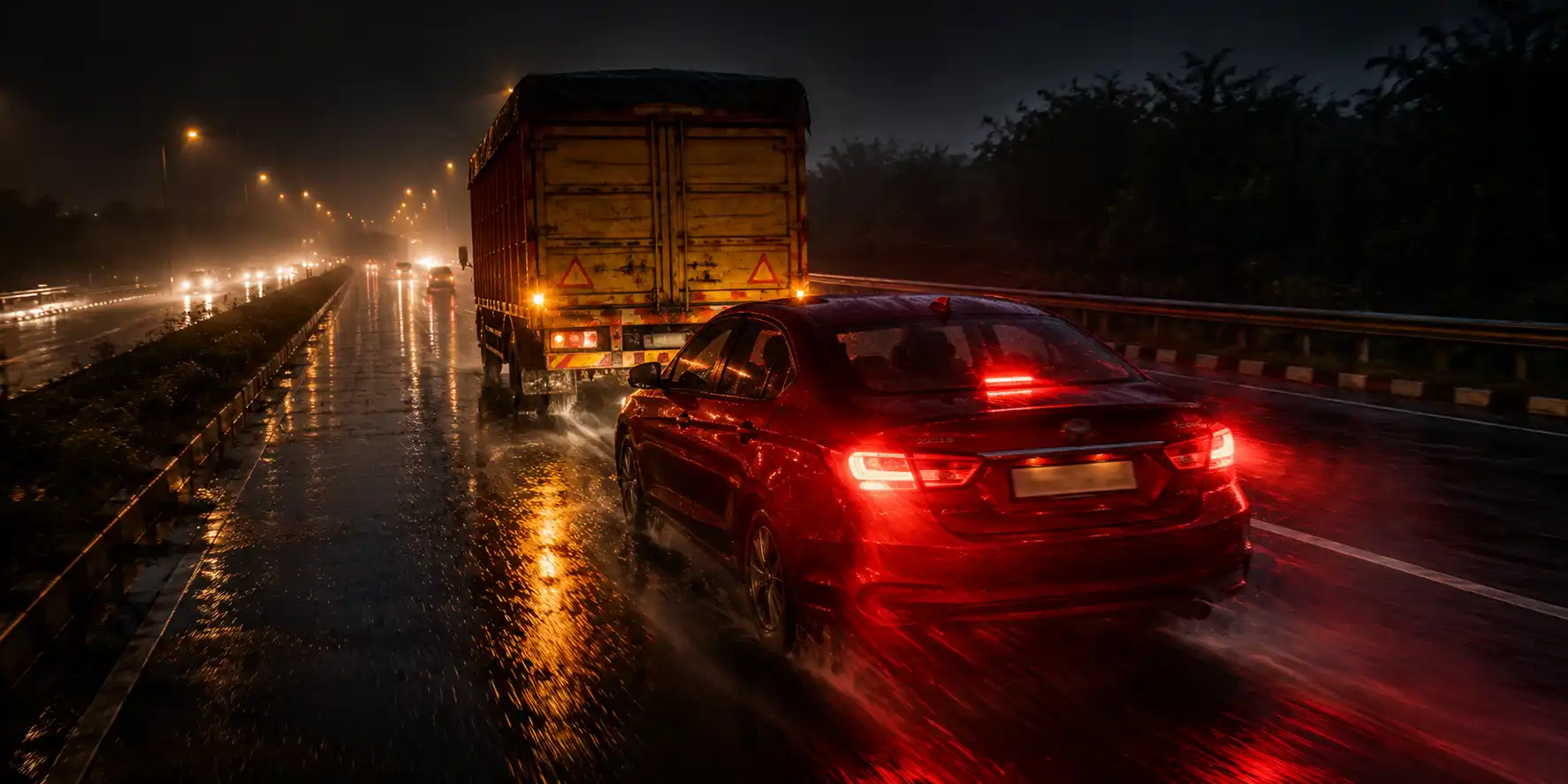
Remember the very first question of this chapter? How much distance should we maintain from the truck ahead to avoid a collision if it suddenly applies the brakes?
Now you have all the equations. Can you actually answer it?
And here is the trickier follow-up: if you double your speed, do you need to double the gap to be equally safe — or do you need much more?
Look at the equation . What kind of relationship does it predict between speed and stopping distance?
The Verse on the Steady Mind
नास्ति बुद्धिरयुक्तस्य न चायुक्तस्य भावना ।
न चाभावयतः शान्तिरशान्तस्य कुतः सुखम् ॥
"जिसका मन टिका हुआ नहीं, उसकी समझ साफ़ नहीं रहती। बिना समझ के सोच नहीं चलती। बिना सोच के शान्ति नहीं। और बिना शान्ति के — सुख कहाँ से आएगा?"
"For the unsteady there is no clear understanding; without understanding, there is no calm; without calm, where is happiness?"
— Krishna's chain runs in one direction: lose attention, lose clarity, lose peace, lose safety. On a wet Indian highway at 100 km/h, this is no longer philosophy — it is a literal description of what happens when a driver looks at their phone for one extra second. The kinematic equations on this page are the physics of that one second. Distraction is not just a moral failing; it is a measurable distance.
Where the Chapter Has Brought You
Page 1 asked a question. The next eight pages built the language to answer it: position, displacement, velocity, acceleration, free fall, graphs, and finally the three equations of motion. Now we answer the original question with the tools we built. Stopping distance is not a memorised formula — it is what the equations predict when you describe what brakes do.
Stopping a vehicle takes two stages
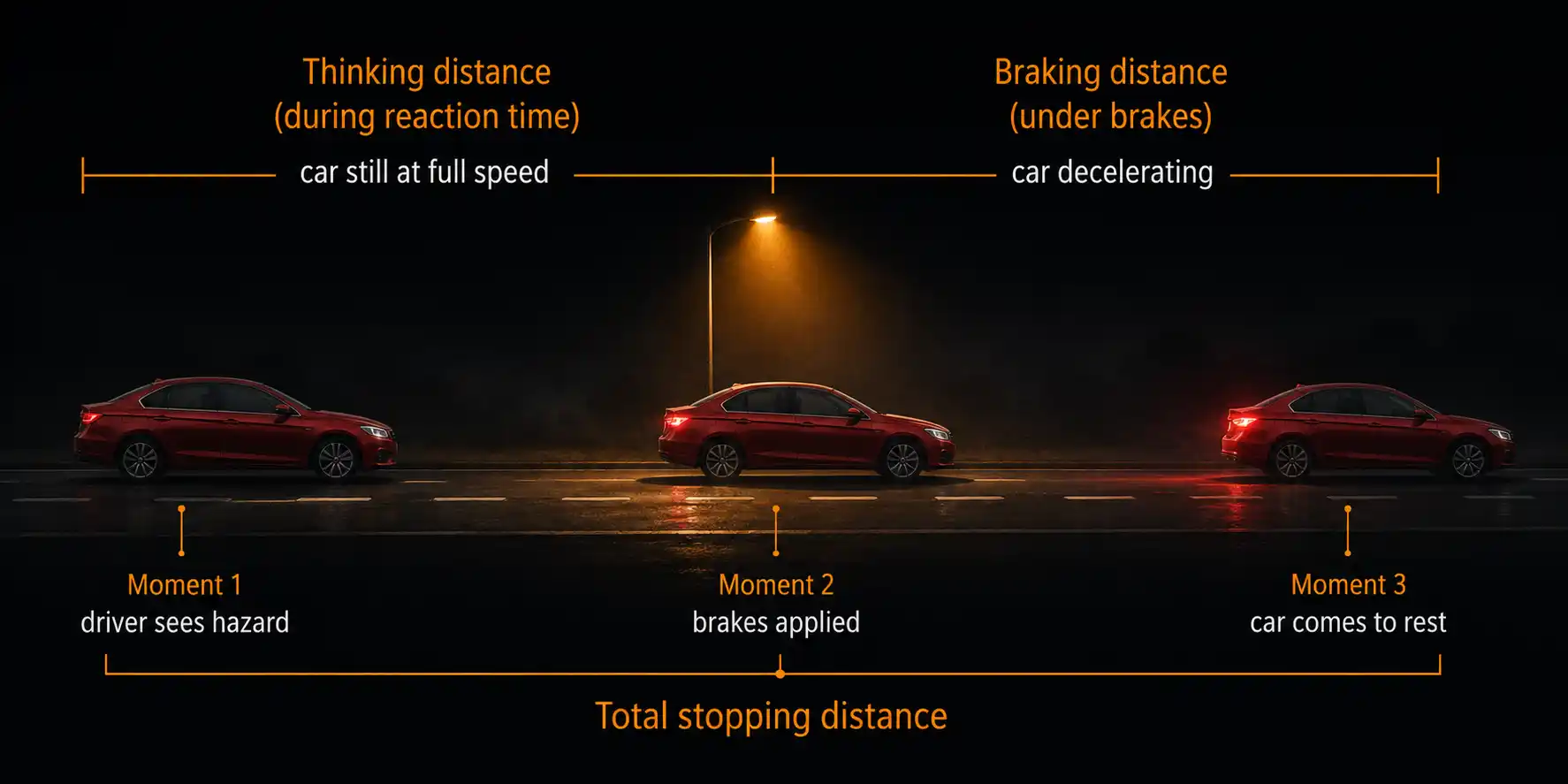
Imagine you're driving on the Mumbai–Pune Expressway at () and the truck ahead suddenly stops. Two distinct things have to happen before your car comes to rest, and each one consumes distance.
Stage 1 — Reaction phase ("thinking distance").
From the moment your eyes register the stopped truck, it takes time for your brain to process the danger and your foot to move from the accelerator to the brake. A typical reaction time for an alert, sober driver is about second. While you react, your car is still moving at full speed — you have not yet pressed the brake. The distance covered in this second is your thinking distance.
At with a -second reaction time, — already half the length of a school football field, and the brake hasn't even engaged yet.
Stage 2 — Braking phase.
Now the brake is engaged. The car decelerates uniformly with some deceleration — typically around on dry tarmac for a modern car. Using kinematic equation 4.4c with :
At with , .
Total stopping distance is the sum:
For our example: . From the moment of danger to your car coming to rest, you've travelled roughly the length of an Olympic swimming pool — even though you reacted in only one second.
Why doubling speed quadruples the stopping distance
The braking part of stopping distance has the form
The key feature is that depends on — the square of the speed. Doubling your speed does not double the braking distance — it multiplies it by . Tripling your speed multiplies it by . This is the single most important fact about driving safety.
Assuming the same braking deceleration and a reaction time:
| Speed | Thinking distance | Braking distance | Total |
|---|---|---|---|
| () | |||
| () | |||
| () | |||
| () |
From to — a fourfold increase in speed — the total stopping distance grows nearly ninefold. This is why every Indian highway has speed limits, and why those limits are not arbitrary — they are derived from this exact equation.
Two more things make this worse in real life.
- Wet roads drop by roughly , doubling braking distance.
- Distraction — checking a phone — easily extends reaction time from to , adding to at highway speeds.
At , on a wet road, with a phone-distracted driver, the total stopping distance can exceed — more than two and a half football fields.
A car is moving on the Yamuna Expressway at . The driver, alert and undistracted, has a reaction time of . After spotting an obstacle, she presses the brake, producing a steady deceleration of . Find the total stopping distance from the moment she first sees the obstacle.
Loading simulator…
On a dry road, a particular car needs to come to a complete stop from (including reaction distance). A friend claims: "At , the same car will need to stop."
Is the friend approximately right, or significantly off?
Bridging Science and Society — How Indian Roads Are Trying to Catch Up
Indian roads are among the world's most congested, and the country has historically had high road-fatality numbers. The kinematic equations on this page are at the heart of every modern intervention:
Q1.What are the two main components of total stopping distance?
Remember the very first question of this chapter? How much distance should we maintain from the truck ahead to avoid a collision if it suddenly applies the brakes?
Now you have all the equations. Can you actually answer it?
And here is the trickier follow-up: if you double your speed, do you need to double the gap to be equally safe — or do you need much more?
Look at the equation . What kind of relationship does it predict between speed and stopping distance?
The Verse on the Steady Mind
नास्ति बुद्धिरयुक्तस्य न चायुक्तस्य भावना ।
न चाभावयतः शान्तिरशान्तस्य कुतः सुखम् ॥
"जिसका मन टिका हुआ नहीं, उसकी समझ साफ़ नहीं रहती। बिना समझ के सोच नहीं चलती। बिना सोच के शान्ति नहीं। और बिना शान्ति के — सुख कहाँ से आएगा?"
"For the unsteady there is no clear understanding; without understanding, there is no calm; without calm, where is happiness?"
— Krishna's chain runs in one direction: lose attention, lose clarity, lose peace, lose safety. On a wet Indian highway at 100 km/h, this is no longer philosophy — it is a literal description of what happens when a driver looks at their phone for one extra second. The kinematic equations on this page are the physics of that one second. Distraction is not just a moral failing; it is a measurable distance.
Where the Chapter Has Brought You
Page 1 asked a question. The next eight pages built the language to answer it: position, displacement, velocity, acceleration, free fall, graphs, and finally the three equations of motion. Now we answer the original question with the tools we built. Stopping distance is not a memorised formula — it is what the equations predict when you describe what brakes do.
Stopping a vehicle takes two stages
Imagine you're driving on the Mumbai–Pune Expressway at () and the truck ahead suddenly stops. Two distinct things have to happen before your car comes to rest, and each one consumes distance.
Stage 1 — Reaction phase ("thinking distance").
From the moment your eyes register the stopped truck, it takes time for your brain to process the danger and your foot to move from the accelerator to the brake. A typical reaction time for an alert, sober driver is about second. While you react, your car is still moving at full speed — you have not yet pressed the brake. The distance covered in this second is your thinking distance.
At with a -second reaction time, — already half the length of a school football field, and the brake hasn't even engaged yet.
Stage 2 — Braking phase.
Now the brake is engaged. The car decelerates uniformly with some deceleration — typically around on dry tarmac for a modern car. Using kinematic equation 4.4c with :
At with , .
Total stopping distance is the sum:
For our example: . From the moment of danger to your car coming to rest, you've travelled roughly the length of an Olympic swimming pool — even though you reacted in only one second.
Why doubling speed quadruples the stopping distance
The braking part of stopping distance has the form
The key feature is that depends on — the square of the speed. Doubling your speed does not double the braking distance — it multiplies it by . Tripling your speed multiplies it by . This is the single most important fact about driving safety.
Assuming the same braking deceleration and a reaction time:
| Speed | Thinking distance | Braking distance | Total |
|---|---|---|---|
| () | |||
| () | |||
| () | |||
| () |
From to — a fourfold increase in speed — the total stopping distance grows nearly ninefold. This is why every Indian highway has speed limits, and why those limits are not arbitrary — they are derived from this exact equation.
Two more things make this worse in real life.
- Wet roads drop by roughly , doubling braking distance.
- Distraction — checking a phone — easily extends reaction time from to , adding to at highway speeds.
At , on a wet road, with a phone-distracted driver, the total stopping distance can exceed — more than two and a half football fields.
A car is moving on the Yamuna Expressway at . The driver, alert and undistracted, has a reaction time of . After spotting an obstacle, she presses the brake, producing a steady deceleration of . Find the total stopping distance from the moment she first sees the obstacle.
Loading simulator…
On a dry road, a particular car needs to come to a complete stop from (including reaction distance). A friend claims: "At , the same car will need to stop."
Is the friend approximately right, or significantly off?
Bridging Science and Society — How Indian Roads Are Trying to Catch Up
Indian roads are among the world's most congested, and the country has historically had high road-fatality numbers. The kinematic equations on this page are at the heart of every modern intervention:
Q1.What are the two main components of total stopping distance?