Speed and Velocity
Why a number on the speedometer is only half the story
Two scooters are riding on the streets of Pune. Both speedometers read 40 km/h. One is heading east, the other heading west.
If a friend on a phone call asks each of them "where will you be in 30 minutes?" — would you give the same answer for both?
Same number on the dial. Same time. But are they going the same place?
The Verse on Direction and Drift
व्यवसायात्मिका बुद्धिरेकेह कुरुनन्दन ।
बहुशाखा ह्यनन्ताश्च बुद्धयोऽव्यवसायिनाम् ॥
"एक ही दिशा में लगी हुई समझ ही लक्ष्य तक पहुँचाती है, हे अर्जुन। बिखरी हुई अनेक दिशाओं में बँटी सोच कहीं नहीं पहुँचाती।"
"A mind set on a single direction reaches its goal. Minds scattered in many directions wander endlessly — for they have no direction."
— Krishna's point is precise: speed without direction goes nowhere. In this chapter, the same idea has a name. Speed tells you how fast something moves. Velocity tells you how fast and which way. One has direction. The other does not. The Gita knew which one matters more.
A Word the Engineer and the Sage Both Need
Engineers building a satellite cannot just say "the rocket is moving at 11 km/s." They must say "11 km/s in the direction tangential to Earth's surface, angled 31° above horizontal at launch." One number off, and the satellite either falls back to Earth or escapes into space. Direction is not a decoration on top of speed — it is what turns speed into something useful.
Speed — how fast, regardless of where
Speed is the simpler of the two ideas. It tells you how much distance an object covers in each unit of time. The average speed over a journey is just:
SI unit: metres per second (). On Indian roads we usually use kilometres per hour (km/h). To convert: .
Notice what speed is built from: distance (a scalar) divided by time (also a scalar). So speed itself has no direction — it is just a number with units. A car driving at 60 km/h east and a car driving at 60 km/h west have the same speed. They are doing very different things, but speed alone cannot tell you that.
Uniform vs non-uniform motion. If an object covers equal distances in equal time intervals — say, 10 m every second, exactly — it is in uniform motion. Its speed is constant. If it covers different distances in equal time intervals (faster sometimes, slower others), it is in non-uniform motion. A train cruising at 100 km/h on the Vande Bharat route between stops is in roughly uniform motion. The same train slowing down into a station is in non-uniform motion.
Worked example — the Aryabhatiya postmen. Two postmen start walking towards each other from a distance of 210 yojanas apart. One walks 9 yojanas per day, the other walks 5 yojanas per day. After how many days do they meet?
Each day they close the gap by yojanas. To close 210 yojanas, they need days. (In those 15 days, one walks 135 yojanas, the other walks 75 yojanas.) This problem is preserved in the Ganitakaumudi, a 14th-century mathematics text — the speed-distance-time relationship is over a thousand years old in India.
Velocity — how fast AND in which direction
Velocity is what you get when you bring direction back into the picture. The average velocity of an object over a time interval is:
Spot the difference: speed uses distance, velocity uses displacement. Velocity inherits the direction of displacement — so along a straight line, we write velocity with a or sign. The SI unit is the same as speed: .
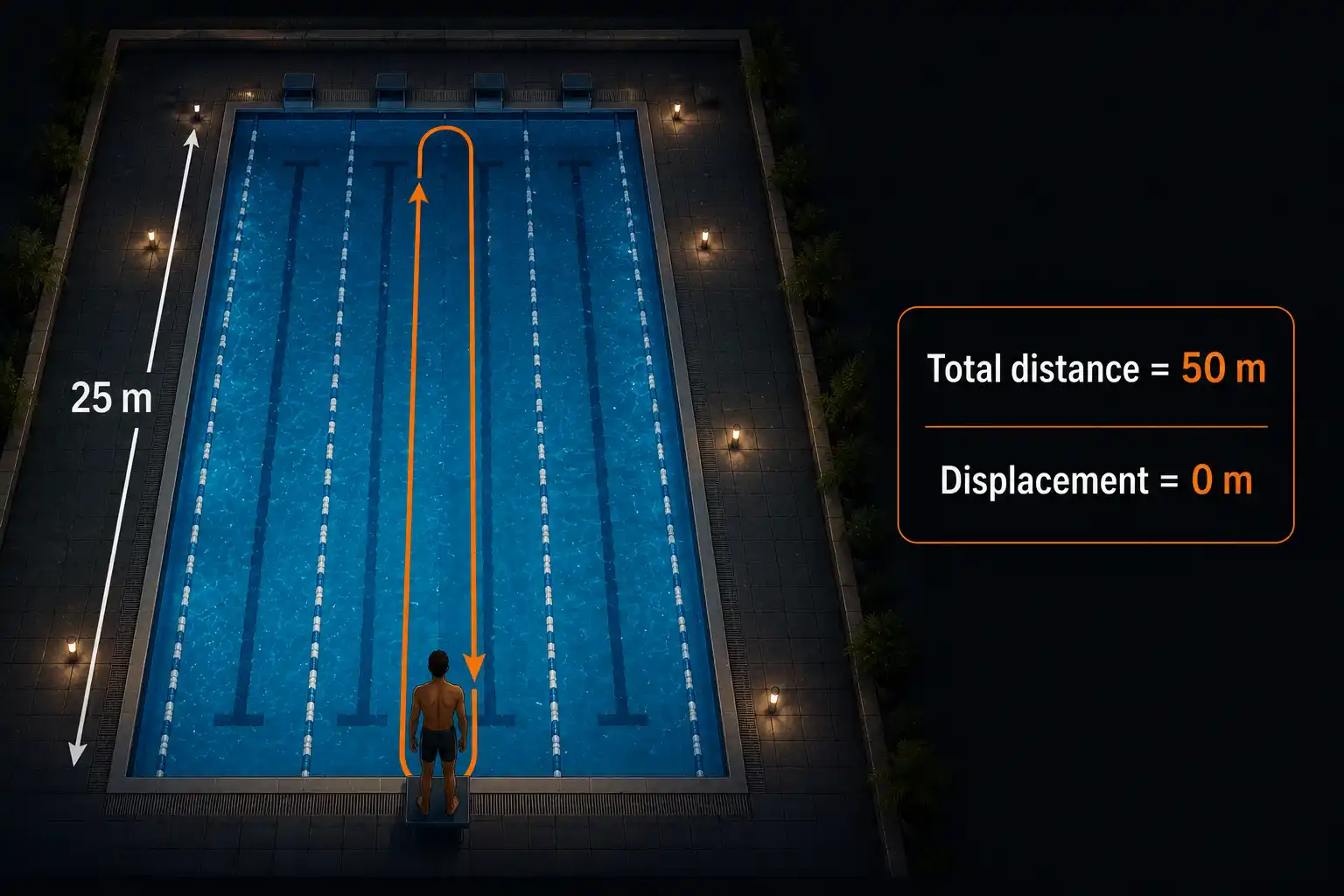
Why this matters. Whenever an object turns back, doubles around, or returns to where it started, its speed and its velocity drift apart in dramatic ways. A swimmer who finishes one lap and returns to the start has covered metres and metres of distance — non-zero average speed — but her displacement is zero, so her average velocity over the lap is zero.
This is not a clever trick of definitions. It is exactly what the swimmer's GPS would show: the GPS reports your displacement over time, not your distance. Look at the next worked example.
A taxi driver in Bengaluru tells you: "I drove for 1 hour at an average speed of 30 km/h."
Which of the following is guaranteed to be true after that hour?
India's Scientific Contributions — A Thousand Years of Speed Calculations
The relationship speed = distance / time is so fundamental that we forget it had to be discovered.
Velocity at this exact moment
Average velocity tells you about a whole interval — "between 9:00 and 9:30, you were moving at 60 km/h" — but it does not tell you what was happening at any single instant inside that interval. Maybe you sped up to 80, slowed to 30, sped up again. The average smooths out all of that.
For the velocity right now, at this exact instant, we use a separate idea: instantaneous velocity. Imagine taking your average velocity over smaller and smaller time windows — over 1 minute, then 1 second, then 0.01 seconds. As the window shrinks, the average value settles toward a single number — that limiting value is the instantaneous velocity at that moment.
From now on in this chapter, when we say just "velocity," we mean instantaneous velocity.
You already use it every day.
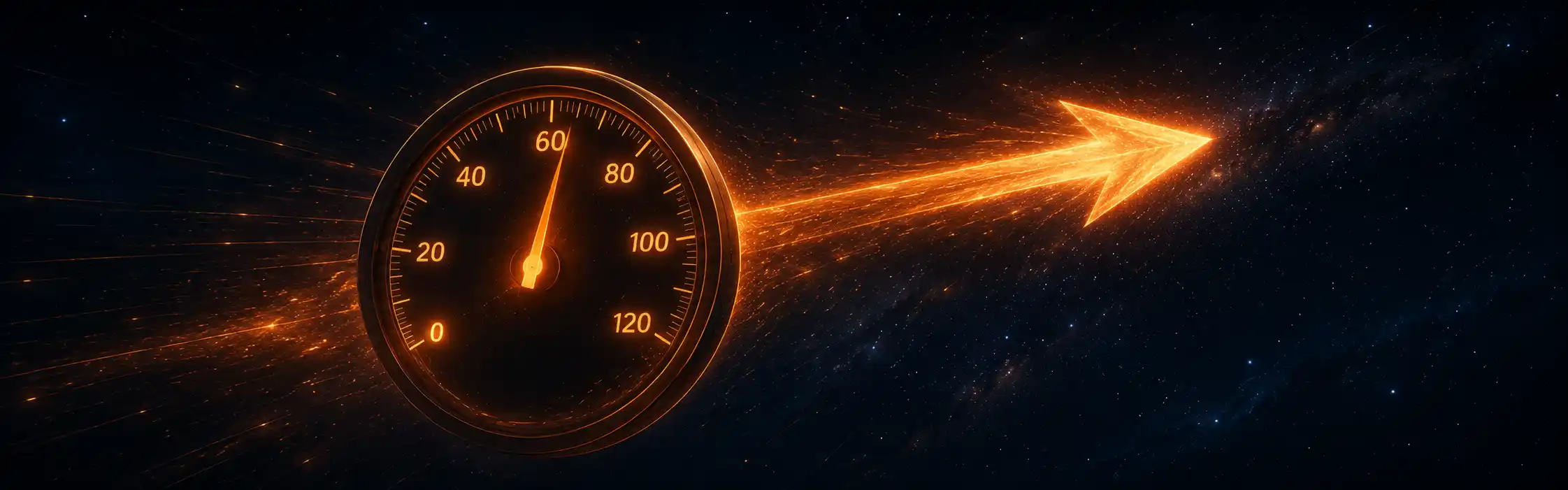
- A car's speedometer is essentially an instantaneous-speed meter. The reading on the dial right now is the magnitude of the velocity right now. The direction comes from where the front tyres are pointed.
- Your phone's GPS computes instantaneous velocity by tracking how your position changes between very short intervals (often every second).
- A cricket commentator says "the ball left the bat at 134 km/h" — that's the instantaneous speed of the ball at the moment of contact, measured by Hawk-Eye cameras tracking it through the air.
In higher classes you'll meet a precise mathematical tool for this — calculus — but the idea is exactly what your speedometer is already doing.
Threads of Curiosity — Why Your GPS Sometimes Lies
Your phone's GPS calculates velocity by comparing your position at two close-together moments. If those positions are noisy — say, the GPS signal is weak under a flyover or in dense traffic — the velocity reading jumps wildly even when you're standing still.
Q1.Which of the following best distinguishes speed from velocity?
Two scooters are riding on the streets of Pune. Both speedometers read 40 km/h. One is heading east, the other heading west.
If a friend on a phone call asks each of them "where will you be in 30 minutes?" — would you give the same answer for both?
Same number on the dial. Same time. But are they going the same place?
The Verse on Direction and Drift
व्यवसायात्मिका बुद्धिरेकेह कुरुनन्दन ।
बहुशाखा ह्यनन्ताश्च बुद्धयोऽव्यवसायिनाम् ॥
"एक ही दिशा में लगी हुई समझ ही लक्ष्य तक पहुँचाती है, हे अर्जुन। बिखरी हुई अनेक दिशाओं में बँटी सोच कहीं नहीं पहुँचाती।"
"A mind set on a single direction reaches its goal. Minds scattered in many directions wander endlessly — for they have no direction."
— Krishna's point is precise: speed without direction goes nowhere. In this chapter, the same idea has a name. Speed tells you how fast something moves. Velocity tells you how fast and which way. One has direction. The other does not. The Gita knew which one matters more.
A Word the Engineer and the Sage Both Need
Engineers building a satellite cannot just say "the rocket is moving at 11 km/s." They must say "11 km/s in the direction tangential to Earth's surface, angled 31° above horizontal at launch." One number off, and the satellite either falls back to Earth or escapes into space. Direction is not a decoration on top of speed — it is what turns speed into something useful.
Speed — how fast, regardless of where
Speed is the simpler of the two ideas. It tells you how much distance an object covers in each unit of time. The average speed over a journey is just:
SI unit: metres per second (). On Indian roads we usually use kilometres per hour (km/h). To convert: .
Notice what speed is built from: distance (a scalar) divided by time (also a scalar). So speed itself has no direction — it is just a number with units. A car driving at 60 km/h east and a car driving at 60 km/h west have the same speed. They are doing very different things, but speed alone cannot tell you that.
Uniform vs non-uniform motion. If an object covers equal distances in equal time intervals — say, 10 m every second, exactly — it is in uniform motion. Its speed is constant. If it covers different distances in equal time intervals (faster sometimes, slower others), it is in non-uniform motion. A train cruising at 100 km/h on the Vande Bharat route between stops is in roughly uniform motion. The same train slowing down into a station is in non-uniform motion.
Worked example — the Aryabhatiya postmen. Two postmen start walking towards each other from a distance of 210 yojanas apart. One walks 9 yojanas per day, the other walks 5 yojanas per day. After how many days do they meet?
Each day they close the gap by yojanas. To close 210 yojanas, they need days. (In those 15 days, one walks 135 yojanas, the other walks 75 yojanas.) This problem is preserved in the Ganitakaumudi, a 14th-century mathematics text — the speed-distance-time relationship is over a thousand years old in India.
Velocity — how fast AND in which direction
Velocity is what you get when you bring direction back into the picture. The average velocity of an object over a time interval is:
Spot the difference: speed uses distance, velocity uses displacement. Velocity inherits the direction of displacement — so along a straight line, we write velocity with a or sign. The SI unit is the same as speed: .
Why this matters. Whenever an object turns back, doubles around, or returns to where it started, its speed and its velocity drift apart in dramatic ways. A swimmer who finishes one lap and returns to the start has covered metres and metres of distance — non-zero average speed — but her displacement is zero, so her average velocity over the lap is zero.
This is not a clever trick of definitions. It is exactly what the swimmer's GPS would show: the GPS reports your displacement over time, not your distance. Look at the next worked example.
A taxi driver in Bengaluru tells you: "I drove for 1 hour at an average speed of 30 km/h."
Which of the following is guaranteed to be true after that hour?
India's Scientific Contributions — A Thousand Years of Speed Calculations
The relationship speed = distance / time is so fundamental that we forget it had to be discovered.
Velocity at this exact moment
Average velocity tells you about a whole interval — "between 9:00 and 9:30, you were moving at 60 km/h" — but it does not tell you what was happening at any single instant inside that interval. Maybe you sped up to 80, slowed to 30, sped up again. The average smooths out all of that.
For the velocity right now, at this exact instant, we use a separate idea: instantaneous velocity. Imagine taking your average velocity over smaller and smaller time windows — over 1 minute, then 1 second, then 0.01 seconds. As the window shrinks, the average value settles toward a single number — that limiting value is the instantaneous velocity at that moment.
From now on in this chapter, when we say just "velocity," we mean instantaneous velocity.
You already use it every day.
- A car's speedometer is essentially an instantaneous-speed meter. The reading on the dial right now is the magnitude of the velocity right now. The direction comes from where the front tyres are pointed.
- Your phone's GPS computes instantaneous velocity by tracking how your position changes between very short intervals (often every second).
- A cricket commentator says "the ball left the bat at 134 km/h" — that's the instantaneous speed of the ball at the moment of contact, measured by Hawk-Eye cameras tracking it through the air.
In higher classes you'll meet a precise mathematical tool for this — calculus — but the idea is exactly what your speedometer is already doing.
Threads of Curiosity — Why Your GPS Sometimes Lies
Your phone's GPS calculates velocity by comparing your position at two close-together moments. If those positions are noisy — say, the GPS signal is weak under a flyover or in dense traffic — the velocity reading jumps wildly even when you're standing still.
Q1.Which of the following best distinguishes speed from velocity?