Free Fall and g
The number that ties every dropped object to the centre of the Earth
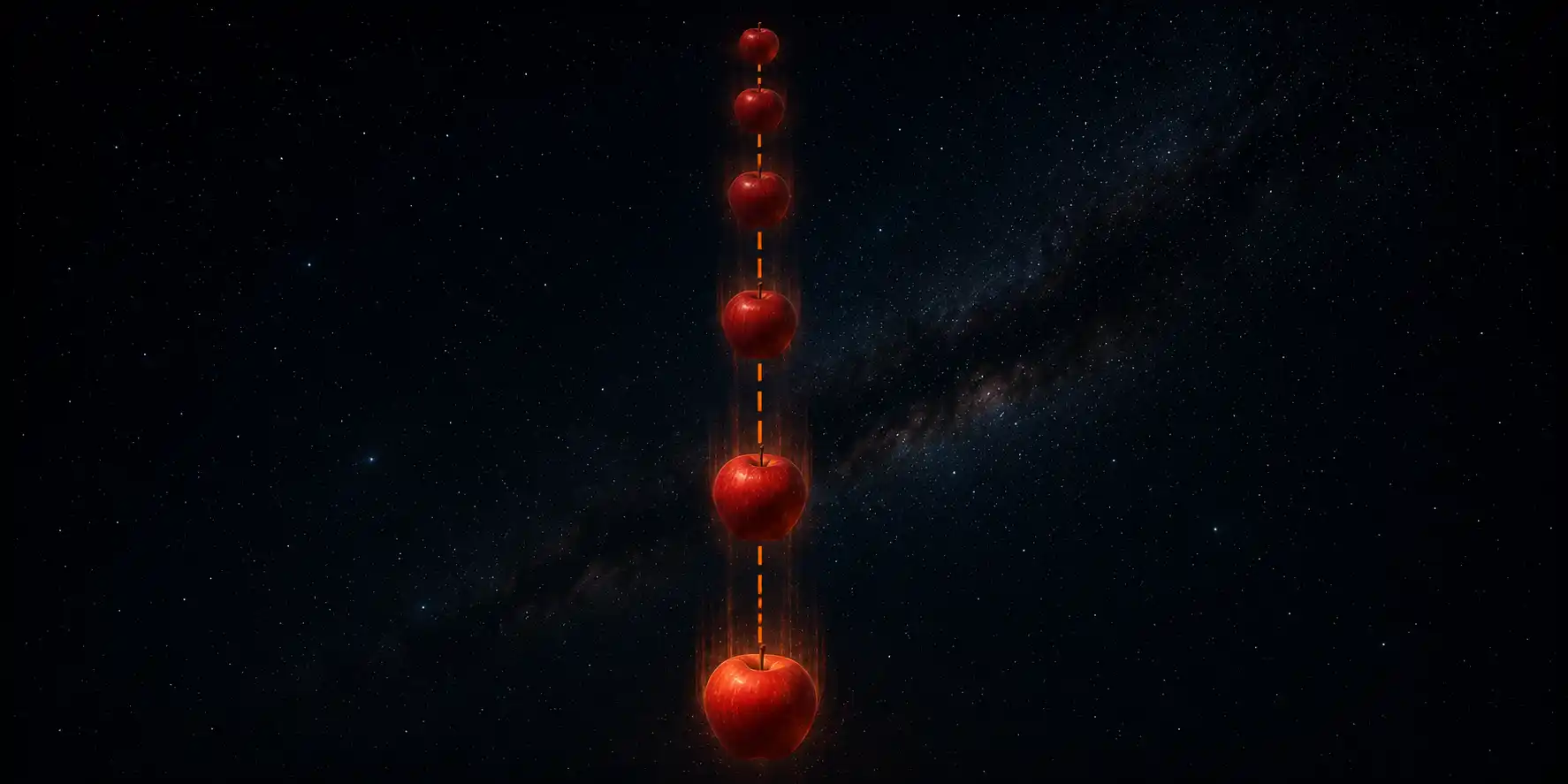
You are standing on a rooftop. In your two hands: a small steel ball and a feather. You hold them at exactly the same height and release them at exactly the same moment.
Which one hits the ground first — and how big is the gap?
On Earth, the answer is one thing. In a perfect vacuum (no air), the answer is something different. Both are correct in their context.
The Verse on the Earth That Holds
यत्ते भूमे विखनामि क्षिप्रं तदपि रोहतु ।
मा ते मर्म विमृग्वरि मा ते हृदयमर्पिपम् ॥
"हे पृथ्वी, जो भी मैं तुझ पर डालूँ या जो भी तू में से उठाऊँ — वो जल्दी से तेरे पास लौट आए। तू सब कुछ अपनी ओर खींच लेती है।"
"O Earth, whatever I scatter upon you or take from you — let it return swiftly to you. You draw everything back to yourself."
— The Atharva Veda's Bhumi Sukta speaks of the Earth as that which holds, gathers, and pulls all things toward itself. A thousand years before Newton named the force, Indian texts had already noticed: drop anything, and the Earth claims it. This page is about the precise number that describes that claim — about of acceleration, every second, for every dropped object.
Why "Constant" Matters
Up to now we have looked at average acceleration — what happened over a whole interval. Often the acceleration changes during the interval (a bus accelerating gently, then hard, then easing off). But there is a beautiful special case where the acceleration is the same at every instant — it does not vary. We call this uniform or constant acceleration. Free fall under gravity is the most important example. The maths becomes much cleaner here, and almost every motion problem in your textbook lives inside this special case.
Constant acceleration
An object moves with constant (uniform) acceleration if its velocity changes by equal amounts in equal time intervals — for any choice of intervals. So if a ball gains of speed in the first second, it gains in the second second, and another in the third — every second, the same amount.
In this case the average acceleration over any interval equals the acceleration at every instant — they are all just one number. The whole motion is described by this single, unchanging .
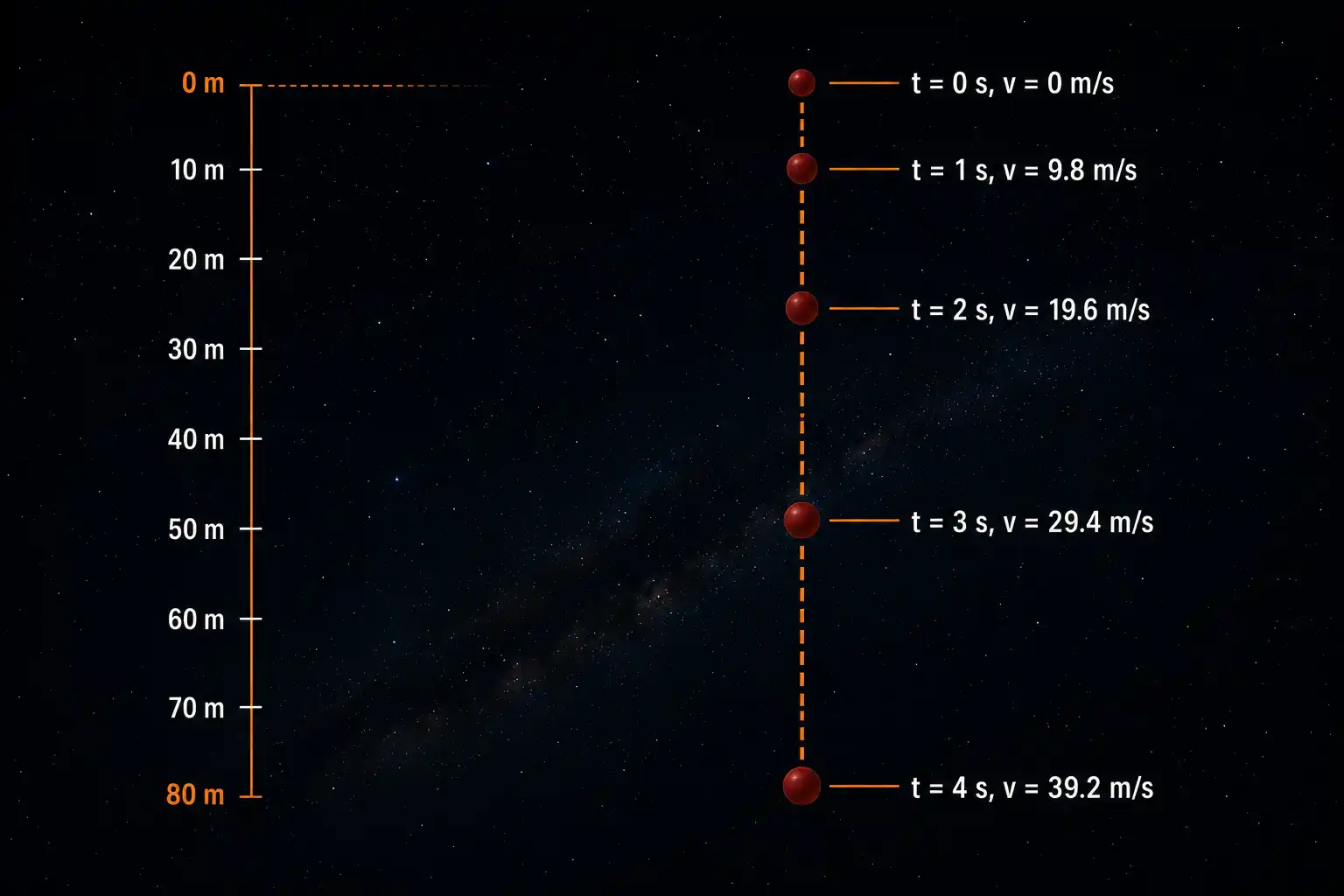
Visual signature of constant acceleration. Imagine taking a strobe photograph of a falling ball — one flash every second. The ball would appear at positions that are spaced unevenly. The first 1-second gap is small, the next is larger, the next larger still. Each new second, the ball falls more distance than the one before, because each second its velocity has grown.
For a ball dropped from rest near Earth's surface, the positions at seconds are:
| Time (s) | Velocity (m/s) | Distance fallen (m) |
|---|---|---|
| 0 | 0 | 0 |
| 1 | 9.8 | 4.9 |
| 2 | 19.6 | 19.6 |
| 3 | 29.4 | 44.1 |
| 4 | 39.2 | 78.4 |
Notice two things. The velocity grows by exactly each second — that is constant acceleration in action. The distance fallen does not grow uniformly; it grows much faster than time. This is the unmistakable fingerprint of acceleration: the gaps are not equal, they get bigger.
Free fall and the number called g
When you drop an object near the surface of the Earth, and you ignore air resistance, the only thing affecting its motion is the Earth's pull. The object accelerates downward at a constant rate — the same rate, regardless of its mass.
- This special acceleration is called the acceleration due to gravity.
- It has its own symbol: .
- Its measured value near Earth's surface is approximately , directed downward (toward the centre of the Earth). For most school problems we take this as or sometimes round it to .
The phrase "free fall" simply means: motion under gravity alone, with no air resistance and no other forces. A real apple falling through air is not in pure free fall — air drag slightly slows it. But for short drops at low speeds, air drag is negligible and free-fall equations work very well.
A surprising fact. A 10-kilogram cannonball and a 100-gram pebble, dropped together from a tower in vacuum, hit the ground at the same instant. Mass does not enter the equation for acceleration. This was famously demonstrated by Galileo Galilei in the 1600s — and again, dramatically, by astronaut David Scott on the Moon in 1971, who dropped a hammer and a feather together from the same height. With no atmosphere, both touched the lunar dust at the same moment, on live television.
Why mass doesn't matter is something you will properly understand when you study Newton's laws and gravitation in the next chapters. For now, accept the experimental fact: free fall is a universal motion.
India's Scientific Contributions — Brahmagupta on Gravity, 628 CE
More than a thousand years before Isaac Newton, the Indian mathematician-astronomer Brahmagupta wrote in his Brāhmasphuṭasiddhānta (628 CE):
On Earth, if you drop a hammer and a feather from the same height, the hammer lands first. On the Moon, astronaut David Scott dropped a hammer and a feather and they landed at exactly the same instant.
Which of the following is the best explanation?
Bridging Science and Society — Why Parachutes Work
If gravity accelerated everything equally and forever, a skydiver jumping from a plane would smash into the ground at incredible speeds. They don't — because of air resistance.
Q1.What is the value of , the acceleration due to gravity near the surface of the Earth?
You are standing on a rooftop. In your two hands: a small steel ball and a feather. You hold them at exactly the same height and release them at exactly the same moment.
Which one hits the ground first — and how big is the gap?
On Earth, the answer is one thing. In a perfect vacuum (no air), the answer is something different. Both are correct in their context.
The Verse on the Earth That Holds
यत्ते भूमे विखनामि क्षिप्रं तदपि रोहतु ।
मा ते मर्म विमृग्वरि मा ते हृदयमर्पिपम् ॥
"हे पृथ्वी, जो भी मैं तुझ पर डालूँ या जो भी तू में से उठाऊँ — वो जल्दी से तेरे पास लौट आए। तू सब कुछ अपनी ओर खींच लेती है।"
"O Earth, whatever I scatter upon you or take from you — let it return swiftly to you. You draw everything back to yourself."
— The Atharva Veda's Bhumi Sukta speaks of the Earth as that which holds, gathers, and pulls all things toward itself. A thousand years before Newton named the force, Indian texts had already noticed: drop anything, and the Earth claims it. This page is about the precise number that describes that claim — about of acceleration, every second, for every dropped object.
Why "Constant" Matters
Up to now we have looked at average acceleration — what happened over a whole interval. Often the acceleration changes during the interval (a bus accelerating gently, then hard, then easing off). But there is a beautiful special case where the acceleration is the same at every instant — it does not vary. We call this uniform or constant acceleration. Free fall under gravity is the most important example. The maths becomes much cleaner here, and almost every motion problem in your textbook lives inside this special case.
Constant acceleration
An object moves with constant (uniform) acceleration if its velocity changes by equal amounts in equal time intervals — for any choice of intervals. So if a ball gains of speed in the first second, it gains in the second second, and another in the third — every second, the same amount.
In this case the average acceleration over any interval equals the acceleration at every instant — they are all just one number. The whole motion is described by this single, unchanging .
Visual signature of constant acceleration. Imagine taking a strobe photograph of a falling ball — one flash every second. The ball would appear at positions that are spaced unevenly. The first 1-second gap is small, the next is larger, the next larger still. Each new second, the ball falls more distance than the one before, because each second its velocity has grown.
For a ball dropped from rest near Earth's surface, the positions at seconds are:
| Time (s) | Velocity (m/s) | Distance fallen (m) |
|---|---|---|
| 0 | 0 | 0 |
| 1 | 9.8 | 4.9 |
| 2 | 19.6 | 19.6 |
| 3 | 29.4 | 44.1 |
| 4 | 39.2 | 78.4 |
Notice two things. The velocity grows by exactly each second — that is constant acceleration in action. The distance fallen does not grow uniformly; it grows much faster than time. This is the unmistakable fingerprint of acceleration: the gaps are not equal, they get bigger.
Free fall and the number called g
When you drop an object near the surface of the Earth, and you ignore air resistance, the only thing affecting its motion is the Earth's pull. The object accelerates downward at a constant rate — the same rate, regardless of its mass.
- This special acceleration is called the acceleration due to gravity.
- It has its own symbol: .
- Its measured value near Earth's surface is approximately , directed downward (toward the centre of the Earth). For most school problems we take this as or sometimes round it to .
The phrase "free fall" simply means: motion under gravity alone, with no air resistance and no other forces. A real apple falling through air is not in pure free fall — air drag slightly slows it. But for short drops at low speeds, air drag is negligible and free-fall equations work very well.
A surprising fact. A 10-kilogram cannonball and a 100-gram pebble, dropped together from a tower in vacuum, hit the ground at the same instant. Mass does not enter the equation for acceleration. This was famously demonstrated by Galileo Galilei in the 1600s — and again, dramatically, by astronaut David Scott on the Moon in 1971, who dropped a hammer and a feather together from the same height. With no atmosphere, both touched the lunar dust at the same moment, on live television.
Why mass doesn't matter is something you will properly understand when you study Newton's laws and gravitation in the next chapters. For now, accept the experimental fact: free fall is a universal motion.
India's Scientific Contributions — Brahmagupta on Gravity, 628 CE
More than a thousand years before Isaac Newton, the Indian mathematician-astronomer Brahmagupta wrote in his Brāhmasphuṭasiddhānta (628 CE):
On Earth, if you drop a hammer and a feather from the same height, the hammer lands first. On the Moon, astronaut David Scott dropped a hammer and a feather and they landed at exactly the same instant.
Which of the following is the best explanation?
Bridging Science and Society — Why Parachutes Work
If gravity accelerated everything equally and forever, a skydiver jumping from a plane would smash into the ground at incredible speeds. They don't — because of air resistance.
Q1.What is the value of , the acceleration due to gravity near the surface of the Earth?