Motion All Around Us
Why stillness is an illusion — and how scientists describe motion carefully

Right now — sitting on your bed, on a chair, on the floor — are you moving, or are you sitting still?
Don't look up an answer. Just think about it: how would you decide?
Think about what "moving" means to you. Moving compared to what?
The Verse That Holds Motion and Stillness Together
तदेजति तन्नैजति तद्दूरे तद्वन्तिके ।
तदन्तरस्य सर्वस्य तदु सर्वस्यास्य बाह्यतः ॥
"वो चलता भी है, और वो चलता भी नहीं। वो बहुत दूर है, और वो बिल्कुल पास भी है। वो हर चीज़ के अंदर है, और हर चीज़ के बाहर भी।"
"It moves, and it moves not. It is far away, and it is near. It is inside everything, and outside everything too."
— Composed nearly three thousand years ago, this verse is the oldest recorded statement of what scientists today call relative motion.
The Question Behind the Verse
How can something move and not move at the same time?
Everything is moving — even when nothing seems to
Look around. A leaf falls. A fan spins. A child runs past on the road. A truck honks somewhere outside. Motion is the most ordinary thing in the world — so ordinary that you almost stop noticing it.
Now look at yourself. You are sitting completely still — at least, that's what it feels like.
But you are not still.
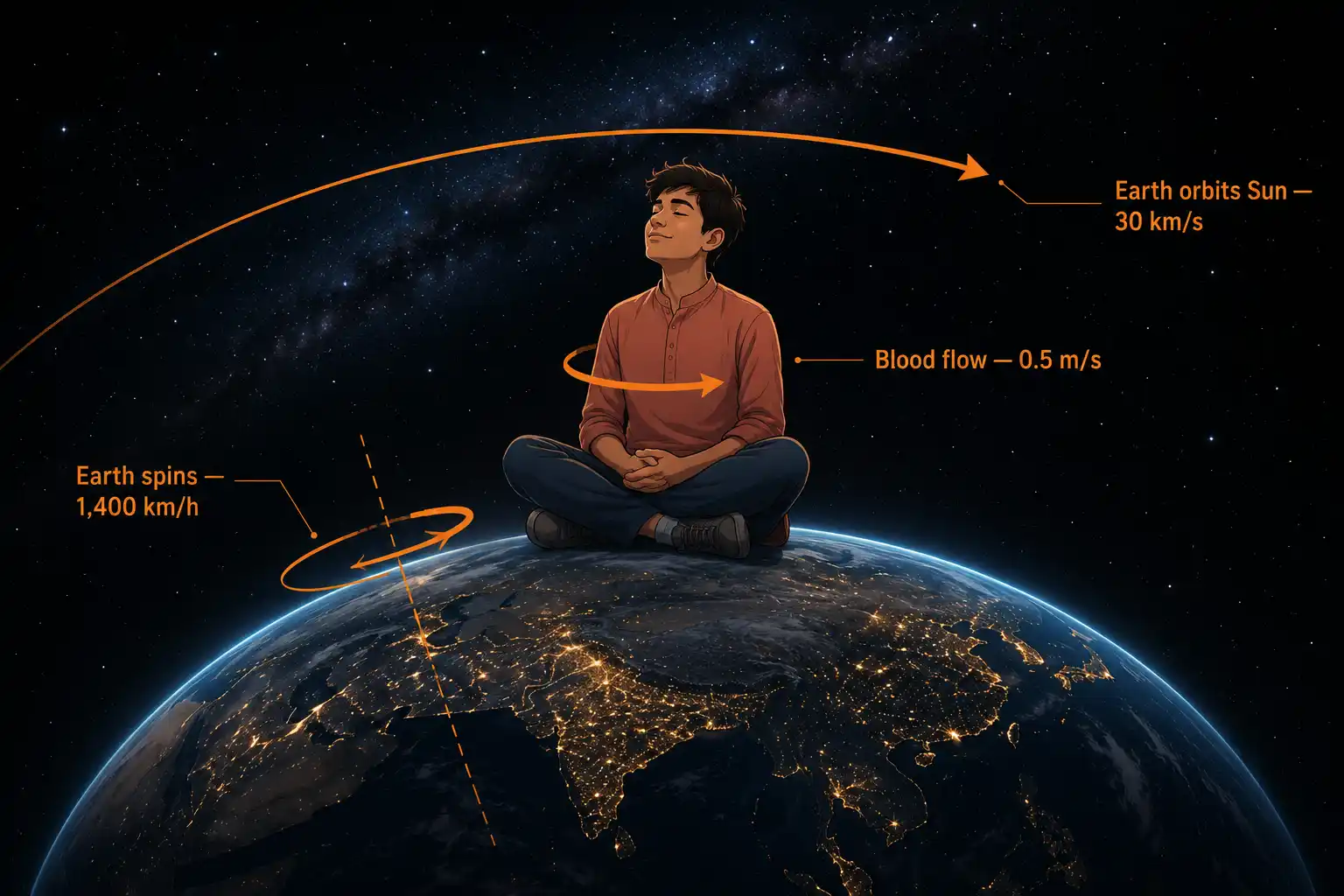
- Inside you, blood is moving through your veins at about half a metre per second.
- The air molecules brushing past your skin are darting around at roughly 500 m/s.
- The Earth is spinning on its axis. At Delhi's latitude, that means the ground beneath you is sweeping eastward at nearly 1,400 km/h.
- The Earth is also orbiting the Sun at about 30 km every second — faster than any rocket humans have ever built for travel.
- And the Sun itself is hauling our entire solar system around the centre of the Milky Way at 220 km/s.
You — sitting still on your bed — are riding all of these motions at once. You don't feel them because everything around you is riding them too. Motion is not the exception. Stillness is the illusion.
In this chapter, you will learn to describe motion the way a scientist does: not just in words, but with numbers, equations, and graphs. By the end, you will be able to predict where a moving object will be at any future moment — something that looks like magic, but is really just a careful way of paying attention.
When do we say something is in motion?
If everything is moving all the time, how do we ever talk about motion at all? The answer is: we always compare to something.
A reference point is the something we compare to.
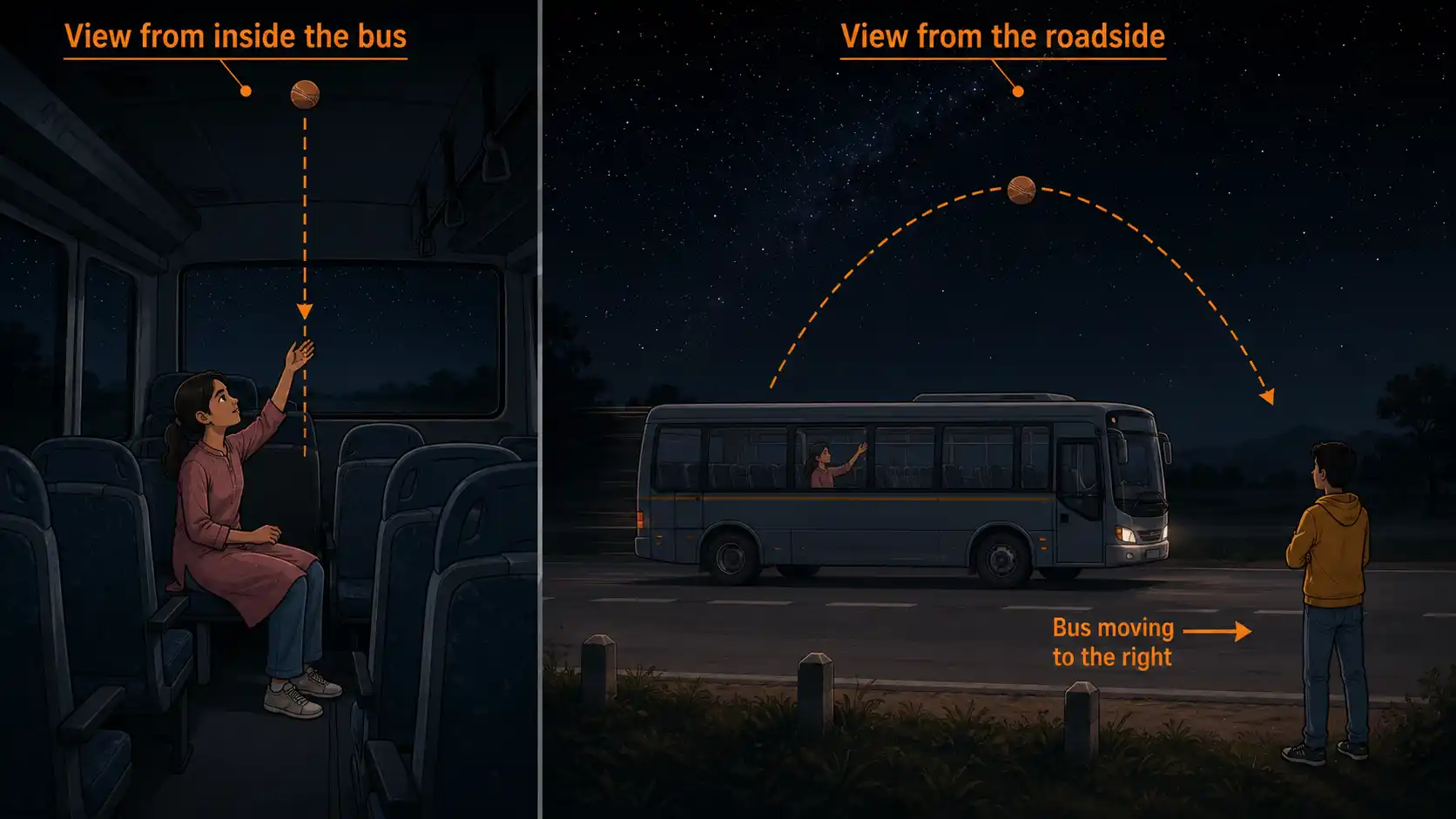
Imagine you are sitting in a parked bus. The bus starts to move. Two people describe what they just saw:
- You, inside the bus, say: "The trees outside are moving backwards."
- A person standing on the road says: "The bus is moving forward, the trees are still."
Who is right? Both are. You picked the bus as your reference point, so the trees move relative to you. The person on the road picked the ground as their reference, so the bus moves relative to them. Neither is wrong — they have just chosen different reference points.
Once a reference point is chosen, the rule is simple:
An object is in motion if its position relative to the reference point changes with time. It is at rest if its position relative to the reference point does not change.
A football lying on the field is at rest relative to the field. The same football, the moment a player kicks it, is in motion — its position relative to the field is changing every instant.
Position itself needs three things to be specified: a reference point, a distance from that reference, and a direction. "Five metres" tells you nothing — five metres from where, and in which direction? — until you fix the reference and the direction.
A drone hovers perfectly still in the air over a moving cargo train. From the drone's camera looking down, the train is moving. From a passenger sitting inside the train, the drone is moving — the train looks still and the drone seems to slide backwards in the sky.
A student says: "The drone is really still, the passenger is wrong because she is the one inside a moving train."
Is the student right?
India's Scientific Contributions — Aryabhata's Bold Reframe
In 499 CE, a 23-year-old astronomer named Aryabhata wrote a book called the Aryabhatiya in Kusumapura (modern-day Patna). In it, he made a claim that shocked his contemporaries:
Locating an object on a straight line
Once we have a reference point, we need a clean way to write down where something is. For motion in a straight line, the simplest tool is a number line.
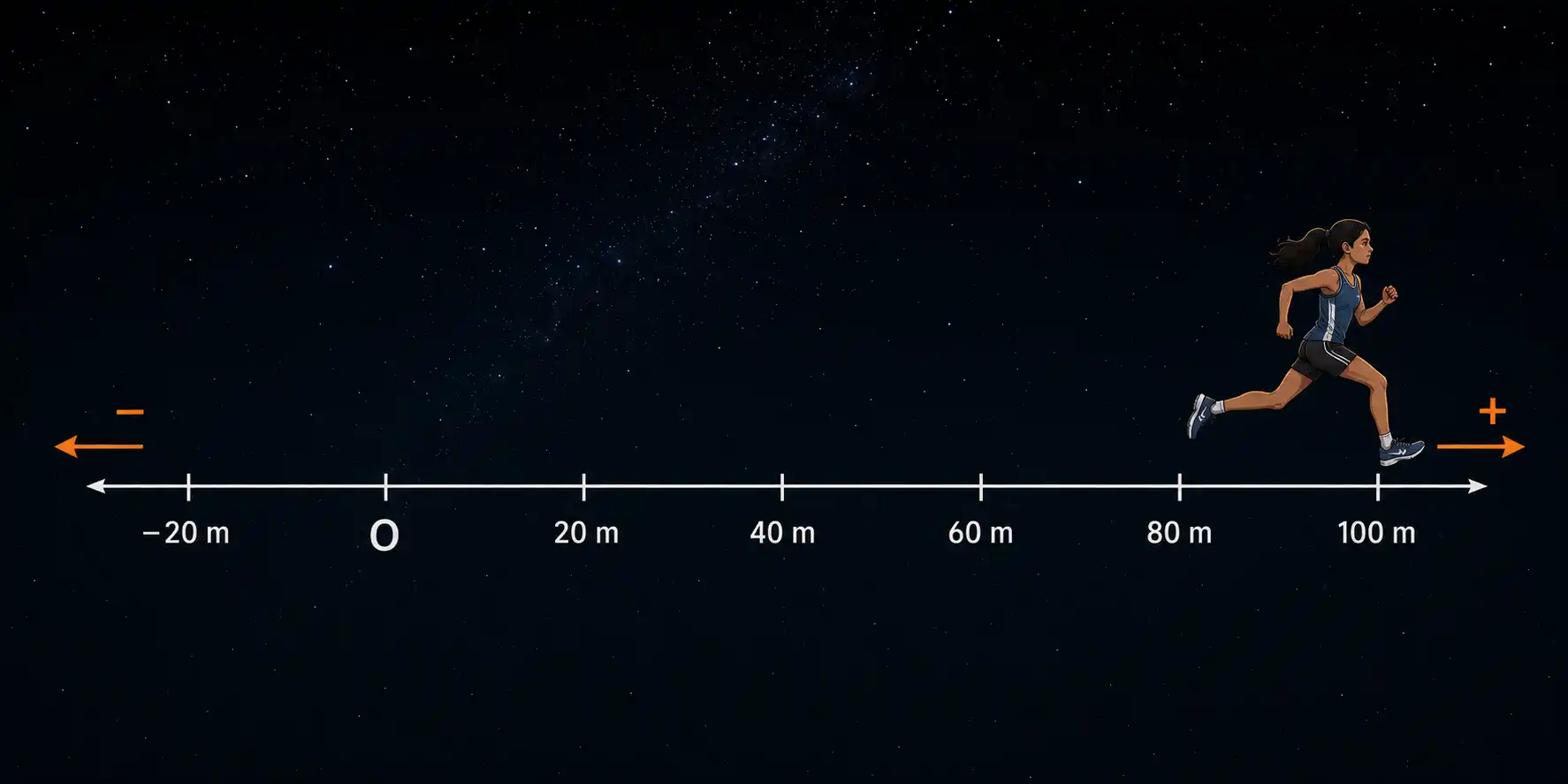
- Pick a fixed point on the line and call it the origin — this is your reference point. Mark it with the letter O.
- Choose one direction along the line and call it positive (usually shown with a + sign).
- The other direction is then negative (shown with a − sign).
Now every position on the line can be written as a single signed number with units, like m or m.
Example. Suppose Neena starts running from O at s. After 4 seconds she is at the 40 m mark — that's m. She keeps running and at 10 seconds she has reached the 100 m mark — that's m. If she had run the other way instead, she would be at m or m.
This simple sign rule lets you write down complicated motion — forward, backward, stopped — using just numbers and a + or − sign. From here on, every graph, every equation in this chapter is built on this one idea.
Threads of Curiosity — There Is No "Absolute Rest"
If you wanted to find a place in the universe that is truly not moving, where would you look?
Q1.Which of the following best describes when an object is said to be in motion?
Right now — sitting on your bed, on a chair, on the floor — are you moving, or are you sitting still?
Don't look up an answer. Just think about it: how would you decide?
Think about what "moving" means to you. Moving compared to what?
The Verse That Holds Motion and Stillness Together
तदेजति तन्नैजति तद्दूरे तद्वन्तिके ।
तदन्तरस्य सर्वस्य तदु सर्वस्यास्य बाह्यतः ॥
"वो चलता भी है, और वो चलता भी नहीं। वो बहुत दूर है, और वो बिल्कुल पास भी है। वो हर चीज़ के अंदर है, और हर चीज़ के बाहर भी।"
"It moves, and it moves not. It is far away, and it is near. It is inside everything, and outside everything too."
— Composed nearly three thousand years ago, this verse is the oldest recorded statement of what scientists today call relative motion.
The Question Behind the Verse
How can something move and not move at the same time?
Everything is moving — even when nothing seems to
Look around. A leaf falls. A fan spins. A child runs past on the road. A truck honks somewhere outside. Motion is the most ordinary thing in the world — so ordinary that you almost stop noticing it.
Now look at yourself. You are sitting completely still — at least, that's what it feels like.
But you are not still.
- Inside you, blood is moving through your veins at about half a metre per second.
- The air molecules brushing past your skin are darting around at roughly 500 m/s.
- The Earth is spinning on its axis. At Delhi's latitude, that means the ground beneath you is sweeping eastward at nearly 1,400 km/h.
- The Earth is also orbiting the Sun at about 30 km every second — faster than any rocket humans have ever built for travel.
- And the Sun itself is hauling our entire solar system around the centre of the Milky Way at 220 km/s.
You — sitting still on your bed — are riding all of these motions at once. You don't feel them because everything around you is riding them too. Motion is not the exception. Stillness is the illusion.
In this chapter, you will learn to describe motion the way a scientist does: not just in words, but with numbers, equations, and graphs. By the end, you will be able to predict where a moving object will be at any future moment — something that looks like magic, but is really just a careful way of paying attention.
When do we say something is in motion?
If everything is moving all the time, how do we ever talk about motion at all? The answer is: we always compare to something.
A reference point is the something we compare to.
Imagine you are sitting in a parked bus. The bus starts to move. Two people describe what they just saw:
- You, inside the bus, say: "The trees outside are moving backwards."
- A person standing on the road says: "The bus is moving forward, the trees are still."
Who is right? Both are. You picked the bus as your reference point, so the trees move relative to you. The person on the road picked the ground as their reference, so the bus moves relative to them. Neither is wrong — they have just chosen different reference points.
Once a reference point is chosen, the rule is simple:
An object is in motion if its position relative to the reference point changes with time. It is at rest if its position relative to the reference point does not change.
A football lying on the field is at rest relative to the field. The same football, the moment a player kicks it, is in motion — its position relative to the field is changing every instant.
Position itself needs three things to be specified: a reference point, a distance from that reference, and a direction. "Five metres" tells you nothing — five metres from where, and in which direction? — until you fix the reference and the direction.
A drone hovers perfectly still in the air over a moving cargo train. From the drone's camera looking down, the train is moving. From a passenger sitting inside the train, the drone is moving — the train looks still and the drone seems to slide backwards in the sky.
A student says: "The drone is really still, the passenger is wrong because she is the one inside a moving train."
Is the student right?
India's Scientific Contributions — Aryabhata's Bold Reframe
In 499 CE, a 23-year-old astronomer named Aryabhata wrote a book called the Aryabhatiya in Kusumapura (modern-day Patna). In it, he made a claim that shocked his contemporaries:
Locating an object on a straight line
Once we have a reference point, we need a clean way to write down where something is. For motion in a straight line, the simplest tool is a number line.
- Pick a fixed point on the line and call it the origin — this is your reference point. Mark it with the letter O.
- Choose one direction along the line and call it positive (usually shown with a + sign).
- The other direction is then negative (shown with a − sign).
Now every position on the line can be written as a single signed number with units, like m or m.
Example. Suppose Neena starts running from O at s. After 4 seconds she is at the 40 m mark — that's m. She keeps running and at 10 seconds she has reached the 100 m mark — that's m. If she had run the other way instead, she would be at m or m.
This simple sign rule lets you write down complicated motion — forward, backward, stopped — using just numbers and a + or − sign. From here on, every graph, every equation in this chapter is built on this one idea.
Threads of Curiosity — There Is No "Absolute Rest"
If you wanted to find a place in the universe that is truly not moving, where would you look?
Q1.Which of the following best describes when an object is said to be in motion?