Think as a Scientist — From One Cell to a Plant
F. C. Steward's carrot experiment and the discovery of totipotency
The Experiment That Changed Biology
In 1958, an English botanist named F. C. Steward working at Cornell University did an experiment that shook biology. He wanted to test a radical question: could a specialised plant cell — one that had finished differentiating — be coaxed back into a dividing state, and even into building a whole new plant?
At the time, the answer was assumed to be no. Differentiation was thought to be a one-way road: meristem cell → mature specialised cell → eventual death. Once a phloem cell, always a phloem cell.
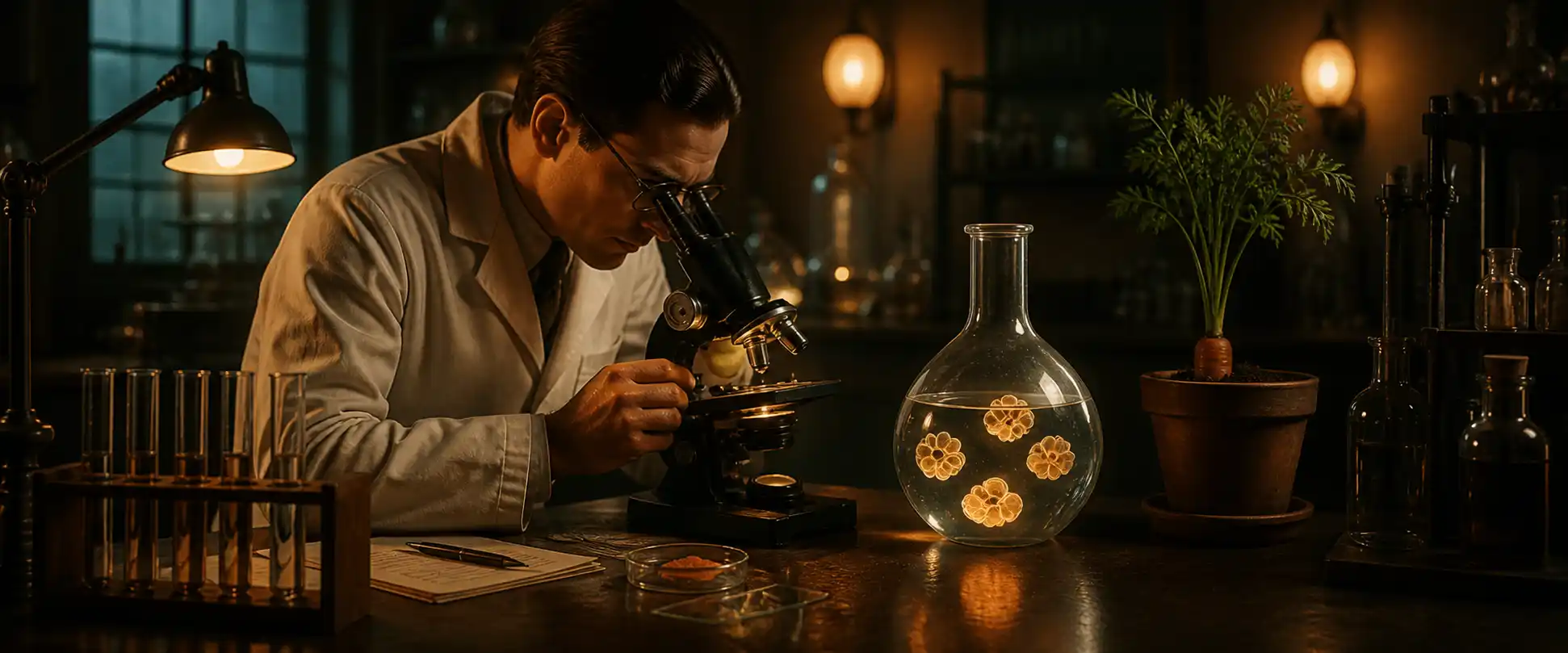
Steward decided to find out. He took small fragments of phloem tissue from a carrot root, placed them in a liquid nutrient medium with sugars and growth-promoting chemicals, and gently stirred the flask. The stirring shook single cells loose from the fragments. They floated freely in the liquid.
Then something amazing happened. The floating phloem cells — supposedly fully specialised — began to divide. Each one became a small cluster of cells, like a tiny meristem. The clusters then organised themselves into embryonic plant structures, just like a developing embryo from a seed. Steward transferred them to solid agar medium. The embryos grew into plantlets — tiny carrots with roots, shoots, and leaves. He planted the plantlets in soil. They grew into full adult carrots, indistinguishable from carrots grown from seeds.
He had built complete carrot plants from individual phloem cells.
The implications were enormous. The ability to do this is called totipotency (toti = whole, potency = power) — the capacity of a single mature cell to give rise to a complete organism. Such cells are called totipotent cells. Steward had shown that mature plant cells could dedifferentiate (lose their specialisation), divide, and redifferentiate into all the cell types needed for a whole plant. This is similar to how a fertilised egg (zygote) develops into an entire animal — except in plants, even mature cells retain this potential.
Walk Through the Experiment
What Steward Tried Changing
Steward was a careful experimenter. He didn't just claim totipotency works under one condition — he tested multiple combinations of conditions to see what mattered. The results showed clearly that light, air, and nutrients all play roles.
Read the table below carefully. Each row tested one set of conditions on the carrot phloem cells. The last column shows whether the cells actually grew (gained mass) or didn't.
Why This Discovery Matters
Steward's experiment was one of those rare moments when a single result changes how we think about an entire field. Three big lessons came out:
-
Differentiation is not always permanent. At least in plants, a specialised cell can be coaxed back into a dividing state.
-
Every cell carries the full instructions for the whole organism. A phloem cell still has all the DNA and information needed to make a complete carrot — including roots, leaves, flowers, even seeds. Most of the time, this information is silent. Under the right conditions, it can be reactivated.
-
Cells are programmable. With the right environment — nutrients, hormones, light, air — biology can be redirected. This is the foundation of modern biotechnology, agricultural cloning, and (one day, perhaps) regenerative medicine.
You started this chapter with the question: how does one cell become so many different kinds of cells? Steward showed us the surprising flip side: how can a specialised cell become any kind of cell again? The fact that both are possible — that cells are not locked into their roles forever — is one of the deepest and most useful insights in modern biology.
Twenty pages ago, you started life as a single cell. Now, having gone through every tissue type that single cell becomes, you can see how extraordinary the journey is. And you've also learned that the journey, in plants at least, can be reversed. The cell remembers.
The Experiment That Changed Biology
In 1958, an English botanist named F. C. Steward working at Cornell University did an experiment that shook biology. He wanted to test a radical question: could a specialised plant cell — one that had finished differentiating — be coaxed back into a dividing state, and even into building a whole new plant?
At the time, the answer was assumed to be no. Differentiation was thought to be a one-way road: meristem cell → mature specialised cell → eventual death. Once a phloem cell, always a phloem cell.
Steward decided to find out. He took small fragments of phloem tissue from a carrot root, placed them in a liquid nutrient medium with sugars and growth-promoting chemicals, and gently stirred the flask. The stirring shook single cells loose from the fragments. They floated freely in the liquid.
Then something amazing happened. The floating phloem cells — supposedly fully specialised — began to divide. Each one became a small cluster of cells, like a tiny meristem. The clusters then organised themselves into embryonic plant structures, just like a developing embryo from a seed. Steward transferred them to solid agar medium. The embryos grew into plantlets — tiny carrots with roots, shoots, and leaves. He planted the plantlets in soil. They grew into full adult carrots, indistinguishable from carrots grown from seeds.
He had built complete carrot plants from individual phloem cells.
The implications were enormous. The ability to do this is called totipotency (toti = whole, potency = power) — the capacity of a single mature cell to give rise to a complete organism. Such cells are called totipotent cells. Steward had shown that mature plant cells could dedifferentiate (lose their specialisation), divide, and redifferentiate into all the cell types needed for a whole plant. This is similar to how a fertilised egg (zygote) develops into an entire animal — except in plants, even mature cells retain this potential.
Walk Through the Experiment
What Steward Tried Changing
Steward was a careful experimenter. He didn't just claim totipotency works under one condition — he tested multiple combinations of conditions to see what mattered. The results showed clearly that light, air, and nutrients all play roles.
Read the table below carefully. Each row tested one set of conditions on the carrot phloem cells. The last column shows whether the cells actually grew (gained mass) or didn't.
Why This Discovery Matters
Steward's experiment was one of those rare moments when a single result changes how we think about an entire field. Three big lessons came out:
-
Differentiation is not always permanent. At least in plants, a specialised cell can be coaxed back into a dividing state.
-
Every cell carries the full instructions for the whole organism. A phloem cell still has all the DNA and information needed to make a complete carrot — including roots, leaves, flowers, even seeds. Most of the time, this information is silent. Under the right conditions, it can be reactivated.
-
Cells are programmable. With the right environment — nutrients, hormones, light, air — biology can be redirected. This is the foundation of modern biotechnology, agricultural cloning, and (one day, perhaps) regenerative medicine.
You started this chapter with the question: how does one cell become so many different kinds of cells? Steward showed us the surprising flip side: how can a specialised cell become any kind of cell again? The fact that both are possible — that cells are not locked into their roles forever — is one of the deepest and most useful insights in modern biology.
Twenty pages ago, you started life as a single cell. Now, having gone through every tissue type that single cell becomes, you can see how extraordinary the journey is. And you've also learned that the journey, in plants at least, can be reversed. The cell remembers.