Xylem and Phloem — The Two Highways of a Plant
How water climbs 25 metres up against gravity, and food travels both ways

A peepal tree near your school is 25 metres tall. The water it drinks comes from soil at its roots — and somehow has to reach every single leaf at the very top. There's no pump, no engine, no electricity. How does water travel 25 metres straight up against gravity, day after day, for 200 years?
Water carries the message of life
अद्भिर्जीवनं रक्षति।
Hindi: Paani jeevan ko sambhalta hai — jal hi har jeev ko jodne wala raasta hai.
English: Water sustains life — it is the path that connects every living thing.
Inside a plant, water is more than a drink. It is the highway that carries minerals from the deepest roots up to the highest leaves — and the river that carries food back down to feed every cell. Two flows in opposite directions, in two separate pipes, working every second of every day.
Two Highways, Different Cargo
Until now, every tissue we've met has been a simple permanent tissue — made of just one kind of cell. Parenchyma is one cell type. Collenchyma is one cell type. Sclerenchyma is one cell type.
But the plant's transport system is different. It is built from multiple cell types working together as a team. Tissues like these are called complex permanent tissues. There are two of them: xylem (water highway) and phloem (food highway).
Xylem and phloem run side by side as long bundles through every stem, every root, and every leaf vein. When you see the parallel lines running through a banana leaf or the central vein of a tulsi leaf, you're looking at xylem and phloem bundles.
Xylem carries water and dissolved minerals UPWARD — from roots, up through the stem, all the way to the leaves at the top. Phloem carries food (mostly sugar) made in the leaves DOWNWARD and SIDEWAYS — to flowers, fruits, stems, roots, and storage organs. The two flows happen in opposite directions, in adjacent pipes, simultaneously.
Xylem — The Water Pipe
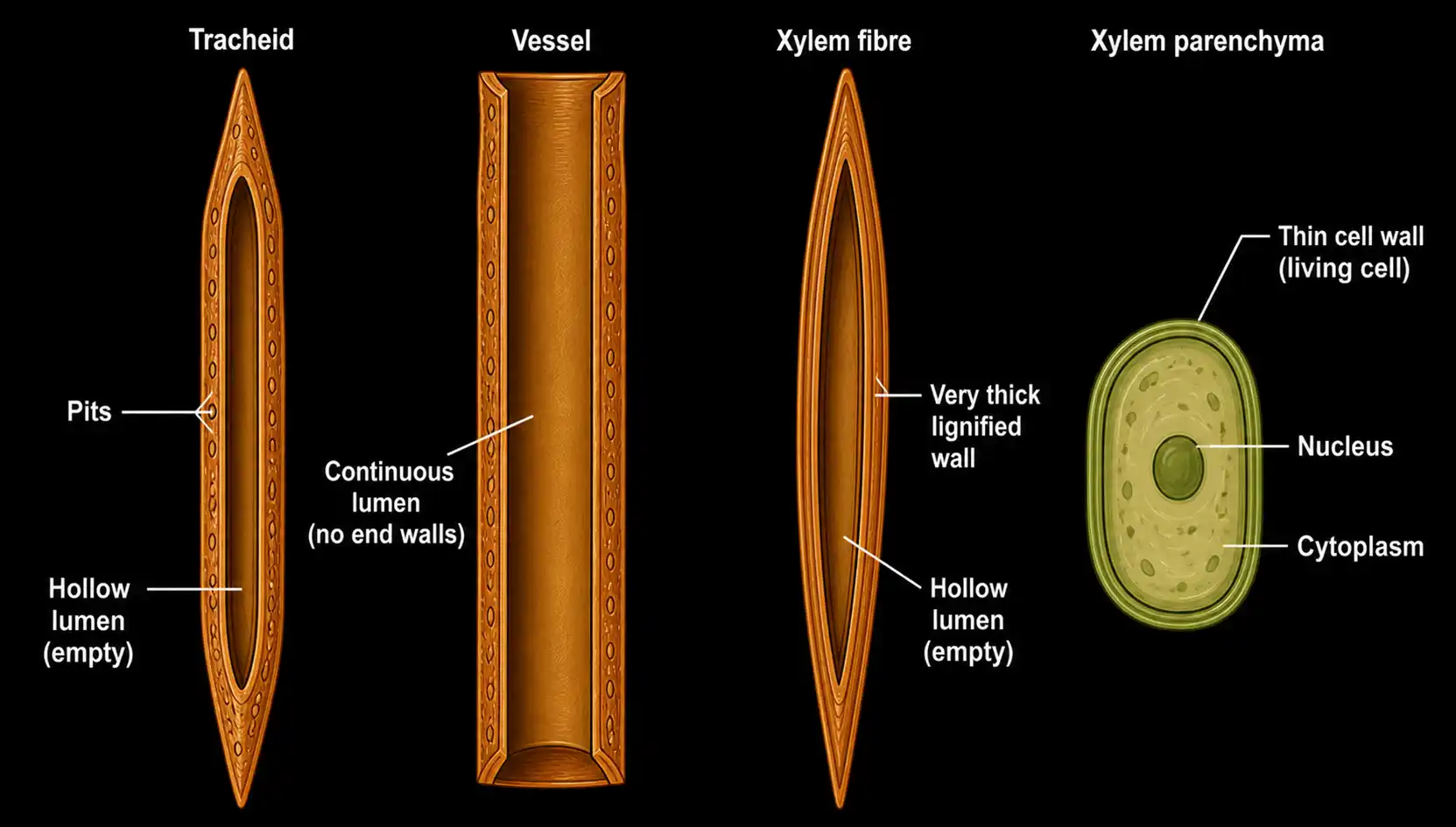
Xylem is built from four types of cells working together:
- Tracheids — long, narrow tube-like cells with thick lignified walls. Dead at maturity, hollow inside. Water flows from one tracheid to the next through tiny pits in the walls.
- Vessels — even longer, wider tube-like cells stacked end-to-end with their connecting walls dissolved away. Dead, hollow. They form continuous pipes that water can rush through with little resistance. Most flowering plants use vessels for fast water transport.
- Xylem fibres — long sclerenchyma cells. Dead. Their job is purely structural support — they reinforce the xylem bundle.
- Xylem parenchyma — the only living cells in xylem. They store some food and sometimes help in lateral water movement.
Notice the pattern: most of the xylem is dead. Tracheids, vessels, and fibres are all dead at maturity. This is not a flaw — it's a feature. Dead cells with empty interiors and tough walls are exactly what you want for a high-pressure water pipe. Living cells inside would just block the flow.
How does water travel UP against gravity? As water evaporates from the leaves through stomata (the transpiration you met earlier), it creates a tiny suction at the top of the xylem. Water molecules stick strongly to each other (cohesion). So as one molecule leaves the leaf, it pulls the next one up behind it. The whole column of water in the xylem is drawn upward — like sipping a thick milkshake through a straw, except the straw is 25 metres long. This is called the transpiration pull, and it works because the xylem cells are dead, hollow, and continuous from root to leaf.
Phloem — The Food Pipe
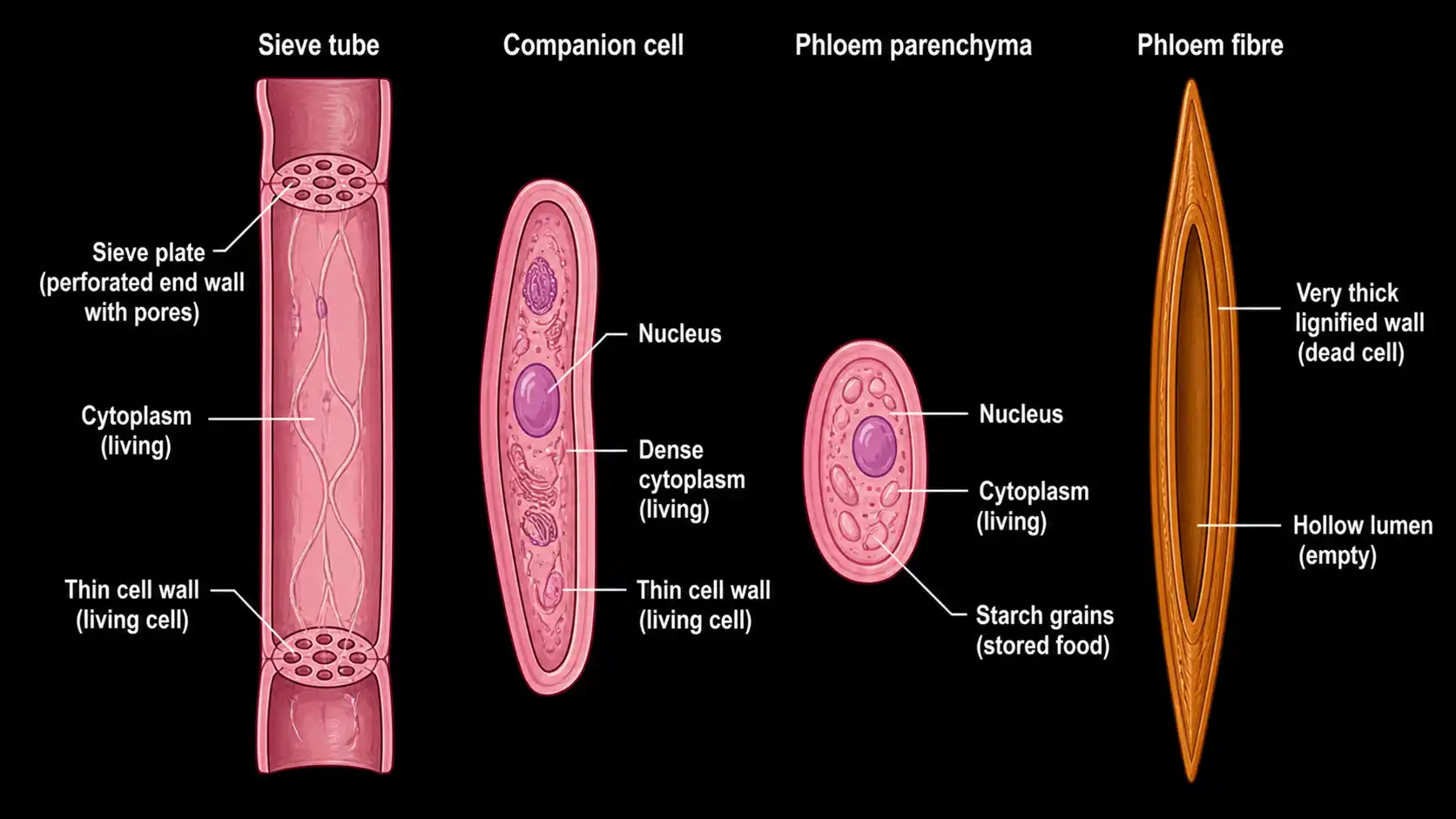
Phloem is built from four cell types too — but the design choices are completely different. Most of phloem is alive, because transporting sugar requires active cellular work, not just passive flow.
- Sieve tubes — long tube-like living cells stacked end-to-end. The end walls between cells are not fully dissolved like in xylem; instead, they are perforated with many tiny holes — like a sieve — through which sugar solution flows. These end walls are called sieve plates.
- Companion cells — small living cells sitting alongside each sieve tube cell. Sieve tubes have lost most of their internal machinery to make room for fast flow. So companion cells take over the metabolic work — they manage loading and unloading of sugar into and out of the sieve tubes.
- Phloem parenchyma — living cells that store food materials, resin, tannins, and latex.
- Phloem fibres — sclerenchyma cells. Dead. They provide structural support to the soft phloem bundle. Jute fibres from the Corchorus plant are mostly phloem fibres.
How does food travel through phloem? Unlike water in xylem (which moves only one way, up), sugar in phloem moves in both directions — wherever it's needed. In summer, sugar flows from leaves down to roots for storage. In spring, stored sugar flows from roots back up to growing buds. Phloem is a two-way road. The sugar gets pushed along by active loading and unloading at the source (usually leaves) and the sink (usually growing or storing parts) — a process that requires living cells, which is why phloem is mostly alive.
A student carefully removes a complete ring of bark (including the phloem layer just under it) from around a tree trunk, leaving the deeper xylem inside untouched. The leaves keep getting water and stay green for several weeks. But over months, the parts of the tree BELOW the cut start to wither and die — even though the soil and roots are healthy. Why?
Tapping Rubber Trees and Maple Trees
Ever seen rubber tappers in Kerala or Tripura? They make a careful diagonal cut into the bark of a Hevea brasiliensis tree. A milky white liquid called latex flows out — and that latex comes from phloem parenchyma cells. The cut deliberately taps into the phloem layer without killing the tree.
How Fast Does Sugar Move in Phloem?
Surprisingly fast. Scientists have measured sugar flow in phloem at about 1 metre per hour in many plants — sometimes more. That means the sugar made by a leaf at the top of a 10-metre tree can reach the roots in just 10 hours.
Q1.Which tissue carries water and minerals from roots to leaves?
A peepal tree near your school is 25 metres tall. The water it drinks comes from soil at its roots — and somehow has to reach every single leaf at the very top. There's no pump, no engine, no electricity. How does water travel 25 metres straight up against gravity, day after day, for 200 years?
Water carries the message of life
अद्भिर्जीवनं रक्षति।
Hindi: Paani jeevan ko sambhalta hai — jal hi har jeev ko jodne wala raasta hai.
English: Water sustains life — it is the path that connects every living thing.
Inside a plant, water is more than a drink. It is the highway that carries minerals from the deepest roots up to the highest leaves — and the river that carries food back down to feed every cell. Two flows in opposite directions, in two separate pipes, working every second of every day.
Two Highways, Different Cargo
Until now, every tissue we've met has been a simple permanent tissue — made of just one kind of cell. Parenchyma is one cell type. Collenchyma is one cell type. Sclerenchyma is one cell type.
But the plant's transport system is different. It is built from multiple cell types working together as a team. Tissues like these are called complex permanent tissues. There are two of them: xylem (water highway) and phloem (food highway).
Xylem and phloem run side by side as long bundles through every stem, every root, and every leaf vein. When you see the parallel lines running through a banana leaf or the central vein of a tulsi leaf, you're looking at xylem and phloem bundles.
Xylem carries water and dissolved minerals UPWARD — from roots, up through the stem, all the way to the leaves at the top. Phloem carries food (mostly sugar) made in the leaves DOWNWARD and SIDEWAYS — to flowers, fruits, stems, roots, and storage organs. The two flows happen in opposite directions, in adjacent pipes, simultaneously.
Xylem — The Water Pipe
Xylem is built from four types of cells working together:
- Tracheids — long, narrow tube-like cells with thick lignified walls. Dead at maturity, hollow inside. Water flows from one tracheid to the next through tiny pits in the walls.
- Vessels — even longer, wider tube-like cells stacked end-to-end with their connecting walls dissolved away. Dead, hollow. They form continuous pipes that water can rush through with little resistance. Most flowering plants use vessels for fast water transport.
- Xylem fibres — long sclerenchyma cells. Dead. Their job is purely structural support — they reinforce the xylem bundle.
- Xylem parenchyma — the only living cells in xylem. They store some food and sometimes help in lateral water movement.
Notice the pattern: most of the xylem is dead. Tracheids, vessels, and fibres are all dead at maturity. This is not a flaw — it's a feature. Dead cells with empty interiors and tough walls are exactly what you want for a high-pressure water pipe. Living cells inside would just block the flow.
How does water travel UP against gravity? As water evaporates from the leaves through stomata (the transpiration you met earlier), it creates a tiny suction at the top of the xylem. Water molecules stick strongly to each other (cohesion). So as one molecule leaves the leaf, it pulls the next one up behind it. The whole column of water in the xylem is drawn upward — like sipping a thick milkshake through a straw, except the straw is 25 metres long. This is called the transpiration pull, and it works because the xylem cells are dead, hollow, and continuous from root to leaf.
Phloem — The Food Pipe
Phloem is built from four cell types too — but the design choices are completely different. Most of phloem is alive, because transporting sugar requires active cellular work, not just passive flow.
- Sieve tubes — long tube-like living cells stacked end-to-end. The end walls between cells are not fully dissolved like in xylem; instead, they are perforated with many tiny holes — like a sieve — through which sugar solution flows. These end walls are called sieve plates.
- Companion cells — small living cells sitting alongside each sieve tube cell. Sieve tubes have lost most of their internal machinery to make room for fast flow. So companion cells take over the metabolic work — they manage loading and unloading of sugar into and out of the sieve tubes.
- Phloem parenchyma — living cells that store food materials, resin, tannins, and latex.
- Phloem fibres — sclerenchyma cells. Dead. They provide structural support to the soft phloem bundle. Jute fibres from the Corchorus plant are mostly phloem fibres.
How does food travel through phloem? Unlike water in xylem (which moves only one way, up), sugar in phloem moves in both directions — wherever it's needed. In summer, sugar flows from leaves down to roots for storage. In spring, stored sugar flows from roots back up to growing buds. Phloem is a two-way road. The sugar gets pushed along by active loading and unloading at the source (usually leaves) and the sink (usually growing or storing parts) — a process that requires living cells, which is why phloem is mostly alive.
A student carefully removes a complete ring of bark (including the phloem layer just under it) from around a tree trunk, leaving the deeper xylem inside untouched. The leaves keep getting water and stay green for several weeks. But over months, the parts of the tree BELOW the cut start to wither and die — even though the soil and roots are healthy. Why?
Tapping Rubber Trees and Maple Trees
Ever seen rubber tappers in Kerala or Tripura? They make a careful diagonal cut into the bark of a Hevea brasiliensis tree. A milky white liquid called latex flows out — and that latex comes from phloem parenchyma cells. The cut deliberately taps into the phloem layer without killing the tree.
How Fast Does Sugar Move in Phloem?
Surprisingly fast. Scientists have measured sugar flow in phloem at about 1 metre per hour in many plants — sometimes more. That means the sugar made by a leaf at the top of a 10-metre tree can reach the roots in just 10 hours.
Q1.Which tissue carries water and minerals from roots to leaves?