Sclerenchyma — Strength from Dead Cells
Wood, walnut shells, and the engineering material of plants
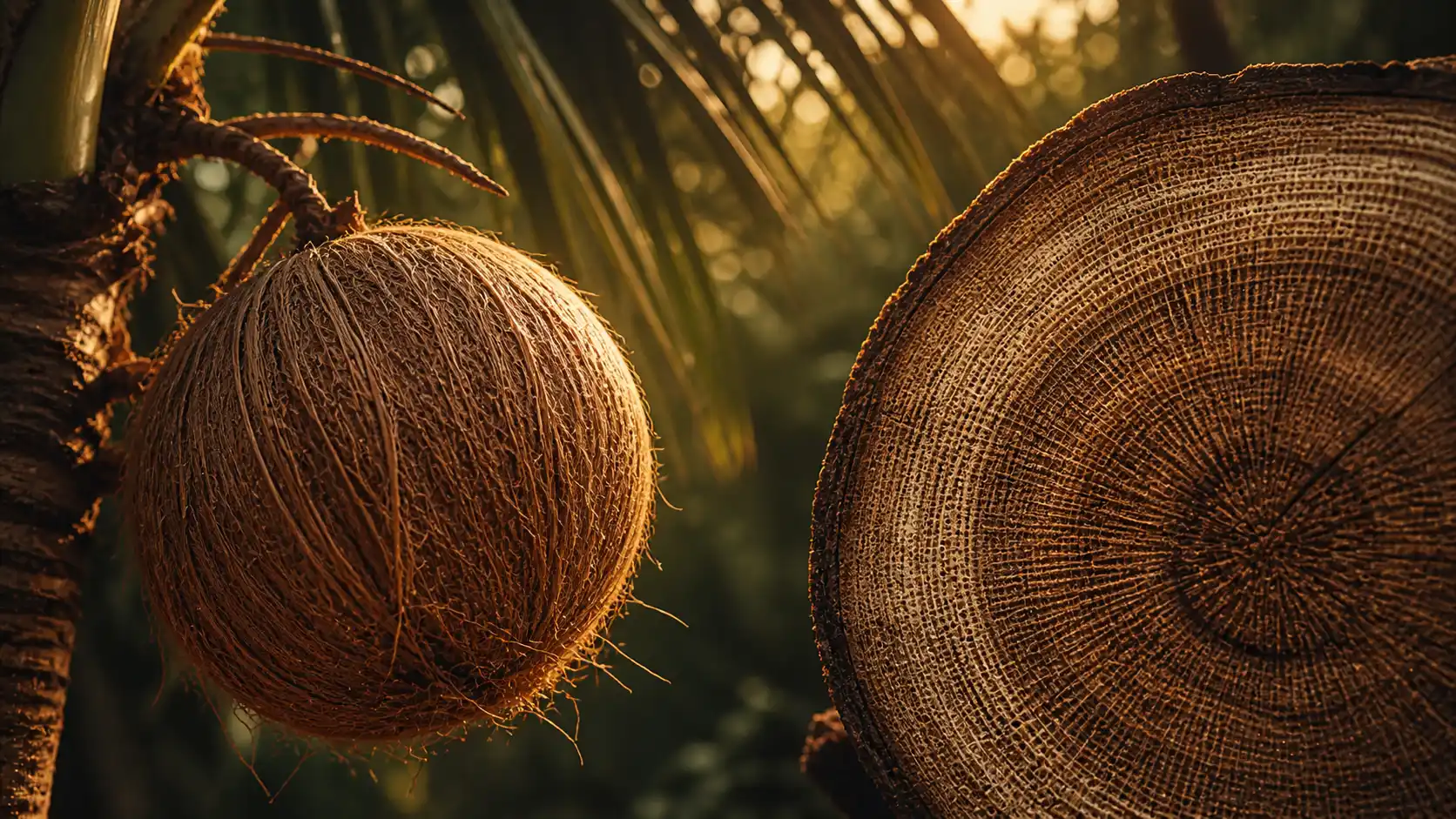
A coconut falls from a 20-metre palm tree onto rocky ground. The coconut survives. The fluid inside doesn't even spill. What in that thick fibrous shell is so tough that it can take a 20-metre fall without cracking?
What ends, what remains
देहिनोऽस्मिन्यथा देहे कौमारं यौवनं जरा।
Hindi: Iss deh mein bachpan, jawani, aur budhapa aate jaate hain — par jo asli tatva hai woh badalta nahi.
English: Childhood, youth, old age — these come and go in this body. But the essential reality remains.
Sclerenchyma cells take this idea literally. Their cytoplasm and nucleus are gone — but the strong wall they built remains, doing its job long after the cell itself has died. Most of a tree trunk is exactly this: dead structure, still standing.
Sclerenchyma — Strength Through Death
Sclerenchyma (scleros = hard, enchyma = tissue) is the third type of simple permanent tissue. It is the plant's engineering material — the tissue that builds the hard, strong, supporting parts.
Sclerenchyma cells are dramatically different from parenchyma and collenchyma:
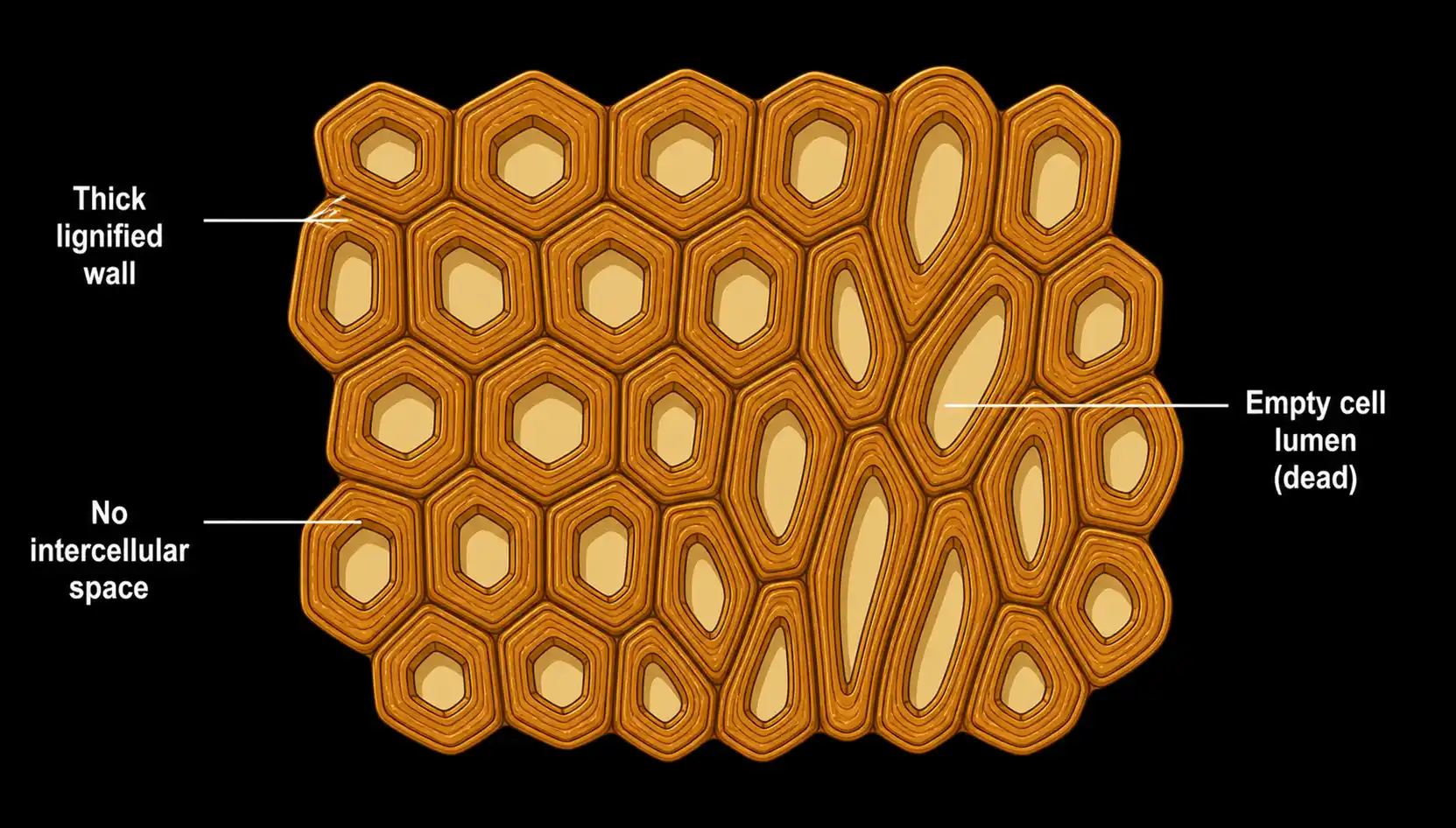
- Dead at maturity (no nucleus, no cytoplasm, no active metabolism)
- Walls heavily thickened with cellulose AND a special chemical called lignin
- Lignin is what makes the wall tough, waterproof, and resistant to rot
- Tightly packed with no intercellular spaces
- No flexibility — these cells cannot stretch or bend much
When a sclerenchyma cell finishes building its lignin-fortified wall, it dies. The cytoplasm dries up. The nucleus disappears. What's left is just a tiny hollow chamber surrounded by an extremely tough wall.
Stack billions of these tough hollow chambers together, and you get wood — the trunk of a 30-metre teak or banyan tree. Pack them in long bundles in seed coats and nut shells, and you get the walnut shell that resists hammers, the mango stone that survives passage through animal digestive systems, the coconut husk that protects the seed inside.
Most of the structural mass of a mature tree is dead sclerenchyma. The living tissues are squeezed into thin layers near the bark and at the growing tips. The bulk of the body is engineering, not metabolism.
Where You'll Find Sclerenchyma
Once you know what to look for, sclerenchyma is everywhere in everyday life:
- Coconut husk — the brown fibres around a coconut. Each fibre is a long bundle of sclerenchyma cells. India processes millions of tonnes of these into coir for ropes, mats, and brushes — a major industry in Kerala.
- Jute fibres — the hessian sacks used for grain storage. Jute is grown extensively in West Bengal and Bangladesh. The 'fibre' of jute is actually long bundles of sclerenchyma extracted from the stem.
- Walnut shells, almond shells, mango stones — incredibly hard seed coverings that protect the seed from being crushed by birds' beaks or animal teeth.
- The 'wood' of a tree trunk — most of a tree's hard inner mass is sclerenchymatous. The strength of timber, the rigidity of bamboo poles, the rigidity of a wooden ruler — all the work of sclerenchyma.
- Leaf veins — those tough lines you see in a leaf? Sclerenchyma fibres reinforcing the soft leaf tissue.
Lignin, the chemical that thickens these walls, is one of the most abundant organic substances on Earth. Without it, no plant could grow taller than a metre or two. Lignin is what made the existence of forests possible.
The Three Simple Permanent Tissues — At a Glance
Parenchyma
- Alive, with nucleus and cytoplasm
- Thin cellulose walls, loose packing
- Soft and unstructured
- Stores food (potato, onion); does photosynthesis (chlorenchyma); helps floating (aerenchyma)
Collenchyma
- Alive, with nucleus and cytoplasm
- Walls thickened only at corners with cellulose and pectin
- Flexible AND strong
- Found in young stems, leaf stalks, tendrils — bends in wind without breaking
Sclerenchyma
- Dead at maturity, hollow inside
- Walls heavily thickened with cellulose and lignin
- Hard, rigid, strong, but inflexible
- Forms wood, jute fibres, coconut husk, seed coats — provides permanent support
Parenchyma
- Alive, with nucleus and cytoplasm
- Thin cellulose walls, loose packing
- Soft and unstructured
- Stores food (potato, onion); does photosynthesis (chlorenchyma); helps floating (aerenchyma)
Collenchyma
- Alive, with nucleus and cytoplasm
- Walls thickened only at corners with cellulose and pectin
- Flexible AND strong
- Found in young stems, leaf stalks, tendrils — bends in wind without breaking
Sclerenchyma
- Dead at maturity, hollow inside
- Walls heavily thickened with cellulose and lignin
- Hard, rigid, strong, but inflexible
- Forms wood, jute fibres, coconut husk, seed coats — provides permanent support
A clever question to keep you sharp: if sclerenchyma cells are dead — no metabolism, no living cytoplasm — how can a tree that is mostly sclerenchyma still 'grow' and stay 'alive'?
Coir — A Coconut-Husk Industry Built on Sclerenchyma
Kerala produces over half of the world's coir — the rough fibrous material from coconut husks used in ropes, mats, brushes, and mattress fillings. Every coir fibre is a bundle of sclerenchyma cells.
Why Wood Doesn't Sink Right Away
Most types of wood float — even though wood looks dense and heavy. The reason is that each sclerenchyma cell is a tiny hollow box with a thick wall. Tons of empty cell-lumens add up to a lot of trapped air. That air is what gives wood its lower density and lets it float on water — at least until the lumens slowly fill with water and the wood eventually sinks.
Q1.Which of the following best describes sclerenchyma cells?
A coconut falls from a 20-metre palm tree onto rocky ground. The coconut survives. The fluid inside doesn't even spill. What in that thick fibrous shell is so tough that it can take a 20-metre fall without cracking?
What ends, what remains
देहिनोऽस्मिन्यथा देहे कौमारं यौवनं जरा।
Hindi: Iss deh mein bachpan, jawani, aur budhapa aate jaate hain — par jo asli tatva hai woh badalta nahi.
English: Childhood, youth, old age — these come and go in this body. But the essential reality remains.
Sclerenchyma cells take this idea literally. Their cytoplasm and nucleus are gone — but the strong wall they built remains, doing its job long after the cell itself has died. Most of a tree trunk is exactly this: dead structure, still standing.
Sclerenchyma — Strength Through Death
Sclerenchyma (scleros = hard, enchyma = tissue) is the third type of simple permanent tissue. It is the plant's engineering material — the tissue that builds the hard, strong, supporting parts.
Sclerenchyma cells are dramatically different from parenchyma and collenchyma:
- Dead at maturity (no nucleus, no cytoplasm, no active metabolism)
- Walls heavily thickened with cellulose AND a special chemical called lignin
- Lignin is what makes the wall tough, waterproof, and resistant to rot
- Tightly packed with no intercellular spaces
- No flexibility — these cells cannot stretch or bend much
When a sclerenchyma cell finishes building its lignin-fortified wall, it dies. The cytoplasm dries up. The nucleus disappears. What's left is just a tiny hollow chamber surrounded by an extremely tough wall.
Stack billions of these tough hollow chambers together, and you get wood — the trunk of a 30-metre teak or banyan tree. Pack them in long bundles in seed coats and nut shells, and you get the walnut shell that resists hammers, the mango stone that survives passage through animal digestive systems, the coconut husk that protects the seed inside.
Most of the structural mass of a mature tree is dead sclerenchyma. The living tissues are squeezed into thin layers near the bark and at the growing tips. The bulk of the body is engineering, not metabolism.
Where You'll Find Sclerenchyma
Once you know what to look for, sclerenchyma is everywhere in everyday life:
- Coconut husk — the brown fibres around a coconut. Each fibre is a long bundle of sclerenchyma cells. India processes millions of tonnes of these into coir for ropes, mats, and brushes — a major industry in Kerala.
- Jute fibres — the hessian sacks used for grain storage. Jute is grown extensively in West Bengal and Bangladesh. The 'fibre' of jute is actually long bundles of sclerenchyma extracted from the stem.
- Walnut shells, almond shells, mango stones — incredibly hard seed coverings that protect the seed from being crushed by birds' beaks or animal teeth.
- The 'wood' of a tree trunk — most of a tree's hard inner mass is sclerenchymatous. The strength of timber, the rigidity of bamboo poles, the rigidity of a wooden ruler — all the work of sclerenchyma.
- Leaf veins — those tough lines you see in a leaf? Sclerenchyma fibres reinforcing the soft leaf tissue.
Lignin, the chemical that thickens these walls, is one of the most abundant organic substances on Earth. Without it, no plant could grow taller than a metre or two. Lignin is what made the existence of forests possible.
The Three Simple Permanent Tissues — At a Glance
Parenchyma
- Alive, with nucleus and cytoplasm
- Thin cellulose walls, loose packing
- Soft and unstructured
- Stores food (potato, onion); does photosynthesis (chlorenchyma); helps floating (aerenchyma)
Collenchyma
- Alive, with nucleus and cytoplasm
- Walls thickened only at corners with cellulose and pectin
- Flexible AND strong
- Found in young stems, leaf stalks, tendrils — bends in wind without breaking
Sclerenchyma
- Dead at maturity, hollow inside
- Walls heavily thickened with cellulose and lignin
- Hard, rigid, strong, but inflexible
- Forms wood, jute fibres, coconut husk, seed coats — provides permanent support
Parenchyma
- Alive, with nucleus and cytoplasm
- Thin cellulose walls, loose packing
- Soft and unstructured
- Stores food (potato, onion); does photosynthesis (chlorenchyma); helps floating (aerenchyma)
Collenchyma
- Alive, with nucleus and cytoplasm
- Walls thickened only at corners with cellulose and pectin
- Flexible AND strong
- Found in young stems, leaf stalks, tendrils — bends in wind without breaking
Sclerenchyma
- Dead at maturity, hollow inside
- Walls heavily thickened with cellulose and lignin
- Hard, rigid, strong, but inflexible
- Forms wood, jute fibres, coconut husk, seed coats — provides permanent support
A clever question to keep you sharp: if sclerenchyma cells are dead — no metabolism, no living cytoplasm — how can a tree that is mostly sclerenchyma still 'grow' and stay 'alive'?
Coir — A Coconut-Husk Industry Built on Sclerenchyma
Kerala produces over half of the world's coir — the rough fibrous material from coconut husks used in ropes, mats, brushes, and mattress fillings. Every coir fibre is a bundle of sclerenchyma cells.
Why Wood Doesn't Sink Right Away
Most types of wood float — even though wood looks dense and heavy. The reason is that each sclerenchyma cell is a tiny hollow box with a thick wall. Tons of empty cell-lumens add up to a lot of trapped air. That air is what gives wood its lower density and lets it float on water — at least until the lumens slowly fill with water and the wood eventually sinks.
Q1.Which of the following best describes sclerenchyma cells?