Muscle Tissue — Three Types, One Job
Voluntary, involuntary, and the rhythmic engine of the heart
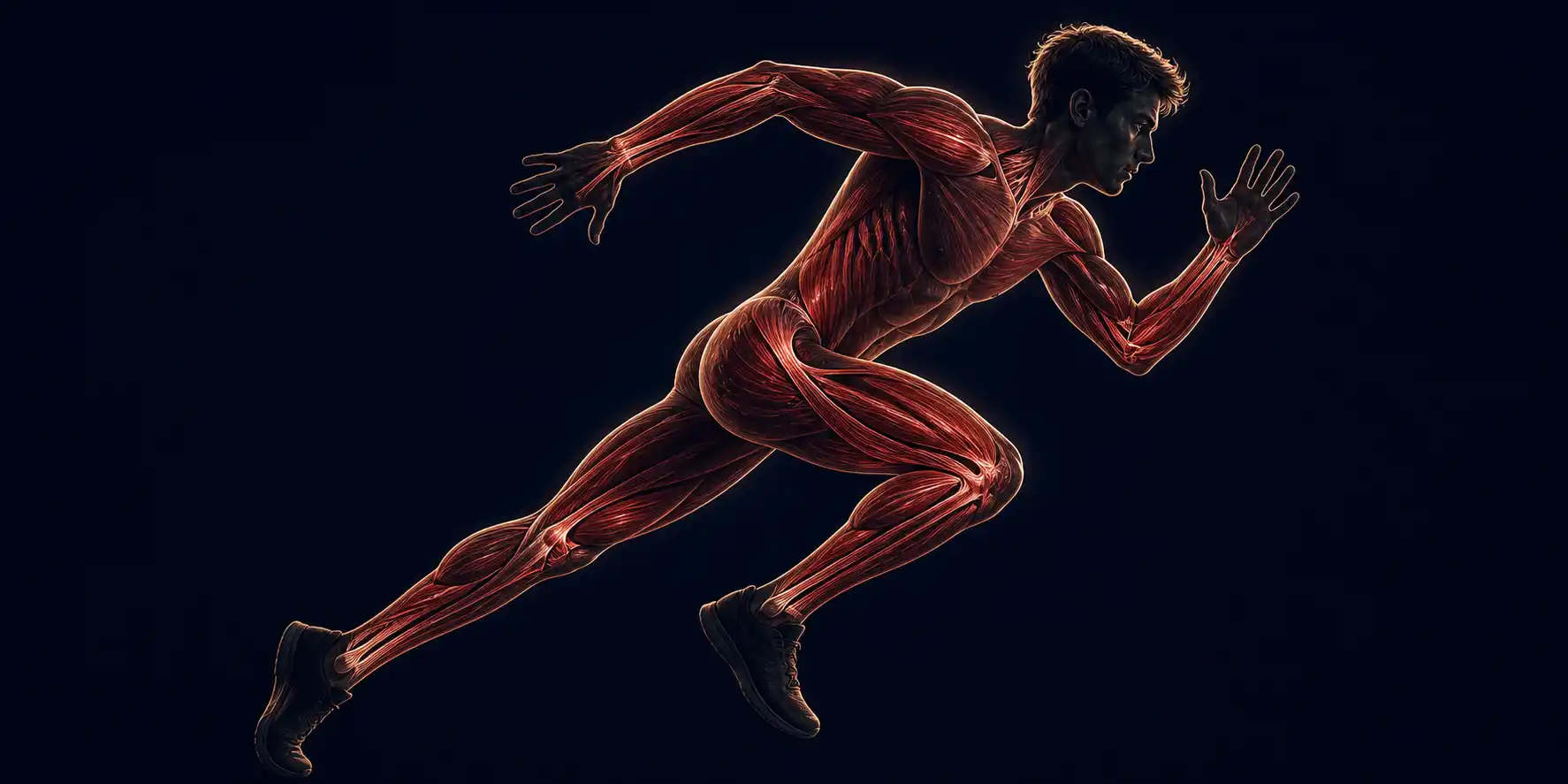
Right now you can decide to lift your hand — and lift it. You can choose to blink your eyes — and blink. But you cannot decide to make your heart beat faster, or to make your stomach digest. Three different muscles, all in the same body, and only some listen to your commands. Why does your body keep some movements under your control and others completely outside it?
Action never stops — even when you do
न हि कश्चित्क्षणमपि जातु तिष्ठत्यकर्मकृत्।
Hindi: Koi insaan ek pal bhi bina kuchh kiye nahi reh sakta — har waqt body mein kuchh na kuchh kaam chal raha hai.
English: No one can remain even for a moment without performing some action — the body is always in motion.
Sit perfectly still right now. Even if every voluntary muscle is frozen, your heart is still beating, your gut is still digesting, your blood vessels are still adjusting their width. The muscles you cannot stop are doing their work as you read this — without thanks, without rest.
What Is Muscle Tissue?
Muscle tissue is the third of the four animal tissues. Its defining property is contraction — its cells can shorten on command. When millions of muscle cells contract together, the result is movement: a finger flexing, a heart beating, food being pushed down the food pipe.
Muscle cells are different from any other animal cell. They are long, cylindrical, and packed with protein fibres that can slide past each other. When the cell receives a signal (electrical from a nerve, or chemical from a hormone), the protein fibres slide together — and the cell gets shorter. Multiply this across a whole muscle, and the muscle pulls.
Muscle cells are often called muscle fibres because they look like long fibres rather than typical round cells. Each fibre can be many centimetres long — among the longest cells in the body.
But muscle is not all the same. Your body has three distinct types of muscle tissue, each tuned for a different kind of work.
- Skeletal Muscle — The One You Control
Skeletal muscle is what you mean when you say 'my muscles' — biceps, triceps, calf muscles, abs, the muscles in your tongue and your face. They are attached to bones (via tendons) and pull on those bones to move your body.
Key features of skeletal muscle:
- Long, cylindrical, unbranched fibres lying parallel to each other in bundles
- Multinucleate — each fibre has many nuclei (most cells have only one)
- Striated — alternating dark and light bands visible across the fibre, due to the regular arrangement of contracting protein filaments
- Voluntary — you control it consciously through your nervous system
- Fast and powerful — can contract quickly and forcefully, but tires after sustained work
Skeletal muscle is what wins races, throws cricket balls, types on phones, and lets you turn pages. It is also the muscle that builds up with exercise and shrinks when unused.
- Smooth Muscle — The Quiet Worker
Smooth muscle lines the walls of internal organs — your stomach, intestines, blood vessels, the iris of your eye, the airways in your lungs, the urinary bladder. It works in the background, controlled by your nervous system without your awareness.
Key features:
- Spindle-shaped cells (pointed at both ends, fat in the middle), much shorter than skeletal muscle fibres
- Single nucleus in each cell
- No striations — the protein filaments are not arranged in regular bands
- Involuntary — you cannot consciously control it. You don't decide when your stomach contracts.
- Slow and tireless — contracts slowly but can keep going for hours without fatigue
Every time food moves through your gut (a process called peristalsis), it's smooth muscle pushing it along by rhythmic contractions. Every time a blood vessel narrows or widens to control blood flow, it's smooth muscle adjusting itself. Every time your iris closes in bright light, it's smooth muscle. You're not aware of any of it.
3. Cardiac Muscle — The Heart's Engine
Cardiac muscle is found in only one place in your body: the walls of your heart. It is a strange mix of the other two — voluntary in appearance, involuntary in control. Its features:
- Cylindrical and branched — fibres connect to each other, forming a network
- Single nucleus per cell
- Faintly striated — bands present but less prominent than skeletal muscle
- Involuntary — completely beyond your conscious control
- Tireless — contracts rhythmically about 70 times a minute, every minute, for your entire life, without rest
Cardiac muscle has a unique property: it doesn't even need a nerve to tell it when to beat. Cardiac cells generate their own rhythm and spread the signal to neighbours through their connections. The heart can keep beating for a short time even outside the body, in a lab dish with the right nutrients. That's how independent this muscle is.
Over an 80-year life, your heart will beat about 3 billion times without a single break.
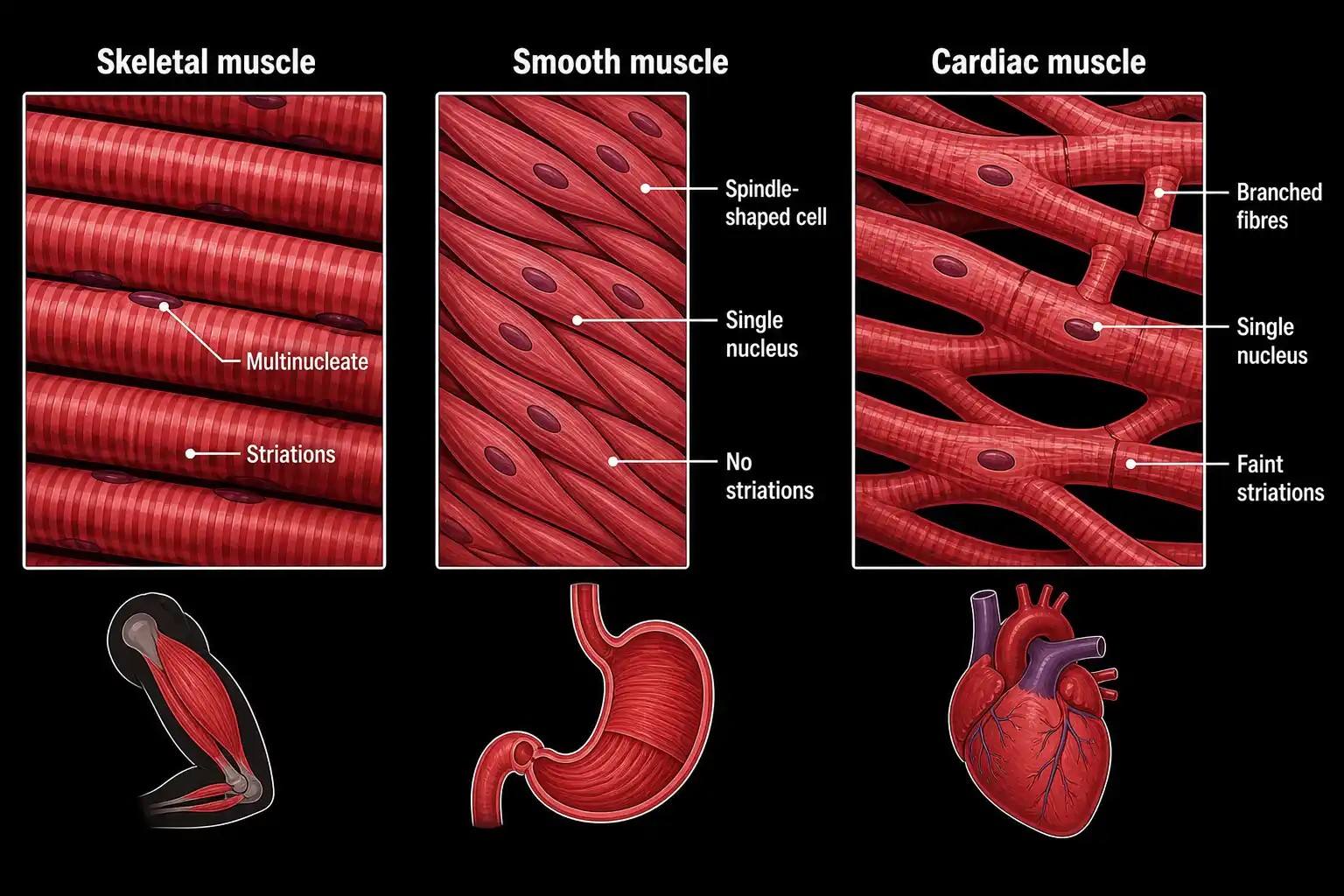
The Three Muscle Types — Side by Side
Skeletal
- Long, cylindrical, unbranched fibres
- Multi-nucleate — many nuclei per fibre
- Striated — strong dark/light bands
- Voluntary — under conscious control
- Found attached to bones; produces all body movement
Smooth
- Spindle-shaped (pointed) cells
- Single nucleus per cell
- Not striated
- Involuntary — runs in the background
- Found in stomach, intestines, blood vessels, iris, airways
Cardiac
- Cylindrical, branched fibres
- Single nucleus per cell
- Faintly striated
- Involuntary — beats on its own rhythm
- Found ONLY in the walls of the heart
Skeletal
- Long, cylindrical, unbranched fibres
- Multi-nucleate — many nuclei per fibre
- Striated — strong dark/light bands
- Voluntary — under conscious control
- Found attached to bones; produces all body movement
Smooth
- Spindle-shaped (pointed) cells
- Single nucleus per cell
- Not striated
- Involuntary — runs in the background
- Found in stomach, intestines, blood vessels, iris, airways
Cardiac
- Cylindrical, branched fibres
- Single nucleus per cell
- Faintly striated
- Involuntary — beats on its own rhythm
- Found ONLY in the walls of the heart
Imagine you could swap your smooth muscle with skeletal muscle — so the muscles in your stomach and intestines would now be voluntary instead of involuntary. What would be the most likely consequence of this swap?
Why Heart Attacks Are So Dangerous
Cardiac muscle has one fatal weakness: it has almost no ability to regenerate. When skeletal muscle gets damaged (like during a workout), the body repairs it within days. But when cardiac muscle dies — typically because a blood clot blocks its blood supply, causing a heart attack — the dead muscle is replaced by scar tissue, which cannot contract. The heart becomes weaker permanently.
The Strongest Muscle in the Body
Quick: which is the strongest muscle in your body? Most people guess the bicep or the thigh. But by some measures, it's the masseter — the muscle that closes your jaw when you bite.
Q1.Which type of muscle is under voluntary control?
Right now you can decide to lift your hand — and lift it. You can choose to blink your eyes — and blink. But you cannot decide to make your heart beat faster, or to make your stomach digest. Three different muscles, all in the same body, and only some listen to your commands. Why does your body keep some movements under your control and others completely outside it?
Action never stops — even when you do
न हि कश्चित्क्षणमपि जातु तिष्ठत्यकर्मकृत्।
Hindi: Koi insaan ek pal bhi bina kuchh kiye nahi reh sakta — har waqt body mein kuchh na kuchh kaam chal raha hai.
English: No one can remain even for a moment without performing some action — the body is always in motion.
Sit perfectly still right now. Even if every voluntary muscle is frozen, your heart is still beating, your gut is still digesting, your blood vessels are still adjusting their width. The muscles you cannot stop are doing their work as you read this — without thanks, without rest.
What Is Muscle Tissue?
Muscle tissue is the third of the four animal tissues. Its defining property is contraction — its cells can shorten on command. When millions of muscle cells contract together, the result is movement: a finger flexing, a heart beating, food being pushed down the food pipe.
Muscle cells are different from any other animal cell. They are long, cylindrical, and packed with protein fibres that can slide past each other. When the cell receives a signal (electrical from a nerve, or chemical from a hormone), the protein fibres slide together — and the cell gets shorter. Multiply this across a whole muscle, and the muscle pulls.
Muscle cells are often called muscle fibres because they look like long fibres rather than typical round cells. Each fibre can be many centimetres long — among the longest cells in the body.
But muscle is not all the same. Your body has three distinct types of muscle tissue, each tuned for a different kind of work.
- Skeletal Muscle — The One You Control
Skeletal muscle is what you mean when you say 'my muscles' — biceps, triceps, calf muscles, abs, the muscles in your tongue and your face. They are attached to bones (via tendons) and pull on those bones to move your body.
Key features of skeletal muscle:
- Long, cylindrical, unbranched fibres lying parallel to each other in bundles
- Multinucleate — each fibre has many nuclei (most cells have only one)
- Striated — alternating dark and light bands visible across the fibre, due to the regular arrangement of contracting protein filaments
- Voluntary — you control it consciously through your nervous system
- Fast and powerful — can contract quickly and forcefully, but tires after sustained work
Skeletal muscle is what wins races, throws cricket balls, types on phones, and lets you turn pages. It is also the muscle that builds up with exercise and shrinks when unused.
- Smooth Muscle — The Quiet Worker
Smooth muscle lines the walls of internal organs — your stomach, intestines, blood vessels, the iris of your eye, the airways in your lungs, the urinary bladder. It works in the background, controlled by your nervous system without your awareness.
Key features:
- Spindle-shaped cells (pointed at both ends, fat in the middle), much shorter than skeletal muscle fibres
- Single nucleus in each cell
- No striations — the protein filaments are not arranged in regular bands
- Involuntary — you cannot consciously control it. You don't decide when your stomach contracts.
- Slow and tireless — contracts slowly but can keep going for hours without fatigue
Every time food moves through your gut (a process called peristalsis), it's smooth muscle pushing it along by rhythmic contractions. Every time a blood vessel narrows or widens to control blood flow, it's smooth muscle adjusting itself. Every time your iris closes in bright light, it's smooth muscle. You're not aware of any of it.
3. Cardiac Muscle — The Heart's Engine
Cardiac muscle is found in only one place in your body: the walls of your heart. It is a strange mix of the other two — voluntary in appearance, involuntary in control. Its features:
- Cylindrical and branched — fibres connect to each other, forming a network
- Single nucleus per cell
- Faintly striated — bands present but less prominent than skeletal muscle
- Involuntary — completely beyond your conscious control
- Tireless — contracts rhythmically about 70 times a minute, every minute, for your entire life, without rest
Cardiac muscle has a unique property: it doesn't even need a nerve to tell it when to beat. Cardiac cells generate their own rhythm and spread the signal to neighbours through their connections. The heart can keep beating for a short time even outside the body, in a lab dish with the right nutrients. That's how independent this muscle is.
Over an 80-year life, your heart will beat about 3 billion times without a single break.
The Three Muscle Types — Side by Side
Skeletal
- Long, cylindrical, unbranched fibres
- Multi-nucleate — many nuclei per fibre
- Striated — strong dark/light bands
- Voluntary — under conscious control
- Found attached to bones; produces all body movement
Smooth
- Spindle-shaped (pointed) cells
- Single nucleus per cell
- Not striated
- Involuntary — runs in the background
- Found in stomach, intestines, blood vessels, iris, airways
Cardiac
- Cylindrical, branched fibres
- Single nucleus per cell
- Faintly striated
- Involuntary — beats on its own rhythm
- Found ONLY in the walls of the heart
Skeletal
- Long, cylindrical, unbranched fibres
- Multi-nucleate — many nuclei per fibre
- Striated — strong dark/light bands
- Voluntary — under conscious control
- Found attached to bones; produces all body movement
Smooth
- Spindle-shaped (pointed) cells
- Single nucleus per cell
- Not striated
- Involuntary — runs in the background
- Found in stomach, intestines, blood vessels, iris, airways
Cardiac
- Cylindrical, branched fibres
- Single nucleus per cell
- Faintly striated
- Involuntary — beats on its own rhythm
- Found ONLY in the walls of the heart
Imagine you could swap your smooth muscle with skeletal muscle — so the muscles in your stomach and intestines would now be voluntary instead of involuntary. What would be the most likely consequence of this swap?
Why Heart Attacks Are So Dangerous
Cardiac muscle has one fatal weakness: it has almost no ability to regenerate. When skeletal muscle gets damaged (like during a workout), the body repairs it within days. But when cardiac muscle dies — typically because a blood clot blocks its blood supply, causing a heart attack — the dead muscle is replaced by scar tissue, which cannot contract. The heart becomes weaker permanently.
The Strongest Muscle in the Body
Quick: which is the strongest muscle in your body? Most people guess the bicep or the thigh. But by some measures, it's the masseter — the muscle that closes your jaw when you bite.
Q1.Which type of muscle is under voluntary control?