Why Plants Stand and Animals Run
The cell wall, the kitchen, and the great fork in the road
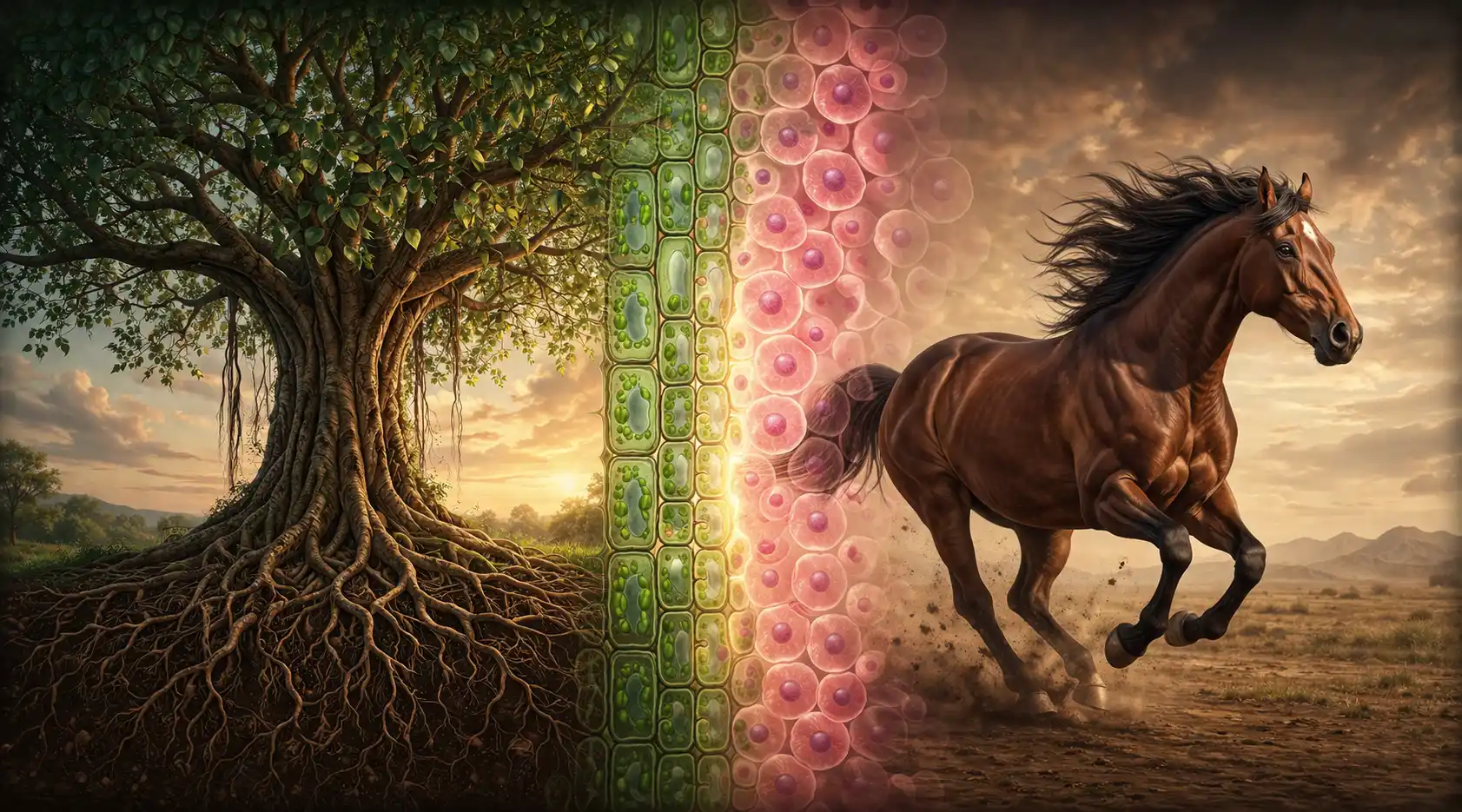
A goat can run at 50 km/h. A peepal tree cannot move an inch in 500 years. But the tree lives 500 years; the goat lives 15. Same planet, same DNA-based life — so why does evolution build a goat to run and a tree to stand still?
One reality, many forms
एकं सद्विप्रा बहुधा वदन्ति।
Hindi: Sachchaai ek hi hai — gyaani log usko alag-alag naamon se bulaate hain.
English: The truth is one — the wise speak of it in many ways.
Plants and animals look completely different. But underneath, both are made of cells, both run on DNA, both descend from the same ancient ancestor. Two solutions, one biology.
The Cell Wall — Why Plants Stand and Animals Run
Push your finger gently against your cheek. It bends inward. Soft.
Now push your finger against the bark of a tree. Doesn't bend. Hard.
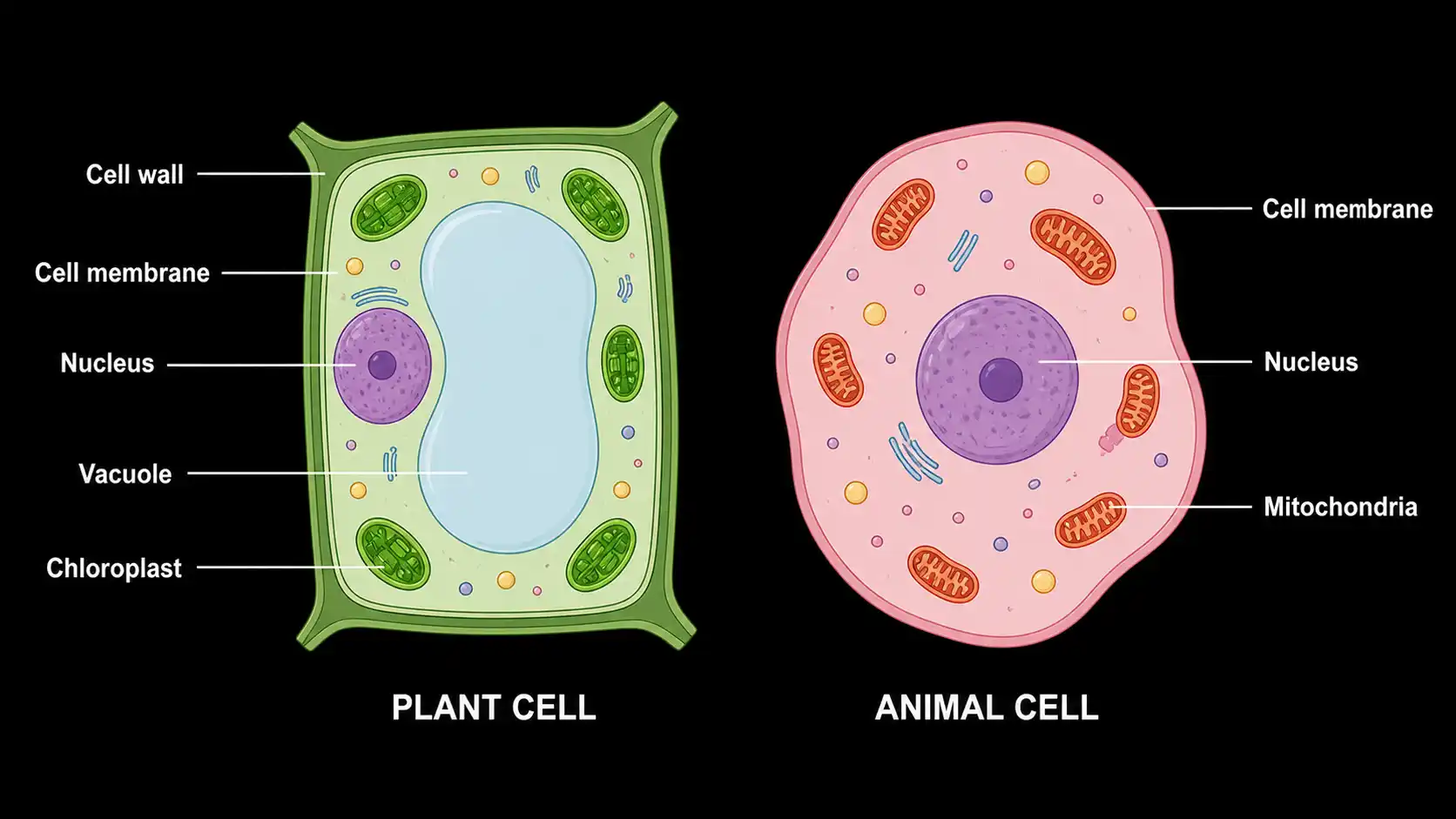
The reason for this difference is one tiny structural detail: plant cells have a cell wall around them, animal cells do not.
A plant cell has two boundaries — a soft inner cell membrane (like all cells) AND a thick outer cell wall made of cellulose that gives the cell rigidity. Many such rigid cells stacked together make the plant stiff and upright. That is how a 30-metre tree stands up against gravity and wind without any bones.
Animal cells skip the wall. Their outer boundary is just the flexible cell membrane. Without a rigid wall, animal cells can change shape — squeeze, stretch, slide past each other. Multiply this flexibility across millions of cells and the result is a body that can walk, swim, fly, fight.
The trade-off is simple. Plants gain strength but lose movement. Animals gain movement but lose the ability to stand without skeletons. Two opposite bets — both winning.
A sponge is an animal — but it spends its whole life stuck to one rock and never moves. Looking at this fact alone, what would you predict about a sponge's cells?
Two Different Kitchens — How They Eat
The second big split between plants and animals is how they get food.
Plants are the only living things that can build their own food from scratch. They take sunlight, carbon dioxide from the air, and water from the soil — and turn it into sugar through a process called photosynthesis. The kitchen is inside their leaves.
Animals can't do this. They don't have a kitchen — they have a stomach. An animal's body is built to find food that's already been made (by plants or other animals), break it down, and absorb the nutrients. Hence: tongues that taste, teeth that chew, stomachs that digest, intestines that absorb.
These two completely different food strategies need completely different tissues. Plants need tissues that catch sunlight (leaves), transport water up from roots (xylem), and move sugar to every part (phloem). Animals need tissues that grab and break food (muscles, digestive lining), carry nutrients to every cell (blood), and remove waste.
Even the way they grow is different. Plants grow from special tissues at root-tips and shoot-tips — growth keeps happening at certain spots throughout life. Animals grow more uniformly, all over, but only until they reach a fixed adult size. After that, growth stops.
Same problem — staying alive. Two opposite solutions. The rest of this chapter is about how plant and animal tissues actually do their separate jobs.
Meet a Scientist — B. G. L. Swamy (1918–1980)
B. G. L. Swamy was one of India's most respected botanists. He studied plant morphology and anatomy in deep detail — the kind of patient microscopic work that mapped out how plant tissues are organised, layer by layer.
The Animals That Don't Move
Sponges, corals, sea anemones, barnacles — all animals, all glued to one spot for their entire lives. They eat, they reproduce, they fight off predators, all without taking a single step.
Q1.What is the main structural difference that makes plant cells rigid and animal cells flexible?
A goat can run at 50 km/h. A peepal tree cannot move an inch in 500 years. But the tree lives 500 years; the goat lives 15. Same planet, same DNA-based life — so why does evolution build a goat to run and a tree to stand still?
One reality, many forms
एकं सद्विप्रा बहुधा वदन्ति।
Hindi: Sachchaai ek hi hai — gyaani log usko alag-alag naamon se bulaate hain.
English: The truth is one — the wise speak of it in many ways.
Plants and animals look completely different. But underneath, both are made of cells, both run on DNA, both descend from the same ancient ancestor. Two solutions, one biology.
The Cell Wall — Why Plants Stand and Animals Run
Push your finger gently against your cheek. It bends inward. Soft.
Now push your finger against the bark of a tree. Doesn't bend. Hard.
The reason for this difference is one tiny structural detail: plant cells have a cell wall around them, animal cells do not.
A plant cell has two boundaries — a soft inner cell membrane (like all cells) AND a thick outer cell wall made of cellulose that gives the cell rigidity. Many such rigid cells stacked together make the plant stiff and upright. That is how a 30-metre tree stands up against gravity and wind without any bones.
Animal cells skip the wall. Their outer boundary is just the flexible cell membrane. Without a rigid wall, animal cells can change shape — squeeze, stretch, slide past each other. Multiply this flexibility across millions of cells and the result is a body that can walk, swim, fly, fight.
The trade-off is simple. Plants gain strength but lose movement. Animals gain movement but lose the ability to stand without skeletons. Two opposite bets — both winning.
A sponge is an animal — but it spends its whole life stuck to one rock and never moves. Looking at this fact alone, what would you predict about a sponge's cells?
Two Different Kitchens — How They Eat
The second big split between plants and animals is how they get food.
Plants are the only living things that can build their own food from scratch. They take sunlight, carbon dioxide from the air, and water from the soil — and turn it into sugar through a process called photosynthesis. The kitchen is inside their leaves.
Animals can't do this. They don't have a kitchen — they have a stomach. An animal's body is built to find food that's already been made (by plants or other animals), break it down, and absorb the nutrients. Hence: tongues that taste, teeth that chew, stomachs that digest, intestines that absorb.
These two completely different food strategies need completely different tissues. Plants need tissues that catch sunlight (leaves), transport water up from roots (xylem), and move sugar to every part (phloem). Animals need tissues that grab and break food (muscles, digestive lining), carry nutrients to every cell (blood), and remove waste.
Even the way they grow is different. Plants grow from special tissues at root-tips and shoot-tips — growth keeps happening at certain spots throughout life. Animals grow more uniformly, all over, but only until they reach a fixed adult size. After that, growth stops.
Same problem — staying alive. Two opposite solutions. The rest of this chapter is about how plant and animal tissues actually do their separate jobs.
Meet a Scientist — B. G. L. Swamy (1918–1980)
B. G. L. Swamy was one of India's most respected botanists. He studied plant morphology and anatomy in deep detail — the kind of patient microscopic work that mapped out how plant tissues are organised, layer by layer.
The Animals That Don't Move
Sponges, corals, sea anemones, barnacles — all animals, all glued to one spot for their entire lives. They eat, they reproduce, they fight off predators, all without taking a single step.
Q1.What is the main structural difference that makes plant cells rigid and animal cells flexible?